Просмотр новости
Найдите то, что Вас интересует
 Спутники
 РН
РН SpaceX
 Роскосмос
 NASA
NASA
СпутникиРНSpaceXРоскосмосNASACan high-resolution imaging and computational processing be used to quantify variation in photomorphogenesis among Arabidopsis seedlings?

William Salter 6 December 2021 2 min read
Can high-resolution imaging and computational processing be used to quantify variation in photomorphogenesis among Arabidopsis seedlings?
https://www.botany.one/computer-vision-for-phenotyping-of-photomorphogenesis/
The successful establishment of a plant seedling is a critical determinant of long-term plant health and survival. Successful establishment is dependent on the response of the germinating seed and growing seedling to many internal and external factors. A seedling’s response to light after emergence from the soil is characterised by important changes in growth and development, collectively termed photomorphogenesis. These include the expansion of the cotyledons, increased root growth and production of chlorophyll. While this sequence of photomorphogenic developmental changes has been well-characterised, the process itself can be highly variable on an individual basis. High-resolution imaging and computational processing have emerged as useful tools for quantification of photomorphogenic phenotypes. They are particularly valuable for studying dynamic processes in real time.
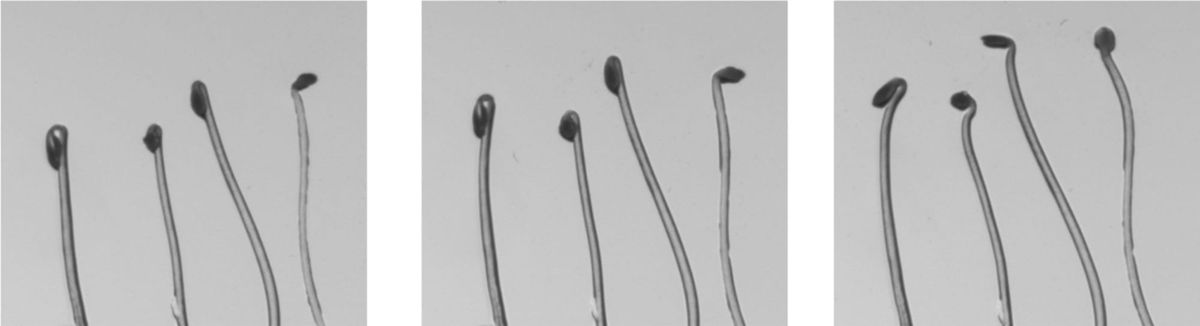
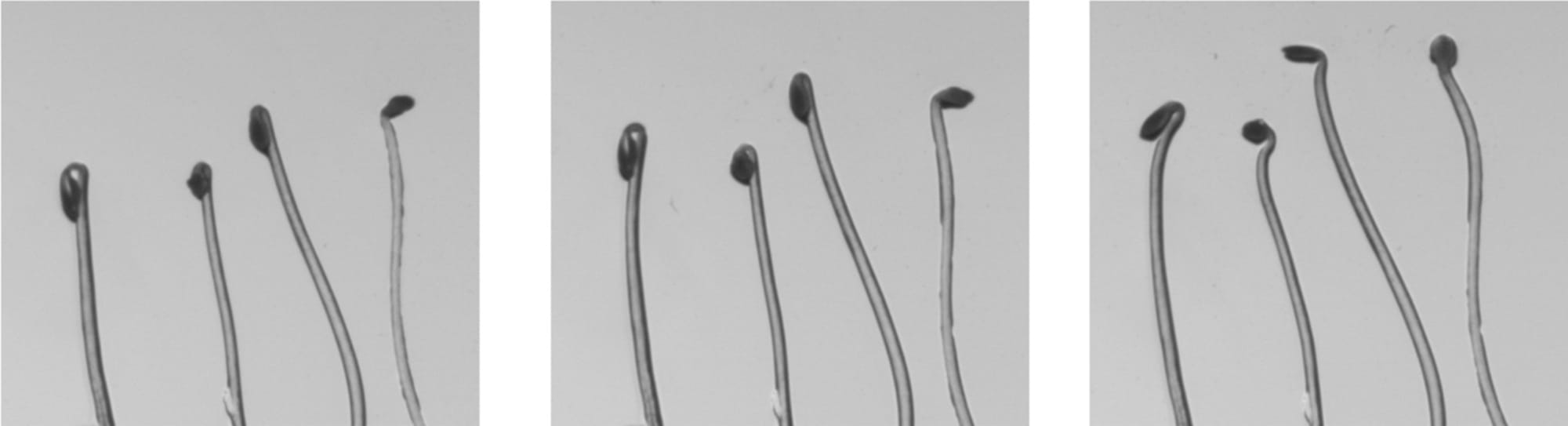 Representative images of 3-day-old Cvi seedlings taken at (left) an initial time point following repositioning, (middle) after 3 h of growth in the dark and (right) after 5 h of growth in blue light. Image credit: S.D. Deslauriers.
In their new study published in AoBP, Stephen Deslauriers from the University of Minnesota presents a new methodology for the study of photomorphogenesis using high-resolution imaging and measurement of growth rate using a computer vision camera and open-source ImageJ software. The study sought to: (i) develop an imaging methodology which could capture changes in growth rate as seedlings transition from darkness to blue light in real time, and (ii) apply this methodology to single-quantitative trait locus (QTL) analysis using the Cvi × Ler recombinant inbred line (RIL) mapping population of Arabidopsis thaliana.
Deslauriers found that an 8 h time course, consisting of 3 h in darkness and 5 h of exposure to blue light, is sufficient to resolve significant differences in growth rate in each condition. QTL analysis detected significant loci associated with dark growth rate on chromosome 5 and significant loci associated with light growth rate on chromosome 2 in the RIL mapping population. Candidate genes associated with these loci, such as the previously characterized ER locus, highlight the application of this approach for QTL analysis. Deslauriers concluded that the methodology can be used for identification of genetic elements that regulate seedling responses to light, however refinements to the imaging system, including the use of multiple cameras, would greatly improve QTL analysis of features related to photomorphogenesis.
For more information on the hardware and imaging setup used in the study please visit phytomorph.wisc.edu.
READ THE ARTICLE
Deslauriers, S.D., 2021. High-resolution imaging as a tool for identifying quantitative trait loci that regulate photomorphogenesis in Arabidopsis thaliana. AoB PLANTS. https://doi.org/10.1093/aobpla/plab063
| # | Наименование новости | Тональность | Информативность | Дата публикации |
|---|---|---|---|---|
| 1 | Estimating genetic variation in seed collections using seed morphology | 0 | 5.1 | 15-11-2021 |
| 2 | Morphological characterisation of trichomes | 0 | 7.56 | 17-01-2022 |
| 3 | Photochemical performance of bunchgrass reproductive structures | 0 | 4.62 | 07-02-2022 |
| 4 | Tolerance to waterlogging in relay sown grain legume crops | 0 | 6.17 | 01-11-2021 |
| 5 | Interactive effects of drought and pollen intensity on seed production | 0 | 6.5 | 03-02-2022 |
| 6 | Exploring the Impact of Plant Traits on Nitrogen Use Efficiency in Maize | 0 | 8.49 | 04-12-2024 |
| 7 | Roles of wood anatomical traits in the coexistence of Mexican oak species | 0 | 4.01 | 10-01-2022 |
| 8 | Principles of resilient coding for plant ecophysiologists | 0 | 10 | 25-11-2021 |
| 9 | From Complexity to Simplicity: Assessing Light Interception Models | 0 | 6.4 | 07-10-2024 |
| 10 | Poor acclimation to drought in subalpine forest tree seedlings | 0 | 7.16 | 14-03-2022 |