Просмотр новости
Найдите то, что Вас интересует
 Спутники
 РН
РН SpaceX
 Роскосмос
 NASA
NASA
СпутникиРНSpaceXРоскосмосNASAHow does drought influence the photochemical performance of reproductive structures of native and exotic bunchgrasses of the Great Basin?

William Salter 7 February 2022 2 min read
How does drought influence the photochemical performance of reproductive structures of native and exotic bunchgrasses of the Great Basin?
https://www.botany.one/photochemical-performance-of-bunchgrass-reproductive-structures/
Viable seed production is a critical feature for the perennial bunchgrasses needed to restore degraded sagebrush steppe rangelands in the Great Basin, USA. Seed filling in bunchgrasses depends on the physiological performance of the seed head and the flag leaf. A recent series of studies conducted by Erik Hamerlynck and his colleagues at the USDA compared the reproductive ecophysiological characteristics of an exotic, widely planted bunchgrass, crested wheatgrass (Agropyron cristatum) to those of native Great Basin bunchgrasses. These studies revealed that compared to native bunchgrasses, crested wheatgrass seed heads had higher photosynthetic rates and capacities. They also identified that seed head photosynthetic contributions were greater than those of flag leaves to overall reproductive effort compared to native bunchgrasses. These features allow crested wheatgrass to produce viable seeds under conditions that limit the success of native grasses. However, it remains unclear how the photosynthetic performance of reproductive structures responds to soil-water availability.
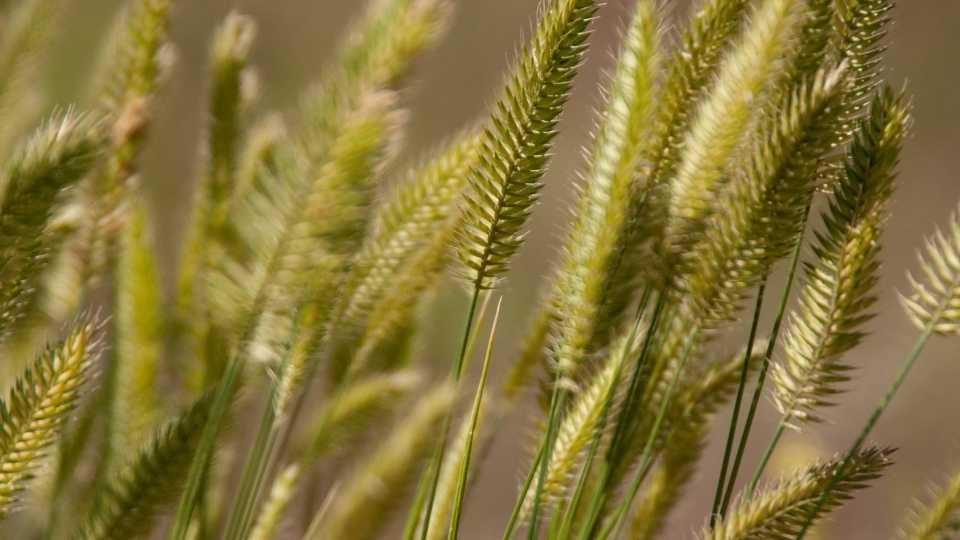 Crested wheatgrass is a widely introduced species in the US and Canada that is often used for the restoration of rangeland ecosystems.
In their new field study published in AoBP, Hamerlynck and O’Connor investigated how soil water availability influences the ecophysiology of native and exotic Great Basin bunchgrass reproductive structures. Specifically, they measured pre- and post-anthesis chlorophyll fluorescence parameters of seed heads and flag leaves of watered and unwatered crested wheatgrass (A. cristatum) and squirreltail wild rye (Elymus elymoides). In addition to measurement of photosynthetic parameters, soil moisture was logged every four hours during the experiment and plots were watered by hand weekly. The experimental field study was run at the USDA Agricultural Research Service Northern Great Basin Experimental Range, located ~70 km west of Burns, OR, USA.
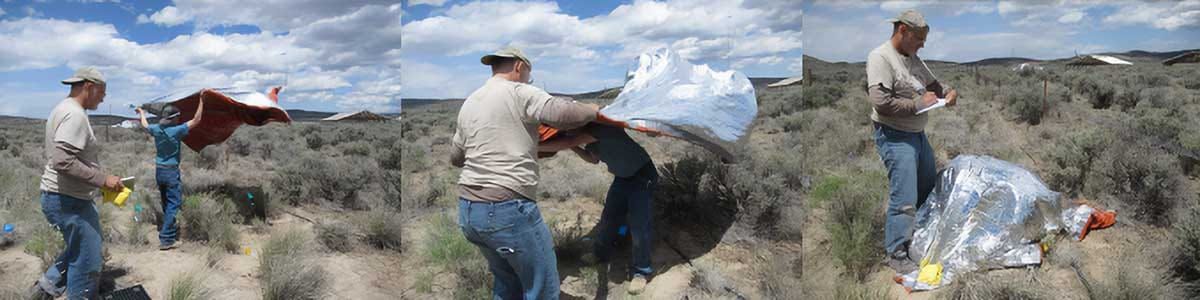
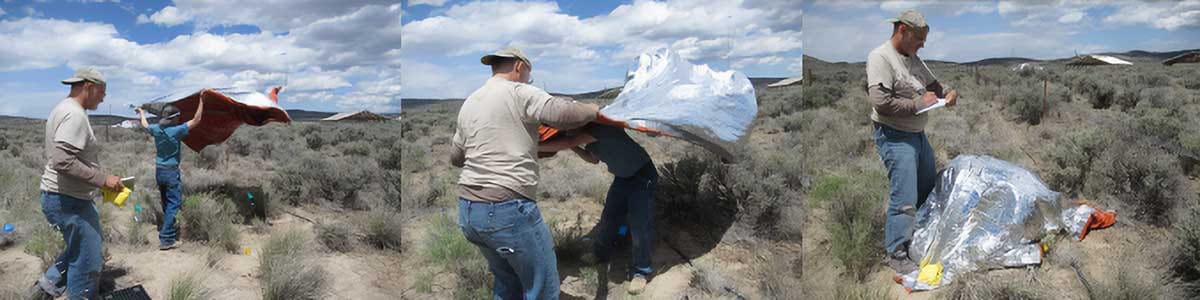 Sequence of photographs showing preparations to sample dark adapted chlorophyll florescence measurements of bunchgrasses under a multi-layered space blanket. Image credit: Hamerlynck and O’Connor.
In their work Hamerlynck and O’Connor found that watering improved the photochemical performance in the reproductive structure most closely associated with that species’ seed filling. In the case of the exotic crested wheatgrass this was the seed head, whilst in squirreltail wild rye it was the flag leaf. They concluded that the physiological and structural differences may contribute to the differential ability of these species to establish from seed, and may help in effective plant material selection needed to improve restoration and conservation success in sagebrush steppe rangelands. The authors hope that future work will build upon their work by using paired chlorophyll fluorescence and gas exchange measurements to fully discriminate between structural and physiological contributions to variation in seed head photosynthetic dynamics.
READ THE ARTICLE
Erik P Hamerlynck, Rory C O’Connor, Photochemical performance of reproductive structures in Great Basin bunchgrasses in response to soil-water availability, AoB PLANTS, Volume 14, Issue 1, February 2022, plab076, https://doi.org/10.1093/aobpla/plab076
| # | Наименование новости | Тональность | Информативность | Дата публикации |
|---|---|---|---|---|
| 1 | Poor acclimation to drought in subalpine forest tree seedlings | 0 | 7.16 | 14-03-2022 |
| 2 | Interactive effects of drought and pollen intensity on seed production | 0 | 6.5 | 03-02-2022 |
| 3 | Computer vision for phenotyping of photomorphogenesis | 0 | 13.45 | 06-12-2021 |
| 4 | Tolerance to waterlogging in relay sown grain legume crops | 0 | 6.17 | 01-11-2021 |
| 5 | Estimating genetic variation in seed collections using seed morphology | 0 | 5.1 | 15-11-2021 |
| 6 | Morphological characterisation of trichomes | 0 | 7.56 | 17-01-2022 |
| 7 | Roles of wood anatomical traits in the coexistence of Mexican oak species | 0 | 4.01 | 10-01-2022 |
| 8 | Conservation strategies for the endangered Dianthus superbus in Latvia | 0 | 4.16 | 11-11-2021 |
| 9 | Can field botany be effectively taught as a distance course? | 0 | 6.21 | 14-02-2022 |
| 10 | Phylogeography of the invasive Brazilian peppertree in South Africa | 0 | 5.5 | 28-03-2022 |