Просмотр новости
Найдите то, что Вас интересует
 Спутники
 РН
РН SpaceX
 Роскосмос
 NASA
NASA
СпутникиРНSpaceXРоскосмосNASAMajor industrial states including Karnataka, Tamil Nadu, Maharashtra, Telangana, Haryana and Punjab are taking longer than expected to notify the final rules, leaving employers in a flux over several divergent provisions. HR departments say they now have to navigate Centre-state rules that don't align, creating inconsistencies in compliance requirements.
NEW DELHI: Just 10 states and union territories have so far formally adopted at least some of the four Labour Codes by notifying the rules, more than 10 months after the central government implemented the reform, causing compliance hurdles for companies with factories in multiple locations.
Major industrial states including Karnataka, Tamil Nadu, Maharashtra, Telangana, Haryana and Punjab are taking longer than expected to notify the final rules, leaving employers in a flux over several divergent provisions. HR departments say they now have to navigate Centre-state rules that don't align, creating inconsistencies in compliance requirements.
For instance, new Labour Codes allow workers to carry forward 30 leaves and encash the remaining. In Maharashtra, meanwhile, the Shops & Establishment Act provides for 45 leaves to be carried forward, with the unused casual leaves getting lapsed. While the OSH (Occupational Safety, Health and Working Conditions) Code, 2020 mandates a centralised, single-window electronic registration for a unified nationwide compliance system to eliminate paperwork, the Haryana Shops Act, 1958 requires independent, state-level intimations and registrations.
Also Read: Export schemes extended amid West Asia crisis
According to government data accessed by ET, 10 states and UTs have finalised the rules under the Occupational Safety, Health & Working Conditions Code, 2020 while nine have notified the final rules for the Industrial Relations Code and the Code on Wages, 2019 and eight notified the rules under the Social Security Code, 2020.
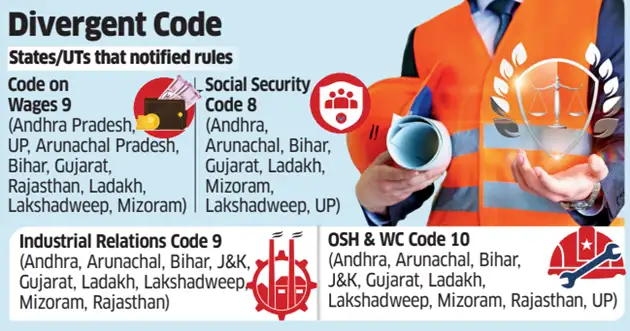 ET Bureau
"Major industrial states have yet to finalise the rules across the four codes, delaying the on-ground implementation of the overlapping provision as companies do not have adequate clarity," an industry executive said, requesting anonymity. The labour and employment secretary held meetings with states and union territories to press for the finalisation of the rules. Heads of the central government's labour bureaus are also pursuing states and UTs for fast-tracking rule notifications. Experts said absence of unified rules under the four codes will result in implementation challenges for the employers and add to disputes, especially for companies with operations in different states.
Also Read: Pulses import duties may ease over poor rains
"There are multiple instances of variation between central and state labour-related laws, creating a lot of ambiguity and compliance challenges for employers," said Puneet Gupta, partner, advisory services - tax at EY India, stressing the need for set timelines for the roll-out so that employers have clarity on the key changes under the codes. "For pan-India employers, the challenge is no longer merely understanding the statutory intent of the codes, but operationalising them across jurisdictions with conflicting shift hours, overtime limits and standing order thresholds," said Ankita Singh, founder of law firm Sarvaank Associates. "Harmonising these state rules quickly is vital, not only to preserve true ease of doing business for multi-state enterprises, but to ensure that statutory wage protections, contract parity, and social security are delivered equally and consistently on the ground," Singh added.