Просмотр новости
Найдите то, что Вас интересует
 Спутники
 РН
РН SpaceX
 Роскосмос
 NASA
NASA
СпутникиРНSpaceXРоскосмосNASAThe brain undergoes “rewiring” throughout adolescence and doesn’t reach its adult architecture until our early 30s, suggests a new study.
Society has tended to describe adulthood as starting at around 18 to 21. And most people may appear fully adult by then. But such looks can be deceiving. The brain won’t reach its adult form until more than a decade after that, a new study finds. At a minimum, its data offer a new interpretation of what it means to be an adolescent.
These data are part of a much larger analysis of when and how often the brain undergoes major changes. The findings appeared November 25, 2025, in Nature Communications.
When thinking about the defining feature of adolescence, many people focus on body changes in preparation for adulthood. What isn’t visible from the outside, though, are the many rewiring changes underway in our brains. The new study investigated these. And its findings show that the brain doesn’t attain its adult architecture until much later than scientists had realized — around age 32.
Neuroscientists Alexa Mousley and Duncan Astle led the research. Both work at the University of Cambridge in England. Their team studied brain scans from more than 4,000 people. They ranged in age from birth to 90. These scans had originally been collected as part of other studies. In poring over those scans, the researchers identified when and how brain connections changed.
Such brain-connectivity changes — rewiring of the neural circuits — occur across our lifespan. They reflect “changes in the way brain regions communicate with each other,” says Lucina Uddin. And, she notes, the timing of the changes seems to “accompany major life-stage transitions.” These tended to occur around ages 9, 32, 66 and 83. A cognitive neuroscientist at the University of California, Los Angeles, Uddin did not take part in the new work. But she does find it “a very exciting study.”
 Scientists used to think the organization of the adult brain was relatively unchanging. The new study now finds its architecture can change twice more after adolescence — in eras known as early and late aging. Neural connections may be lost during these periods, affecting memory or other issues.The Good Brigade/DigitalVision/Getty Images PlusThe changing brain
The human brain contains some 86 billion neurons. These nerve cells “talk” to one another, sharing information. Each neuron has a long arm, or axon, that reaches out toward other neurons.
Insulating cells wrap around the axons. These help neural signals travel faster. Because the insulating cells are fatty, they look white, so we call them the brain’s white matter. The neurons’ cell bodies make up the brain’s gray matter.
The number of neurons in the brain doesn’t change much over our lifespan. But how the cells connect to each other does. Unused connections get “pruned” or wither away. At the same time, new ones form and useful ones grow stronger. Axons that send frequent signals can get more insulation — a thicker jacket of white matter.
Although scientists knew these kinds of changes happen, it wasn’t clear if there were particular times for when they take place, at least after early adolescence.
The new study finds there are.
Five eras — or “epochs” — of brain development emerged from the analysis. Each spanned a time during which the brain reorganizes in specific ways.
The new study is “sort of taking a Taylor Swift approach to brain development,” says neurologist Leah Kroll. It calls out five discrete eras and suggests how these eras may relate to health vulnerabilities.The first epoch runs from birth until around age 9. The next phase — adolescence — kicks off then and continues to around age 32. Two more epochs, adulthood and early aging, ended around 66 and 83, after which the late-aging phase kicked off. Those last two epochs were a bit of a surprise. Scientists had largely expected that after early adulthood, the brain’s structure stayed roughly unchanged.
Faster and more efficientA baby’s brain has lots of connections. Not all are useful. So the body prunes away many of these as a child grows. During this time, more insulation wraps around axons to strengthen links that do prove useful.
Around age 9, adolescence starts. Brains now begin to change in ways that help different regions communicate.
“Neural efficiency is, as you might imagine, well connected by short paths,” Mousley explained in a statement issued by the University of Cambridge. And, she adds, “the adolescent era is the only one in which this efficiency is increasing.” Those increases continue on into our early 30s — much longer than scientists had realized.
This image uses different colors to show connections among brain cells during the adolescent phase of human brain development.
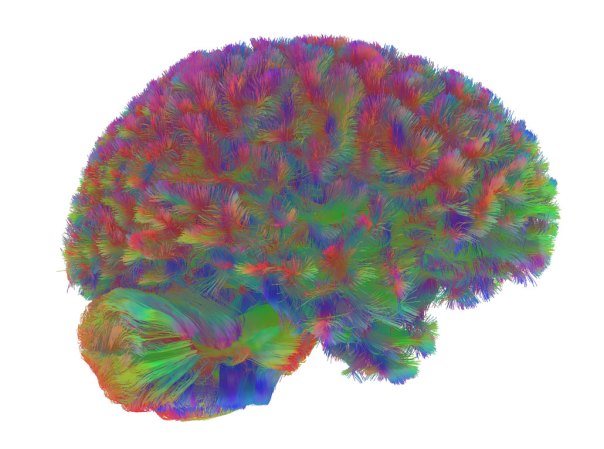 Alexa Mousley/University of Cambridge
Brain connections largely stabilize between ages 32 and 66. Then, as people grow older, they begin to lose white matter, and their brains lose efficiency. This happens in the so-called early aging (through age 83) and late aging eras.
Understanding that the brain doesn’t change steadily over one’s life can be helpful, Astle said in the Cambridge University statement. How the brain is wired may be linked to a number of mental health and other conditions. “Differences in brain wiring predict difficulties with attention, language, memory and a whole host of different behaviors,” Astle said. So the new findings “will help us identify when and how its wiring is vulnerable to disruption.”
The study “is a new and refreshing way to think about [brain] organization,” says Richard Cytowic. He’s a neuroscientist at George Washington University in Washington, D.C. The new data, he says, confirm that “we change in leaps and bounds, rather than step by step.” It also means that the end of adolescence remains difficult to determine. And, he adds, it leaves open the question of how white matter matures as we age.
The new study’s lead author explains her team’s surprising findings, which she says might correlate to health risks. For instance, Alexa Mousley notes: “About two-thirds of people who will develop a mental health disorder do so before the age of 25,” during adolescence — when brain reorganization is at its peak.So what does this mean for teens?
Researchers, politicians, media and others “have been talking about how people reach adulthood later than they used to,” says Hillary Schwarb. This cognitive neuroscientist works at the University of Nebraska – Lincoln. While the Cambridge study “is important,” she says, “it only looks at one part of the brain, called white matter.” What it doesn’t do, she cautions, is “explain how thinking or behavior changes” over time. As such, it’s the first of many steps needed to better understand how connections inside the brain affect thinking and feeling over our lifespan.
Concludes Schwarb, when it comes to how the brain functions, there’s still much to learn.
Submit your question here, and we might answer it an upcoming issue of Science News Explores
adolescence: A transitional stage of physical and psychological development that begins at the onset of puberty, typically between the ages of 11 and 13, and ends with adulthood. People undergoing this transition are known as adolescents.
adolescent: Someone in that transitional stage of physical and psychological development that begins at the onset of puberty, typically between the ages of 11 and 13, and ends with adulthood.
axon: The long, tail-like extension of a neuron that conducts electrical signals away from the cell.
behavior: The way something (often a person or other organism) conducts itself or acts towards others.
brain scan: A technique to view structures inside the brain, typically with X-rays or a magnetic resonance imaging (or MRI) machine. With MRI technology — especially the type known as functional MRI (or fMRI) — the activity of different brain regions can be viewed during an event, such as viewing pictures, computing sums or listening to music.
circuit: A network that transmits electrical signals. In the body, nerve cells create circuits that relay electrical signals to the brain. In electronics, wires typically route those signals to activate some mechanical, computational or other function.
cognitive: A term that relates to mental activities, such as thinking, learning, remembering and solving puzzles.
development: (in biology) The growth of an organism from conception through adulthood, often undergoing changes in chemistry, size and sometimes even shape.
epoch: A span of time over which some dramatic changes have occurred.
function: The specific role some structure or device plays. (in math) A relationship between two or more variables in which one variable (the dependent one) is exactly determined by the value of the other variables.
gray matter: One of two main types of tissue found in the brain and spinal cord. It consists mainly of nerve cell bodies.
host: (in biology and medicine) The organism (or environment) in which some other thing resides. Humans may be a temporary host for food-poisoning germs or other infective agents.
information: (as opposed to data) Facts provided or trends learned about something or
mature: (adj.) Connoting an adult individual or full-grown and fully developed (non-juvenile) form of something. (verb) To develop toward — or into — a more complex and full-grown form of something, be it a living thing, a technology or an idea.
mental health: A term for someone’s emotional, psychological and social well-being. It refers to how people behave on their own and how they interact with others. It includes how people make choices, handle stress and manage fear or anxiety. Poor mental health can be triggered by disease or might reflect a short-term response to life’s challenges. It can occur in people of any age, from babies to the elderly.
nerve: A long, delicate fiber that transmits signals across the body of an animal. An animal’s backbone contains many nerves, some of which control the movement of its legs or fins, and some of which convey sensations such as hot, cold or pain.
neuron: The main cell type of the nervous system — the brain, spinal column and nerves. These specialized cells transmit information by producing, receiving and conducting electrical signals. Neurons also can transmit signals to other cells with chemical messengers.
neuroscientist: Someone who studies the structure or function of the brain and other parts of the nervous system.
society: An integrated group of people or animals that generally cooperate and support one another for the greater good of them all.
transition: The boundary where one thing (paragraphs, ecosystems, life stage, state of matter) changes or converts into another. Some transitions are sharp or abrupt. Others slowly or gradually morph from one condition or environment to another.
white matter: One of the two main tissue types found in the brain and spinal cord. It consists mainly of bundles of nerve fibers.
A version of this article appears in the June 1, 2026 issue of Science News Explores.
Alison Pearce Stevens is a former biologist and forever science geek who writes about science and nature for kids. She lives with her husband, their two kids and a small menagerie of cuddly (and not-so cuddly) critters.
| # | Наименование новости | Тональность | Информативность | Дата публикации |
|---|---|---|---|---|
| 1 | Brain development may continue into your 30s, new research shows | 0 | 9.42 | 19-02-2026 |
| 2 | Un estudio científico confirma que la adolescencia dura hasta los... 32 años | 0 | 7 | 25-01-2026 |
| 3 | Un estudio científico confirma que la adolescencia dura hasta los... 32 años | 0 | 7 | 25-01-2026 |
| 4 | Your brain doesn't peak in your 20s after all: Study reveals your mind is at its sharpest between 55 and 60 | 3 | 6 | 06-07-2026 |
| 5 | Your brain can keep improving into your 90s, study finds | 0 | 13.1 | 13-06-2026 |
| 6 | Невролог Преображенская объяснила, как замедлить старение мозга | 0 | 8.19 | 24-07-2026 |
| 7 | Je hersenen veranderen op deze vier leeftijden ingrijpend. En één moment springt eruit | 0 | 13.62 | 19-08-2026 |
| 8 | Your Personality Changes More Than You Think. It Evolves Almost as Much as Your Health and Income | 0 | 16.53 | 05-08-2026 |
| 9 | Как позаботиться о здоровье мозга, чтобы отложить его старение. Советы невролога | 0 | 10.69 | 22-07-2026 |
| 10 | Hangi Yaşta Duygusal Olarak Büyümeyi Bıraktın/Bırakacaksın? | 0 | 9.31 | 29-08-2026 |