Просмотр новости
Найдите то, что Вас интересует
 Спутники
 РН
РН SpaceX
 Роскосмос
 NASA
NASA
СпутникиРНSpaceXРоскосмосNASAA subtle shift in the periodic table reveals a complex and largely unexplored layer of biology. On the far right side of the periodic table, just beneath oxygen, sits a lesser-known group of elements called the chalcogens, or “ore-forming” elements. While sulfur is widely recognized for its role in biology, its heavier relatives, selenium and [...]
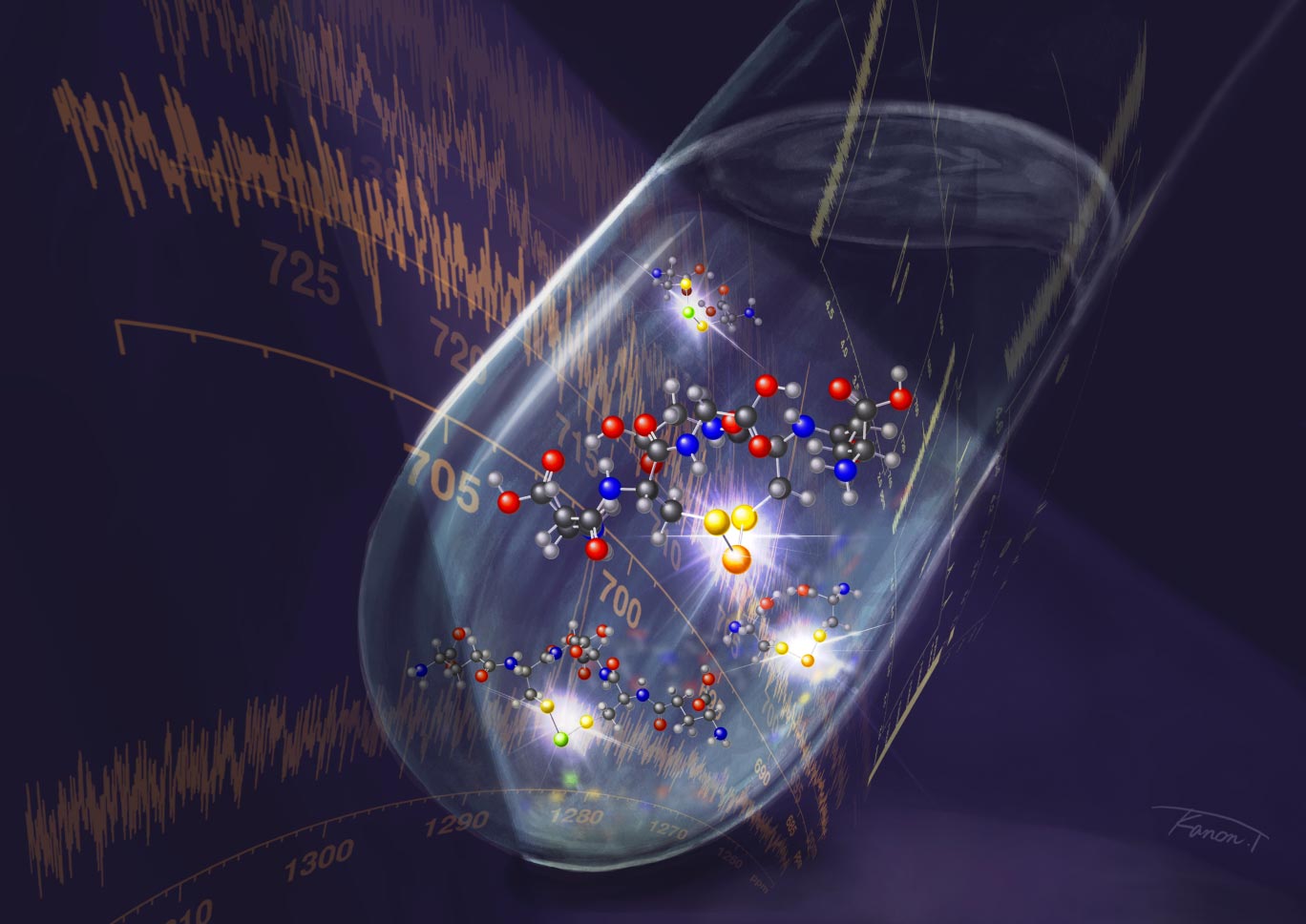 A new NMR approach visualizes chalcogen connectivity in glutathione/cysteine trichalcogenides, paving the way toward a platform for chemical biology. Credit: Kanon TanakaA subtle shift in the periodic table reveals a complex and largely unexplored layer of biology.
On the far right side of the periodic table, just beneath oxygen, sits a lesser-known group of elements called the chalcogens, or “ore-forming” elements. While sulfur is widely recognized for its role in biology, its heavier relatives, selenium and tellurium, are far less understood. Yet all three quietly influence the chemistry that keeps cells alive.
Sulfur is a cornerstone of redox regulation, the system that manages the constant exchange between oxidation and reduction inside cells. This balance is essential. When it breaks down, it can lead to oxidative stress, a condition linked to aging and a range of diseases. Glutathione, one of the body’s most important antioxidants, depends on sulfur to neutralize harmful reactive molecules and maintain cellular stability.
Recent research suggests that the heavier elements selenium and tellurium also participate in these redox processes. However, studying molecules that contain chains of different chalcogen atoms has been challenging because they are unstable. Most previous work has relied on mass spectrometry, which cannot directly show how atoms are bonded. To overcome this limitation, a research team at Kyoto University developed a new method to better observe these chalcogen chains.
Exploring the Chemistry of Chalcogens“We have long been interested in understanding how subtle atomic substitutions can alter biological function,” says corresponding author Kazuma Murakami. “Chalcogen chemistry offers a unique window into redox biology that remains largely unexplored.”
The researchers created a new approach based on an in situ reaction in an aqueous solution containing oxidized glutathione-cystine molecules. In this solution, they introduced selenium or tellurium atoms.
They then analyzed the resulting structures using 1H-detected 77Se/125Te nuclear magnetic resonance spectroscopy, NMR. To evaluate redox behavior, they used radical scavengers, which help protect cells from damage caused by unstable molecules and can also prevent ferroptosis, a form of controlled cell death.
Using this method, the team successfully produced and analyzed heterologous trichalcogenide molecules that include sulfur, selenium, or tellurium. This allowed them to directly observe the unstable bonds linking different chalcogen atoms. Their results showed that these compounds have strong redox activity.
“This is the first direct spectroscopic view of heterochalcogen bonds in redox systems,” says Murakami. “By combining multinuclear NMR with superchalcogenide chemistry, we have opened a new avenue for studying redox-active biomolecules.”
Implications for Biology and MedicineThis technique could make it possible to design new redox-active molecules in a more targeted way and aid in developing functional biomolecules and peptides. It may also support research into oxidative stress and diseases linked to ferroptosis.
The researchers plan to apply their method to more complex biomolecules and continue investigating the biological roles of chalcogen-modified glutathione derivatives. They also aim to create new redox-active compounds that could be useful in future medical treatments.
Reference: “Exploring Chalcogen Connection in Glutathione Trichalcogenides via 1H-Detected 77Se/125Te NMR” by Kazuma Murakami, Keisuke Tao-Kakuyama, Thi Hong Van Nguyen, Katsutoshi Nishino and Takaaki Akaike, 15 March 2026, ACS Measurement Science Au.
DOI: 10.1021/acsmeasuresciau.5c00193
The study was funded by the Japan Society for the Promotion of Science.
Never miss a breakthrough: Join the SciTechDaily newsletter.
Follow us on Google and Google News.
| # | Наименование новости | Тональность | Информативность | Дата публикации |
|---|---|---|---|---|
| 1 | A New Chapter in Chemistry? Scientists Uncover New Way Metals Bind Oxygen | 0 | 16.88 | 13-04-2026 |
| 2 | Scientists Discover a 3.7-Billion-Year-Old Secret of Early Life | 0 | 21 | 21-08-2026 |
| 3 | Scientists Reveal How Cells Tame One of Biology’s Most Dangerous Metals | 0 | 12.46 | 27-08-2026 |
| 4 | Did Cellular Life Begin Twice? New Study Points to Two Independent Origins | 0 | 19.84 | 11-08-2026 |
| 5 | A Strange Quantum Effect May Explain One of Biology’s Greatest Mysteries | 0 | 18.7 | 13-05-2026 |
| 6 | The Surprising Cellular Benefit of the Pigment Behind Red Hair | 0 | 17.18 | 12-07-2026 |
| 7 | This Tiny Bacterial Secret Could Lead to Better Cancer Drugs | 0 | 20.33 | 03-07-2026 |
| 8 | Common fern found gathering rare earth metals out of the ground | 0 | 6.81 | 24-11-2025 |
| 9 | Geologists Discover the World’s Largest Mineral Deposit Found in Batteries and Skincare Under a South Korean County Famous for Wine and Jazz | 5 | 6 | 29-04-2026 |
| 10 | Researchers Uncover Hidden Oxygen Dynamics Inside Ceria Catalysts | 0 | 14.93 | 19-05-2026 |