Просмотр новости
Найдите то, что Вас интересует
 Спутники
 РН
РН SpaceX
 Роскосмос
 NASA
NASA
СпутникиРНSpaceXРоскосмосNASAPolyamines may protect cells from toxic iron buildup by keeping reactive iron under control. Iron keeps cells alive, but when too much of it remains chemically reactive, the same metal can become destructive. Excess free iron can drive reactions that damage DNA, proteins, and cell membranes, creating a problem cells must constantly control. Whitehead Institute [...]
 Using fluorescent sensors in living cells, researchers found that polyamines may help prevent iron from becoming dangerously reactive. Without enough polyamines, reactive iron can rise, potentially leaving cells more vulnerable to damage. Credit: Shutterstock
Polyamines may protect cells from toxic iron buildup by keeping reactive iron under control.
Iron keeps cells alive, but when too much of it remains chemically reactive, the same metal can become destructive. Excess free iron can drive reactions that damage DNA, proteins, and cell membranes, creating a problem cells must constantly control.
Whitehead Institute Member Ankur Jain, former postdoc Whitney Henry, and graduate student Pushkal Sharma have identified an unexpected part of that protective system: small molecules known as polyamines.
Their findings, published in the journal Cell, show that polyamines can bind iron and keep it in a non-reactive state until cells need the metal. The discovery helps explain a long-standing biological puzzle about why cells maintain polyamines at such unusually high concentrations.
The work also reveals a previously unknown defense against iron toxicity. That mechanism could eventually inform cancer research, where increasing iron stress might help kill tumor cells, and may provide new clues about early-onset Parkinson’s disease, in which mutations can disrupt polyamine levels in neurons.
Polyamines had a hidden protective roleThe Jain Lab primarily studies RNA, the molecule that carries information from DNA to the proteins responsible for most cellular functions. Researchers there are particularly interested in how RNA folds, misfolds, and sometimes forms clumps inside cells.
Jain and Sharma originally focused on polyamines because these molecules bind to RNA and influence its structure. But their abundance suggested another role. Polyamines are among the most plentiful small molecules inside cells, reaching concentrations comparable to ATP, the molecule cells use as their main energy currency.
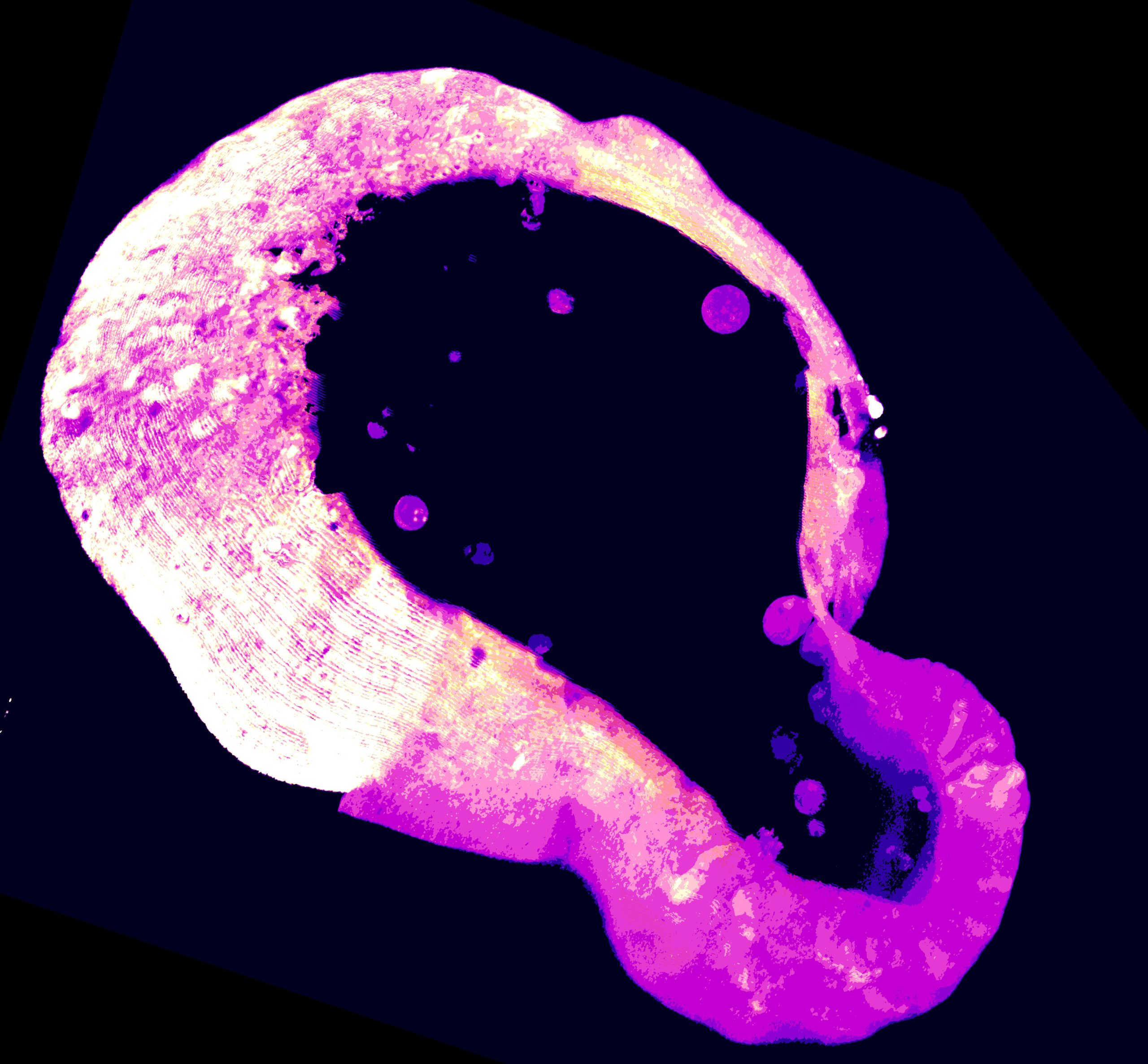 Polyamine sensor in gut organoids. Credit: Pushkal Sharma/ Whitehead Institute
“We’ve known that without polyamines, cells stop growing and dividing,” says Jain, who is also an associate professor of biology at the Massachusetts Institute of Technology (MIT). “But their best-known function only requires a small fraction of the polyamine levels cells actually have.”
Genetic screening pointed to iron toxicityTo investigate what else polyamines might be doing, the researchers used a large-scale genetic screen that allowed them to examine the entire genome at once instead of testing individual genes one-by-one. The goal was to identify cellular processes that became especially important when polyamine concentrations changed.
One protein stood out. When polyamine levels were reduced, cells became highly dependent on GPX4 for survival. GPX4 protects cells from damaging chemical reactions involving the fatty molecules that form cell membranes.
The researchers also found that cells with fewer polyamines produced more of another protein that acts as an iron sponge, storing the metal in a mineralized form. Taken together, those clues suggested that polyamines themselves might help keep iron chemically stable and prevent it from becoming toxic.
Live cell sensors confirmed the linkTo test that hypothesis directly, the researchers created a fluorescent sensor capable of measuring chemically reactive iron inside living cells. The sensor makes cells glow according to how much reactive iron they contain, allowing changes to be followed under a microscope in real time.
They then combined the new iron sensor with another sensor previously developed to measure cellular polyamine levels. When the two were used together, a clear relationship appeared: as polyamine concentrations fell, chemically reactive iron increased.
That pattern provided direct evidence that polyamines help prevent dangerous iron buildup inside cells.
The findings suggest new disease pathwaysThe discovery could also help explain why some cancer treatments aimed at polyamines have produced disappointing results. Cancer cells often maintain high polyamine levels to support rapid growth and division, and drugs designed to lower those levels have been explored as a way to slow tumor growth. So far, however, their effectiveness has been limited.
“We saw that when polyamine levels fall, cells rely on GPX4 to protect themselves from iron toxicity,” says Sharma, who is also the first author of the study. “This could mean that combining drugs that lower polyamine levels with those that block GPX4 might be more effective for killing cancer cells than targeting either pathway alone.”
The findings may also be relevant to Parkinson’s disease. Mutations in genes involved in transporting polyamines within cells have been linked to a rare form of early-onset Parkinson’s, while unusually high concentrations of iron have long been observed in the brains of people with the disease.
Whether excess iron directly contributes to the death of neurons in Parkinson’s remains uncertain. Still, the finding that polyamines can buffer reactive iron provides one possible biological connection between these observations and gives researchers another avenue to investigate.
The new fluorescent iron sensor may also prove useful beyond this study. Because it allows scientists to monitor chemically reactive iron inside living cells, it could support research into aging, cancer, and neurodegeneration.
“There are a lot of promising future directions for this work,” Jain says. “It’s exciting to think about how these tools and findings could help answer further questions about disease pathways and potentially help design better therapies.”
Reference: “Polyamines buffer labile iron to suppress ferroptosis” by Pushkal Sharma, Heather R. Keys, Ryan P. Mansell, Jillian Stark, Louisa Girard, Christalyn Ausler, Rachel Anderson, Sebastian Müller, Shinya Imada, Ivan S. Pires, Tenzin Kunchok, Millenia Waite, Bingbing Yuan, Amy Deik, Luke Ferro, Paula T. Hammond, Raphaël Rodriguez, Maria-Eirini Pandelia, Whitney S. Henry and Ankur Jain, 14 August 2026, Cell.
DOI: 10.1016/j.cell.2026.07.040
Research reported in this press release was supported by the National Institutes of Health under grant number R35GM151111 awarded to A.J., which funded 25% of the project’s costs. Additional support was provided by the Bumpus Foundation and the Pew Charitable Trusts. The content is solely the responsibility of the authors and does not necessarily represent the official views of the National Institutes of Health.
Never miss a breakthrough: Join the SciTechDaily newsletter.
Follow us on Google and Google News.
| # | Наименование новости | Тональность | Информативность | Дата публикации |
|---|---|---|---|---|
| 1 | A New Chapter in Chemistry? Scientists Uncover New Way Metals Bind Oxygen | 0 | 16.88 | 13-04-2026 |
| 2 | Researchers Expose Hidden Chemistry of “Ore-Forming” Elements in Biology | 0 | 18.06 | 14-04-2026 |
| 3 | Scientists Just Discovered a Cellular Survival System That Was Never Supposed To Exist | 0 | 18.71 | 17-06-2026 |
| 4 | The Surprising Cellular Benefit of the Pigment Behind Red Hair | 0 | 17.18 | 12-07-2026 |
| 5 | Powerful Antioxidant Found To Play a Key Role in Proper Protein Folding | 0 | 17.48 | 01-05-2026 |
| 6 | Researchers Capture the First Atomic-Level Images of a Critical Human DNA Repair Enzyme | 0 | 13.62 | 17-06-2026 |
| 7 | Common fern found gathering rare earth metals out of the ground | 0 | 6.81 | 24-11-2025 |
| 8 | New Antivenom Strategy Is 10 Times More Potent Than a Current Treatment | 0 | 20.66 | 06-08-2026 |
| 9 | Why high levels of the amino acid cysteine are toxic to cells | 0 | 4.83 | 18-09-2026 |
| 10 | World-first 'super alloy' is 2x as strong as steel | 0 | 8.6 | 22-06-2026 |