Просмотр новости
Найдите то, что Вас интересует
 Спутники
 РН
РН SpaceX
 Роскосмос
 NASA
NASA
СпутникиРНSpaceXРоскосмосNASARevolutionizing scientific communication and insight through auditory and visual representations.


Rachel Shekar 24 April 2024 4 min read
Revolutionizing scientific communication and insight through auditory and visual representations.
https://www.botany.one/symphony-of-insights-transforming-crop-simulation-with-sound-and-music/
In the realm of scientific research and exploration, the presentation and interpretation of complex data has traditionally relied heavily on visual representations. However, with the advent of innovative techniques, the use of sound and music to depict scientific data and biological processes has emerged as a powerful tool.
By leveraging the pivotal roles that sight and hearing play in human communication and our understanding of the world around us, the utilization of sound and music not only offers a fresh perspective to scientists but also provides a new way to communicate scientific findings with students and the general public. Moreover, it serves as a valuable tool for those who are visually impaired.
From comprehending star brightness and protein folding to deciphering ocean water chemistry, this tool has been instrumental in unraveling a wide range of scientific phenomena. And now, its applications have extended to effectively communicating and sharing valuable insights derived from crop models.
Crop models are sophisticated computer-based tools that simulate and predict the growth, development, and yield of crops under different environmental conditions. They integrate various parameters such as climate data, soil properties, crop characteristics, and management practices to provide valuable insights into how crops respond to different stressors.
A new paper published in in silico Plants present new software that visually and audibly represents simulations of crops in real-time.
Researcher Simone Bregaglio and colleagues at the Council for Agricultural Research and Economics developed mandala, which is able to reproduce plant physiological processes to understand the effects of cold, heat, and drought stresses on crop growth and development.
0:00
/0:44
In this simulation for maize growing in Rome drought stress can be heard as acute violin vibrato notes and seen as a distortion of the perimeter of the yellow circles. Reduced biomass and yield from drought stress can be seen at the end of the growing season.
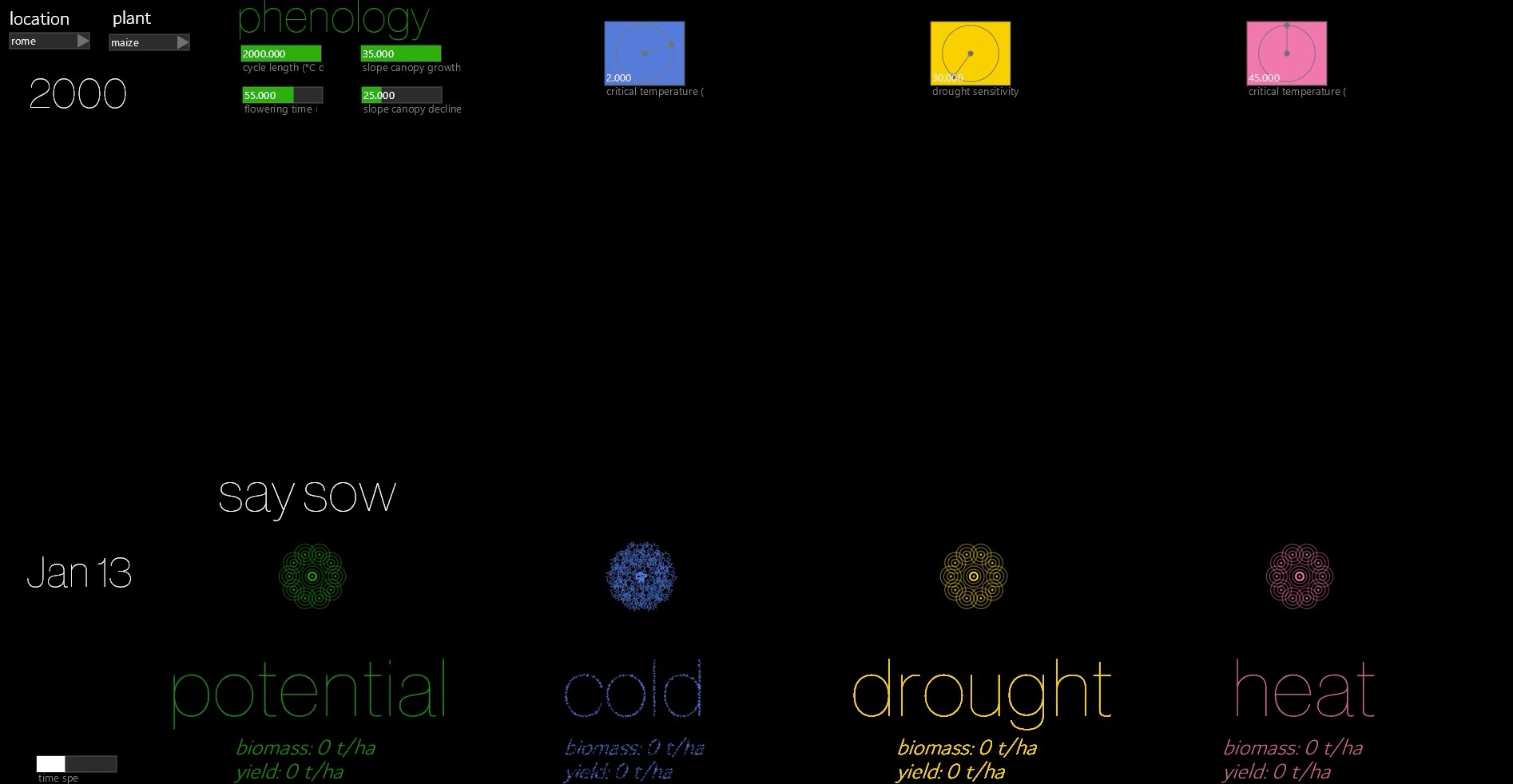
Mandala features classical string instruments playing in unison to convey essential information such as production level, stress functions, and flowering while a drum beats to denote the passing of time. “The music was developed according to the movement of the seed circles assigning a different starting note and a different musical instrument for each production level (potential = C2, double bass; cold-limited = E2, light blue; drought-limited = G2, viola; heat-limited = C3, violin). At the beginning of the growing season the four seeds start playing a triads chords made by three notes plus unison (a root, a third and fifth). When they start growing the ten external circles enlarge and depart from the central circle in an opening movement and start the chords scale progression in a pentatonic scale (from C2 + to C4+). We decided to use the pentatonic scale as the notes of the pentatonic scale are harmonious in whichever order they are played. It occurs in many musical traditions and in addition many past and contemporary musicians from different cultures have recognized pentatonic scales’ emotive and therapeutic power, emphasizing their suitability to convey the narrative of plant stress. Also, the use of classical string instruments playing in unison aligns with the crop cycle’s symbolic representation and has the intention to present the mandala as a chord quartet,” explains Carriero.
 Sounds used to abstract crop phenology and growth. The colored notes on the musical staff are related to the four production levels (green = potential; light blue = cold-limited; yellow = drought-limited; pink = heat-limited) and their progression is linked to different phenological stages (from seed to maturity).
It also includes visual art to depict data. Four colors are used to represent four plants: an unstressed plant and plants subjected to cold, heat, or drought stress. Visuals depict phenology and physiological functions such as stress, photosynthesis, and yield formation.
 Symbols to render crop phenology and growth, and exemplification of the effect of stress (red) on flowering (left) and yield and biomass (right).
Mandala’s crop simulation model incorporates standard plant functions such as the utilization of growing degree days to forecast developmental rate, efficiency of light interception and utilization, and sensitivity to temperature and drought. The simulations also rely on environmental inputs like light, temperature, and humidity.
Using this information, the model simulates physiological processes, encompassing phenology, photosynthesis, and yield formation. It particularly highlights the impact of cold, heat, and drought stress on crop growth and development. Using the model, the authors were able to replicate existing yield data for maize and wheat across multiple locations spanning a period of three years.
The mandala software is freely downloadable from Zenodo. To use the software, modify the patch and editing data, users must first download the free vvvv software. Customizable resources include the vvvv patch, the audio files, the source code of the crop model with a sample console application and an R file to analyze and visualize model results.
Users can utilize the graphical interface to assess how altering the duration of crop cycles and other crucial factors affects the overall yield. The source code itself can also be customized. For instance, users can add additional crops and alter visual and auditory elements.
By combining auditory cues with visual representations, mandala provides a unique and immersive experience for understanding the growth and development of crops. This innovative approach enhances scientific communication and offers valuable insights into the effects of environmental factors on crop yields.
READ THE ARTICLE:
Simone Bregaglio, Giulia Carriero, Roberta Calone, Maddalena Romano, Sofia Bajocco, Playing a crop simulation model using symbols and sounds: the ‘mandala’, in silico Plants, Volume 6, Issue 1, 2024, diad023, https://doi.org/10.1093/insilicoplants/diad023
The mandala software is freely downloadable at https://zenodo.org/records/10210150.
| # | Наименование новости | Тональность | Информативность | Дата публикации |
|---|---|---|---|---|
| 1 | Drones and AI: The New Age of Cotton Production | 0 | 10 | 27-01-2025 |
| 2 | Technical profile: Rediscovering ancient grains | 7 | 8 | 19-12-2025 |
| 3 | Understanding the Mechanics Behind Bark Formation | 0 | 7.09 | 31-10-2024 |
| 4 | Optimizing Soybean Production in the Southern Cone | 0 | 9.07 | 23-08-2024 |
| 5 | Behind the scenes, the quiet threshold moments at the AI Impact Summit | 0 | 6.75 | 22-02-2026 |
| 6 | Immersive Technology: See What We See. Understand What We Do | 0 | 4.9 | 01-01-1970 |
| 7 | ‘Agriculture is always evolving’: NI’s young farmers turning to latest tech in face of industry challenges | 0 | 10 | 09-10-2024 |
| 8 | Exploring Simulated Morphic Fields for Sustainable Multi-Agent Learning and Education | 0 | 5 | 15-07-2026 |
| 9 | SHINE: Multimodal Machine Learning Approaches for Solar Energetic Particles Events Event Prediction and Posthoc Analysis | 0 | 10 | 02-04-2026 |
| 10 | Programmtips: Vorschlag [Online-Abo] | 0 | 19.09 | 24-08-2026 |