Просмотр новости
Найдите то, что Вас интересует
 Спутники
 РН
РН SpaceX
 Роскосмос
 NASA
NASA
СпутникиРНSpaceXРоскосмосNASAMODELBARK provides valuable insights into the dynamics of bark formation through computer simulations.
Bark plays a vital role for trees – it prevents water loss, is a barrier against insects and disease and provides insulation from extreme temperatures.
Humans use bark in a variety of products because of its unique structure. For example, thick, lightweight cork is commonly used for wine bottle stoppers, flooring, cork boards, and fishing bobbers. Fibrous bark can be crafted into rope and woven into textiles. Since ancient times, thin bark has been utilized to make paper and cloth.
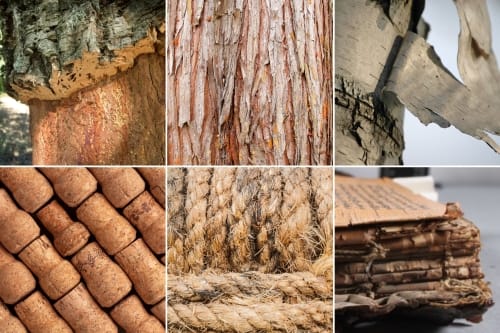 The many forms and uses of bark: cork oak and corks, cedar and cordage, birch and paper (L-R).
Bark is the outermost portion of the stem of woody plants. Stems are composed of layers of tissue with varying function:
Bark is commonly composed of phloem (inner bark), one or more layers of phellogen, phelloderm, and phellem (outer bark).
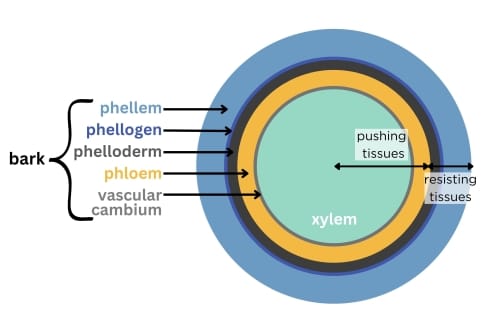 A simplified diagram of the tissues comprising a woody stem.
Biomechanical stimuli—consisting of physical forces and mechanical signals—affect the growth of stem tissues and cells, influencing bark development. Vascular cambium cells divide into xylem and phloem, while phellogen gives rise to phellem and phelloderm, leading to radial growth and stem expansion which creates outward and tangential pressure on surrounding tissues. This internal tension and pressure serve as stimuli that can affect further cell division and differentiation, regulating rates of cell division and elongation.
As the stem ages and its diameter increases, changes in tissue organization complicate the assessment of how these stimuli affect the differentiation and activity of meristematic tissue. Therefore, computational models are crucial for understanding the influence of biomechanical stimuli on bark formation.
As a master’s student at Universidad Politécnica de Madrid, Álvaro Gutiérrez-Climent joined a team to develop MODELBARK, a computational model capable of simulating bark formation over time. A description of this model’s development and features was recently published in in silico Plants.
The development of the model began with microscopy work. Researchers analyzed the bark anatomical features of seedlings and adult cork oaks (Quercus suber), holm oaks (Q. ilex) and their hybrids using microscopy. This data was used to determine the onset time for the first phellogen and to determine the mechanical coefficients for the different tissues.
MODELBARK is a simple yet powerful tool for modeling radial secondary growth of tree stems at the cellular level. The model simulates the growth of a woody stem starting from a single vascular cambium cell. As this cambium cell divides, new cells are added in sequential time steps. Bark formation is dependent on the resistance of outer tissue to pressure exerted from the expanding internal tissue. The mechanical properties that influence this resistance, such as elasticity and cohesion between neighboring cells, vary depending on the type of tissue.
Biomechanical stimuli can trigger changes in how cells develop, leading to the formation of specialized tissues. In contrast to the vascular cambium, which remains active throughout the life of the tree, a new phellogen forms in a more internal position after a year or more, rendering the previous one inactive. This important process is represented in the model: when the pressure surpasses the resistance, it prompts the formation of the first and subsequent phellogens. The differences in the anatomical structure of bark among various species arise from variations in the division rates of the vascular cambium and phellogen, as well as the mechanical properties of the outer tissue.
MODELBARK is capable of simulating the development of various bark types by accounting for the key factors influencing bark anatomy. By adjusting parameters like cell division rates, tissue thickness and resistance values, the authors successfully replicated various bark formations.
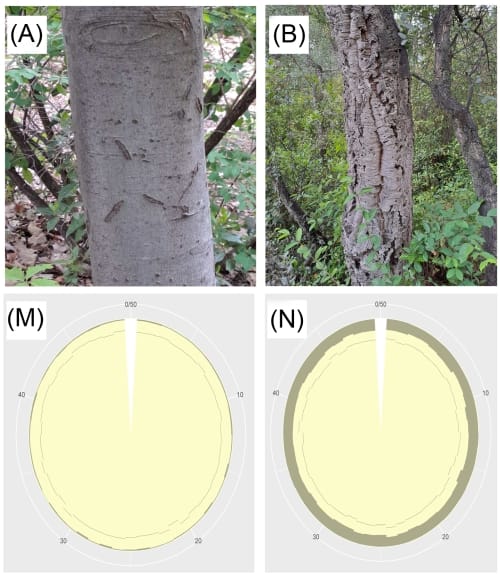 The difference between the thin bark of beech and thick cork oak is evident in photos and graphical results of the MODELBARK simulations.
This model offers valuable insights into the mechanics of bark formation. This understanding can aid researchers in exploring how trees adapt to changing climates and protect themselves against pests and diseases.
MODELBARK features an intuitive interface and is freely available, making it ideal for educational use.
READ THE ARTICLE:
Álvaro Gutiérrez-Climent, Juan Carlos Nuño, Unai López de Heredia, Álvaro Soto, ModelBark: a toy model to study bark formation in woody species, in silico Plants, Volume 6, Issue 2, 2024, diae017, https://doi.org/10.1093/insilicoplants/diae017
MODELBARK, along with its manual, is freely available for download from the GitHub software repository (https://github.com/GGFHF/ModelBark) under the GNU General Public License v3.0.
| # | Наименование новости | Тональность | Информативность | Дата публикации |
|---|---|---|---|---|
| 1 | Cracking the Code of Hazelnut Tree Architecture | 0 | 7.23 | 25-03-2025 |
| 2 | Researchers Challenge Established Theory on Stomatal Movement | 0 | 9.15 | 25-11-2024 |
| 3 | Symphony of Insights: Transforming Crop Simulation with Sound and Music | 0 | 8.1 | 24-04-2024 |
| 4 | A Model Approach to Understanding the Properties of Guard Cell Walls: The Key to Stomatal Function | 0 | 7.07 | 28-07-2024 |
| 5 | Simulationen: Wie Strukturen in den Zentren von Galaxien gemeinsam wachsen | 0 | 10 | 07-08-2026 |
| 6 | Modelling DNA origami folding | 0 | 10 | 01-09-2015 |
| 7 | Создана цифровая модель поведения сплава при нагревании | 0 | 10 | 24-08-2026 |
| 8 | Расчет скоростей развития деформаций. | 0 | 5 | 22-11-2024 |
| 9 | Симулятор индуса | 0 | 0 | 20-07-2026 |
| 10 | Mathematicians Unleash Multifold Speed Boost for Supercomputer Simulations of Molecules | 5 | 8 | 24-06-2026 |