Просмотр новости
Найдите то, что Вас интересует
 Спутники
 РН
РН SpaceX
 Роскосмос
 NASA
NASA
СпутникиРНSpaceXРоскосмосNASAIreland’s iconic table mountain has a fascinating geological history.
Rising dramatically above the landscape of County Sligo, Benbulbin is one of Ireland’s most distinctive landmarks. Its broad, flat summit and sheer limestone cliffs make it look almost artificially sculpted. But its shape is the product of a geological story stretching back more than 300 million years, involving tropical seas, shifting sedimentary basins, glaciers, and the slow erosion that continues today.
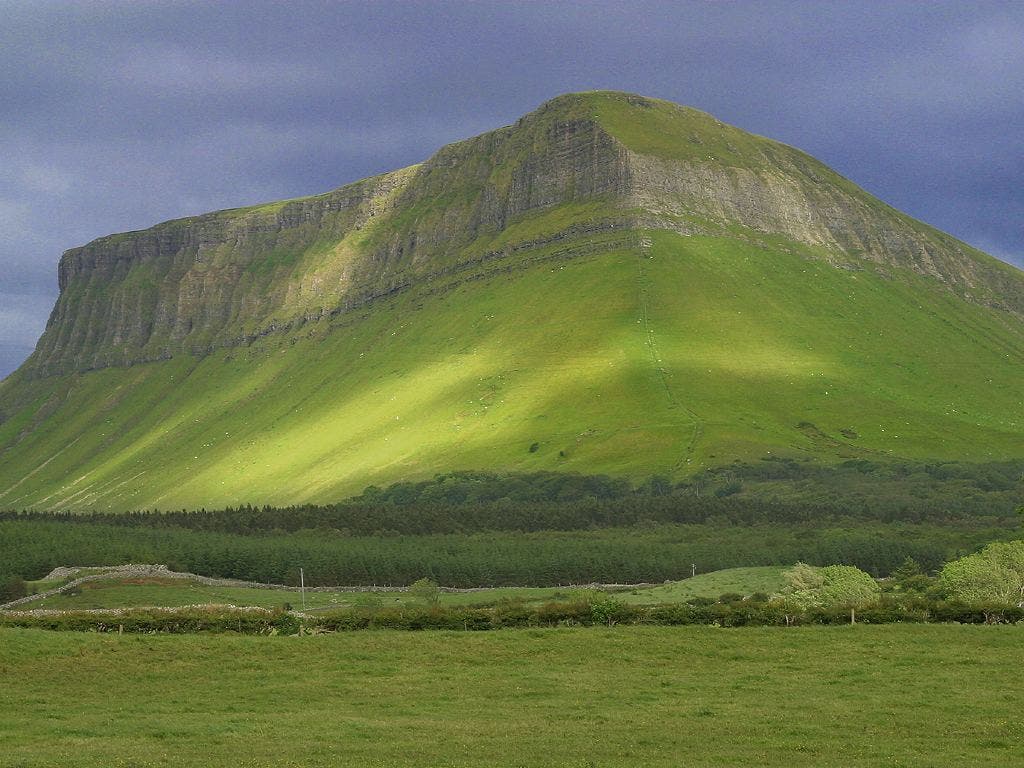 Photo by Jon Sullivan.
A mountain built from the sea
Photo by Jon Sullivan.
A mountain built from the sea
Benbulbin is part of the Dartry Mountains and rises to 526 meters (1,726 feet). Its story begins during the Carboniferous Period, when Ireland looked almost nothing like it does today.
The period is called the Carboniferous because of the vast amounts of carbon-rich coal deposits formed during this time. At the time, roughly 330–340 million years ago, what is now Ireland lay much closer to the equator and large parts of the country were covered by warm tropical seas. These waters teemed with life, including corals, brachiopods, crinoids, bryozoans and other marine organisms.
As these organisms lived and died, their skeletons and shells accumulated on the seafloor, eventually compacting into layers of limestone, which would later become one of the key components of Benbulbin’s geology. Today, this limestone forms the lower slopes of the mountain, and it’s filled with fossils that offer a window into a world that existed hundreds of millions of years ago.
But Benbulbin isn’t just one enormous block of limestone. Its distinctive profile comes partly from a layered sequence of rocks with very different strengths.
What rocks are in Benbulbin? Illustration: ZME Science.
Near the base lies the Benbulben Shale Formation, composed largely of dark marine shale deposited from fine mud settling through comparatively deeper water. Above it are alternating limestone, mudstone and shale beds belonging to the Glencar Limestone Formation.
Higher still lies the much more resistant Dartry Limestone Formation, which forms many of Benbulbin’s dramatic upper cliffs.
These rocks preserve abundant traces of the Carboniferous sea. Fossils of corals and other sea organisms can be found in the limestone, while some beds preserve signs of creatures burrowing through the ancient seafloor. Chert — hard silica-rich rock occurring as nodules within the limestone — also appears in parts of the succession.
In other words, Benbulbin is essentially a towering cross-section through an ancient marine environment. Benbulbin consists of different types of rocks, but they’re all linked to the sea.
 Photo by andrewcparnell.
All that explains what Benbulbin is made of. But it doesn’t explain its extraordinary shape.
The answer lies partly in the way its rocks are stacked.
The sedimentary layers making up Benbulbin remain relatively close to horizontal. The harder limestone near the top resists erosion better than the softer shale-rich rocks beneath it. Over time, erosion therefore eats into the lower and weaker layers more rapidly while the harder limestone survives as a resistant cap.
This process naturally produces steep escarpments and broad upland surfaces. But glaciers took that basic geological architecture and dramatically exaggerated it.
During this period, Ireland (like much of Europe) was covered in massive glaciers that slowly carved their way through the landscape. These glaciers were powerful enough to reshape entire mountains, and Benbulbin was no exception. The ice sheets moved from northeast to southwest, scouring the earth and leaving behind dramatic cliffs and steep slopes.
As the glaciers moved, they eroded the softer layers of shale and limestone, while the harder rock above resisted erosion. This difference in erosion rates is responsible for Benbulbin’s stepped appearance, where the lower slopes are gently sloping, but the upper cliffs are nearly vertical. The mountain’s distinctive shape owes much to this glacial activity, which left behind the sharp ridges and flat summit that have become so iconic.
 Benbulbin from Mullaghmore Head, with Classiebawn Castle in the foreground.
The Role of Tectonics
Benbulbin from Mullaghmore Head, with Classiebawn Castle in the foreground.
The Role of Tectonics
Benbulbin’s history also has a tectonic component, although not quite in the way the dramatic landscape might suggest.
Around 400 million years ago, during the Devonian period, the landmass that would eventually become Ireland was part of a supercontinent called Pangea, located near the equator. The collision of tectonic plates caused intense folding and faulting in the earth’s crust, which raised the land above sea level and created mountain ranges.
As tectonic forces continued to act on the region, the landscape was slowly transformed. Volcanic activity and uplift contributed to the formation of the limestone and shale layers that now make up Benbulbin. Over time, these tectonic forces would also play a role in shaping the broader landscape of County Sligo, with Benbulbin standing as one of the most visible reminders of this geological activity.
The mountain is still changingBenbulbin’s current appearance is the result of millions of years of natural processes, but the landscape around the mountain is still changing today. Erosion continues to shape the cliffs and ridges, slowly wearing away at the rock and altering the mountain’s profile. This process is slow, almost imperceptible to human eyes, but over the course of millennia, it will continue to reshape the landscape.
Landslides are not uncommon in the area, particularly after heavy rains, when water seeps into cracks in the rock and loosens large sections of the cliffs. These processes are a reminder that, while Benbulbin may seem like a permanent fixture in the landscape, it is still subject to the forces of nature.
Who knows what it will look like millions of years from now?