Просмотр новости
Найдите то, что Вас интересует
 Спутники
 РН
РН SpaceX
 Роскосмос
 NASA
NASA
СпутникиРНSpaceXРоскосмосNASAArtificial intelligence is rapidly entering multilingual qualitative research through automated transcription, translation, coding, summarisation and quotation editing. Existing scholarship has examined many of these practices separately. Yet qualitative claims are usually produced through a sequence of transformations, and an apparently minor alteration at one stage can shape every subsequent stage. I therefore ask: How does AI mediation across the multilingual qualitative evidence pipeline alter meaning, epistemic authority and responsibility, and what methodological safeguards should follow? The research conducted a critical integrative study of cross-language qualitative methods, AI-assisted qualitative analysis, machine translation bias, reflexivity, and epistemic justice. The synthesis identifies an algorithmic interpretive layer located between participant expression and researcher interpretation. This layer does not merely transmit language. It selects, normalises and reorganises it. Five linked mechanisms explain how meaning can be progressively narrowed: semantic compression, linguistic normalisation, category anchoring, evidentiary laundering and accountability diffusion. Their interaction produces cascading meaning loss, in which transformations that appear acceptable in isolation become consequential when inherited by subsequent analytical decisions. To address this problem, the study proposes an AI-Mediated Interpretive Chain of Custody. The framework requires versioned source preservation, transformation logs, model and prompt provenance, risk-based human adjudication, interpretive checkpoints, and claim-to-source traceability. It treats translation as situated interpretation rather than a search for one mechanically correct equivalent. The article advances qualitative methods by shifting attention from the accuracy of individual tools to the integrity of the complete evidence pathway. It offers researchers, ethics committees, editors and reviewers a practical basis for judging when AI-supported multilingual findings remain meaningfully connected to participant expression.
A polished English quotation can conceal a long and unstable methodological history. Before it appears in an article, a participant’s account may have been recorded in one language, transcribed by speech-recognition software, translated by a large language model (LLM), shortened by a summarisation tool, allocated to a code by another model, interpreted by a researcher, and edited once more for publication. At each point, the text can remain grammatically plausible while its social force, uncertainty, humour, silence, register or culturally specific meaning changes. The published wording may look direct, yet it can be several transformations removed from the participant’s expression.
This problem is becoming urgent because AI tools are no longer confined to a single analytical task. Automated transcription is embedded in meeting platforms and qualitative software; machine translation is available at negligible marginal cost; and generative AI can propose codes, themes, summaries, and illustrative quotations within a single interface. Research on AI-assisted qualitative analysis has expanded accordingly. Studies assess the use of LLMs in coding and thematic analysis, debate human–AI collaboration, and propose disclosure and reflexivity practices (De Paoli, 2024; Jones, 2025; Morgan, 2023; Tai et al., 2024; Wachinger et al., 2025). A parallel cross-language literature has long shown that translation is an interpretive act shaped by linguistic competence, cultural knowledge, power and reporting decisions (Squires, 2009; Temple & Young, 2004; van Nes et al., 2010). More recent work connects these concerns to AI translation, including minimum disclosure standards and auditable translation workflows (Ghimire, 2026; Kiluba & Muyumba, 2026).
These advances are valuable, but the literature remains organised mainly around individual tasks. Translation papers concentrate on how one language is rendered into another. AI analysis papers concentrate on coding, thematic development or efficiency. Ethics papers emphasise consent, confidentiality and disclosure. Reporting frameworks ask researchers to state which tools were used. This task-by-task organisation creates a blind spot: later stages inherit the transformed output of earlier stages. If transcription removes a pause that signals discomfort, translation converts a culturally marked expression into generic English, and AI coding then treats that wording as literal, the final theme cannot be evaluated by checking coding alone. The methodological object requiring scrutiny is the whole evidence pathway.
I call the computational and organisational mediation across this pathway the algorithmic interpretive layer. It is a layer because several AI functions may intervene between participant expression and human interpretation. It is interpretive because these systems do more than copy or transport text. Their outputs depend on training data, model architecture, probability-based generation, prompts, platform settings and the languages supplied. Even when researchers use AI only for “clerical” support, the distinction between clerical and interpretive work is unstable. Punctuation can alter emphasis; a translated term can narrow a category; a summary can decide what counts as central; and a recommended quotation can determine which voice becomes visible.
The central argument of this article is that AI-mediated multilingual qualitative research is vulnerable to cascading meaning loss. This does not mean that every use of AI corrupts data or that a pure, technology-free account exists. All qualitative inquiry involves selection and interpretation. Cascading meaning loss refers more specifically to the progressive narrowing, redirection or concealment of possible meanings when one transformed representation becomes the input for the next, without adequate return to source-language evidence. Because each output may be fluent and credible, cumulative change can be less visible than a single obvious mistranslation.
The article makes three contributions. First, it integrates four bodies of scholarship that are usually discussed separately: cross-language qualitative methods, AI-assisted qualitative analysis, linguistic bias in language technologies, and epistemic justice. This integration relocates the unit of methodological assessment from an individual tool to a connected interpretive system. Second, it specifies five mechanisms through which change becomes cumulative: semantic compression, linguistic normalisation, category anchoring, evidentiary laundering and accountability diffusion. Third, it proposes an AI-Mediated Interpretive Chain of Custody (AICoC), a practical framework for preserving interpretive traceability from participant expression to published claim. The argument is relevant to research conducted in under-resourced languages and to scholars whose data are generated outside dominant English-speaking settings. Language technologies are unevenly developed across the world’s languages, while academic publications continue to reward smooth English (Joshi et al., 2020; Nekoto et al., 2020). The risk is therefore not distributed equally. Communities whose language, dialect or cultural references are poorly represented in training data may be most exposed to computational alteration and least able to challenge the published representation.
The study addresses the following research question: How does AI mediation across the multilingual qualitative evidence pipeline alter meaning, epistemic authority and responsibility, and what methodological safeguards should follow? The study first explains why the issue cannot be reduced to a matter of technical accuracy. The study then describes the critical integrative study, presents the five mechanisms of cascading meaning loss, develops the algorithmic interpretive layer, and sets out the AICoC framework.
Cross-language qualitative researchers have repeatedly rejected the idea that translation is a neutral substitution of words. Temple and Young (2004) showed that translation decisions are connected to the researcher’s epistemological position and to questions about whose account is authorised. Squires (2009) identified language competence, translator role and conceptual equivalence as recurrent methodological challenges. van Nes et al. (2010) argued that meaning may change when researchers move repeatedly between languages during analysis and writing. Xian (2008) similarly demonstrated that translators can operate as active knowledge producers rather than invisible technicians.
This literature has two implications for AI-mediated work. First, no translation can be evaluated solely by lexical correspondence. A term may be accurate at the dictionary level but misleading in relation to social position, irony, politeness, historical reference or implied meaning. Second, translation decisions affect analysis rather than merely preparing data for analysis. If researchers code only an English translation, the chosen English wording becomes an analytical boundary. Alternative meanings that remain visible in the source language may no longer be available to influence a code or theme. Human translation practices are not automatically superior. Translators and bilingual researchers also make situated choices, and back-translation can create a misleading appearance of equivalence. Strong cross-language methods make those choices discussable through translator reflexivity, team dialogue, source-language comparison and clear reporting (Abfalter et al., 2021; Bergen, 2018; Chiumento et al., 2018; Yunus et al., 2022). The issue raised by AI is not the arrival of mediation itself. It is the scale, speed, opacity and easy recombination of mediating operations.
Early methodological discussion of LLMs in qualitative research often treated the model as an assistant for bounded tasks. Morgan (2023) explored ChatGPT as an aid to qualitative analysis, while Tai et al. (2024) tested LLM support for deductive coding. Subsequent studies compared human and model-generated codes and themes, designed protocols for AI-supported thematic analysis, and examined collaborative arrangements (Barrera et al., 2025; Costa et al., 2025; Goyanes et al., 2025; Nicmanis & Spurrier, 2025; Wachinger et al., 2025). The literature reports useful capacities, particularly speed, pattern generation and assistance with large textual corpora. It also identifies instability, fabrication, loss of interpretive depth, confidentiality concerns and over-reliance (Hitch, 2024; Marshall & Naff, 2024; Roberts et al., 2024). The epistemological debate now ranges from a rejection of generative AI in reflexive inquiry to proposals for methodologically congruent collaboration and reconfigured reflexivity (Chatzichristos, 2025; Christou, 2026; Ibrahim et al., 2026; Jowsey et al., 2025; Matta et al., 2026; Nguyen-Trung, 2025, 2026; Paulus & Marone, 2024).
Multilingual inquiry adds a second layer of difficulty. A model can be involved before formal analysis begins, through transcription or translation, and then again during coding or writing. These interventions may involve different platforms with different data policies, language performance and hidden updates. Kwon et al. (2025) found that LLMs can help non-native English researchers translate participant quotations, while also introducing practical and evaluative challenges. Lingard and Klasen (2025) cautioned that apparent advances in AI translation leave major methodological issues below the surface. Ghimire (2026) responded to weak reporting by proposing a minimum disclosure standard for AI-mediated translation. Kiluba and Muyumba (2026) demonstrated an auditable multilingual workflow in the Democratic Republic of Congo. The emerging guidance improves visibility, but disclosure alone does not demonstrate that a published interpretation remains connected to participant expression. A paper may accurately report the model used and still fail to show how a disputed translation influenced codes, themes and claims. Conversely, demanding human verification of every line may be infeasible for large projects and may reproduce the assumption that one authorised English rendering resolves interpretive uncertainty. What is missing is a framework that links transformations to downstream analytical consequences.
The pipeline perspective changes the question from “Was the translation accurate?” or “Did the model code reliably?” to “What transformations occurred between expression and claim, which alternatives were removed, and who judged the consequences?” This shift matters for three reasons. First, transformation is path dependent. Once source-language audio has been converted into an English transcript, researchers may never revisit the audio. Codes then respond to translated phrasing, not to the original rhythm, hesitation or culturally marked term. Themes inherit those codes, and publications inherit the themes. Later methodological care cannot fully recover information that was discarded earlier.
Second, errors can interact. A transcription error may produce a plausible but incorrect word. Translation may then generate a fluent equivalent of that incorrect word. Coding software may place the fluent output into a coherent category. Agreement at the final stage can therefore confirm consistency within a transformed dataset rather than fidelity to the participant’s account. Third, the pipeline redistributes authority. Researchers may rely on vendors for transcription, commercial LLMs for translation, software-based coding suggestions, and editorial tools for polished English. Responsibility becomes dispersed even though the researcher remains accountable for the published claim. This tension is methodological, ethical and epistemic.
Table 1 shows the fragmented focus of current literature and the gap that the present synthesis addresses.
I used a critical integrative study because the problem spans disciplines and includes conceptual, empirical, ethical, and technical publications. An integrative study is suited to combining diverse forms of evidence while generating a new conceptual account rather than only aggregating findings (Torraco, 2005; Whittemore & Knafl, 2005). I also drew on critical interpretive synthesis, which treats concepts and problem definitions in the literature as objects of analysis and permits an argument to develop through iterative comparison (Dixon-Woods et al., 2006). The purpose was not to calculate the average accuracy of a particular model. Model performance changes quickly, benchmark scores do not settle questions of social meaning, and the relevant evidence includes methodological reflections that would be excluded from a narrow effectiveness study. The aim was to explain how individually documented concerns connect across the full production of qualitative evidence.
I conducted structured searches across SAGE Journals, Taylor & Francis Online, SpringerLink, PubMed, ACM Digital Library and ACL Anthology, supported by bibliographic discovery and backward and forward citation tracing. Searches were updated on 26 July 2026. Combinations of the following terms were used: “qualitative research”, “multilingual”, “cross-language”, “translation”, “transcription”, “large language model”, “generative AI”, “machine translation”, “thematic analysis”, “coding”, “reflexivity”, “epistemic injustice”, “linguistic bias”, “audit trail”, “provenance” and “chain of custody”.
Publications were included when they met at least one of four criteria: they examined language transformation in qualitative inquiry; evaluated or theorised AI use in qualitative data work; documented linguistic or cultural bias relevant to language technologies; or offered concepts needed to analyse epistemic authority and traceability. The study prioritised peer-reviewed work, while retaining conceptual and editorial contributions when they introduced a methodologically important argument not yet represented in empirical studies. Publications concerned only with quantitative sentiment classification, clinical prediction, generic educational use of AI, or translation quality, without relevance to interpretive inquiry, were excluded.
Selection proceeded iteratively. An initial set established the long-standing cross-language concerns. A second set covered empirical and conceptual work on LLM-supported qualitative analysis. A third set tested whether scholarship on machine translation, low-resourced languages and epistemic injustice altered the emerging explanation. Searching and citation tracing continued until additional publications extended examples, but did not change the five explanatory mechanisms. The final analytic corpus comprised 46 methodological, empirical and conceptual publications; study-method sources were treated separately.
The researcher recorded each publication’s research problem, stage of the evidence pathway, language assumptions, role assigned to AI, reported risk, proposed safeguard and location of responsibility. I then compared publications within and across four provisional domains: cross-language method, AI-supported analysis, linguistic bias, and ethics or reflexivity. During repeated comparison, three questions were asked: What changes in the representation of participant expression? How can that change influence a later decision? Who can detect, contest or authorise it?
The first-cycle concepts included loss of ambiguity, standardisation, source detachment, automation bias, hidden mediation and uncertain responsibility. I then examined relationships among these concepts. This process produced five mechanisms that explain cumulative change rather than a list of isolated risks. Negative-case analysis was used to refine the framework. For example, literature demonstrating productive human–AI collaboration challenges the simple argument that AI necessarily reduces quality. The resulting framework, therefore, focuses on traceability, adjudication and proportional safeguards rather than prohibition. This study is interpretive and theory-building. It does not claim exhaustive coverage of every fast-growing AI publication or every tradition of translation studies. Its value depends on the explanatory reach of the synthesis and on the clarity with which readers can examine the route from literature to concepts.
Semantic compression occurs when a representation retains a broadly recognisable topic while reducing the range of meanings carried by the source. Compression can begin during transcription. Automated speech recognition may omit false starts, overlapping speech, elongated sounds, pauses or local pronunciation. Some services automatically insert punctuation, divide speakers or remove filler words. These operations make text readable, but readability is not methodologically neutral. In an interview about professional uncertainty, for example, repeated hesitation may be analytically important rather than verbal noise. Translation can create a second compression. A culturally specific term may be replaced with a familiar English category; an indirect refusal may become a direct negative statement; and a proverb may be translated into its presumed message rather than retained as a culturally situated form. van Nes et al. (2010) showed that repeated movement between languages can make original meanings harder to access. AI can accelerate this movement and present a single high-probability output as if no alternatives existed.
Summarisation introduces a third compression. LLM summaries are designed to reduce textual volume and select apparent salience. Yet salience in qualitative research depends on the research question, theoretical orientation, participant position and researcher engagement. A rarely stated account may be analytically important because it challenges the dominant pattern. A model asked to identify “main themes” may favour frequency and explicit statements, thereby removing contradictions or uncertainties before formal analysis begins. Compression is not always unacceptable. Transcription conventions, translation and coding all reduce information. The methodological concern is unmarked and irreversible compression. When researchers retain source audio, source-language transcripts, alternative translations and analytic notes, they can revisit what was reduced. When a compressed English summary replaces those materials, later checking becomes impossible.
Linguistic normalisation is the movement of participant expression towards dominant, standardised and institutionally valued forms of language. Language models learn from unequal textual environments and generate likely sequences rather than grounded understanding (Bender et al., 2021). High-resource languages and formal registers are more extensively represented than many African, Indigenous and minoritised languages, dialects and code-switching practices (Joshi et al., 2020; Nekoto et al., 2020). Bias in natural language processing is therefore not only a matter of offensive output. It concerns which language forms a system recognises as coherent, informative or worthy of preservation (Blodgett et al., 2020; Helm et al., 2024). Comparative evidence also indicates that models developed in different national and linguistic environments can reproduce distinct cultural biases (Zhu et al., 2024).
In qualitative work, normalisation can alter social evidence. Grammar correction may erase markers of class, generation, occupation and local identity. Translation may replace kinship terms, honorifics or communal forms of agency with individualised English expressions. Code-switching may be rendered entirely in one language, concealing how the speaker positioned an idea. Emotionally restrained speech may be expanded into explicit feeling language because the model predicts what a fluent explanation should sound like. The pressure towards normalisation is reinforced by academic publications. Researchers working in languages other than English often need to produce readable English quotations for international audiences. Kwon et al. (2025) show why LLM assistance can be attractive in this work. The danger is not polished prose itself. It is the possibility that fluency becomes a proxy for fidelity. A grammatically smooth quotation may receive less scrutiny precisely because it reads naturally.
Normalisation also affects whose speech becomes quotable. Editors and authors may select quotations that require little explanation, while culturally dense accounts are summarised in the researcher’s voice. Participants closest to dominant linguistic norms then appear to speak directly, whereas other participants are more heavily mediated. This distribution is an epistemic justice issue because it influences whose knowledge is recognised in the article (Fricker, 2007; Sivaji, 2026).
Category anchoring occurs when an early machine-produced representation establishes the terms through which later analysis is conducted. Anchoring can operate through wording. If an expression is translated as “resistance”, subsequent coding may cluster it with opposition, although the source term may also indicate caution, endurance or moral refusal. The first label narrows the analytic field. AI-generated codes create a more direct anchor. Empirical studies show that LLMs can generate plausible codes and themes, but agreement with human coders varies by task, prompt and research design (De Paoli, 2024; Sakaguchi et al., 2025; Tai et al., 2024). Ashwin et al. (2026) found that LLM coding errors can be systematically associated with participant characteristics. This is particularly important for multilingual datasets because apparent coding differences may reflect language performance rather than differences in experience.
Anchoring does not require researchers to accept model outputs unquestioningly. A suggested code can shape attention even when it is later edited. Once a dataset is organised under a proposed category, confirming extracts become easier to see, and disconfirming possibilities require extra work. Reusing the same model for translation and coding can intensify this effect: the system codes wording that it helped produce, creating an appearance of internal coherence. Methodological congruence is therefore critical. Reflexive thematic analysis does not treat codes as objective labels waiting to be discovered. Themes are developed through sustained researcher engagement and reflexive interpretation (Braun & Clarke, 2021). An LLM-generated codebook can quietly import a coding-reliability logic into an interpretive design. This is not merely a technical error. It changes the implied nature of knowledge. Category anchoring is reduced when researchers delay AI-generated themes until after source-led familiarisation, analyse selected material in the source language, use counter-prompts to seek alternative readings, and document occasions when translated wording changed a code. It is also reduced by separating exploratory model output from authoritative analytical decisions.
Evidentiary laundering is the process through which successive transformations produce an output that appears cleaner and more direct than its provenance warrants. The term does not imply misconduct. It identifies a representational effect: uncertainty is removed from view while authority increases. Consider a quotation translated by an LLM and then lightly edited by a researcher. If the article presents it in quotation marks without indicating the source language, translation process or disputed terms, readers encounter the sentence as participant speech. The visual conventions of quotation transfer evidentiary authority to a wording the participant never used. A similar effect occurs when AI-generated summaries are incorporated into analytic memos and later cited as if they arose from direct reading.
Current reporting initiatives address part of this problem. Jones (2025) proposes a heuristic for disclosing generative AI across qualitative research activities. Ghimire (2026) specifies minimum disclosure for AI-mediated translation. Samuel and Wassenaar (2025) emphasise the importance of informed consent for AI transcription. Such guidance is necessary because invisible tool use prevents meaningful appraisal. Yet a list of tools does not reveal the lineage of a particular finding. Reviewers need to know not only that AI was used, but where the wording supporting a claim came from, which transformations it passed through, and how contested decisions were resolved.
Evidentiary laundering is encouraged by a common separation between methods and findings. Methods sections describe a general workflow, while findings present seamless quotations and themes. If transformations differ across interviews or languages, a general statement may obscure unequal treatment. A high-resource language may be transcribed and translated accurately, while another requires extensive correction. Reporting both under one label, such as “AI-assisted translation verified by the researcher”, conceals materially different evidence quality. The safeguard is claim-level traceability. Researchers should be able to move from a published quotation or interpretive claim back through the final translation, analytical extract, source-language transcript and audio or original record, subject to ethical access controls. Traceability does not make an interpretation uniquely correct. It makes the basis and transformation of the interpretation open to informed examination.
Accountability diffusion occurs when many actors influence evidence, but no actor has clear responsibility for a transformation. In an AI-mediated project, these actors may include participants, interviewers, transcribers, translators, bilingual advisers, software vendors, model developers, data hosts, analysts, authors and editors. Each may control only part of the pathway. Commercial systems intensify diffusion because researchers may not know which model version produced an output, whether the provider retained the data, how the service handles a low-resource language, or when the model changed. Prompts may be stored in personal accounts rather than project records. Translation may be conducted by a team member who assumes that coding colleagues will verify it, while coders assume linguistic verification has already occurred.
Qualitative researchers cannot transfer scholarly responsibility to a model or vendor. Marshall and Naff (2024) argue that the use of AI raises ethical obligations regarding consent, privacy, and bias. Roberts et al. (2024) similarly warn against accepting assistance without examining its epistemic implications. However, stating that the researcher remains responsible is insufficient unless responsibilities are allocated at each stage. A monolingual principal investigator cannot personally judge every source-language ambiguity. Responsible practice may require bilingual collaborators, community advisers or professional interpreters with recognised epistemic standing. Accountability is also shaped by unequal academic resources. Wealthier institutions may use secure enterprise tools and employ bilingual teams. Researchers with limited funding may rely on free platforms or LLMs because conventional translation is costly. A framework that simply prohibits AI could deepen inequality without removing hidden translation work. Proportional accountability is more useful for protecting sensitive data, identifying high-risk transformations, directing scarce human expertise to culturally dense and claim-bearing material, and reporting residual uncertainty. Table 2 consolidates the five mechanisms by linking their observable signs to their downstream analytical consequences and the corresponding priority responses.
The five mechanisms point to a conceptual change in how AI should be located within the qualitative method. AI is commonly described as a tool used by a researcher. That description is accurate but incomplete. When several systems transform the data, AI serves as an algorithmic interpretive layer between participants’ expressions and researchers’ interpretations. The layer has four properties. First, it is distributed as it may consist of several models, platforms and automated functions rather than one identifiable tool. Second, it is generative. Outputs are probabilistic reconstructions, not transparent transfers of an unchanged object. Third, it is recursive. A model can process text already produced by another model, and researchers may feed generated summaries back into later prompts. Fourth, it is unequal. Its performance and representational effects vary by language, dialect, speaker and subject.
This concept extends the familiar double hermeneutic of interpretive qualitative research. In a double hermeneutic, participants make sense of their world, and researchers make sense of participants’ sense-making. AI mediation introduces additional operations that have interpretive effects without human experience or accountable understanding. Calling this a “triple hermeneutic” would overstate machine understanding and treat the model as equivalent to a knowing person. The algorithmic interpretive layer is a better term because it recognises material influence without attributing consciousness or moral agency to the system. The layer also clarifies why output agreement is an incomplete quality test. Two LLMs may generate similar English translations because they are trained on overlapping dominant-language materials. A researcher and model may agree on a theme because both encounter a normalised transcript. The agreement shows convergence among outputs but does not establish that silenced alternatives were preserved. Qualitative quality requires an account of meaning-making, not only reproducibility.
The model in Figure 1 shows the pathway. Each stage produces a representation that may be treated as data by the next stage. Cascading risk increases when source returns become less frequent, transformations are overwritten, or the same model spans multiple stages. Interpretive integrity rises when researchers preserve versions, record decisions, and create checkpoints at which linguistic and cultural knowledge can alter the analysis.
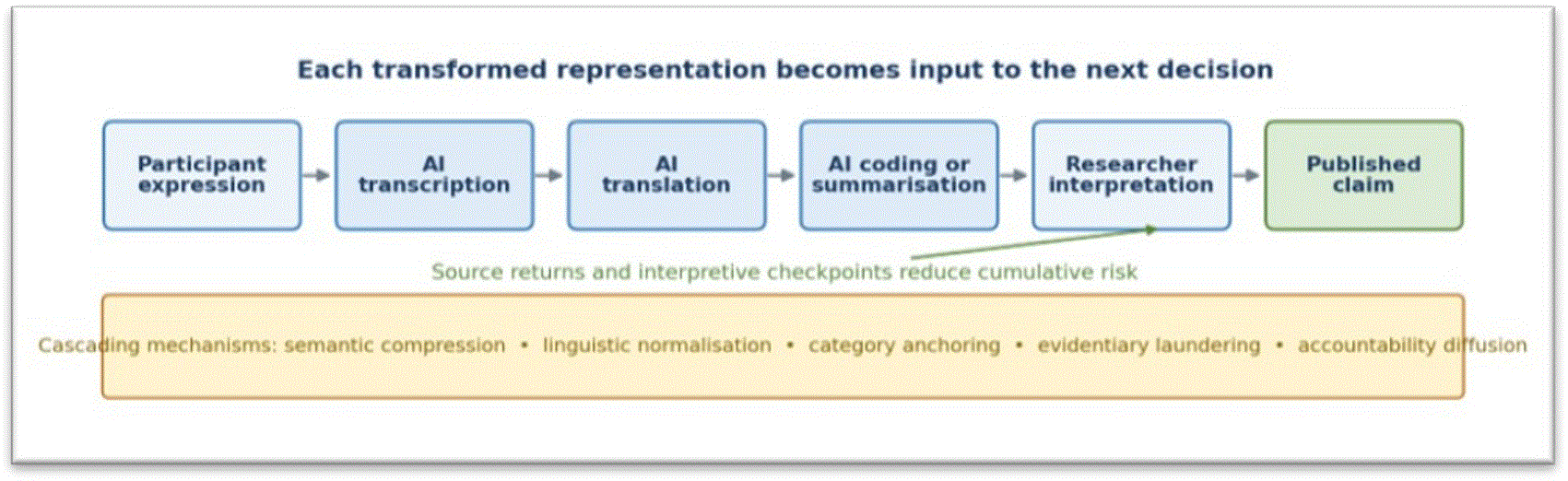
Source: Authors’ conceptualisation.
The pathway is not always linear. Researchers may translate only selected excerpts, code in the source language, return findings to participants, or revise a translation after analysis. These loops are methodological strengths when documented because they prevent one early output from becoming fixed. The figure, therefore, identifies a minimum lineage rather than prescribing a universal order.
To govern the algorithmic interpretive layer, the study proposes an AI-Mediated Interpretive Chain of Custody. The term “chain of custody” is used carefully. In forensic practice, it usually demonstrates that an item remained identifiable and unaltered. Qualitative meaning cannot be preserved as a fixed object in the same way. Interviews are co-produced, transcription is representational, translation admits alternatives, and analysis creates an argued interpretation. The purpose of AICoC is therefore not to certify one true translation. It is to preserve the lineage of transformations, keep consequential alternatives available, and identify the humans accountable for interpretive decisions.
The framework is based on six principles.
1. Source primacy: transformed outputs do not replace the earliest ethically retained record.
2. Version visibility: each consequential transformation is stored as a distinct, dated version.
3. Provenance specificity: model, provider, version, where available, settings, prompt and operator are recorded.
4. Risk-proportionate adjudication: human linguistic and cultural study is concentrated where errors would most affect participant representation or central claims.
5. Interpretive return: analysts periodically return from codes, summaries and claims to source-language material.
6. Human responsibility: a named researcher accepts responsibility for every transformation used as evidence.
These principles convert general transparency into an operational method. They also avoid two unhelpful extremes: treating AI output as neutral, or requiring complete avoidance of AI regardless of research setting.
Stage 1: Ethical entry and consent
AI use should be considered before data collection, not disclosed retrospectively after a tool has processed recordings. Consent materials should explain in accessible language which forms of automated processing may occur, whether data leave the research institution, whether a provider may retain inputs, and what alternatives are available. For sensitive studies, consent to participate should be separable from consent to third-party AI processing. Researchers must also consider whether collective or community consultation is needed when language data has cultural ownership beyond the individual speaker. The stage record should include the approved tools or tool classes, the data-location assessment, the consent wording, participant choices, and the procedure for changes. If the team later adopts a materially different service, the ethical decision should be revisited.
Stage 2: Source capture and preservation
Researchers should preserve the earliest authorised record in a secure, access-controlled form. For interviews, this may include audio, fieldnotes and a source-language transcript. File identifiers should remain stable across the project. Automated “clean-up” should never overwrite the verbatim or convention-based transcript. Researchers need to state what the transcription system changed. Speaker segmentation, punctuation, removal of fillers and handling of overlapping speech may all affect interpretation. A sample should be checked across speakers, recording conditions and language varieties rather than only across randomly selected minutes. If accuracy differs substantially between participant groups, the response should address the inequality rather than report a single average error rate.
Stage 3: Translation and linguistic adjudication
Each translated text should be linked to its source segment. For central or culturally dense material, the record should include the initial AI translation, human revisions, alternative renderings and a brief rationale for the selected wording. Source terms that lack a stable English equivalent may be retained with an explanation. Adjudication should be organised according to risk. A full bilingual review may be necessary for small datasets, sensitive claims or poorly supported languages. In larger projects, the team can prioritise passages that support main findings, contain figurative or culturally marked language, show model uncertainty, involve disagreement, or represent marginal and negative cases. The reviewer’s role and linguistic relationship to the setting should be reported. Back-translation can be one diagnostic activity, but it should not be treated as proof of equivalence.
Stage 4: Analysis with source-language checkpoints
Before using an LLM for coding or summarisation, researchers should complete human familiarisation with the data appropriate to their methodological approach. Prompts, model outputs and researcher decisions should be retained separately. AI suggestions should be labelled as suggestions and should not silently populate the final codebook. Source-language checkpoints should occur when codes are created, merged or elevated into themes. At each checkpoint, the analyst asks whether the analytical label depends on translated wording, whether another plausible translation changes the interpretation, and whether code-switching, silence or register has been lost. A bilingual team member should study at least the extracts carrying the greatest claim weight. Researchers should also test model behaviour rather than only its most convenient output. Useful tests include changing the prompt, requesting competing interpretations, supplying the same passage in source and translated forms, and checking whether coding differs by named demographic information that is irrelevant to the research question. These tests do not validate a model universally. They reveal how a particular analytical arrangement behaves.
Stage 5: Claim construction and quotation selection
Themes become publishable findings through claims, narrative explanation and selected quotations. This is the point at which evidentiary laundering is most likely. AICoC requires a claim-evidence map linking each major claim to source-language extracts, translation decisions, analytic memos and disconfirming material. The map can remain confidential and need not be submitted with participant-identifying data. Its existence allows the team to audit whether the published argument is supported by a diverse and appropriately interpreted evidence base. Quotations should be labelled when translated, with the method described in the paper. Material edits for readability should preserve meaning and be distinguished from translation. If an English quotation cannot carry an important feature, the author can retain the source term, add a short explanation, or discuss the translation choice analytically. Uncertainty should be stated where it matters rather than polished away.
Stage 6: Reporting, preservation and study
The methods section should report AI involvement stage by stage. At minimum, it should identify the purpose, the tool or model, the data supplied, human study, material changes, the source-return procedure, and any remaining limitations. Model dates matter because commercial systems change. Reporting should also distinguish between secure local tools and public services and explain how consent and confidentiality were protected. The project should preserve an internal transformation ledger for the period required by ethics and data management plans. The ledger need not contain full sensitive text. It can use segment identifiers, hashes, decision notes and restricted links. Journals could invite authors to submit a non-identifying AICoC statement as supplementary material. Reviewers would then evaluate the relationship between tools, languages, transformations and claims rather than searching for a simple declaration that “AI was used”. Table 3 translates the six stages of the AICoC framework into a minimum record by specifying the evidence to retain, the interpretive checkpoint to apply, and the human role accountable at each stage.
AICoC is deliberately proportional. Risk rises along three dimensions: representational stakes, linguistic uncertainty and analytical dependence. Representational stakes are high when findings concern stigmatised groups, sensitive experiences, public policy, legal consequences or contested identity. Linguistic uncertainty is high for under-resourced languages, dialects, culturally dense speech, poor recordings and code-switching. Analytical dependence is high when AI output is used directly for coding, theme generation, quotation selection or central claims. When all three are low, sample checking and clear disclosure may be sufficient. When one is high, targeted bilingual study and source-language checkpoints are needed. When two or three are high, researchers should avoid unreviewed automated transcriptions, strengthen consent, retain alternative renderings, and involve people with relevant linguistic and cultural knowledge throughout the analysis. This matrix makes safeguards responsive to likely harm and methodological consequence rather than to the mere presence of AI.
The framework extends the qualitative audit trail. Conventional audit trails document sampling, coding, memoing and theme development. In multilingual AI-mediated research, the trail must begin earlier and include how language became analysable text. Dependability is weakened when an analyst cannot determine which version of a transcript was entered for coding. Confirmability is weakened when the published quotation cannot be linked to source material. Credibility is weakened when cultural and linguistic alternatives are removed before participant or peer reflection can occur.
Interpretive traceability does not restore positivist certainty. It supports a different claim: the researcher can show how an interpretation was produced, which alternatives were considered, where AI influenced the process, and why the final account is warranted. This is compatible with interpretive phenomenology, reflexive thematic analysis, grounded theory and narrative approaches, although the checkpoints will differ. A phenomenological study may prioritise experiential language and tone; a discourse study may preserve grammar and code-switching; a grounded theory study may focus on how translation shapes conceptual categories.
Reflexivity is often framed through the researcher’s biography, position and relationships with participants (Olmos-Vega et al., 2023). AI-mediated inquiry requires technological reflexivity as well: why a tool was selected, what it made easy, what it made less visible, and how its categories entered the researcher’s thinking. Ibrahim and Voyer (2025) describe the need to treat LLM chatbots as interpretative technology. This position avoids both anthropomorphism and instrumental innocence. A useful reflexive memo should record moments of surprise, excessive fluency, disagreement between languages, temptation to accept fast output, and changes in analysis after returning to source material. Researchers should ask whose linguistic competence is being substituted, whose labour is being hidden, and whose speech becomes easier to publish. These questions connect tool use to academic power rather than treating bias as a detachable technical fault.
Binary declarations are poorly matched to the variety of AI uses. Spell-checking a researcher-written sentence is different from translating interviews, generating codes or selecting quotations. Journals should request stage-specific disclosure and judge the relationship between AI function and evidentiary weight.
Editors and reviewers can ask five concise questions:
1. Which participant-derived materials were supplied to an AI system, and under what consent and security conditions?
2. Which transformations created the text that analysts actually coded?
3. How were high-risk linguistic and cultural decisions adjudicated?
4. Can central claims and quotations be traced to source-language evidence?
5. What limitations remain because of unequal model performance or unavailable expertise?
These questions are more informative than either banning AI-generated content or accepting a generic transparency statement. They also align editorial evaluation with the methodological innovation expected in qualitative methods journals.
The issue extends beyond individual study quality. If AI systems translate diverse accounts towards dominant English categories, cumulative research may underrepresent forms of knowledge that are difficult to translate. Standardisation can then influence literature reviews, theory development and policy because published English findings become training material and evidence for later work. The pipeline may therefore be recursive at a field level: normalised publications train systems that normalise future data. Epistemic justice requires more than improving benchmark accuracy. It requires meaningful authority for speakers and scholars whose languages are being transformed. Bilingual researchers and community collaborators should be recognised as methodological contributors, not merely language service providers. Budgets should include linguistic adjudication, and journals should permit source-language terms and translation notes where these strengthen interpretation.
This study has three limitations. First, the literature is changing rapidly, and publications or model capabilities appearing after the search date may alter specific practices. The conceptual focus on pathways rather than product performance is intended to remain useful despite such a change. Second, the synthesis brings together fields with different quality criteria and vocabularies. This breadth enables the contribution but cannot replace language-specific or discipline-specific guidance. Third, AICoC is a conceptual framework. Its feasibility, burden and capacity to detect consequential transformation require empirical evaluation across research traditions and resource settings. The study also relies largely on English-language academic literature, which reproduces part of the imbalance it criticises. Future development of the framework should include scholarship published in other languages and leadership from researchers working with low-resourced and minoritised languages.
The proposed framework generates an empirical programme for qualitative methodologists.
First, researchers should study cumulative rather than isolated errors. Experimental work could compare complete workflows, such as human transcription plus human translation, AI transcription plus human translation, and AI use across transcription, translation and coding. Outcomes should include changes in codes, themes, negative cases and quotation selection, not only word-level accuracy. Second, research should examine distributional interpretive effects. Ashwin et al. (2026) demonstrate that LLM coding errors may vary with participant characteristics. Future studies should test whether particular languages, dialects, genders, age groups, professions or political positions are more likely to be compressed, normalised or misclassified. Such work requires carefully governed multilingual datasets and collaboration with affected language communities.
Third, researchers should identify effective source-return thresholds. Full human verification may be unnecessary in some settings and inadequate in others. Studies can compare random sampling, uncertainty-triggered study, claim-bearing-extract study and community adjudication to determine which strategies best detect consequential changes under different resource constraints. Fourth, researchers should examine the anchoring of automation in interpretive teams. Controlled methodological studies can test whether analysts exposed to AI translations or preliminary themes produce less varied interpretations than analysts who first encounter source-led human work. Reflexive accounts can explore how speed, authority cues and fluent language influence judgment.
Fifth, methods research should develop reporting and study instruments. The AICoC framework requires testing across disciplines, language combinations and qualitative traditions. Editors could pilot a short supplementary statement and examine whether it improves reviewer assessment without encouraging formulaic compliance. Sixth, scholars should investigate field-level feedback loops. Published translations and AI-assisted interpretations may be incorporated into future training corpora, studies, and policy documents. Research is needed on whether repeated computational normalisation gradually narrows the concepts available for representing experiences outside dominant-language settings.
These priorities support six propositions for testing:
The interpretive divergence between source material and published claims increases more than additively when AI is used at multiple sequential stages without source-language checkpoints.
Fluent target-language output reduces researchers’ detection of consequential meaning change compared with visibly uncertain or alternative-rich output.
Reusing the same model family for translation and coding increases category anchoring compared with independent linguistic and analytical processes.
Claim-bearing and culturally dense passages yield greater benefit from bilingual adjudication than uniformly sampled passages.
Stage-specific provenance improves study identification of methodological weakness more than general AI disclosure.
The risk of linguistic normalisation is greatest where low model support intersects with strong publication pressure for standard academic English.
AI-mediated multilingual qualitative research cannot be evaluated one tool at a time. Participant expression may pass through transcription, translation, summarisation, coding and editorial polishing before it becomes a published finding. At every stage, plausible output can narrow meaning while making the evidence appear more fluent and certain. Consequently, methodological assessment must move beyond the accuracy of individual tools and examine the complete pathway through which participant expression is converted into qualitative evidence. This study identifies an algorithmic interpretive layer and explains five mechanisms of cascading meaning loss: semantic compression, linguistic normalisation, category anchoring, evidentiary laundering and accountability diffusion. These mechanisms show that transformations which appear minor in isolation may become consequential when their outputs guide later analytical decisions. The proposed AI-Mediated Interpretive Chain of Custody responds by preserving source versions, recording transformations, documenting model and prompt provenance, directing human expertise to high-risk material, returning analysis to source-language evidence, and linking published claims to their interpretive lineage.
The contribution extends existing calls for AI disclosure by showing that transparency about tool use is necessary but insufficient. Researchers must also demonstrate how computational transformations influenced the evidence supporting their interpretations. The framework provides researchers with source-return checkpoints, connects ethical oversight to the interpretive consequences of automated processing, and gives reviewers a basis for assessing whether multilingual findings remain connected to participant expression. These safeguards matter most for under-resourced languages and culturally specific communication that dominant-language models may standardise. The framework does not require researchers to preserve untouched meaning or reject AI categorically. Transformations should remain visible, alternatives recoverable, and human responsibility clear. Future studies should test the framework across languages and qualitative traditions to identify which safeguards provide the greatest protection. The standard is not whether AI was used, but whether researchers can explain what changed, how it was evaluated and why claims remain warranted. Moving from tool disclosure to pathway integrity is necessary if technological innovation is to expand research capacity without making some participants’ voices easier to process than to hear.
No ethics and consent were required for this study.
Zenodo: “Preserving Participant Meaning in AI-Mediated Multilingual Qualitative Research”. DOI: https://doi.org/10.5281/zenodo.21903935 [Oluka, A.& Mashau, P. (2026)].
This repository contains the 46-publication analytic corpus, extraction and coding matrix, methodological source register, codebook, selection criteria, search strategy, and source data underlying Tables 1 to 3 and Figure 1. The published articles are third-party sources and are not redistributed; their bibliographic details and persistent identifiers are supplied in the dataset. Data are available under the terms of the Creative Commons Attribution 4.0 International licence (CC BY 4.0).