Просмотр новости
Найдите то, что Вас интересует
 Спутники
 РН
РН SpaceX
 Роскосмос
 NASA
NASA
СпутникиРНSpaceXРоскосмосNASA
A European grant for the most ambitious projects
Awarded by the European Research Council, the ERC Advanced Grant supports established, internationally recognised scientists, enabling them to develop research projects involving high scientific risk and offering significant potential for innovation.
In 2025, 319 researchers were selected from 3,329 applications, with total funding of €838 million under the Horizon Europe programme. The selected projects, which run for five years, are eligible for funding of up to €2.5 million.
Understanding why a crack propagates
Crack propagation is the primary mechanism behind material failure. When a brittle material, such as glass or certain polymers, breaks, a crack can propagate very rapidly until it causes the material to fracture completely.
Although this phenomenon has already been the subject of intensive research, current models do not yet explain all the situations observed experimentally.
Through the MASSTICK project, Julien Réthoré aims to advance this understanding by examining the role of inertia, an aspect still largely underestimated in classical theories of dynamic fracture.
The central hypothesis of the project is that the movement of a crack tip may be governed by inertial phenomena, which are still largely overlooked in current dynamic fracture models.
An approach combining experimentation and modelling
To test this hypothesis, the project will combine novel experiments, state-of-the-art multiphysical instrumentation and ultra-high-speed imaging. These tools will enable the propagation of cracks to be observed with very high precision and the accompanying physical phenomena to be measured. The team will also study these phenomena at very fine scales, in the vicinity of the crack tip, in order to better understand the mechanisms driving their propagation. The observations will then be compared with numerical models to verify this hypothesis.
The aim is to propose a new formulation of dynamic fracture, to integrate it into numerical simulation tools, and to build a database of ultra-fast imaging and field measurements, which will be made available to the scientific community.
Illustration of an impact test being carried out on a Plexiglas plate to study, using a high-speed camera (up to 4 million frames per second) with high resolution (8 Mpix), the dynamic propagation (up to several thousand km/h). The images are used to measure displacements, analyse them and ultimately build models to simulate this dynamic fracture.
The European Research Council (ERC) has announced the successful applicants for its 2025 ERC Advanced Grant call. Among them is Julien Réthoré, a research director at the Research Institute in Civil and Mechanical Engineering (GeM) at Centrale Nantes.
Awarded by the European Research Council, the ERC Advanced Grant supports established, internationally recognised scientists, enabling them to develop research projects involving high scientific risk and offering significant potential for innovation.
In 2025, 319 researchers were selected from 3,329 applications, with total funding of €838 million under the Horizon Europe programme. The selected projects, which run for five years, are eligible for funding of up to €2.5 million.
Crack propagation is the primary mechanism behind material failure. When a brittle material, such as glass or certain polymers, breaks, a crack can propagate very rapidly until it causes the material to fracture completely.
Although this phenomenon has already been the subject of intensive research, current models do not yet explain all the situations observed experimentally.
Through the MASSTICK project, Julien Réthoré aims to advance this understanding by examining the role of inertia, an aspect still largely underestimated in classical theories of dynamic fracture.
The central hypothesis of the project is that the movement of a crack tip may be governed by inertial phenomena, which are still largely overlooked in current dynamic fracture models.
To test this hypothesis, the project will combine novel experiments, state-of-the-art multiphysical instrumentation and ultra-high-speed imaging. These tools will enable the propagation of cracks to be observed with very high precision and the accompanying physical phenomena to be measured. The team will also study these phenomena at very fine scales, in the vicinity of the crack tip, in order to better understand the mechanisms driving their propagation. The observations will then be compared with numerical models to verify this hypothesis.
The aim is to propose a new formulation of dynamic fracture, to integrate it into numerical simulation tools, and to build a database of ultra-fast imaging and field measurements, which will be made available to the scientific community.
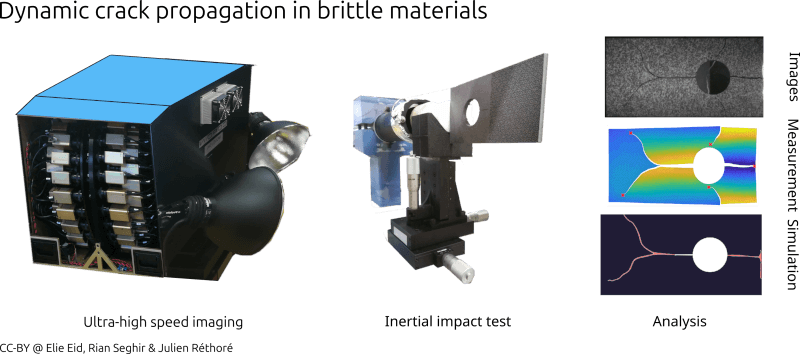
Illustration of an impact test being carried out on a Plexiglas plate to study, using a high-speed camera (up to 4 million frames per second) with high resolution (8 Mpix), the dynamic propagation (up to several thousand km/h). The images are used to measure displacements, analyse them and ultimately build models to simulate this dynamic fracture.
| # | Наименование новости | Тональность | Информативность | Дата публикации |
|---|---|---|---|---|
| 1 | Additive manufacturing: transforming railway maintenance | 0 | 9.18 | 07-07-2026 |
| 2 | Centrale Nantes has been awarded the jury’s special prize at the 2026 Eco-mobility Awards | 0 | 14.69 | 28-06-2026 |
| 3 | Two students from Centrale Nantes have won the 2026 RISC-V national competition | 0 | 12.09 | 24-06-2026 |
| 4 | Launch of the European AIMPERES project: AI to help decarbonise maritime transport | 0 | 13.37 | 21-06-2026 |
| 5 | Redesign of the Protaper Next X2 Rotary Endodontic Instrument | 0 | 9.58 | 29-07-2026 |
| 6 | Biomimetic Design of Artificial Hip Joints Inspired by the Surface of Turtle Shells and Armadillo Scales | 0 | 11.04 | 29-07-2026 |
| 7 | Bamboo in Composite Materials: Applications, Advantages and Processing | 0 | 12.94 | 29-01-2026 |
| 8 | Development of Sustainable Composites for Automotive Applications | 0 | 12.33 | 30-04-2026 |
| 9 | Laser-fused 'glass' motor improves drive efficiency | 0 | 12.31 | 17-03-2026 |
| 10 | Graphene-boosted plastic makes auto parts 20% stronger, 18% lighter | 0 | 12.32 | 18-11-2025 |