Просмотр новости
Найдите то, что Вас интересует
 Спутники
 РН
РН SpaceX
 Роскосмос
 NASA
NASA
СпутникиРНSpaceXРоскосмосNASAThe fusée and chain system is one of those terms in high horology parlance that instantly elevates the status of a given watch. And yet few appreciate the elegance and subtle complexities of this horological contraption that surprisingly predates the invention of the hairspring itself. The need for constant torque A high-performance oscillating system requires a […]
The fusée and chain system is one of those terms in high horology parlance that instantly elevates the status of a given watch. And yet few appreciate the elegance and subtle complexities of this horological contraption that surprisingly predates the invention of the hairspring itself.
The need for constant torqueA high-performance oscillating system requires a somewhat constant power source in order to keep it swinging consistently. This issue relates to isochronism and the insufficiencies of real-world oscillators. For a watch, this means that its precision is, to a degree, dependent on how constant the torque reaching the escapement is.
This is not as easy as one might think. The mainspring stores potential energy in its wound coils, which it then slowly feeds into the gear train as the barrel unwinds. Because of how the system is built, and due to physics-related constraints, the power coming from the mainspring barrel is all but constant.
Ideally, the torque would be linearly decreasing — meaning that the slope of the barrel torque is directly proportional to the arming angle.
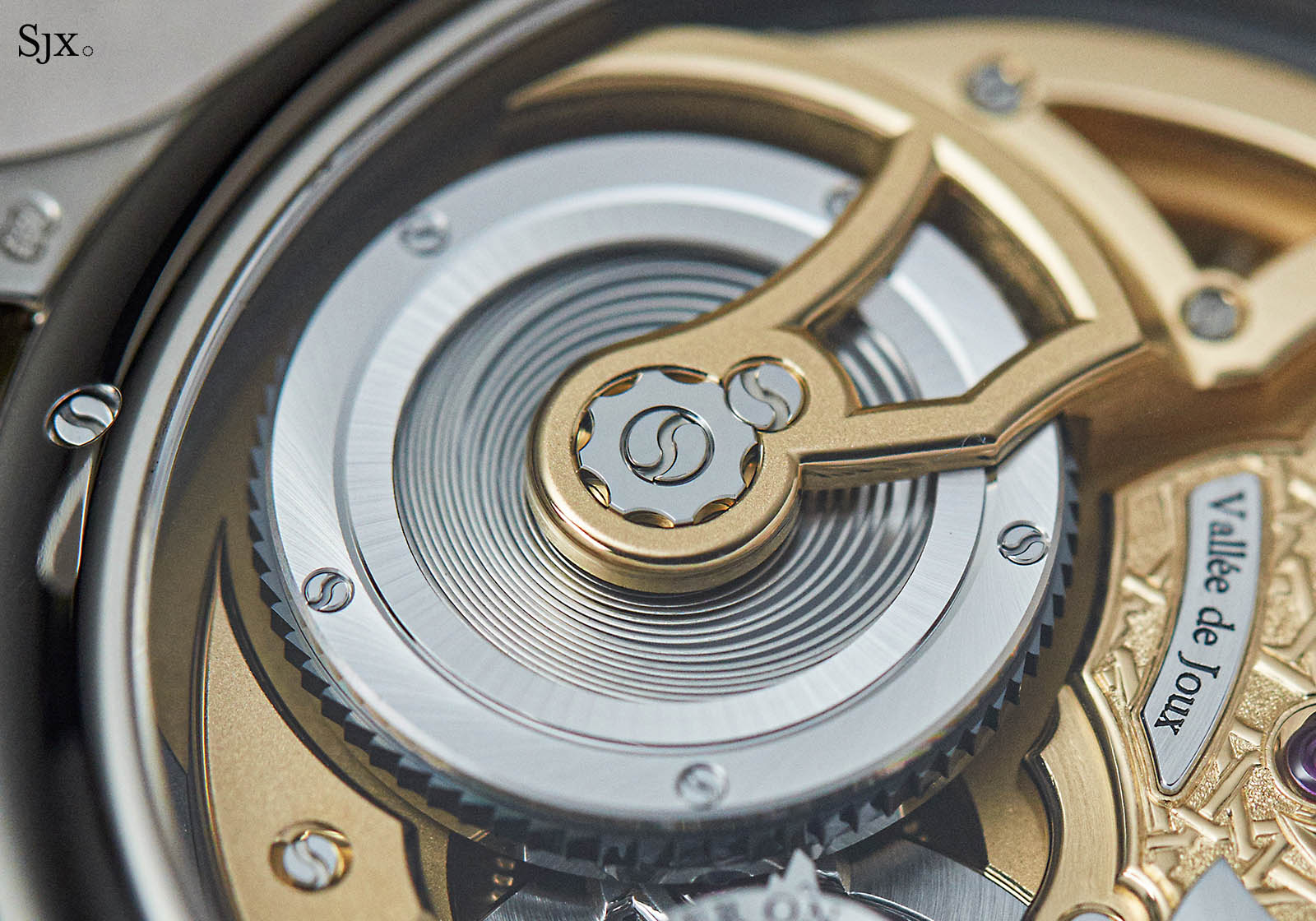
Coiled mainspring inside a barrel.
When a mainspring barrel is fully wound, the torque it feeds into the going train is maximal, sometimes causing the balance wheel to swing too wide and over-bank. As the mainspring unwinds, the torque stabilises to a steadily declining rate. But as the movement enters its last hours of power reserve, the torque from the barrel decreases considerably and more abruptly, causing severe accuracy issues.
Having outlined the behaviour of a mainspring barrel, the solution to inconsistent torque delivery seems almost intuitive: a system that initially eliminates excess torque and then proportionally amplifies it as the mainspring unwinds.
Some historyIt is unclear exactly when the fusee and chain system appeared in watchmaking. There exists a sketch of a crude threaded cone system and pulley drawn by Leonardo Da Vinci in the 15th century, so the basic principles were known even then.
The first spring-powered clocks were only made later in the 16th century — well before the invention of the hairspring in 1675 by Christiaan Huygens. Those early clocks relied on verge and foliot escapements — which were by construction not isochronous and their gross accuracy relied on the constant supply of stable power.
As such, the fusee was developed quite early relative to other horological innovations, since it addressed the primary issue facing clocks and watches at the time. But these early systems were limited by the technologies available, and frequently used rudimentary catgut cords or wire for connecting the cone with the barrel.
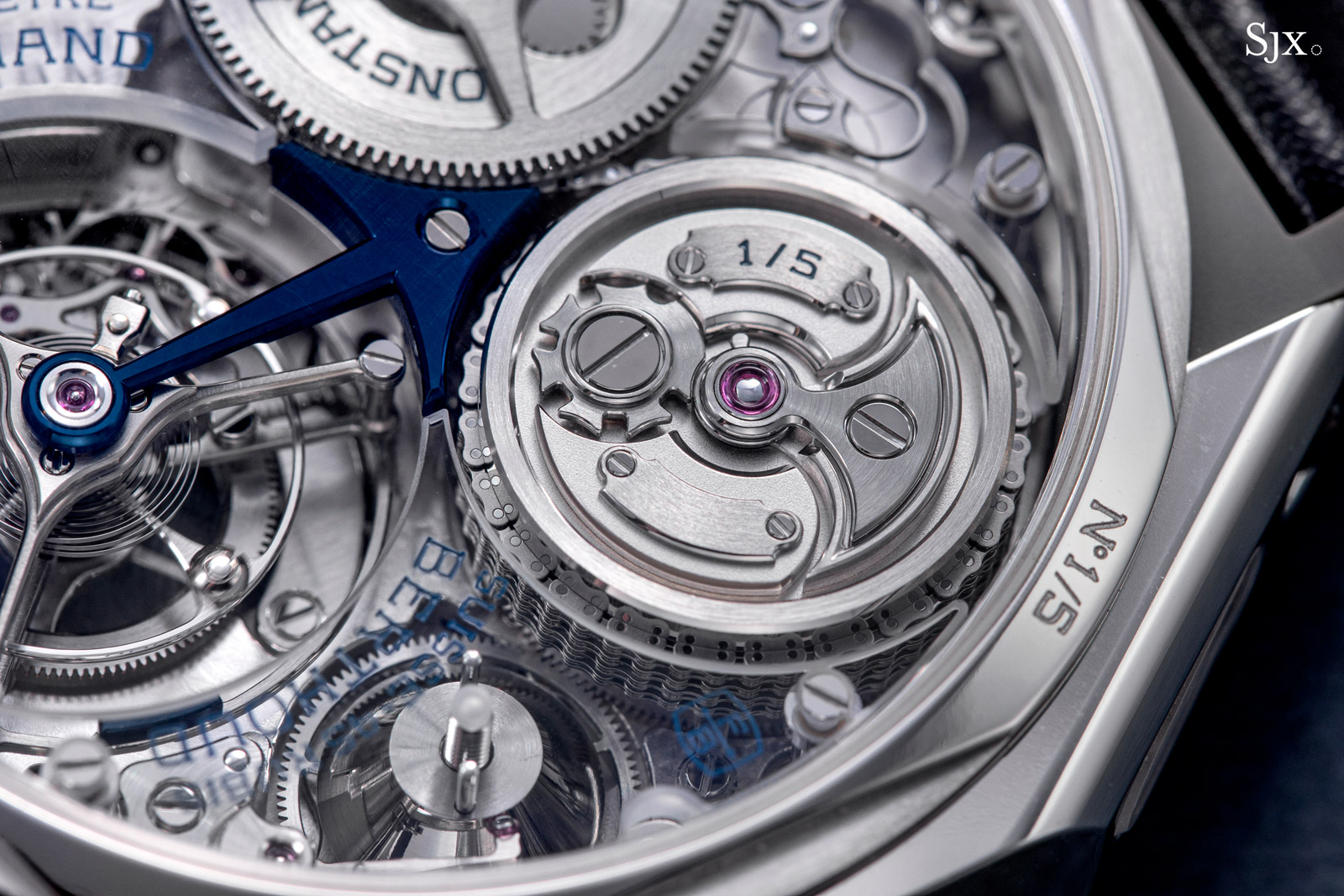
A very modern implementation of the fusee inside a Ferdinand Berthoud FB1.3-1
The fusee and chain system was refined and widely used during the heyday of marine chronometers, when precision was actively pursued by ameliorating every possible source of inaccuracy.
The historic H4 Marine Timekeeper by John Harrison for example features a fusee and chain system and is endowed with a proprietary power maintaining mechanism of Harrison’s own design. Harrison initially invented the maintaining power for keeping a weight-driven clock running when it was rewound, but cleverly adapted the device for use with a fusee. Why such a mechanism is required will be explained later.
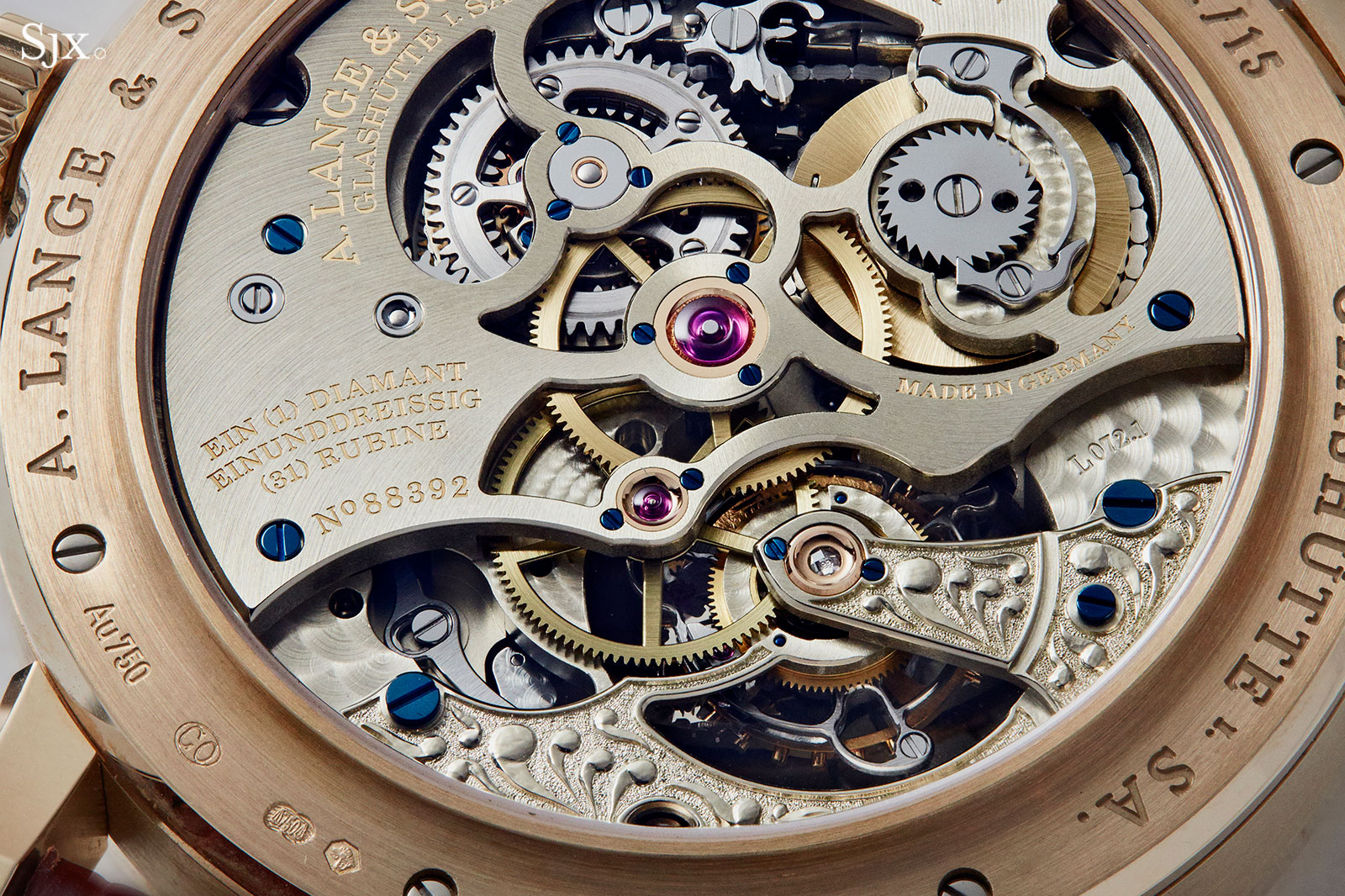
The fusee and chain system eventually made its debut in a wristwatch in 1994, with the ambitious A. Lange & Söhne Tourbillon Pour le Mérite. The sturdy and well-designed architecture of the movement remains a standard for fusee and chain constructions to this day.
Law of leversBy connecting gears (or pulleys), power can be transferred from one axle to another. Power in rotational systems is the product of torque and angular velocity. Assuming no frictional losses, two gears meshed in motion share the same power but each can have different torque and angular velocity values.
This is where transmission ratios come into play. When a large-diameter gear drives a smaller gear, the small wheel naturally rotates much faster than the large one. This increase in angular velocity mandates a proportional decrease in torque, so that the smaller wheel’s power value remains the same as that of the larger wheel.
This basic concept of levers and mechanical advantage is exploited in any mechanical watch’s going train: the escape wheel has a very high angular velocity but feeble torque, compared to the mainspring barrel which turns very slowly but exerts high torque. Once again assuming no frictional losses along the way, the escape wheel theoretically has the same power as the barrel.
ConstructionAlthough difficult to execute, the fusee and chain principle is straightforward enough to grasp. The most prominent component is the cone-like fusee, which can be thought of as a stack of progressively smaller-diameter concentric wheels, with the largest wheel on the bottom and the smallest on top.
The largest wheel engages one end of a very fine chain. The other end of the chain is journaled to the barrel drum. Assuming the power reserve is down all the way, the chain is fully wrapped around the barrel drum and attached to the fusee’s base.
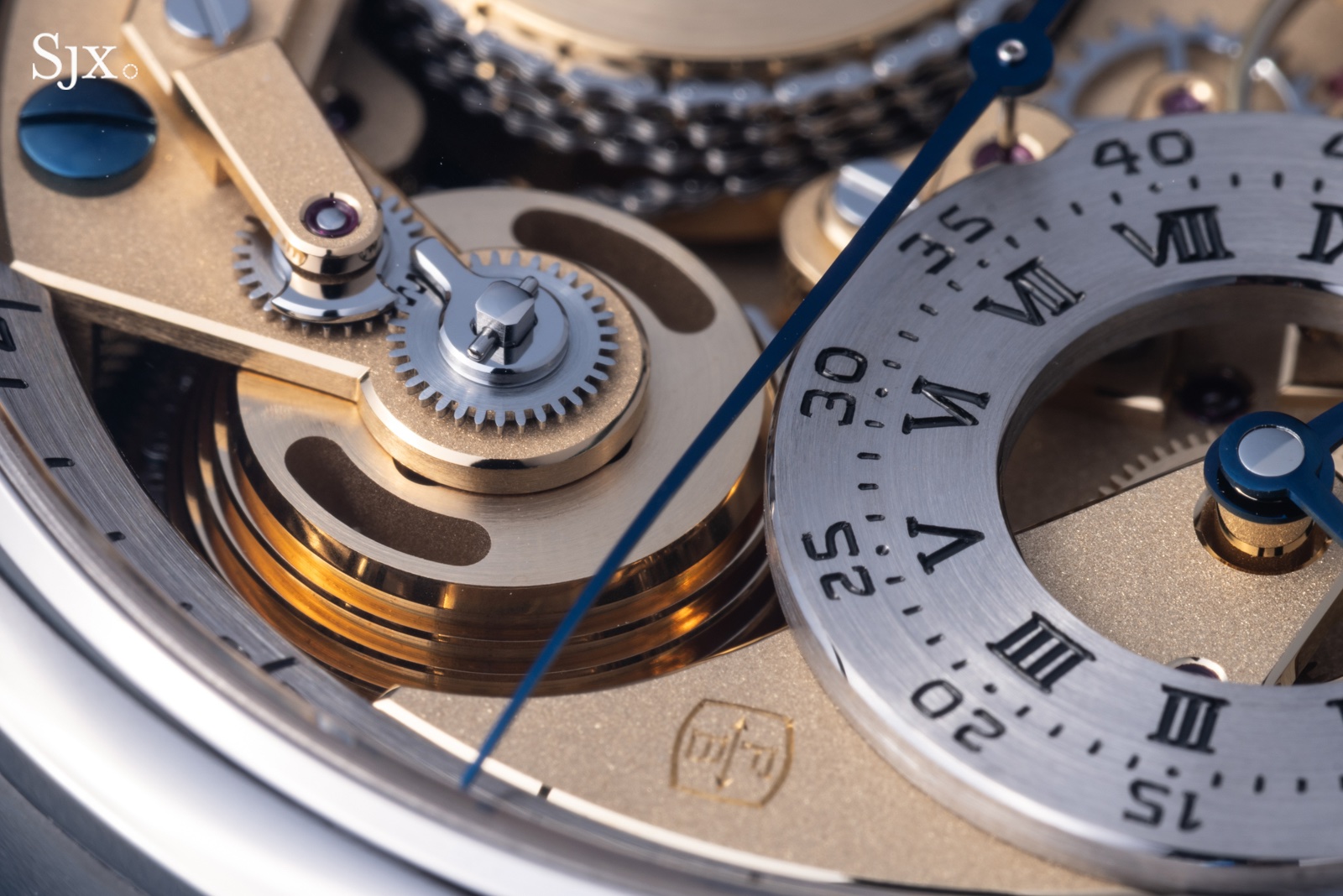
In order to wind such a movement, the user always engages the fusee and never the barrel directly. In a classical movement, winding is accomplished through the barrel arbor, but in this construction the barrel arbor is rigidly fixed to the mainplate.
By turning the fusee, the wearer indirectly winds the mainspring through the pulley system created by the chain. As the movement is wound, the chain coils on the fusee, slowly stepping up the levels. The winding is done when the chain is fully reeled on the fusee and only attached by one end to the barrel drum.
At this point the barrel is fully wound, with the mainspring coiled around the fixed arbour. The fully tensioned mainspring is ready to unwind and turn the barrel in the opposite direction, thus also engaging the fusee and making the movement run. The first wheel of the going train is fixed co-axially to the fusee cone, and connects to the centre pinion in the same fashion a classical toothed barrel drum would.
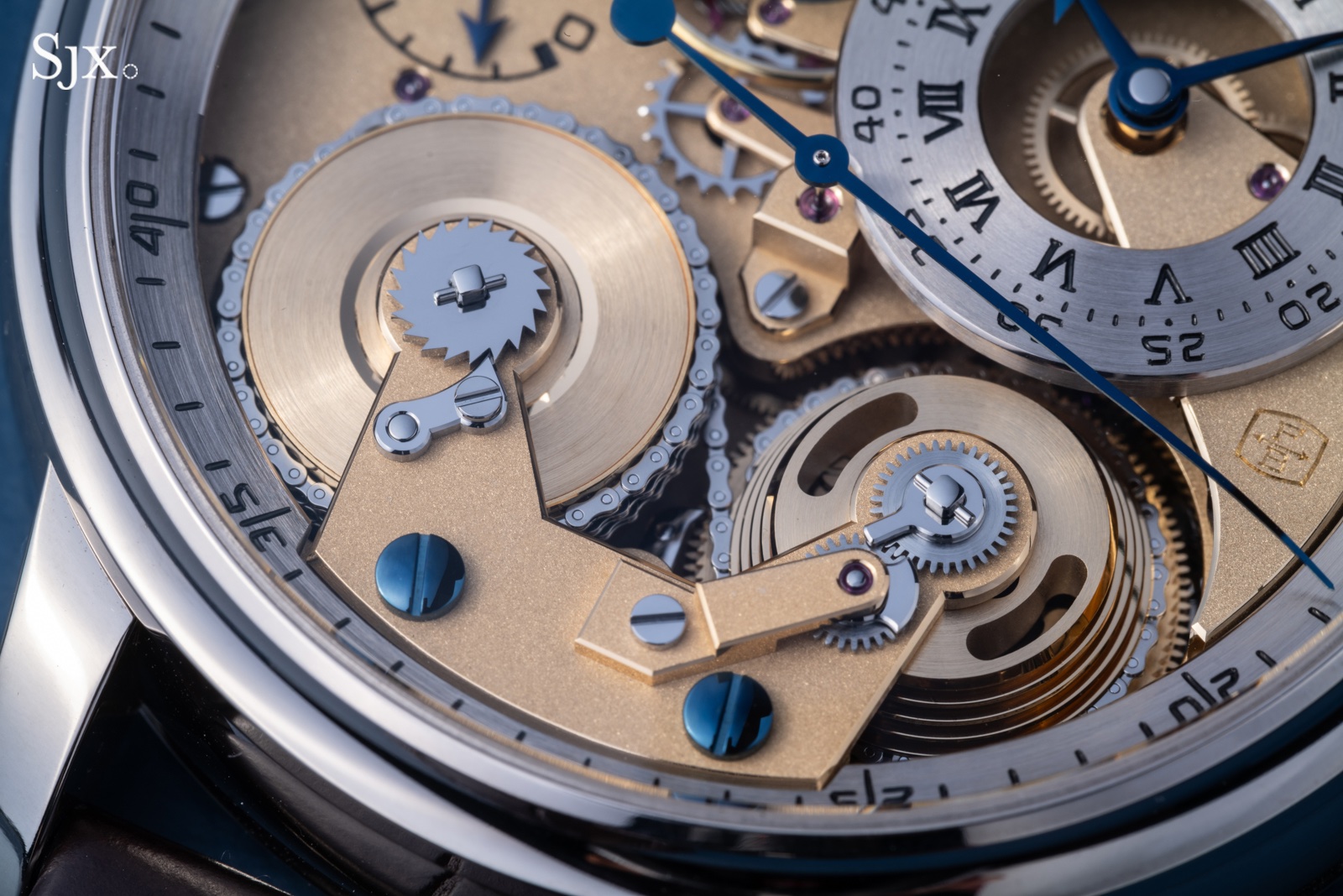
As the watch starts to run, the barrel exerts its maximum torque through the chain onto the fusee. Since the chain tugs on the smallest wheel in the cone, the actual torque reaching the going train is diminished — a “high gear” effect. The fusee’s angular velocity is set by the escapement, so this means the barrel doesn’t have a constant unwinding speed. The barrel initially unwinds at a slow pace.
As the movement continues running, the chain reels off the cone. While the torque exerted by the barrel weakens, the lever arm increases. The torque reaching the going train is more or less equal and the barrel unwinds at a progressively faster pace.
As the movement reaches its final hours of power reserve and the barrel is almost depleted, the mechanical advantage increases accordingly, as the chain reels off the cone’s base. The barrel turns faster while delivering increasingly more feeble torque, which is conveniently compensated by the lowest levels of the fusee. This is equivalent to a low gear on a bicycle.
The result of this variable transmission between barrel and fusee is an almost constant torque flow to the escapement. But because the mainspring’s torque decline rate is not truly linear, the fusee shape needs to be tailored accordingly.
The torque from the barrel declines unevenly, so the fusee needs to account for this variance. That’s why the stepped profile of the fusee resembles a distinct hyperbolic curve.

Hyperbolic profile of the fusee. Figure adapted from‘Théorie générale de l’horlogerie’, Vol. 1, Léopold Defossez.
Fusee cones in older examples had a sharper and higher profile, to account for the large variance in spring power. Modern springs are more constant due to new materials and manufacturing techniques, so the cones we see on modern pieces tend to be flatter in profile relative to their historical counterparts.
Deducing the exact shape of the fusee from the torque decrease slope of the mainspring is a mathematical affair comprising integral calculus, so getting a fusee and chain to work optimally is not very simple.
Early examples were crafted empirically, but the most optimal shape is a hyperboloid — the three-dimensional equivalent of a hyperbolic curve. The groove that allows the chain to be seated neatly follows a helix with a decreasing radius.
The going fuseeThe keen reader might have noticed from the description of the fusee how the entire going train would theoretically reverse during winding. If a plain fusee is used that would indeed be the case. Such a reversal would disrupt the movement’s running and possibly break certain escapement types — like the fragile detent escapement. The solution is what’s known as a ‘Harrison maintaining power’.
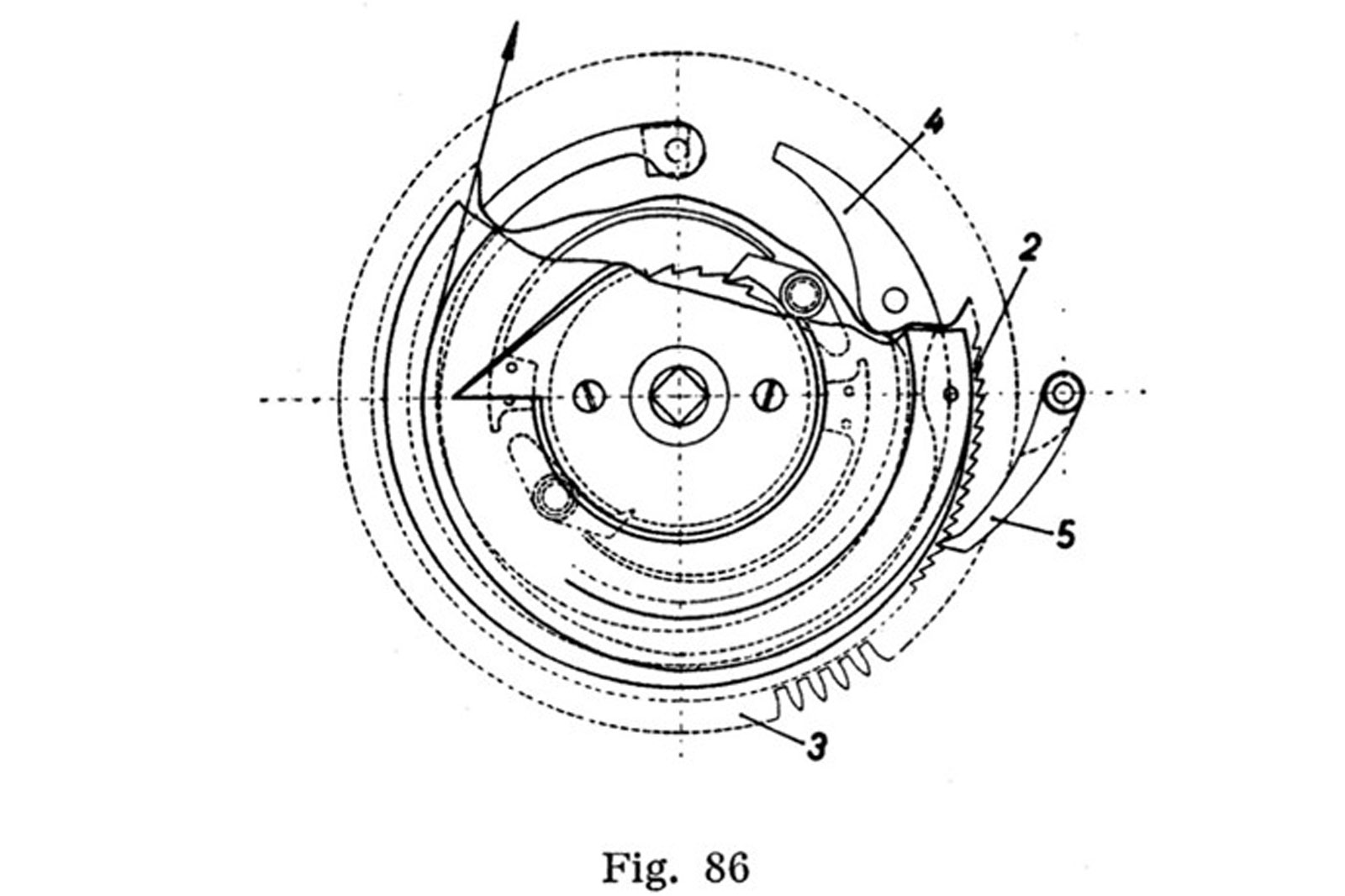
Harrison-style fusee maintaining power. Figure adapted from ‘Théorie générale de l’horlogerie’, Vol. 1, Léopold Defossez.
The maintaining power mechanism is inserted between the fusee cone and the first wheel of the going train. When the fusee is wound and reverses, the maintaining power device engages instantly and temporarily feeds power to the going train, until winding is completed.
We covered this complex system in-depth when exploring the F.P. Journe Centigraphe. F.P. Journe cleverly adapted Harrison’s power maintaining device for use in double-ended barrels, which are employed in both the Centigraphe and Grande Sonnerie collections.
There is another way of keeping the movement running while the fusee is wound and reversed: a differential gear set. The implementation of differential gears in winding systems first appeared in weight-driven clocks to address differently the same problem solved by Harrison’s elaborate maintaining power. More recently, such a winding system was adapted for wristwatch by Stephane von Gunten for his brand Haute-Rive. We went in-depth with the Haute-Rive Honoris, explaining how the differential winding effect works.
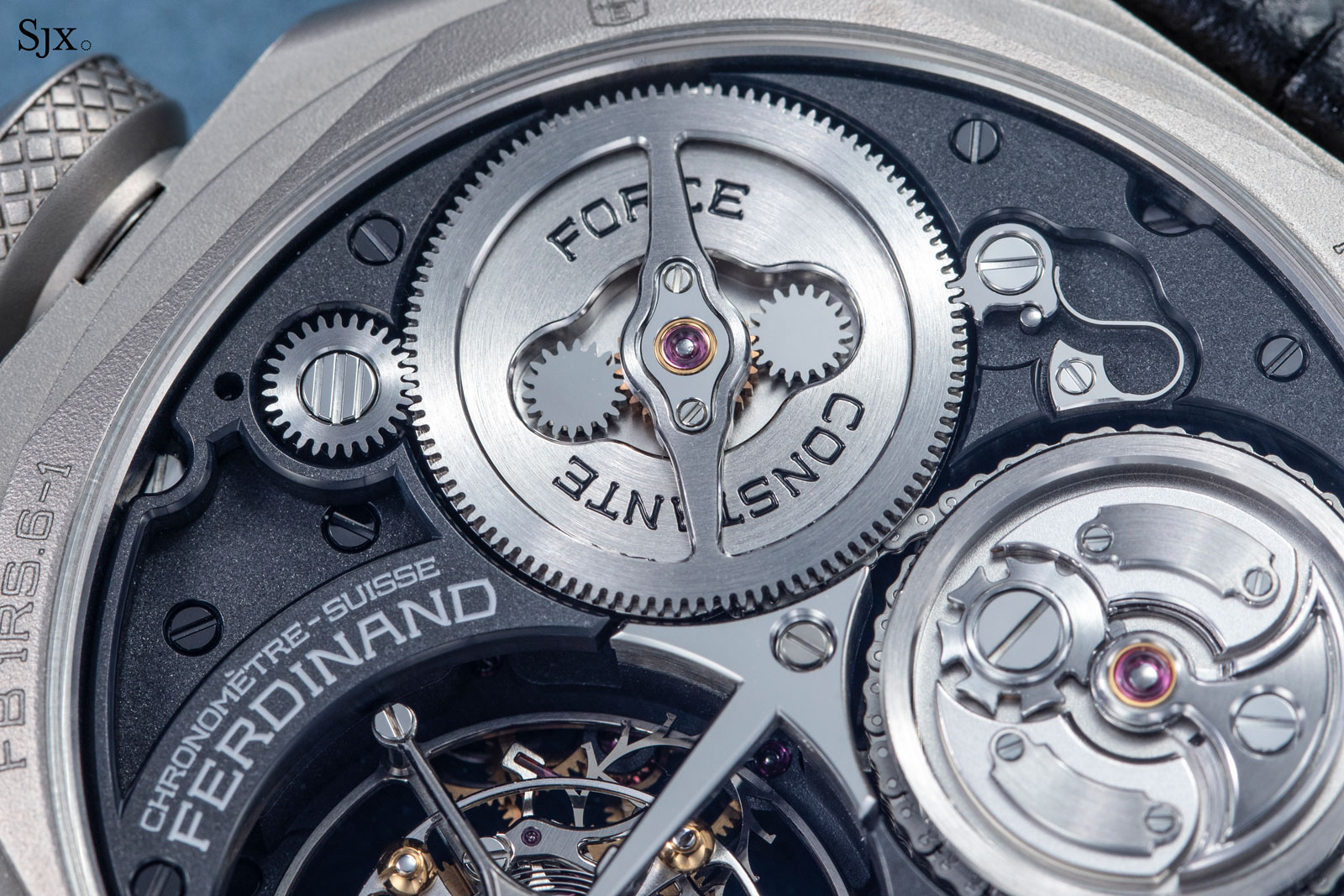
Differential gearset on an inverted fusee.
In brief, the differential acts as a three-way node, with torque balanced between three inputs and outputs. As such, even though the cone reverses direction during winding, the torque generated by the spring’s resistance still flows through a pair of satellite pinions to the going train. When the winding ends, the system locks and power is transmitted normally.
A. Lange & Söhne favours the differential system, as did Ferdinand Berthoud in the brand’s early iteration of the mechanism inside the FB-T.FC family of movements.
Most other fusee and chain wristwatches on the market today, like the Breguet Tradition 7047 and the Zenith Academy Georges Favre-Jacot, rely on classic maintaining power devices. Ferdinand Berthoud also switched to a classic maintaining power construction in last year’s Naissance d’une Montre 3.
Safely implementsThe fusee and chain may be a solution to one problem, but like any complex system it raises some other issues. In this case, there are a few very particular safety devices that need to be implemented to ensure the fragile system works well and that the chain is never over-tensioned.
In simple barrel constructions, overwinding can be prevented with the use of a slipping bridle mounted on the mainspring, which allows the fully wound spring to disengage from the barrel. With the fusee and chain, there is a point at which the pulley will simply bind if the movement is over-wound. This risks dislodging, or worse, snapping, the chain.
As such, some sort of safety implement is needed, so that the wearer is prevented from winding the system beyond a certain point.
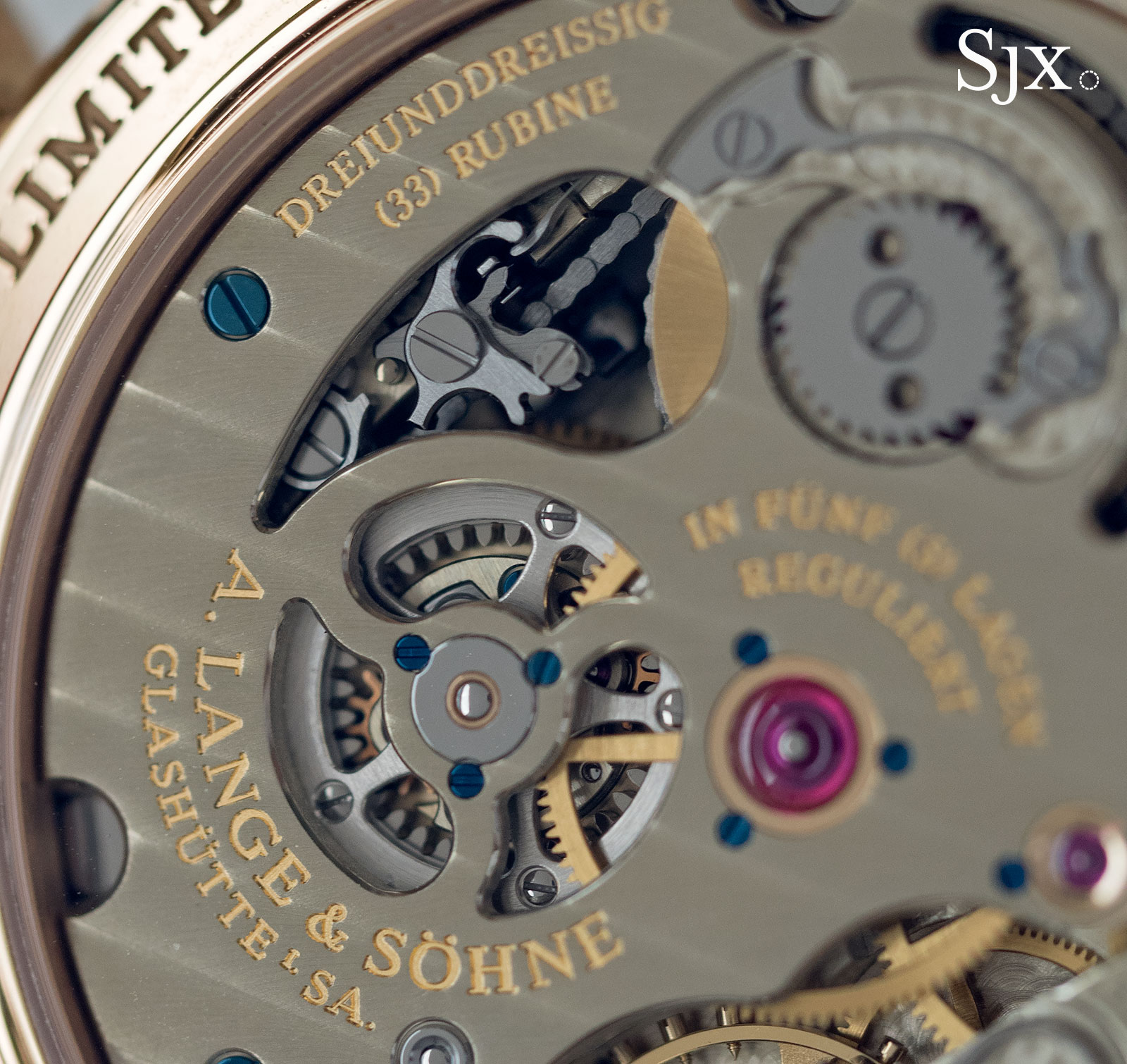
Cut-out showing the elaborate winding stop finger used by A. Lange & Söhne.
In the A. Lange & Söhne construction, there is a special rivet on a certain link of the chain, which when reaching a critical point engages a finger that locks onto the ratchet wheel. This sudden stoppage signals to the wearer that the watch is wound enough.
A similar, if slightly simplified, safety is implemented in the Zenith Academy Georges Favre-Jacot. A finger is fixed on the cone itself and remains inactive until the chain reaches the top of the fusee. A small cutout allows the links to press on the finger as they tighten, making it latch on the supporting bridge.
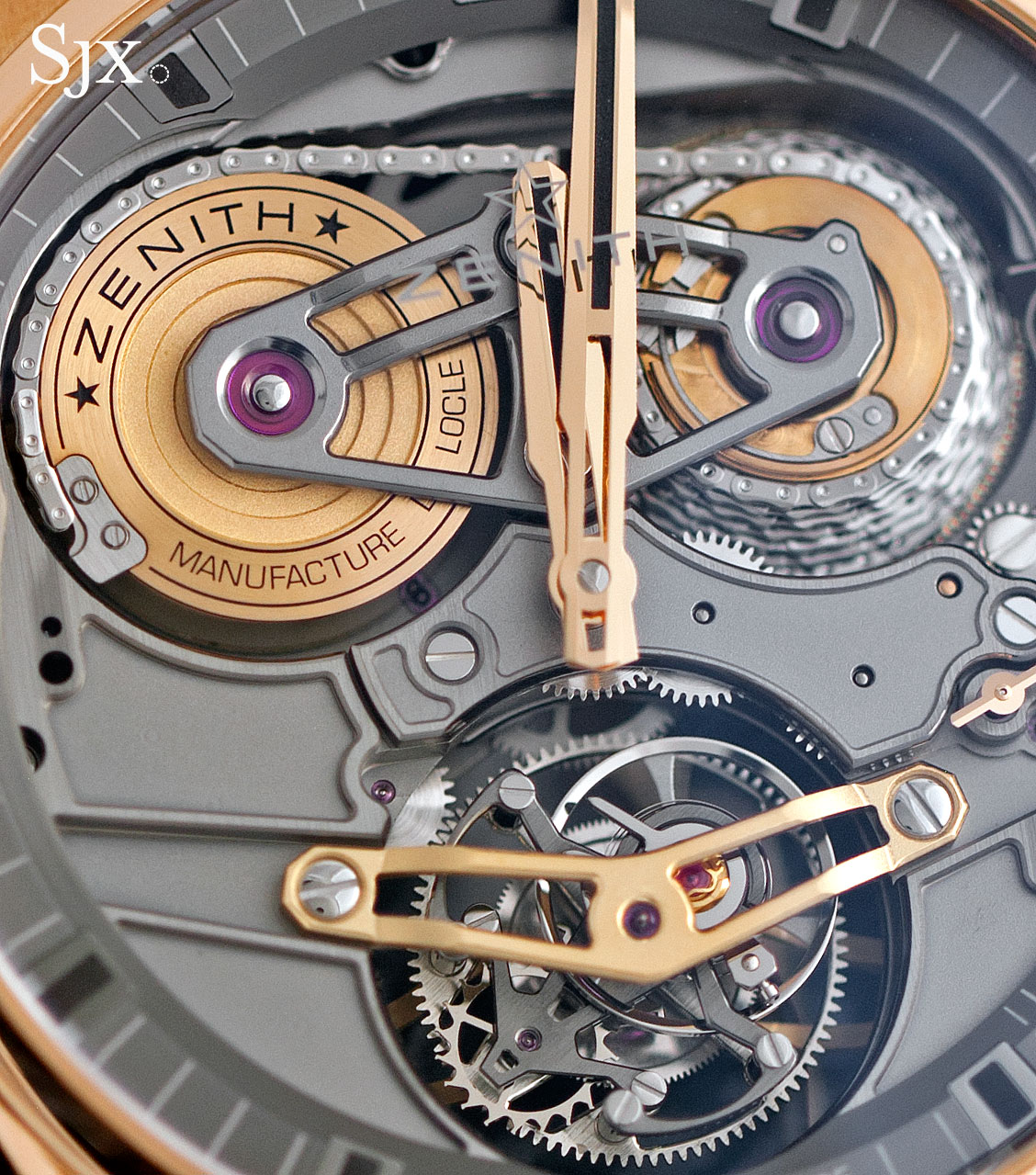
Zenith Academy-Georges Favre Jacot Tourbillon with a dial-side fusee.
Breguet went for a different, but equally reliable system inside the Tradition 7047. There is a small Maltese cross sitting at the base of the fusee. As the fusee turns, a finger advances the cross piece in steps. There is another finger on the cross itself and after a certain number of turns it locks on the fusee’s finger, preventing further rotation.
There is also the issue of the barrel fully unwinding, allowing the chain to slack off and possibly not rewind properly. As such, the unwinding of the barrel needs to be limited. Breguet’s particular setup looks to be working both ways, so it locks the fusee again after the same number of turns as when it was initially wound.

The safety mechanism inside the Breguet Tradition 7047. Image – Breguet.
The A. Lange & Söhne construction relies on an elaborate system linked to the power reserve mechanism, which stops the movement towards the end of the running range. The system does not act directly on the fusee, but downstream on the going train.
The simplest approach to the matter was taken by Ferdinand Berthoud. Instead of locking the fusee component, they added a Maltese cross stop work on the barrel, directly limiting its number of turns.
This means that the movement halts before the barrel is almost depleted while the system also prevents further winding after a certain point. However, since the barrel is locked instead of the fusee, the wearer can still tug directly at the chain.
As far as I can tell there is no implement to prevent that from happening. Ferdinand Berthoud claims their chain to resist to almost 12 kg-force, so presumably the wearer won’t be able to damage it easily. Other brands advertise between 2 and 3 kg-force tensile strengths.
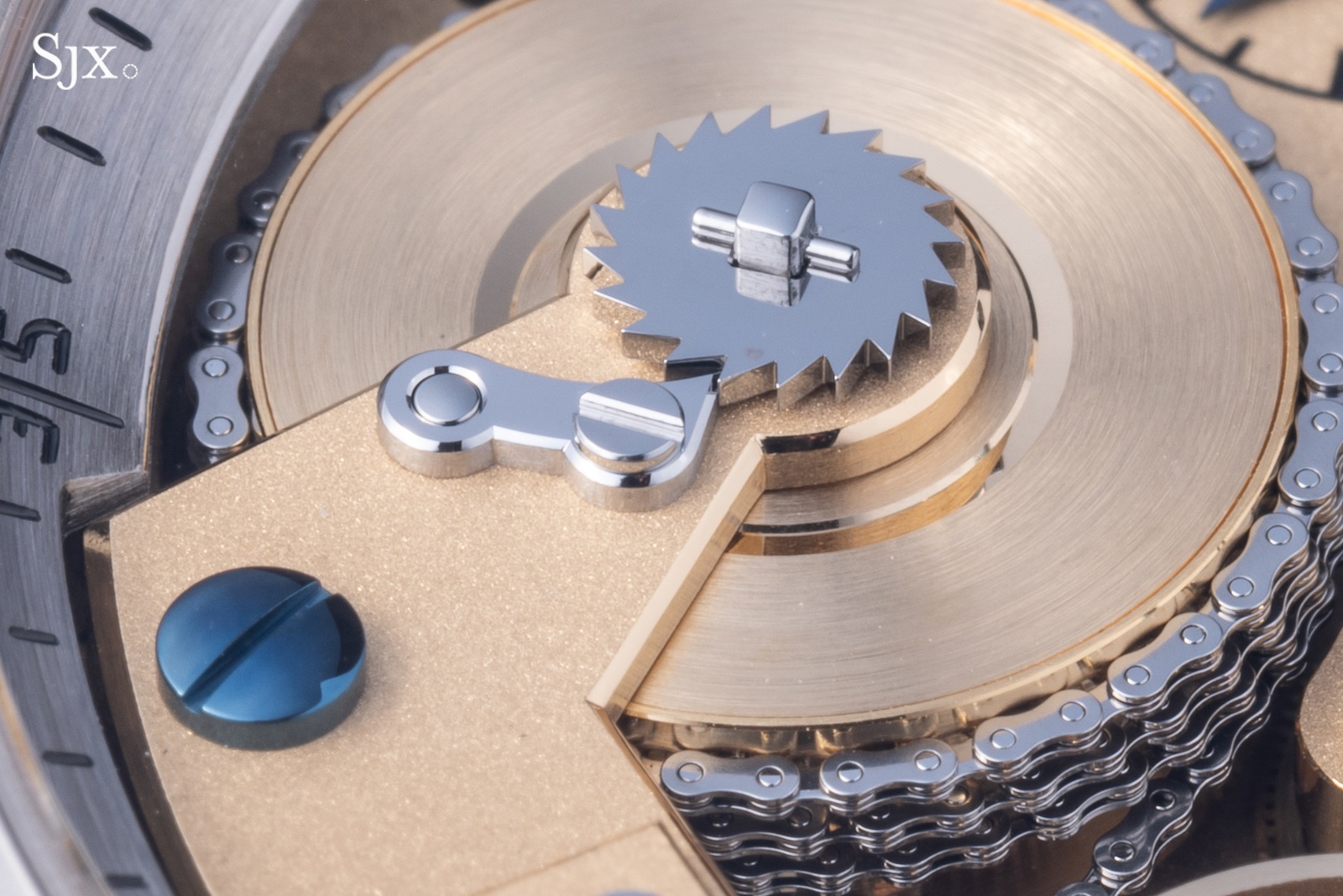
Pinned ratchet for the barrel, used not for winding but to adjust the tension of the chain.
One last subtlety of fusee and chain constructions is the proper chain tension between the fusee and barrel. As mentioned, the mainspring arbour is fixed to the mainplate and doesn’t move. However, it’s not bolted and can usually be adjusted after assembly to ensure there is no unnecessary slackness in the chain.
Usually a locking ratchet is used by the watchmaker to adjust the slackness in the chain after assembly. This explains the design of the movement inside the Richard Lange “Pour le Mérite” which uses a normal sprung click on the ratchet, which to a layperson looks like a simple winding click.
Other curious constructions and concluding thoughtsBefore ending our exploration of fusee and chain systems, there are a couple of other interesting constructions that should be mentioned.
The first is Christophe Claret’s Angelico Tourbillon, a short-lived series that featured a detent escapement, tourbillon and a fusee and cord — not a chain, but a Dyneema fibre cable joining the cone and barrel.

The Angelico Tourbillon movement. Image – Christophe Claret
Dyneema is a high tensile strength composite that is usually found in all sorts of sports and performance-related applications. One could argue that using it for a fusee is overkill — which it is — but it remains an interesting echo of the earliest catgut string fusee movements.
The second interesting modern take on the fusee is the Romain Gauthier Logical One. Instead of having multiple lever ratios stacked vertically, the Logical One relies on a flat, snail cam component. A much shorter chain is journaled to the large lever arm at one end; at the other it is indirectly linked to the barrel.
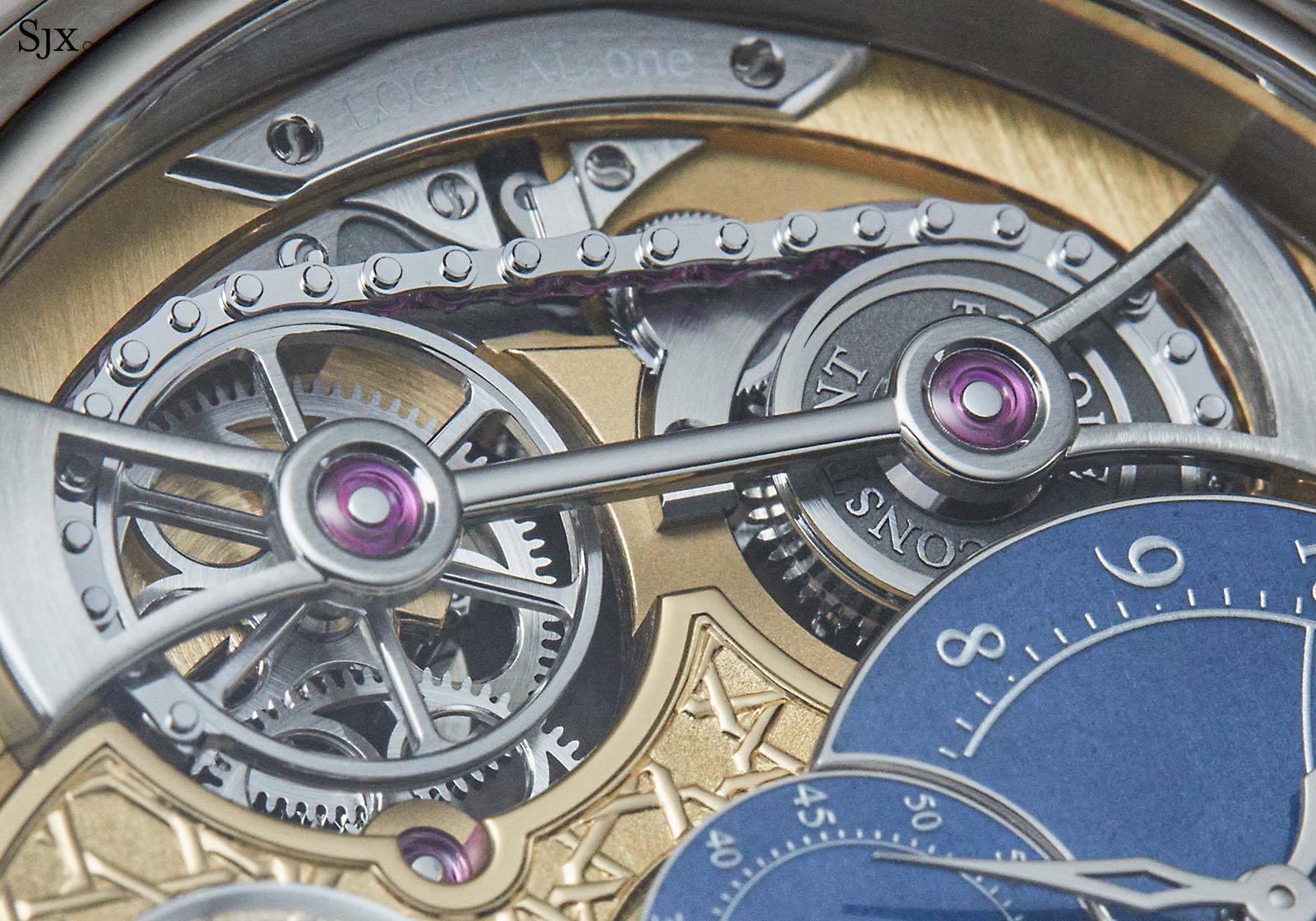
When the watch is fully wound, the chain is wrapped around the entire cam’s profile. At any given moment the chain’s pull is tangential to the cam’s surface. As the movement unwinds, the cam’s radius increases so the lever arm increases — much like in a normal fusee.
Although new mainspring materials have largely reduced the need for complex constant-force devices, the fusee and chain retains a compelling mechanical elegance rather that pure necessity. Today it is found only in artisanal watchmaking — a deliberate statement of craft and ingenuity and less of a functional requirement. In that sense, it serves as a reflection of high horology itself: a discipline that is not purely about telling the time.
| # | Наименование новости | Тональность | Информативность | Дата публикации |
|---|---|---|---|---|
| 1 | Hands On: A. Lange & Söhne Lange 1 Tourbillon Perpetual Calendar “Lumen” | 0 | 19.18 | 16-07-2026 |
| 2 | Retrospective: A. Lange & Söhne Zeitwerk Handwerkskunst | 0 | 19.39 | 01-01-2026 |
| 3 | The Uber-Lange 1 Gets the “Lumen” Treatment | 0 | 25.29 | 14-04-2026 |
| 4 | A Unique A. Lange & Söhne Grand Complication Emerges | 0 | 22.5 | 26-05-2026 |
| 5 | Conversations: Lange CEO Wilhelm Schmid on Capacity and Limited Editions | 0 | 20.29 | 13-05-2026 |
| 6 | Hands On: A. Lange & Söhne Cabaret Tourbillon Honeygold | 0 | 19.27 | 16-05-2026 |
| 7 | Hands On: A. Lange & Söhne Saxonia Annual Calendar | 0 | 21 | 30-04-2026 |
| 8 | In-Depth: IWC’s ProSet Perpetual Calendar | 0 | 23.13 | 21-07-2026 |
| 9 | Eighties Luxe: Piaget Polo 79 Two-Tone | 0 | 21.45 | 28-01-2026 |
| 10 | Hands On: Piaget Polo Signature Date | 0 | 18.69 | 04-05-2026 |