Просмотр новости
Найдите то, что Вас интересует
 Спутники
 РН
РН SpaceX
 Роскосмос
 NASA
NASA
СпутникиРНSpaceXРоскосмосNASAIWC’s history was dotted with landmark innovations such as Albert Pellaton’s pawl winding system, Kurt Klaus’ famous perpetual calendar, and Richard Habring’s split-seconds chronograph module. Though IWC has arguably been thin on such innovation in recent years, the ProSet perpetual calendar is a long overdue return to form. The calendar’s clever features make it true […]
IWC’s history was dotted with landmark innovations such as Albert Pellaton’s pawl winding system, Kurt Klaus’ famous perpetual calendar, and Richard Habring’s split-seconds chronograph module. Though IWC has arguably been thin on such innovation in recent years, the ProSet perpetual calendar is a long overdue return to form.
The calendar’s clever features make it true to IWC’s identity as an engineer’s manufacture. Set entirely via the crown just like the Kurt Klaus calendar, ProSet can also be adjusted forwards and backwards, making it both idiot-proof and convenient.

This bidirectional perpetual calendar module made its debut earlier this year at Watches & Wonders inside the Big Pilot’s Watch Perpetual Calendar ProSet, which blends the manufacture’s latest engineering feat with the beloved styling of the pilot’s watch. The ProSet system is currently only available inside the 42 mm Big Pilot. Powered by a downsized base calibre, the 42 mm ProSet is the first Big Pilot under 46 mm to include a perpetual calendar.
IWC has a tweaked and scaled down the its signature Kurt Klaus module in the past for the 42 mm Portugieser and some Portofinos, but somehow it never made into the reduced Big Pilot collection.

Unfortunately, these smaller watches lacked the now-iconic digital year display, and instead featured a subtler (but more forgettable) leap cycle aperture. The ProSet brings back the four-digit year display, making this watch almost indistinguishable from the original 46 mm version. Apart from some styling choices, the main difference in the displays is the lack of a power reserve indicator.
The cal. 82665 inside the ProSet is powered by a single mainspring barrel that supplies enough energy for a 60-hour power reserve. Although a step down in terms of complexity from IWC’s seven-day movements, this platform still enjoys modern features including the Pellaton pawl winding system (in full ceramic) and a free-sprung balance.

However technically advanced cal. 82665 is, it still leaves the impression of an industrial and sightly rough movement. IWC has lowered the overall quality of their movements in recent years — presumably as a cost-cutting measure. The best examples are the latest entries in the seven-day cal. 52000 movement family, which now lack Breguet overcoils, feature pointless faux balance bridges and are finished to a lesser degree.
Similarly, cal. 82665 inside the ProSet feels rough around the edges, although the industrial finish is sufficiently tidy. A big indicator of the quality step-down is the cheap hairspring stud. Past versions of the 82000 series featured a more refined stud with a locking cap, which ensured long-term stability of the regulator.
Yet despite these shortcomings, the overall package remains difficult to dismiss. Although the aviation-inspired design is decidedly instrument-like, the presence of a traditional haute horlogerie complication and the optional 18k pink gold case elevate the watch. The Big Pilot ProSet is also available in ceramic and steel — in this latter configuration, the ProSet offers a compelling value proposition.
IWC and calendarsIWC’s love affair with perpetual calendars started in 1985 with the introduction of the Valjoux 7750-powered Da Vinci Perpetual Calendar Chronograph. A landmark watch of the post-Quartz Crisis era, the Da Vinci featured a fully synchronised perpetual calendar that was operated solely through the crown.

Kurt Klaus’ Da Vinci perpetual calendar module was immediately recognisable by its four-digit year indicator.
Prior to the debut of the Da Vinci, perpetual calendars relied on case pushers for setting the various indications, of which there are many. Pushers make sense for a few reasons. First, it’s impossible, or at least tedious and impractical, to set all calendar indications through a single three-position crown. But pushers require extra holes in the case, and can be damaged if the user attempts adjustment with anything other than the included stylus.
Kurt Klaus joined IWC in the late 1950s and worked under the famed technical director Albert Pellaton. Mr Klaus rose to fame came with the introduction of an ingenious perpetual calendar module, which was initially engineered to fit over stock movements such as the Valjoux 7750 platform and other ETA calibers.
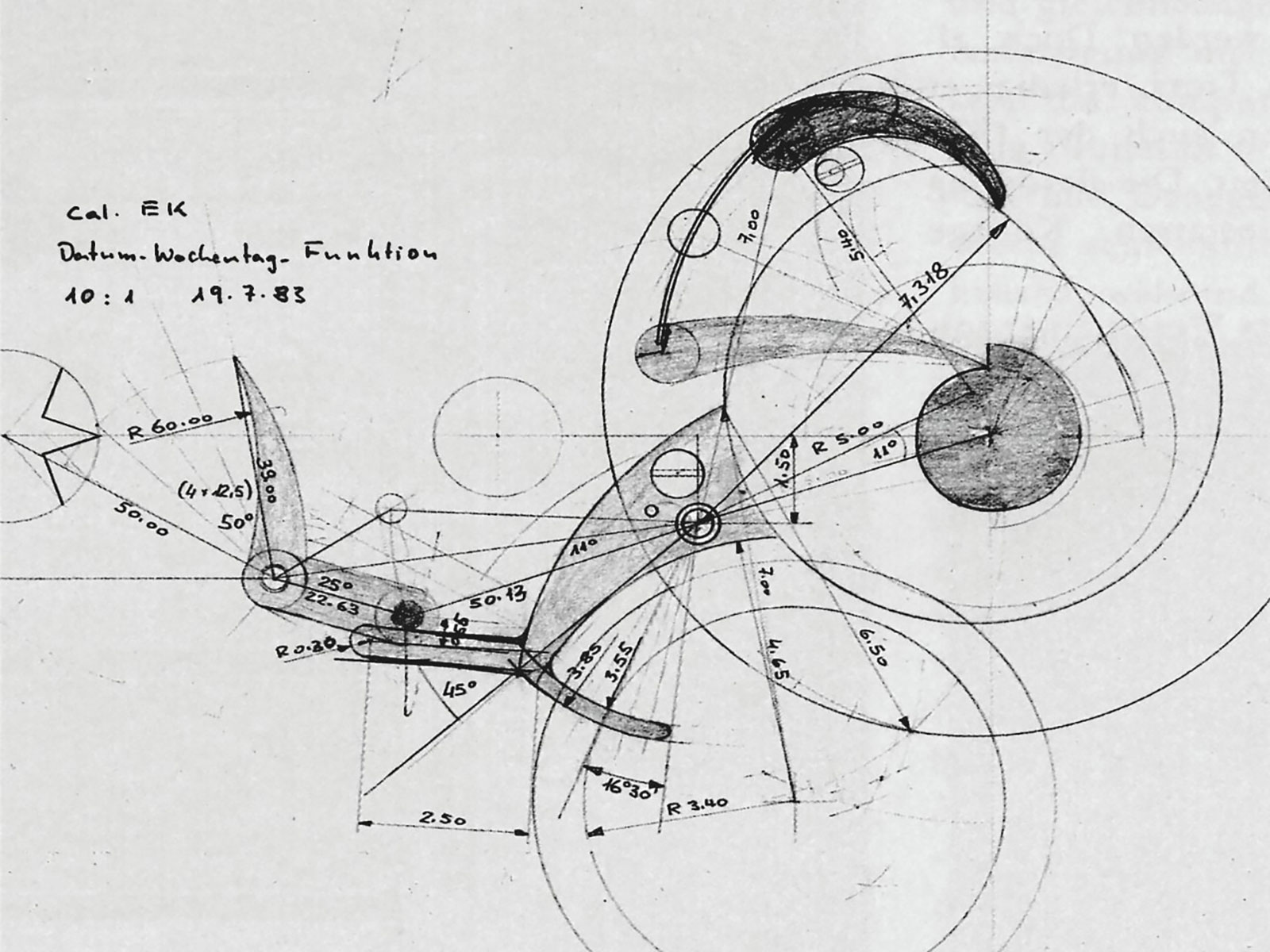
Hand-drawn sketch for the original Da Vinci perpetual calendar module.
Crucially, Mr Klaus’ module was operated solely through the crown — as easy as setting a simple date. The trick behind this mechanism lay in how all the indications were synchronised together. By simply setting the date, the other indications updated automatically.
With the ProSet, IWC makes another meaningful contribution to the field of perpetual calendars. Interestingly, despite its apparent similarity to the Kurt Klaus design — with its crown-based interface and four-digit year indicator— the ProSet design is entirely new, borrowing little from anything the manufacture has launched in the past.

To understand why the ProSet is an important advancement in the field first requires an understanding of its technical lineage. The majority of perpetual calendars on the market — the Kurt Klaus construction included — rely on the classic grand lever and month cam design.
The delicate interaction between these components means that such complications are notoriously fragile, and can only be adjusted forward. This forward-only constraint is among the less glamorous realities of owning a perpetual calendar.
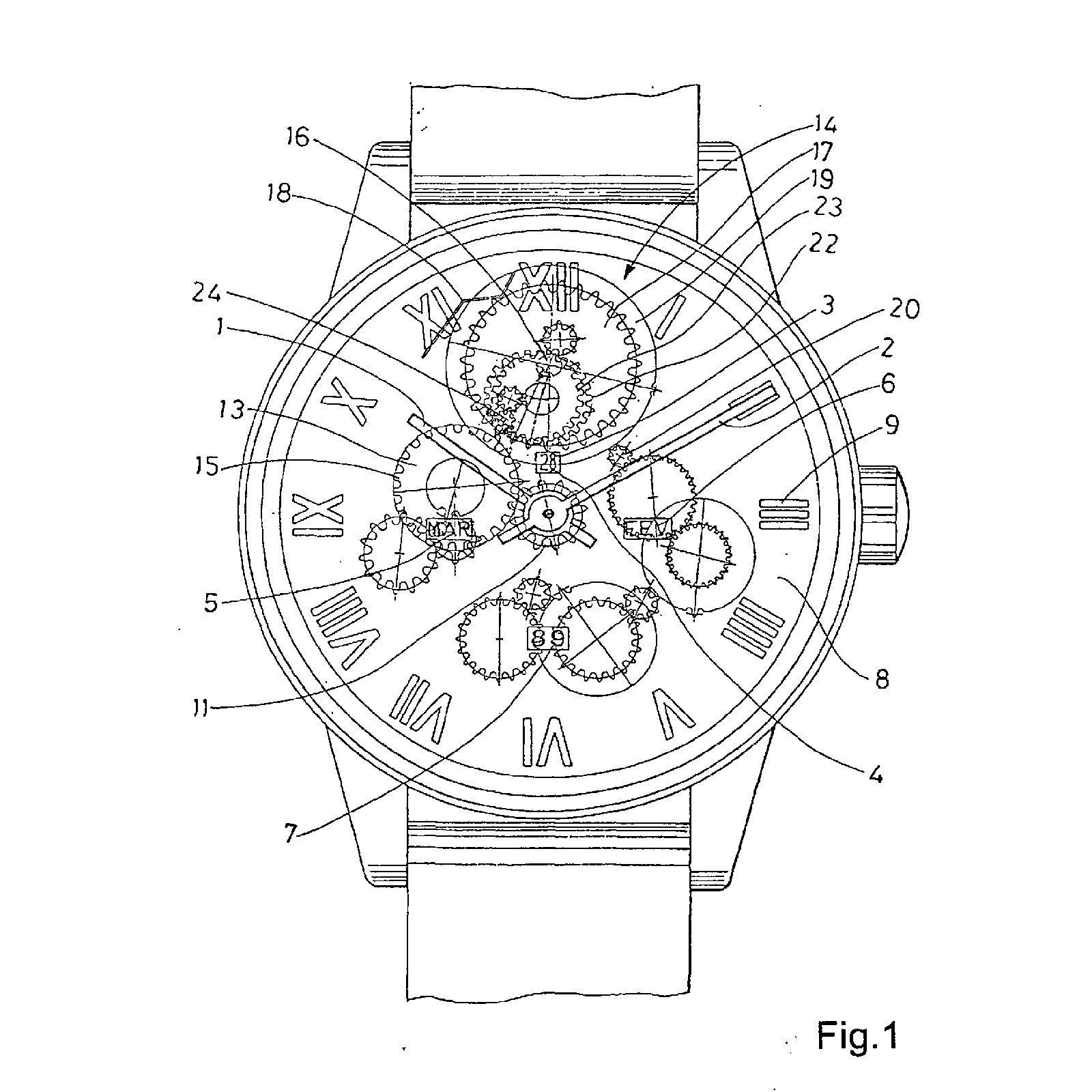
Figure extracted from patent EP1351104B1 detailing the gear-based perpetual calendar.
Things changed in 1996, when Ulysse Nardin launched a revolutionary perpetual calendar developed by Dr Ludwig Oechslin. Leaning on his intimate knowledge of astronomical complications and experience with unconventional mechanisms, Dr Oechslin fundamentally rethought the perpetual calendar, doing away completely with levers and cams.
Dr Oechslin’s calendar was based solely on epicyclic gears. The concept relied on the cyclical nature of the calendar — the same succession of 12 months each year, same succession of four years in one leap cycle. As such, a gear-based mechanical counter should be able to reliably track the calendar by simply calculating the exact transmission ratios.
By bending the rules of gear engagement, Dr Oechslin managed to design a complex yet viable mechanical calendar that could be set both forward and backward, which relied on gears with selectively cut teeth to allow the date wheel to jump over multiple steps at once, depending on the month’s length.
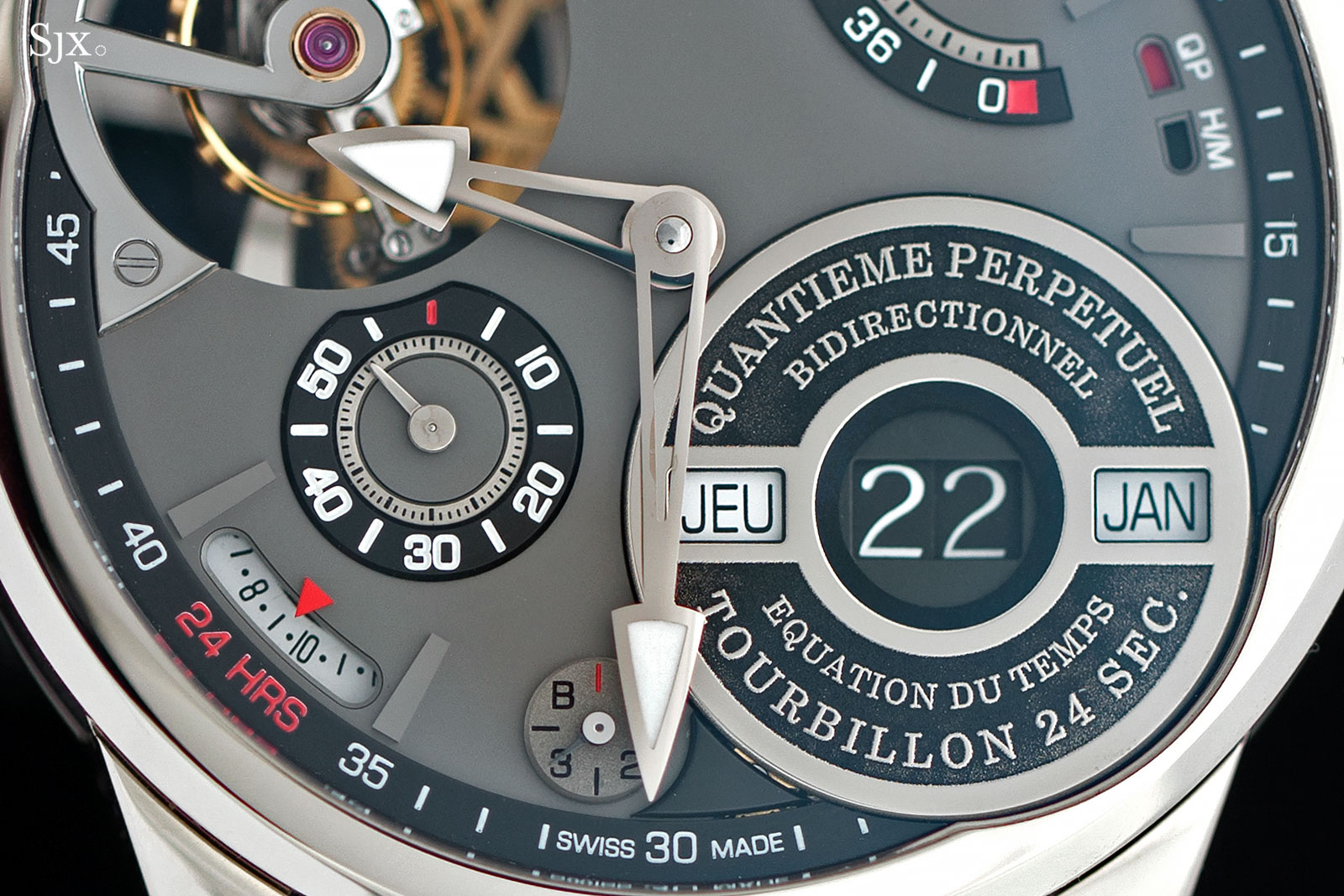
The Greubel Forsey Quantième Perpétuel à Équation.
Wondrous as the concept was, Dr Oechslin’s calendar proved slightly impractical to produce and repair, which meant the design never really took off. The liberal use of cut teeth, mismatched gear modules and overlaps put strain on some of the smaller pinions and made servicing the pieces difficult.
The idea of using gears and retractable teeth was later improved upon by Greubel Forsey (GF) with the Quantième Perpétuel à Équation launched in 2015 and revisited with 2025’s QP Balancier. Citing Dr Oechslin’s work, the team at GF patented an improved design which added cams to the mix of epicyclic gears and reduced the number and variety of wheels involved. But given GF’s limited volume, this patented breakthrough hasn’t had wider impact.
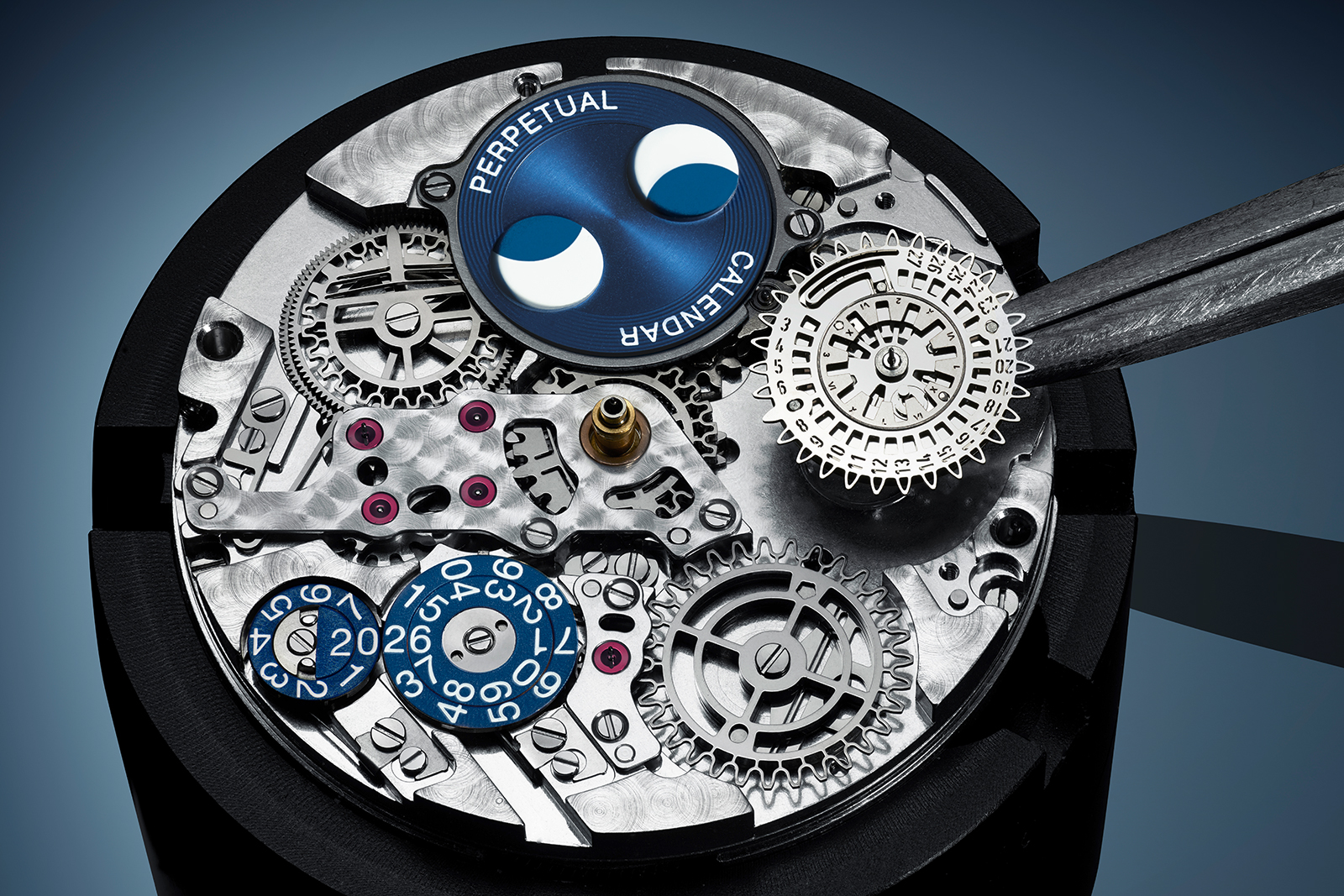
The ProSet module. Image — IWC
In this context, IWC’s ProSet might just be the first alternative perpetual calendar to combine user-friendliness and secure bidirectional setting that can be realistically produced at scale. The Kurt Klaus module was used in the past by Jaeger-LeCoultre as well, so perhaps we’ll even see the ProSet platform shared within the Richemont group.
Cutting teethBefore delving into the ProSet, we’ll briefly consider the case of cut gears. Normally meshing pairs of gears feature the same module (a dimensional constraint) and the same tooth shape. For motion to be transmitted efficiently, the exactness of the tooth profile is paramount — especially for a movement’s going train.
Engaged gears can be modelled as no-slip tangent circles which drive one another. These figures are called pitch circles and, if overlapped with the gears themselves, the teeth profile gets split into two sections. The tooth portion outside of the pitch circle is called the addendum and the one inside the pitch is called the dedendum.
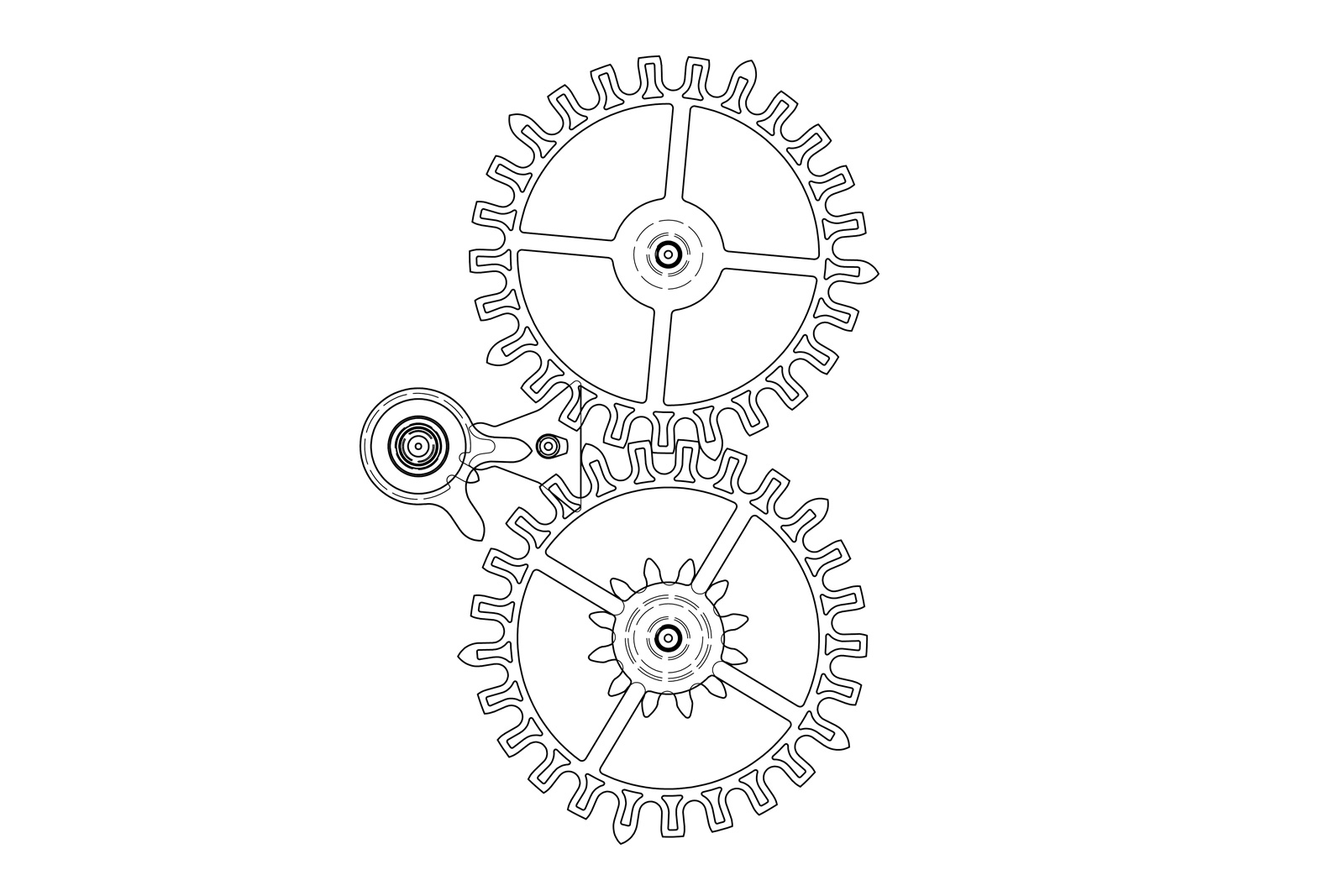
Escape wheels with cut teeth used in the Dual Direct escapement. Diagram – Ulysse Nardin
Although the completeness of the tooth is necessary for smooth and efficient power transmission, cutting off part of the addendum on one gear still allows it to be driven by a complete gear. Sure, the meshing will be jerky and not as efficient, but transmission of motion remains possible.
The idea behind cutting the addendum of a gear’s teeth is to leave only select teeth untouched, thus creating a second in-plane functional layer. This is one of the tricks used inside the ProSet that saves vertical space and ensures that separate sub-mechanisms can be engaged in-plane by the same mobile without interference.
Turning the gearsThe entire module is powered solely by the movement’s hour wheel (not shown) through a space-saving planetary setup. The hour wheel cannon features a toothed segment that engages the three pinions 8B. The pinions then engage the ring gear 8A. Using a simple transmission ratio, the 12-hour revolution of the hour wheel is turned into a 24-hour revolution of 8A.

View of the central planetary setup. Image — patent EP4581427A1, annotated by the author.
The ring gear 8A features cut teeth on the outside, with the exception of two groups of three uncut teeth each (marked in red above), separated by one tooth. The utility of these teeth will become apparent later.
Atop this elaborate ring gear sits wheel 9A which matches 8A in profile, with the exception of one uncut tooth, 6A. This tooth is placed directly above the spacing between the two groups of uncut teeth in wheel 8A.
Sharing the same axis with 8A and 9A is another gear 23A which is not connected in any way with the pair. This gear simply pivots on the central sleeve formed in the module’s mainplate and facilitates the setting of the calendar via the crown.

Complete central gear stack; Wheel 9A highlighted in purple. Image — patent EP4581427A1, annotated by the author.
The 8A and 9A assembly turns counterclockwise, engaging two indications of the calendar: the date via the uncut tooth 6A and the day of the week and moon phase through the cut toothing.
The cut toothing connects via an intermediary pinion to gear 9B, which is similarly cut and features a solitary complete tooth 6B. Every 24 hours, this finger-like tooth switches a seven-pointed star wheel 10 by one step. The star wheel carries the day of the week indicator and also a small pinion which meshes with a large wheel underneath gear 9B.
The double-stacked gear underneath 9B then connects with the moon phase indicator. This moon phase complication only involves four mobiles and achieves an impressive deviation of just one day in 1,040 years. The original Kurt Klaus module had a moon phase display accurate to one day in 122 years, although a second iteration introduced in 2003 reduced the error to one day in 577.5 years. The ProSet raises the bar even further.
Mechanical programmingThe key component of the ProSet module is the so-called “program wheel” 12, which serves as the mechanical brains of the calendar.

Image — patent EP4581427A1, annotated by the author.
Although the program wheel is a multilayered stack of gears, it is important to note that it only features two functional levels: the main 31-tooth date wheel and a lower layer of three retractable teeth.
The 31-tooth wheel is engaged every 24 hours by tooth 6A, which advances the entire assembly by one step in the clockwise direction. Unless the current month has fewer than 31 days, the cycle is repeated without fault daily. If, however, the current month is less than 31 days long, the lower level of three retractable teeth comes into play.

Program wheel assembly. Image — IWC
The program wheel relies on two circular cams to track the months’ lengths and the leap year cycle respectively. By using a reinterpreted Geneva stop work mechanism, a small pinion causes both cams to turn a certain amount every time the program wheel makes a full revolution.
The month cam has internal toothing much like a ring gear and the program wheel’s hub carries a pinion. As the program wheel slowly turns over the course of a month, the pinion encounters a rigid pin set into the plate, which causes the pinion to advance by two tooth spacings. This is almost identical to a Maltese cross mechanism and the pinion remains locked by design outside of this interaction.
The month cam advances by one twelfth of a revolution each month. An eccentric pin fixed on the pinion slides inside a tunnelling pattern carved into the leap cycle cam. This interaction is similar to an Archimedes trammel and causes the leap cycle cam to advance by one fourth of a revolution every year. For every full turn of the month cam, the leap cam only makes exactly one quarter of a revolution.

Exploded view of the program wheel. Image — IWC, annotated by the author
Each cam mechanically encodes information in its profile; the month cam has five small protrusions — one for each month with less than 31 days (February included). The leap cam has three protrusions, one for each non-leap year in one full cycle.
These protrusions work with the three retractable teeth. Two teeth work directly with the month cam and the third works with the year cam. The teeth slide in sleeves sculpted in the program wheel hub and are kept securely against their respective cam via blade springs. Since all these components are LIGA manufactured, the retaining springs are directly cut out of components of the program wheel’s hub.
View of the program wheel hub with retractable teeth. Wheel 9A passes over the retractable teeth. Image — patent EP4581427A1, annotated by the author.
Every time the current month has 30 days, the corresponding protrusion in the month cam pushes one tooth out, which corresponds to the 30th day on the large date wheel. This is where one of the uncut teeth highlighted in gear 8A engages with this retractable tooth, causing the program wheel to jump from the 30th to the 31st and then to the 1st of the next month all in one night. The jump from the 31st to the 1st is done by finger 6A in the usual fashion.
The month cam features a double-sided protrusion for the month of February, which forces both retractible teeth out. This ensures the date wheel makes three jumps in one night, from the 29th to the 1st.

The ProSet is exclusively set through the generously-sized onion-shaped crown.
Since a 29-day-long February only occurs on leap years, the leap cam has to compensate and subtract one day for three years in the cycle. The cam is synchronised to push out the third tooth during non-leap years, causing the program wheel to make four jumps in one night (28th to the 1st of the next month).
All day corrections are accomplished through rolling motions, so whether the system moves forward or backward, the mechanism works the same — hence the natural bidirectional setting capability for all indications.
Safety implementsPerpetual calendars are notoriously sensitive to mishandling so many contemporary designs feature some sort of safety mechanism. In the case of the ProSet, the movement changes the date gradually, posing the risk that the user might inadvertently engage crown setting at the same time — about an hour around midnight.

ProSet module durning assembly. Image — IWC
In order to ensure the components don’t bind or snap in such an instance, the switching fingers for the date, month and day of the week are constructed as compliant mechanisms. Fixed on flexible blade springs, the teeth are allowed one degree of freedom.
The blade springs are tuned to give in and slightly buckle if the torque applied on the tooth is higher than a certain threshold. If the tooth encounters any resistance greater than the torque required to move a certain mobile, it simply gives in and retracts away from the gear, ratcheting over it.

ProSet module almost fully assembled. Image — IWC
As such, if the calendar is slowly advancing at midnight and the wearer chooses to manually change the date, the system will not fail and all the gears will simply ratchet over the safety teeth. This solution is elegant and simple to manufacture via the LIGA process. This sort of safety can be used for ordinary date changing mechanisms and since the patent was filed by Richemont, we might see it used again in the future in other brands as well.
ConclusionsIWC’s ProSet is without question the most scalable alternative perpetual calendar system currently on the market, with a wholly modular architecture that should make it compatible with a wide range of base movements.
In the short-term, the user-friendly and bidirectional calendar seems like a natural choice for the brand’s beefier seven-day movements so we’ll probably see this update in the near future.

Although the ProSet hasn’t been on the market long, there are already isolated reports of the calendar date falling out of sync and needing some sort of professional adjustment. Such kinks are unavoidable for products like these that rethink a concept from the ground up instead of expanding on a known base.
Indications getting out of sync suggests a mismatch between the sprung safety teeth’s rigidity and the strength of the indexing springs. If that is indeed the underlying issue, there should be no problem for IWC to sort it out.
Overall the ProSet concept is clever and doesn’t yet betray any significant shortcomings, and has the potential to uproot classic perpetual calendars inside the Richemont group. For IWC in particular, the ProSet is a refreshing return to past form, and represents a worthy successor to the Kurt Klaus module.
IWC Big Pilot’s Watch Perpetual Calendar ProSet
Ref. IW339601 (ceramic)
Ref. IW329602 (pink gold)
Ref. IW329601 (stainless steel)
Diameter: 42 mm (42.9 mm for ceramic case)
Height: 14 mm (14.3 mm for ceramic case)
Material: White ceramic, 18k pink gold, or stainless steel
Crystal: Sapphire
Water resistance: 100 m
Movement: Cal. 82665
Functions: Hours, minutes, seconds, perpetual calendar displaying the date, day, month and four-digit year and moon phase for both northern and southern hemispheres
Winding: Self-winding
Frequency: 28,800 beats per hour (4 Hz)
Power reserve: 60 hours
Strap: Rubber strap (ceramic), leather strap (pink gold), or rubber strap and matching bracelet (stainless steel)
Limited edition: No
Availability: Available at IWC boutiques and retailers
Price: US$54,700 (pink gold), US$41,600 (ceramic), US$38,800 (stainless steel) excluding taxes
For more information, visit IWC.com.
| # | Наименование новости | Тональность | Информативность | Дата публикации |
|---|---|---|---|---|
| 1 | Hands On: IWC Pilot’s Venturer Vertical Drive | 0 | 20.45 | 14-04-2026 |
| 2 | IWC Expands Ingenieur 35 Collection | 0 | 24.25 | 15-04-2026 |
| 3 | Hands On: IWC Portugieser Chronograph Ceratanium | 0 | 20.35 | 25-03-2026 |
| 4 | Hands On: A. Lange & Söhne Lange 1 Tourbillon Perpetual Calendar “Lumen” | 0 | 19.18 | 16-07-2026 |
| 5 | IWC Reimagines the Portugieser Chronograph in Ceratanium | 0 | 20.26 | 26-02-2026 |
| 6 | A. Lange & Söhne’s Saxonia Annual Calendar Returns | 0 | 21.3 | 14-04-2026 |
| 7 | Conversations: Lange CEO Wilhelm Schmid on Capacity and Limited Editions | 0 | 20.29 | 13-05-2026 |
| 8 | Insight: The Chain and Fusée | 0 | 18.14 | 16-06-2026 |
| 9 | Hands On: Piaget Polo 79 Sodalite | 0 | 22.3 | 22-07-2026 |
| 10 | Hands On: Piaget Polo Signature Date | 0 | 18.69 | 04-05-2026 |