Просмотр новости
Найдите то, что Вас интересует
 Спутники
 РН
РН SpaceX
 Роскосмос
 NASA
NASA
СпутникиРНSpaceXРоскосмосNASANexon's future strategy has emerged. The company plans to strengthen the Dungeon & Fighter franchise and expand its new-game lineup in the second half of this year. For the Chinese version of Dungeon & Fighter Mobile, Nexon will deepen its co-development partnership with Tencent to accelerate the de
Nexon's future strategy has emerged. The company plans to strengthen the Dungeon & Fighter franchise and expand its new-game lineup in the second half of this year. For the Chinese version of Dungeon & Fighter Mobile, Nexon will deepen its co-development partnership with Tencent to accelerate the delivery of content. ARC Raiders will seek to attract new and returning players with its largest update yet. Nexon is also preparing a series of new games based on existing intellectual property, starting with Dungeon & Fighter: Idle RPG this year.
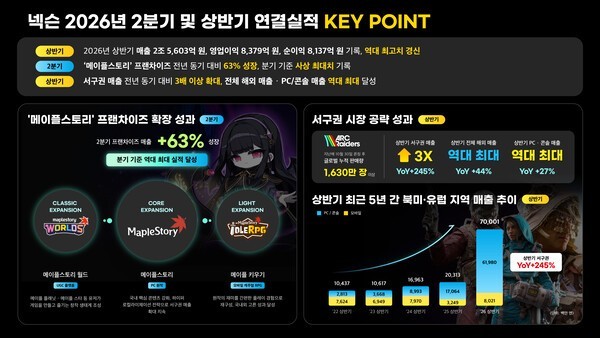
Nexon said at its second-quarter 2026 earnings conference call on August 13 that second-quarter revenue was about 1.139 trillion won, up 2% from a year earlier. Operating profit was about 294.3 billion won, down about 17% from a year earlier.
The company said revenue from the MapleStory franchise increased 63% and cumulative sales of ARC Raiders surpassed 16.3 million units, but higher labor costs, platform fees and marketing expenses weighed on profitability.
Meanwhile, Nexon disclosed its strategy for major franchises and plans for new games in the second half. It will first focus on recovering the underperforming Dungeon & Fighter franchise. The company expects revenue from the PC version this year to remain at a similar level to last year, while revenue from the mobile version is expected to decline. Major seasonal updates rolled out on PC and mobile in the first half fell short of initial expectations.
Nexon's strategy to recover Dungeon & Fighter centers on increasing the amount of content supplied and introducing new ways to play. The company plans to increase the types and volume of content offered in major seasonal updates and add new experiences that make use of the franchise's action-oriented gameplay, beyond level-cap expansions and raids.
For the Chinese version of Dungeon & Fighter Mobile, Nexon will deepen its collaboration with Tencent. Beginning in the third quarter, content production will ramp up through the organization whose development responsibilities were transferred to Tencent. Nexon said it has also maintained its existing development personnel at Neople, expanding its development capabilities. For repetitive pixel-art work, the company plans to use artificial intelligence (AI) solutions to give developers more time for creative work.
In the third quarter, Nexon is also preparing updates and events timed to China's National Day holiday. It aims to release the new franchise title Dungeon & Fighter: Idle RPG this year, followed by Dungeon & Fighter Classic and Project OVERKILL from next year.
Global hit ARC Raiders will unveil its major "Frozen Trail" update in early October. The update will be the largest content expansion since launch, with the goal of reactivating its existing core player base while attracting new users.
Nexon plans to apply two major updates a year to ARC Raiders going forward, alongside smaller updates at roughly two-week intervals. The company aims to build a long-term live-service structure and sustain the game's momentum.
For the FC franchise, Nexon is focusing on rebuilding its user base. During the World Cup period, interest in the tournament and the inflow of new and returning users in Korea fell short of expectations, but traffic and revenue have improved since the TOTS update at the end of June, the company said. Nexon expects third-quarter FC revenue to be similar to the year-earlier period.
In the second half, the company will focus more on increasing traffic and user engagement than on short-term revenue. It is also discussing ways to expand the user base in Korea based on its long-term agreement with Electronic Arts (EA).
Nexon will continue expanding its new games and existing IPs into additional regions. The company is also preparing releases for Overgeared and Azur Promilia. MABINOGI MOBILE is scheduled to launch in Japan in the fourth quarter.
Nexon sees managing the costs arising from portfolio diversification and restoring Dungeon & Fighter's performance as key tasks for improving profitability. The key to its second-half results will be whether growth led by MapleStory can be broadened through a recovery in Dungeon & Fighter and FC and stronger performance from new IP.
[Full Transcript of Nexon's Second-Quarter 2026 Earnings Conference Call Q&A]
Q. I understand that the investments planned for the third quarter are reflected in the outlook. Is it correct to view the increase in costs as a one-off? At the March Capital Markets Briefing (CMB), you talked about the importance of cost management. How do you plan to balance cost management with investments needed for growth?
A. (Shiro Uemura, Nexon CFO) The costs in our third-quarter guidance should be viewed less as one-off expenses and more as a reflection of the current change in our revenue mix. As we explained earlier, MapleStory: Idle RPG and MapleStory Worlds are performing well, but these titles have a cost structure in which variable costs rise with revenue. Therefore, we need to reflect a certain level of costs. This includes upfront investments. We have four titles in the pipeline for the fourth quarter this year, so we will incur related marketing expenses, meaning the costs are not limited to the third quarter. We are taking a more disciplined approach to our cost structure so that development activities can generate strong economic returns for investors over time while also providing fun for players. At the same time, we are allocating the resources needed for areas where clear returns are expected, including marketing to support new-game launches. While variable costs will rise as we diversify our revenue sources, we expect margins to improve as diversification expands.
Q. Does the significant diversification of your title portfolio compared with the past mean that earnings should also be viewed differently from several years ago, as this is reflected in costs?
A. (CFO) In terms of the fact that Dungeon & Fighter and some other titles are currently underperforming, that is the correct interpretation. However, we are diversifying our revenue sources to pursue a more stable business, while firmly controlling costs within that process and working to increase profits.
Q. I understand that during this World Cup period, the plan was to focus on increasing engagement among FC users. How do you analyze the reasons for failing to secure as many users as expected? Please also explain the timeframe and measures through which you expect the FC franchise to return to growth.
A. (Junghun Lee, CEO of Nexon Japan) First, the expected World Cup effect did not materialize fully in Korea. Interest in the World Cup itself in Korea was lower than expected. As a result, the inflow of returning and new users and the increase in traffic that we expected from the in-game World Cup event fell short of the original plan. However, traffic and revenue trends have improved since the TOTS update at the end of June. Taking this into consideration, we expect third-quarter revenue to be similar to the same period last year.
For the remainder of this year, our top priority is to continuously strengthen traffic and user engagement and solidify the franchise's foundation again, rather than pursuing short-term revenue growth. Our current goal is to ensure that the FC franchise ends the year on a more stable foundation.
Finally, at our previous earnings announcement, we announced a long-term agreement with EA regarding FC. This demonstrates that both companies have confidence in the long-term growth potential of the FC franchise. EA and Nexon are continuing to actively discuss specific measures to ensure that the FC franchise maintains its unrivaled position in the genre in Korea and further expands its user base.
Q. At the recent Nexon Developers Conference (NDC), you also emphasized context capital. I understand that you said this would become a key competitive advantage in the generative AI era. Do you have confidence that you can use context capital to return Dungeon & Fighter, which is currently underperforming, to growth? How do you expect to apply the knowledge and know-how accumulated so far specifically to turn around Dungeon & Fighter?
A. (CEO) Context capital, simply put, is the capital of time accumulated by game development teams and player communities living together for decades. We have entered an era in which AI can write code and draw pictures, but we believe the context accumulated by Nexon's many long-running live-service titles over decades cannot easily be replicated by competitors.
The same applies to Dungeon & Fighter. All of Nexon's long-running live-service titles, including MapleStory, are working to use this context capital to understand player preferences accurately and create a variety of content more quickly. We expect the results of these efforts to continue to emerge over the long term.
Q. What effect do you expect from the major ARC Raiders update, "Frozen Trail"? Is the goal to increase sales and acquire new users, or to reactivate existing users?
A. (Patrick Söderlund, Executive Chairman of Nexon) ARC Raiders has significantly exceeded our expectations in terms of sales performance and has become a global hit. The team is focused on the major Frozen Trail update. It is the largest content update since launch. We want to reinvigorate the existing core player base while bringing new players into the ARC Raiders ecosystem. Looking at examples from other companies that have successfully delivered updates in similar games or situations, we believe this can be a very strong package.
We are preparing smoothly with a target of unveiling it in early October. We are also developing several scenarios in preparation for the subsequent trajectory of ARC Raiders. Two major updates a year and continuous smaller updates are the key. Smaller updates could come roughly every two weeks, while major content updates will be delivered twice a year.
Q. The special dividend was a decision the market did not expect. Please explain the timing and size of the special dividend and how you view the cash level after the dividend.
A. (CFO) First, I will explain the background and size of the special dividend. Nexon has built a large cash balance by generating stable profits over a long period from its franchises and new games. Recently, we recorded more than ¥140 billion in gains from investments in listed companies, and as of the end of the second quarter, we held ¥842 billion in cash.
As we said at the March CMB, the management transformation initiative covers every aspect of the business. Taking all of this into account, and considering that we can retain sufficient capital for investments in growth opportunities, the board decided to use part of our excess cash for a special dividend.
The decision reflects our strong confidence that our existing businesses and new titles have the ability to generate sustained cash flow over the long term. The transformation initiative also has as its key objectives improving the cost structure and margins over the long term and increasing the sustainability of earnings by diversifying revenue sources.
We believe we will still have sufficient funds for business investment after paying the special dividend. Our policy of pursuing organic growth remains unchanged. The same applies to our merger and acquisition (M&A) investment strategy. Our cash balance will be about ¥500 billion after the special dividend, but this will not affect our future growth or M&A investment strategy.
Going forward, if cash accumulates beyond the level we need to maintain for strategic opportunities, we will actively consider further returns to shareholders.
Q. The cash balance is expected to be more than ¥500 billion after the special dividend. Should this be viewed as the benchmark for the cash level you need? Also, Nexon has historically made extensive use of share buybacks, but chose a special dividend this time. Is there a standard for deciding between the two approaches?
A. (CFO) Our shareholder-return policy, which we have disclosed to shareholders, is, first, to return at least 33% of the previous year's operating profit and, second, to maintain return on equity (ROE) of at least 10%, with a target of 15%. If we were to use an amount equivalent to this special dividend for share buybacks, we estimate that it would take about 25 months based on the pace of purchases to date. Because the number of shares outstanding would decline by about 18%, there is also a risk of raising concerns about liquidity.
To ensure that we implement the return policy mentioned earlier, we judged that it would be appropriate to distribute this excess cash as a special dividend. A special dividend allows us to provide value to all shareholders quickly and fairly without affecting liquidity. Considering the current business environment and all circumstances, we determined that the cash we currently hold is no longer immediately necessary and can be allocated to shareholder returns. Going forward, we will make flexible decisions depending on the business environment, while continuing to manage the balance sheet and return capital to shareholders through a combination of dividends and share buybacks.
Q. Dungeon & Fighter received several major updates in the second quarter and July. How do you view the recovery of the user base and its sustainability after the recovery? We also expect co-developed content with Tencent to be unveiled in the fourth quarter. Please explain your outlook for the Dungeon & Fighter franchise this year.
A. (CEO) First, I will explain the overall trajectory of the Dungeon & Fighter franchise for 2026. We expect the PC version to deliver stable performance at a level similar to last year, while the mobile version is expected to decline from the previous year. Dungeon & Fighter's annual performance is heavily influenced by user responses to major seasonal updates at the beginning of the year and during each season. Metrics can also move depending on quarterly or semiannual seasonal events and updates throughout the year, but the most important factor is the major seasonal update. In 2026, the major seasonal updates for the PC and mobile versions in the first half fell short of our initial expectations.
From a long-term perspective, there are two directions for addressing Dungeon & Fighter's challenges.
First, we will increase the types and volume of content supplied in major seasonal updates. We intend to increase overall content production from its current level and expand major updates that have traditionally centered on a single type of content into a broader variety of formats.
Second, alongside this, we will continue creating new ways to play. Familiar updates such as level-cap expansions and raids, which users have experienced for a long time, remain important, but we also need to add new ways to play that users have not experienced before while preserving the action-oriented fun that is at the heart of Dungeon & Fighter.
This is particularly important for the mobile version, where casual users account for a relatively larger share than on PC, making the creation of new experiences more important.
There is another point investors should watch in the mobile version. Beginning in the third quarter, development has been transferred to Tencent, and content production through this team is now ramping up. As a result, content supply has also become more sophisticated since the second half of this year. It may take a little more time for this collaboration process to become fully established and translate into actual results. However, as we address the two challenges mentioned earlier, we expect closer and stronger collaboration with Tencent to play an important role in accelerating the pace of change.
To improve operating profit across the group, both managing the transition costs arising from portfolio diversification and gradually recovering the performance of Dungeon & Fighter in China are important. We intend to pursue both pillars together to improve profitability across the group. From this perspective, Dungeon & Fighter remains a key priority. In the third quarter, the company is preparing updates and events timed to China's National Day holiday, a major momentum driver in the Chinese market.
Dungeon & Fighter: Idle RPG, a new title in the franchise, is progressing smoothly with a target launch this year. We plan to introduce additional franchise-expansion titles, including Dungeon & Fighter Classic and Project OVERKILL, in succession beginning next year. Dungeon & Fighter: Idle RPG is similar in direction to MapleStory's franchise-expansion strategy, but the major Dungeon & Fighter expansion titles are based on internal development, allowing us to expect a relatively high-margin structure.
Q. You said you will increase the supply of Dungeon & Fighter content. Does this mean you will increase headcount? Could AI also be used? How do you view the resulting increase in costs?
A. (CEO) For the China service, while we are co-developing with Tencent and transferring development responsibilities, we are maintaining the size of the team producing content at Neople Studio. Accordingly, our direct development capabilities have been strengthened.
To increase content production, we also need to use AI solutions to reduce repetitive tasks in pixel-art work and increase the time people can devote to creative work. There is no need to be concerned that increasing content production will necessarily lead to a large increase in costs. We are managing this properly.
Q. You said you will begin publishing Blizzard Entertainment's Overwatch from the fourth quarter. What level of revenue and operating profit should we expect?
A. (CFO) Overwatch service began on August 12. As a well-known title, it has made a smooth start, but it is too early to provide specific details. We do not expect a very large contribution in the third quarter and see it making a limited contribution. However, we expect to be able to grow it gradually going forward.