Просмотр новости
Найдите то, что Вас интересует
 Спутники
 РН
РН SpaceX
 Роскосмос
 NASA
NASA
СпутникиРНSpaceXРоскосмосNASA

USD 52.15 BN
MARKET SIZE, 2032



Source: Secondary Research, Interviews with Experts, MarketsandMarkets Analysis
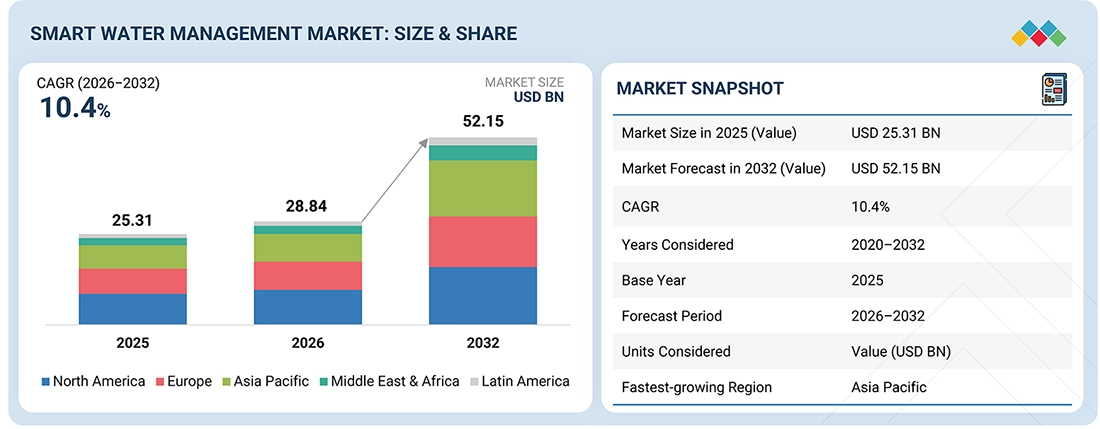
The global smart water management market is estimated to reach USD 28.84 billion in 2026 and is projected to grow to USD 52.15 billion by 2032, registering a CAGR of 10.4% during the forecast period. Market growth is driven by increasing investments in digital water infrastructure, the rising adoption of smart meters, IoT-enabled sensors, and AI-powered analytics to improve water distribution efficiency and reduce non-revenue water losses. Utilities and municipalities are increasingly deploying real-time monitoring, predictive maintenance, and automated control systems to optimize network performance, strengthen regulatory compliance, and support sustainable water resource management amid growing urbanization, aging infrastructure, and climate-related water challenges.
By Offering
By offering, the services segment is expected to register the highest CAGR of 11.7%.
By End User
By end user, the residential segment is projected to grow at the fastest rate from 2026 to 2032.
By Region
Asia Pacific to the fastest-growing region in the global smart water management market.
Competitive Landscape - Key Players
Xylem, Siemens, Schneider Electric, Suez, and ABB were identified as some of the star players in the smart water management market, given their strong market share and product footprint.
Competitive Landscape - Startup/SMEs
Hydropoint, GWF, Xenius, and Takadu have distinguished themselves among startups and SMEs in the smart water management market.
Smart water management adoption is accelerating as utilities face growing pressure to reduce water losses, improve network efficiency, and ensure reliable water distribution. Many water utilities are deploying digital technologies to monitor water quality, detect leaks, optimize pressure, and track consumption in real time. These capabilities help minimize non-revenue water, lower operational costs, and improve asset performance while supporting sustainability goals. As urbanization, aging infrastructure, and climate-related water challenges continue to increase, utilities require greater visibility across their water networks. Smart water management platforms enable operators to make faster, data-driven decisions, respond quickly to system disruptions, and improve overall service delivery. This growing focus on digital water infrastructure is strengthening the role of smart water management as a critical component of modern, resilient water utility operations.
The smart water management market is rapidly evolving from conventional monitoring and metering solutions toward intelligent, data-driven platforms that generate long-term value. Today, much of the market revenue comes from SCADA systems, smart metering, manual inspection, and maintenance services. However, future growth will be driven by AI-powered analytics, IoT-enabled water networks, predictive maintenance, digital twin technology, integrated water management platforms, and cloud-based utility analytics. These innovations enable utilities, municipalities, industrial users, irrigation authorities, and treatment plant operators to reduce water losses, improve operational efficiency, optimize resource utilization, and enhance customer engagement. Ultimately, they deliver reliable water supply, lower operational costs, improved water quality, stronger sustainability outcomes, and greater customer satisfaction through smarter, more resilient water infrastructure.
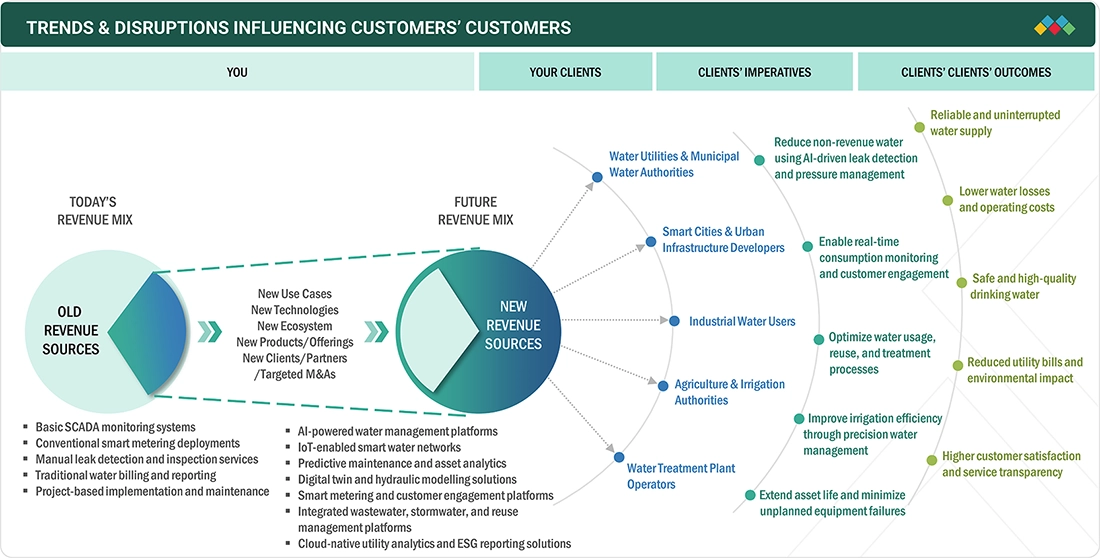
Source: Secondary Research, Interviews with Experts, MarketsandMarkets Analysis



OPPORTUNITIES
Impact
Level

Source: Secondary Research, Interviews with Experts, MarketsandMarkets Analysis
The rapid adoption of Internet of Things (IoT), Advanced Metering Infrastructure (AMI), edge computing, cloud platforms, and real-time sensing technologies is accelerating the growth of the smart water management market. Utilities are increasingly deploying connected sensors, smart meters, and edge-enabled devices to monitor water quality, pressure, leakage, and consumption across distribution networks. Cloud-based platforms enable centralized data collection, remote asset management, and advanced analytics, allowing operators to make faster and more informed decisions. Real-time visibility into water infrastructure improves operational efficiency, minimizes non-revenue water, and enhances service reliability. These technologies also support predictive maintenance, automated fault detection, and optimized resource allocation, helping utilities reduce operational costs while improving sustainability. Growing investments in digital water infrastructure and smart city initiatives continue to drive widespread adoption of intelligent water management solutions worldwide.
Long procurement cycles and budget constraints remain significant barriers to the adoption of smart water management solutions, particularly among public utilities and municipal water authorities. Implementing advanced technologies such as smart meters, IoT sensors, communication networks, and cloud-based management platforms requires substantial upfront capital investment. Since many water utilities operate under government funding or regulated budgets, project approvals often involve multiple stakeholders, extensive tendering procedures, and lengthy evaluation processes. Budget limitations frequently delay modernization projects, especially in developing regions where aging infrastructure competes with other public spending priorities. Additionally, concerns regarding return on investment and long implementation timelines discourage smaller utilities from adopting advanced digital solutions. These financial and administrative challenges slow market growth despite the increasing need for efficient and sustainable water management systems.
Artificial intelligence-powered predictive analytics and digital twin technologies are creating significant growth opportunities in the smart water management market. AI algorithms analyze large volumes of operational data from sensors, meters, and treatment facilities to forecast equipment failures, detect anomalies, optimize water distribution, and improve demand forecasting. Digital twins create virtual replicas of water infrastructure, enabling utilities to simulate network performance, evaluate maintenance strategies, and test operational scenarios before implementing changes in the physical system. Together, these technologies improve asset utilization, reduce maintenance costs, enhance operational resilience, and support faster decision-making. As utilities focus on reducing non-revenue water, improving service quality, and achieving sustainability targets, investments in AI-driven digital water platforms are expected to increase, driving innovation and long-term market expansion.
Integrating modern smart water management technologies with aging water infrastructure remains one of the industry's biggest challenges. Many utilities continue to operate decades-old pipelines, pumps, valves, and monitoring systems that were not designed to support digital connectivity or real-time data exchange. Connecting IoT sensors, smart meters, SCADA systems, and cloud platforms with these legacy assets often requires customized integration, additional communication infrastructure, and significant system upgrades. Data interoperability issues between old and new technologies further complicate implementation, increasing deployment time and costs. Utilities must also ensure uninterrupted water services during modernization projects, making upgrades more complex. Successfully overcoming these integration challenges requires phased deployment strategies, standardized communication protocols, and investments in scalable digital infrastructure that can coexist with existing water networks.
| COMPANY | USE CASE DESCRIPTION | BENEFITS |
|---|---|---|
|
|
Xylem provides integrated smart water management solutions combining smart meters, network monitoring sensors, advanced analytics, leak detection, digital twin technology, and asset performance management. Water utilities use the platform to monitor water distribution networks in real time, detect leaks, optimize pressure, improve water quality monitoring, reduce non-revenue water (NRW), and enhance operational efficiency through AI-driven insights and predictive maintenance. | Reduced non-revenue water (NRW) and leak losses | Real-time network visibility and water quality monitoring | Optimized asset performance and predictive maintenance | Lower energy and operating costs | Improved regulatory compliance and customer service |
|
|
Siemens delivers digital water solutions through industrial automation, IoT connectivity, SCADA, AI-based analytics, digital twins, and intelligent control systems for water and wastewater facilities. Utilities and industrial operators use these solutions to automate treatment plants, optimize pumping operations, monitor critical infrastructure, improve energy efficiency, and ensure continuous compliance with environmental and water quality regulations. | Intelligent plant automation and process optimization | Reduced energy consumption and operational costs | Improved treatment efficiency and regulatory compliance | Predictive maintenance for critical assets | Increased operational resilience and sustainability |
|
|
ABB provides smart water management solutions by integrating electrification, process automation, digital monitoring, industrial IoT, and advanced control technologies. Water utilities and industrial facilities use ABB's solutions to optimize pumping stations, monitor electrical assets, automate treatment processes, improve energy management, and enhance system reliability with predictive diagnostics and remote operations. | Optimized pump and process performance | Lower energy consumption through intelligent automation | Improved asset reliability and reduced downtime | Remote monitoring and predictive diagnostics | Enhanced operational efficiency and sustainable water management |
Logos and trademarks shown above are the property of their respective owners. Their use here is for informational and illustrative purposes only.
The smart water management market ecosystem consists of technology & hardware providers, software providers, and end users, all contributing to the digital transformation of water utilities. Technology & hardware providers such as Xylem, ABB, Honeywell, Kamstrup, Landis+Gyr, Siemens, Itron, Neptune Technology Group, Badger Meter, and SUEZ develop smart meters, sensors, communication networks, control systems, and monitoring equipment that enable real-time water measurement and infrastructure management. Software providers including Oracle, Schneider Electric, Siemens, ABB, IBM, and TaKaDu offer meter data management, SCADA integration, AI-powered analytics, leak detection, asset performance management, and predictive maintenance solutions to improve operational efficiency. End users, including Sydney Water, Thames Water, United Utilities, Veolia, American Water, Melbourne Water, and Aqua, deploy these technologies to optimize water distribution, reduce non-revenue water, enhance regulatory compliance, improve customer service, and achieve sustainability goals. Collaboration among these stakeholders accelerates innovation, strengthens water infrastructure resilience, and supports efficient water resource management across municipalities and utilities worldwide.
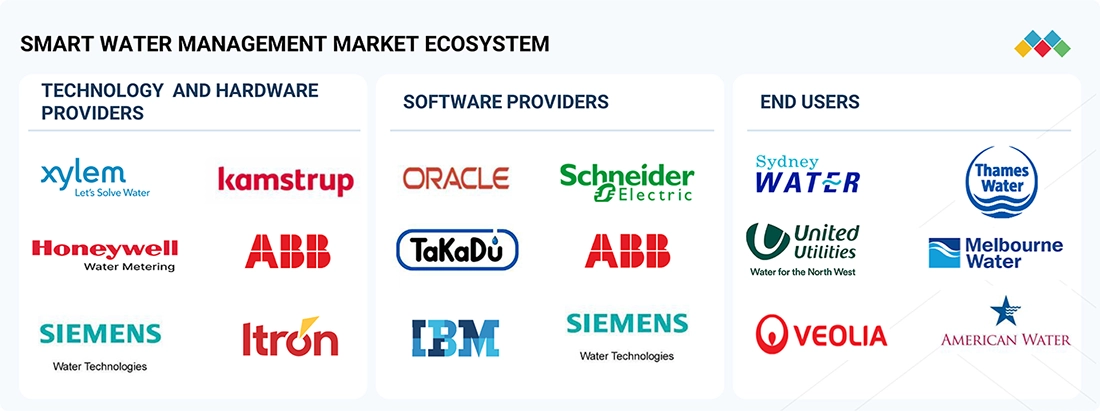
Logos and trademarks shown above are the property of their respective owners. Their use here is for informational and illustrative purposes only.
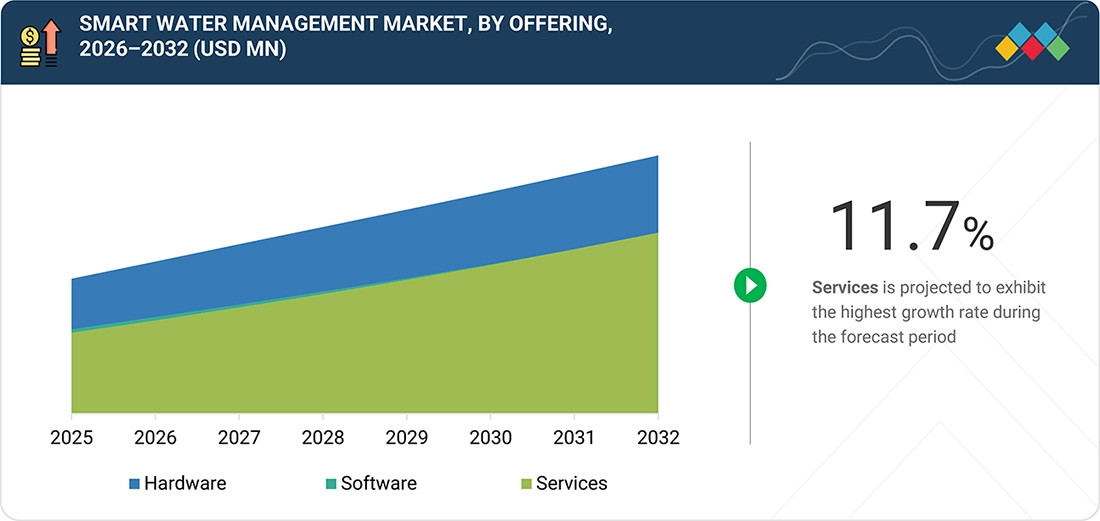
Source: Secondary Research, Interviews with Experts, MarketsandMarkets Analysis
Smart water management solutions account for the largest share of the market as they serve as the core intelligence layer for utilities and water operators. Software platforms such as SCADA, meter data management, asset management, network monitoring, leak detection, and water quality management integrate data from smart meters, sensors, and control devices into a unified platform for real-time decision-making. As utilities modernize aging infrastructure and prioritize non-revenue water reduction, predictive maintenance, and regulatory compliance, demand for integrated software solutions continues to rise. These platforms improve operational visibility, automate workflows, optimize asset performance, and enable faster response to leaks and service disruptions. While hardware deployment remains essential and services support implementation and maintenance, software solutions are becoming the primary investment area as utilities increasingly adopt data-driven and AI-enabled water management systems.
The industrial segment holds the largest share of the smart water management market due to the high volume of water consumed across industries such as power generation, manufacturing, oil & gas, mining, food & beverages, and pharmaceuticals. Industrial facilities are investing in smart water management solutions to optimize water usage, minimize wastewater generation, comply with stringent environmental regulations, and reduce operational costs. Advanced metering, leak detection, water quality monitoring, and predictive analytics help industries improve process efficiency while supporting sustainability and water reuse initiatives. Growing pressure to meet ESG targets and ensure uninterrupted operations is accelerating the adoption of intelligent water management platforms. As industries continue to digitalize their water infrastructure, smart technologies are becoming an integral part of operational and environmental management strategies, driving sustained growth within this end-user segment.
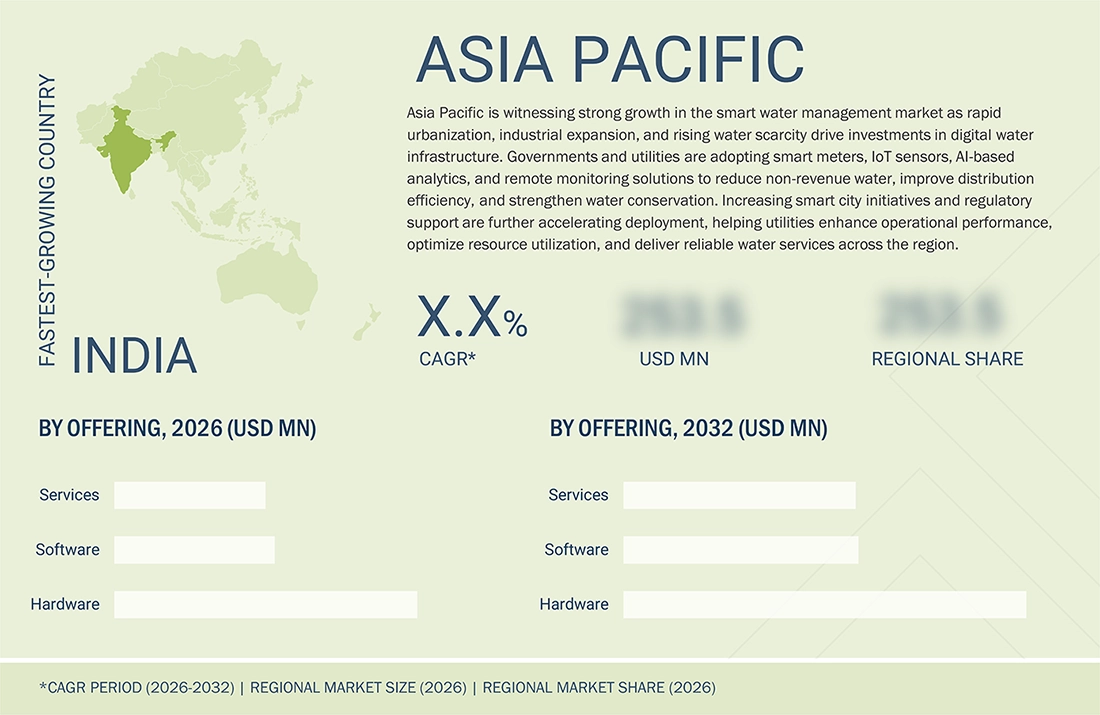
Asia Pacific is the fastest-growing region in the smart water management market as governments and utilities accelerate investments in digital water infrastructure to address rising water demand and resource scarcity. Rapid urbanization, industrial expansion, and population growth are increasing pressure on aging water distribution networks, creating a greater need for efficient monitoring and control systems. Many water utilities are transitioning from conventional water management practices to IoT-enabled smart meters, advanced sensors, and real-time analytics platforms to improve operational efficiency and reduce water losses. Managing non-revenue water, ensuring reliable water supply, and optimizing energy consumption across expanding urban and rural networks are becoming increasingly important. Smart water management solutions provide real-time visibility into network performance, enable predictive maintenance, and support faster leak detection and informed decision-making. Together, supportive government initiatives, digital transformation programs, and growing investments in sustainable water infrastructure are driving strong market growth across the Asia Pacific region.
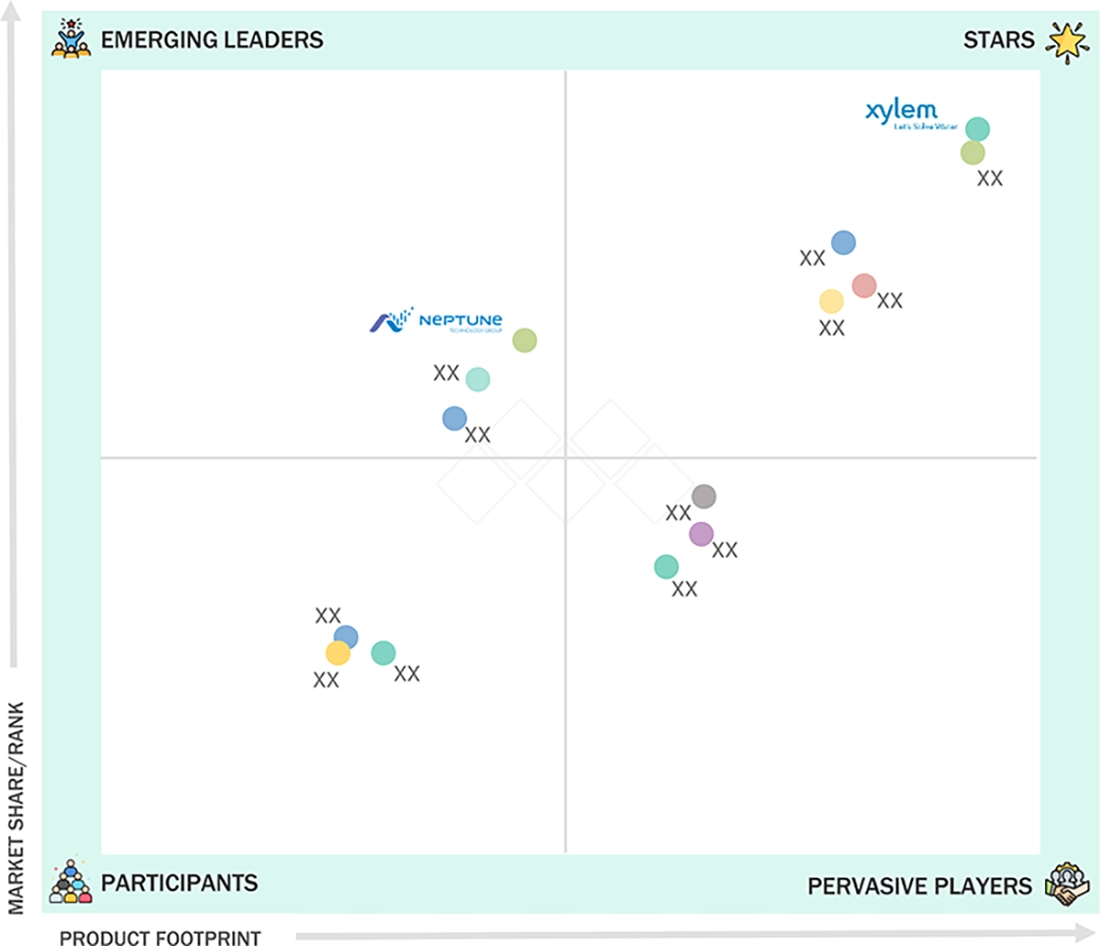
In the smart water management market matrix, Xylem (Star) holds a leading position with a strong combination of market share and extensive product footprint, supported by its comprehensive portfolio of smart metering, analytics, digital water, and network management solutions. Neptune Technology Group (Emerging Leader) is strengthening its market presence through advanced smart water meters, AMI solutions, and expanding utility partnerships. While Xylem maintains its leadership through global reach, continuous innovation, and broad customer adoption, Neptune Technology Group demonstrates significant potential to advance toward the leaders' quadrant as utilities increasingly invest in digital water infrastructure, real-time monitoring, and intelligent water resource management.
Source: Secondary Research, Interviews with Experts, MarketsandMarkets Analysis
| REPORT METRIC | DETAILS |
|---|---|
| Market Size in 2025 (Value) | USD 25.31 Billion |
| Market Size in 2026 (Value) | USD 28.84 Billion |
| Market Forecast in 2032 (Value) | USD 52.15 Billion |
| Growth Rate | CAGR of 10.4% from 2026-2032 |
| Years Considered | 2020-2032 |
| Base Year | 2025 |
| Forecast Period | 2026-2032 |
| Units Considered | Value (USD Billion) |
| Report Coverage | Revenue forecast, company ranking, competitive landscape, growth factors, and trends |
| Segments Covered |
|
| Regions Covered | North America, Europe, Asia Pacific, Middle East & Africa, and Latin America |
We have successfully delivered the following deep-dive customizations:
| CLIENT REQUEST | CUSTOMIZATION DELIVERED | VALUE ADDS |
|---|---|---|
| Leading Service Provider (US) | Regional Analysis: • Further breakdown of the North American smart water management market • Further breakdown of the European smart water management market • Further breakdown of the Asia Pacific smart water management market • Further breakdown of the Middle Eastern & African smart water management market • Further breakdown of the Latin American smart water management market | • Identifies high-growth regional opportunities, enabling tailored market entry strategies • Optimizes resource allocation and investment based on region-specific demand and trends |
| Company Information | Detailed analysis and profiling of additional market players (up to 5) | • Broadens competitive insights, helping clients make informed strategic and investment decisions • Reveals market gaps and opportunities, supporting differentiation and targeted growth initiatives |
 Exclusive indicates content/data unique to MarketsandMarkets and not available with any competitors.
4
MARKET OVERVIEW
Highlights the market structure, growth drivers, restraints, and near-term inflection points influencing performance.4.3
INTERCONNECTED MARKETS AND CROSS-SECTOR OPPORTUNITIES
4.4
STRATEGIC MOVES BY TIER-1/2/3 PLAYERS
5
INDUSTRY TRENDS
Explains the evolving landscape through demand-side drivers, supply-side constraints, and opportunity hotspots.5.1
'PORTER'S FIVE FORCES ANALYSIS
5.2
MACROECONOMIC OUTLOOK
5.2.2
GDP TRENDS AND FORECAST
5.2.3
TRENDS IN GLOBAL SMART WATER MANAGEMENT INDUSTRY
5.5.1
AVERAGE SELLING PRICE TREND, BY KEY PLAYERS,
5.5.2
INDICATIVE PRICING ANALYSIS, BY HARDWARE,
5.6
KEY CONFERENCES AND EVENTS, 2026–2027
5.7
HS CODE: LIQUID METERS, INCL. CALIBRATING METERS THEREFOR (902820), 2021-2025
5.7.1
EXPORT SCENARIO FOR HS CODE: 902820
5.7.2
IMPORT SCENARIO FOR HS CODE: 902820
5.8
TRENDS/DISRUPTIONS IMPACTING CUSTOMER BUSINESS
5.9
INVESTMENT AND FUNDING SCENARIO
5.11
IMPACT OF 2025 US TARIFF – SMART WATER MANAGEMENT MARKET
5.11.3
PRICE IMPACT ANALYSIS
5.11.4
IMPACT ON COUNTRIES/REGIONS
5.11.5
IMPACT ON END-USE INDUSTRIES
6
TECHNOLOGICAL ADVANCEMENTS, AI-DRIVEN IMPACT, PATENTS, INNOVATIONS, AND FUTURE APPLICATIONS
6.1
KEY EMERGING TECHNOLOGIES
6.2
COMPLEMENTARY TECHNOLOGIES
6.3
TECHNOLOGY/PRODUCT ROADMAP
6.5
IMPACT OF AI/GEN AI ON SMART WATER MANAGEMENT MARKET
6.5.1
TOP USE CASES AND MARKET POTENTIAL
6.5.2
BEST PRACTICES IN SMART WATER MANAGEMENT PROCESS
6.5.3
CASE STUDIES OF AI IMPLEMENTATION IN SMART WATER MANAGEMENT MARKET
6.5.4
INTERCONNECTED ADJACENT ECOSYSTEM AND IMPACT ON MARKET PLAYERS
6.5.5
'CLIENTS' READINESS TO ADOPT GENERATIVE AI IN SMART WATER MANAGEMENT MARKET
7.1
REGIONAL REGULATIONS AND COMPLIANCE
7.1.1
REGULATORY BODIES, GOVERNMENT AGENCIES, AND OTHER ORGANIZATIONS
8
CUSTOMER LANDSCAPE & BUYER BEHAVIOR
8.1
DECISION-MAKING PROCESS
8.2
BUYER STAKEHOLDERS AND BUYING EVALUATION CRITERIA
8.3
ADOPTION BARRIERS & INTERNAL CHALLENGES
8.4
UNMET NEEDS FROM VARIOUS END-USE INDUSTRIES
9
SMART WATER MANAGEMENT MARKET, BY OFFERING (MARKET SIZE & FORECAST TO 2032 – IN VALUE, USD MILLION) OFFERING-WISE DEMAND POTENTIAL AND GROWTH PATHWAYS SHAPING SMART WATER MANAGEMENT ADOPTION IN DIVERSE INDUSTRIES
9.1.1
OFFERING: SMART WATER MANAGEMENT MARKET DRIVERS
9.2.2
SMART VALVES & CONTROLLERS
9.3.1
METER DATA MANAGEMENT SOFTWARE
9.3.2
SUPERVISORY CONTROL & DATA ACQUISITION (SCADA) SOFTWARE
9.3.3
ASSET MANAGEMENT SOFTWARE
9.3.4
NETWORK MONITORING & MANAGEMENT SOFTWARE
9.3.5
LEAK DETECTION & NON-REVENUE WATER (NRW) ANALYTICS SOFTWARE
9.3.6
WATER QUALITY MANAGEMENT SOFTWARE
9.3.7
PRESSURE MANAGEMENT SOFTWARE
9.3.8
SMART IRRIGATION SOFTWARE
9.4.1
PROFESSIONAL SERVICES
9.4.1.2
SYSTEM INTEGRATION & DEPLOYMENT
9.4.1.3
SUPPORT & MAINTENANCE
10
SMART WATER MANAGEMENT MARKET, BY END USER (MARKET SIZE & FORECAST TO 2032 – IN VALUE, USD MILLION) END USER WISE DEMAND POTENTIAL AND GROWTH PATHWAYS SHAPING SMART WATER MANAGEMENT ADOPTION IN DIVERSE INDUSTRIES
10.1.1
END USER: SMART WATER MANAGEMENT MARKET DRIVERS
10.4.2
ENERGY & UTILITIES
11
SMART WATER MANAGEMENT MARKET, BY REGION (MARKET SIZE & FORECAST TO 2032 – IN VALUE, USD MILLION) ASSESSING GROWTH PATTERNS, INDUSTRY FORCES, REGULATORY LANDSCAPE, AND MARKET POTENTIAL ACROSS KEY GEOGRAPHIES AND COUNTRIES
11.4.4
REST OF ASIA PACIFIC
11.5
MIDDLE EAST & AFRICA
11.5.4
REST OF MIDDLE EAST & AFRICA
11.6.3
REST OF LATIN AMERICA
12
COMPETITIVE LANDSCAPE STRATEGIC ASSESSMENT OF LEADING PLAYERS, MARKET SHARE, REVENUE ANALYSIS, COMPANY POSITIONING, AND COMPETITIVE BENCHMARKS INFLUENCING MARKET POTENTIAL
12.2
KEY PLAYERS' STRATEGIES/RIGHT TO WIN
12.4
MARKET SHARE ANALYSIS
12.5
BRAND/PRODUCT COMPARISON
12.6
COMPANY EVALUATION MATRIX: KEY PLAYERS,
12.6.5
COMPANY FOOTPRINT: KEY PLAYERS,
12.6.5.1
COMPANY FOOTPRINT
12.6.5.2
REGION FOOTPRINT
12.6.5.3
OFFERING FOOTPRINT
12.6.5.4
END USER FOOTPRINT
12.7
COMPANY EVALUATION MATRIX: STARTUPS/SMES,
12.7.1
PROGRESSIVE COMPANIES
12.7.2
RESPONSIVE COMPANIES
12.7.5
COMPETITIVE BENCHMARKING: STARTUPS/SMES,
12.7.5.1
DETAILED LIST OF KEY STARTUPS/SMES
12.7.5.2
COMPETITIVE BENCHMARKING OF KEY STARTUPS/SMES
12.8
COMPANY VALUATION AND FINANCIAL METRICS
12.9
COMPETITIVE SCENARIO
IN-DEPTH REVIEW OF COMPANIES, PRODUCTS, SERVICES, RECENT INITIATIVES, AND POSITIONING STRATEGIES IN THE SMART WATER MANAGEMENT MARKET LANDSCAPE
13.1.1.1
BUSINESS OVERVIEW
13.1.1.2
PRODUCTS/SOLUTIONS/SERVICES OFFERED
13.1.1.3
RECENT DEVELOPMENTS
13.1.1.4.1
KEY STRENGTHS/RIGHT TO WIN
13.1.1.4.2
STRATEGIC CHOICES
13.1.1.4.3
WEAKNESSES AND COMPETITIVE THREATS
13.1.2.1
BUSINESS OVERVIEW
13.1.2.2
PRODUCTS/SOLUTIONS/SERVICES OFFERED
13.1.2.3
RECENT DEVELOPMENTS
13.1.2.4.1
KEY STRENGTHS/RIGHT TO WIN
13.1.2.4.2
STRATEGIC CHOICES
13.1.2.4.3
WEAKNESSES AND COMPETITIVE THREATS
13.1.3
SCHNEIDER ELECTRIC
13.1.3.1
BUSINESS OVERVIEW
13.1.3.2
PRODUCTS/SOLUTIONS/SERVICES OFFERED
13.1.3.3
RECENT DEVELOPMENTS
13.1.3.4.1
KEY STRENGTHS/RIGHT TO WIN
13.1.3.4.2
STRATEGIC CHOICES
13.1.3.4.3
WEAKNESSES AND COMPETITIVE THREATS
13.1.4.1
BUSINESS OVERVIEW
13.1.4.2
PRODUCTS/SOLUTIONS/SERVICES OFFERED
13.1.4.3
RECENT DEVELOPMENTS
13.1.4.4.1
KEY STRENGTHS/RIGHT TO WIN
13.1.4.4.2
STRATEGIC CHOICES
13.1.4.4.3
WEAKNESSES AND COMPETITIVE THREATS
13.1.5.1
BUSINESS OVERVIEW
13.1.5.2
PRODUCTS/SOLUTIONS/SERVICES OFFERED
13.1.5.3
RECENT DEVELOPMENTS
13.1.5.4.1
KEY STRENGTHS/RIGHT TO WIN
13.1.5.4.2
STRATEGIC CHOICES
13.1.5.4.3
WEAKNESSES AND COMPETITIVE THREATS
13.1.6.1
BUSINESS OVERVIEW
13.1.6.2
PRODUCTS/SOLUTIONS/SERVICES OFFERED
13.1.6.3
RECENT DEVELOPMENTS
13.1.7.1
BUSINESS OVERVIEW
13.1.7.2
PRODUCTS/SOLUTIONS/SERVICES OFFERED
13.1.7.3
RECENT DEVELOPMENTS
13.1.8.1
BUSINESS OVERVIEW
13.1.8.2
PRODUCTS/SOLUTIONS/SERVICES OFFERED
13.1.8.3
RECENT DEVELOPMENTS
13.1.9
NEPTUNE TECHNOLOGY
13.1.9.1
BUSINESS OVERVIEW
13.1.9.2
PRODUCTS/SOLUTIONS/SERVICES OFFERED
13.1.9.3
RECENT DEVELOPMENTS
13.1.10.1
BUSINESS OVERVIEW
13.1.10.2
PRODUCTS/SOLUTIONS/SERVICES OFFERED
13.1.10.3
RECENT DEVELOPMENTS
13.1.14
SMART ENERGY WATER
14.1.1.1
KEY DATA FROM SECONDARY SOURCES
14.1.2.1
KEY DATA FROM PRIMARY SOURCES
14.1.2.2
KEY PRIMARY PARTICIPANTS
14.1.2.3
BREAKDOWN OF PRIMARY INTERVIEWS
14.1.2.4
KEY INDUSTRY INSIGHTS
14.2
MARKET SIZE ESTIMATION
14.2.1
BOTTOM-UP APPROACH
14.2.3
BASE NUMBER CALCULATION
14.3
MARKET FORECAST APPROACH
14.6
RESEARCH ASSUMPTIONS
14.7
RESEARCH LIMITATIONS AND RISK ASSESSMENT
15.2
KNOWLEDGESTORE: 'MARKETSANDMARKETS' SUBSCRIPTION PORTAL
15.3
CUSTOMIZATION OPTIONS
The research study involved four major activities in estimating the smart water management market size. Exhaustive secondary research has been done to collect important information about the market and peer markets. The next step has been to validate these findings and assumptions and size them with the help of primary research with industry experts across the value chain. Both top-down and bottom-up approaches have been used to estimate the market size. Post which, the market breakdown and data triangulation have been adopted to estimate the market sizes of segments and sub-segments.
Secondary ResearchThe market size of companies offering smart water management solutions and services for various subscribers is arrived at based on the secondary data available through paid and unpaid sources and by analyzing the different offerings (hardware, software and services) of major companies in the ecosystem and rating them based on their performance and quality. In the secondary research process, various sources were referred to for identifying and collecting information for this study. The secondary sources included annual reports, press releases and investor presentations of companies, white papers, journals, and certified publications and articles from recognized authors, directories, and databases.
Secondary research was mainly used to obtain key information about the industry’s supply chain, the total pool of key players, market classification, and segmentation according to the industry trends to the bottom most level, regional markets, and key developments from both market- and technology-oriented perspectives, all of which were further validated by primary sources.
Primary ResearchIn the primary research process, various primary sources from both the supply and demand sides were interviewed to obtain qualitative and quantitative information for the report. The primary sources from the supply side include industry experts, such as Chief Executive Officers (CEOs), Vice Presidents (VPs), marketing directors, technology and innovation directors, and related key executives from various key companies and organizations providing smart water management solutions. The primary sources from the demand side include end users, such as Chief Information Officers (CIOs), consultants, service professionals, technicians and technologists, and managers at public and investor-owned utilities.
In the market engineering process, top-down and bottom-up approaches have been extensively used, along with several data triangulation methods, to perform market estimation and market forecasting for the overall market segments and subsegments listed in the report. Extensive qualitative and quantitative analyses have been performed on the complete market engineering process to list key information/insights throughout the report.
After the complete market engineering process (including calculations for market statistics, market breakup, market size estimations, market forecasting, and data triangulation), extensive primary research has been conducted to gather information. Primary research has been conducted to identify the segmentation, industry trends, key players, competitive landscape, and key market dynamics, such as drivers, restraints, opportunities, challenges, industry trends, and key strategies.
BREAKDOWN OF PRIMARIES

Note: Tier 1 companies have revenues of more than USD 10 billion; tier 2 companies’ revenue ranges from USD 1 billion to USD 10 billion; and tier 3 companies’ revenue ranges from USD 500 million to USD 1 billion.
To know about the assumptions considered for the study, download the pdf brochure
In the market engineering process, the top-down and bottom-up approaches were used along with multiple data triangulation methods to estimate and validate the size of the smart water management market, as well as other dependent submarkets. The research methodology used to estimate the market sizes includes the following:

After arriving at the overall market size from the above estimation process, the smart water management market has been split into several segments and sub-segments. To complete the overall market engineering process and arrive at the exact statistics for all segments and sub-segments, data triangulation and market breakdown procedures have been used, wherever applicable. The data has been triangulated by studying various factors and trends from both the demand and supply sides.
The smart water management market size has been validated using top-down and bottom-up approaches.
Smart water management is an integration of smart meters, smart technology solutions, and services that use Information and Communication Technology (ICT) and real-time data and responses as a vital part of the solution for challenges. It brings transparency and improved control to the whole water supply chain, improves water distribution network efficiency, reduces energy costs in pumping water through the distribution network, streamlines water utility operations, and enhances asset management for water and wastewater utility infrastructure by continuously and remotely monitoring critical water infrastructure. It focuses on prioritizing the flow of data for informed decisions through enterprise asset management, analytics and data management, smart irrigation management, Advanced Pressure Management (APM), and network management.
With the given market data, MarketsandMarkets offers customizations as per the company’s specific needs. The following customization options are available for the report:

The research and discussions with the MarketsandMarkets team were insightful and influential towards driving our team's strategic direction. After engaging with the analyst team, we were able to have focused use cases, a targeted market segment, and strategic partners to consider as part of our GTM. The insights shared by MarketsandMarkets captured some useful information that we could leverage to develop our point of view for the next steps. The market reports were a great start for the project, but the analyst hours made a rough diamond turn into a polished gem of a project