Просмотр новости
Найдите то, что Вас интересует
 Спутники
 РН
РН SpaceX
 Роскосмос
 NASA
NASA
СпутникиРНSpaceXРоскосмосNASA

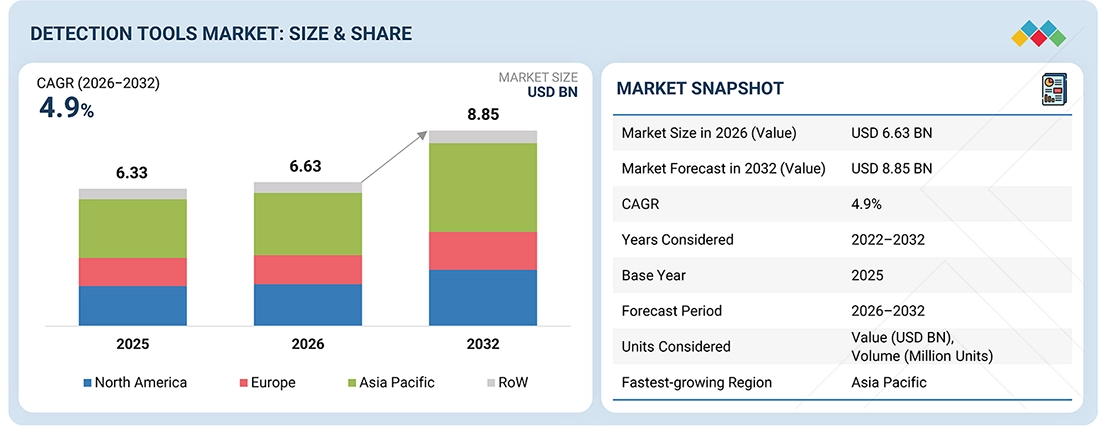
USD 8.85 BN
MARKET SIZE, 2032



Source: Secondary Research, Interviews with Experts, MarketsandMarkets Analysis
The global detection tools market is projected to grow from USD 6.63 billion in 2026 to USD 8.85 billion by 2032, at a CAGR of 4.9% during the forecast period. The demand for detection tools is primarily driven by increasing infrastructure development, expansion of utility networks, and the growing need for safe, accurate, and non-destructive inspection across construction, industrial, and utility applications. Rising investments in transportation, commercial buildings, power distribution, water and gas pipelines, and telecommunications infrastructure have increased the need to detect concealed utilities, reinforcing bars, electrical wiring, and underground assets before drilling or excavation.
DETECTION TOOLS MARKET, BY REGION
By region, North America dominated the market with a share of 33.6% in 2025.
DETECTION TOOLS MARKET, BY PRODUCT TYPE
By product type, the thermal-assisted detection tools segment is expected to register a CAGR of 6.5% from 2026 to 2032.
DETECTION TOOLS MARKET, BY PRICE TIER
By price tier, the radar tools segment is expected to grow at the fastest CAGR of 7.0% during the forecast period.
DETECTION TOOLS MARKET, BY TECHNOLOGY
By technology, the electromagnetic detection segment is expected to dominate the market during the study period.
DETECTION TOOLS MARKET, BY DISTRIBUTION CHANNEL
By distribution channel, the wholesalers/industrial distributors segment is expected to dominate the market during the forecast period.
DETECTION TOOLS MARKET, BY INDUSTRY
The infrastructure & public utilities industry is expected to register the highest CAGR during the forecast period.
COMPETITIVE LANDSCAPE - KEY PLAYERS
Hilti (Liechtenstein), Stanley Black & Decker Inc. (US), Robert Bosch GmbH (Germany), Milwaukee Tool (US), and Leica Geosystems (Switzerland) were identified as some of the star players in the detection tools market, given their strong market share and product footprint.
COMPETITIVE LANDSCAPE - STARTUPS/SMES
PREXISO (Switzerland), Huepar (China), Megger (UK), Proceq (Switzerland), and Extech Instruments (US), among others, have established themselves as specialized players in the detection tools market.
The growth of the detection tools market is accelerated by continuous advancements in sensing technologies, increasing adoption of predictive maintenance, and rising investments in infrastructure modernization across construction, industrial, and utility sectors. The integration of radar, thermal imaging, multi-sensor detection, AI-assisted diagnostics, and wireless connectivity has significantly improved detection accuracy, inspection speed, and operational efficiency. Additionally, the growing emphasis on workplace safety, non-destructive inspection, and asset reliability is encouraging end users to replace conventional inspection methods with advanced detection tools. These factors, coupled with expanding industrial automation and smart infrastructure projects, are driving the widespread adoption of detection tools globally.
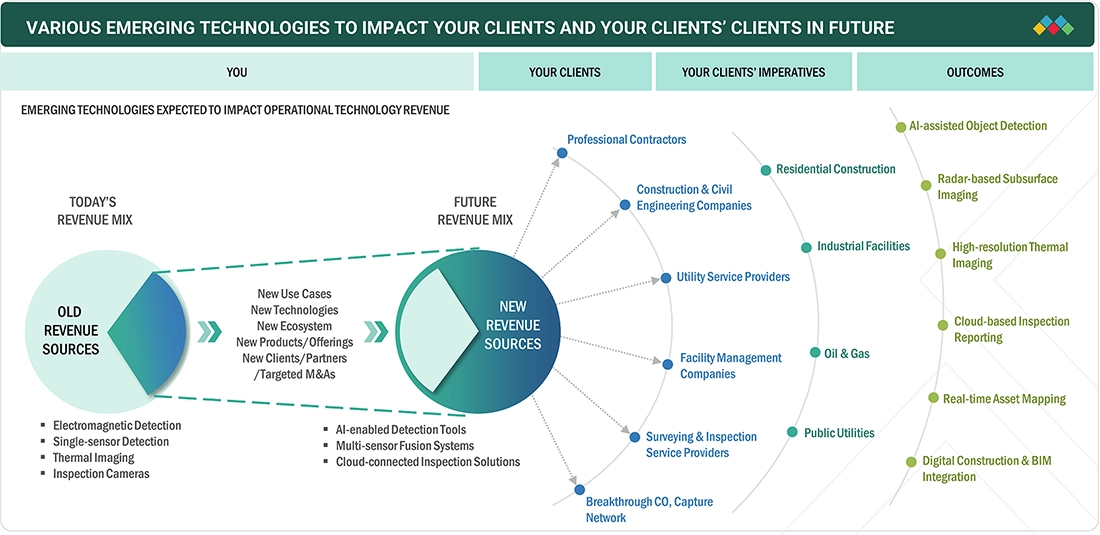
The detection tools market is witnessing rapid technological transformation, driven by the integration of advanced sensing technologies and digital inspection capabilities. Manufacturers are increasingly incorporating radar-based sensing, multi-sensor detection, high-resolution thermal imaging, AI-assisted diagnostics, wireless connectivity, and cloud-based reporting into detection tools to improve accuracy, efficiency, and user experience. At the same time, the market is shifting from conventional standalone devices to smart, connected solutions that support real-time data sharing and predictive maintenance. This technological disruption is enabling faster, more reliable, and non-destructive inspections while expanding the adoption of detection tools across construction, industrial facilities, utilities, infrastructure, and facility management applications.
Source: Secondary Research, Interviews with Experts, MarketsandMarkets Analysis



OPPORTUNITIES
Impact
Level

Source: Secondary Research, Interviews with Experts, MarketsandMarkets Analysis
Rapid investments in transportation, commercial buildings, residential projects, and utility infrastructure are significantly driving the demand for detection tools. Construction contractors and utility operators increasingly rely on these tools to accurately locate underground pipes, cables, reinforcing bars, and other concealed assets before drilling or excavation. This helps prevent accidental damage, improve worker safety, reduce project delays, and minimize repair costs. In addition, the modernization and maintenance of aging utility networks are further accelerating the adoption of advanced, non-destructive detection solutions across infrastructure projects.
The high cost of advanced detection tools remains a key restraint for market growth, particularly among small and medium-sized contractors and businesses with limited capital budgets. Premium products incorporating radar technology, high-resolution thermal imaging, AI-enabled analytics, and wireless connectivity involve higher acquisition and maintenance costs compared to conventional detection tools. This price premium can delay purchasing decisions and limit adoption, especially in price-sensitive markets. Additionally, the need for periodic calibration, software updates, and operator training further increases the total cost of ownership, posing a challenge to widespread market penetration.
The increasing integration of artificial intelligence (AI), wireless connectivity, cloud-based reporting, and advanced sensing technologies presents a significant growth opportunity for the detection tools market. Smart detection tools can automatically identify concealed objects, improve detection accuracy, provide real-time diagnostics, and enable seamless data sharing across connected devices. These capabilities support predictive maintenance, remote inspections, and digital asset management, helping organizations improve operational efficiency and reduce downtime. As industries accelerate digital transformation demand for intelligent, connected detection solutions is expected to create substantial opportunities for manufacturers to develop innovative, value-added products.
Maintaining detection accuracy in complex environments remains a significant challenge for the detection tools market. Factors such as reinforced concrete, dense construction materials, high moisture content, electromagnetic interference, and closely spaced underground utilities can reduce detection precision and increase the likelihood of false positives or missed detections. Variations in material composition and site conditions also affect the performance of wall scanners, utility & pipe detectors, and handheld metal detectors. Consequently, users often require multiple detection technologies or repeated inspections to verify results, increasing inspection time and operational complexity.
| COMPANY | USE CASE DESCRIPTION | BENEFITS |
|---|---|---|
|
|
Bosch develops professional detection tools, including D-tect wall scanners, GTC handheld thermal cameras, and digital measuring devices. These products are used in construction, building renovation, electrical installations, and facility maintenance to detect concealed pipes, live wires, metal objects, and structural elements before drilling or cutting. | Detects multiple concealed materials with high accuracy | Reduces drilling errors and rework | Improves worker safety during construction and maintenance | Enables faster, non-destructive inspections |
|
|
Hilti offers advanced wall scanners, concrete scanners, and detection systems designed for construction, infrastructure, and engineering projects. Its solutions help contractors identify embedded rebar, post-tension cables, conduits, and utilities before coring, drilling, and structural modifications | Minimizes damage to embedded infrastructure | Supports safe drilling in reinforced concrete | Improves productivity on complex construction sites | Enhances project quality and compliance |
|
|
Stanley Black & Decker, through brands such as DEWALT and STANLEY, provides stud finders, wall scanners, thermal imaging solutions, and laser measurement tools. These products support residential, commercial, and industrial construction, enabling users to accurately locate studs, electrical wiring, and metallic objects | Simplifies installation and renovation work | Improves measurement accuracy | Increases jobsite productivity | Suitable for both professional contractors and DIY users |
|
|
Leica Geosystems develops utility detection systems, ground penetrating radar (GPR) solutions, and underground mapping technologies for surveying, utility locating, and infrastructure management. These solutions are widely used before excavation to locate buried utilities and create digital underground asset maps. | Improves underground utility mapping accuracy | Reduces excavation risks and service interruptions | Supports digital construction workflows | Enables efficient infrastructure maintenance |
|
|
Milwaukee Tool offers M12 and M18 inspection cameras (M-Spector series), thermal imagers, and digital inspection solutions for construction, electrical, plumbing, HVAC, and industrial maintenance applications. These products enable technicians to inspect confined spaces and identify equipment issues without disassembly. | Accelerates equipment troubleshooting | Reduces maintenance downtime | Improves technician safety in confined spaces | Supports preventive and predictive maintenance programs |
Logos and trademarks shown above are the property of their respective owners. Their use here is for informational and illustrative purposes only.
The detection tools ecosystem comprises raw material providers, manufacturers, distributors, and end users, each playing a critical role in the value chain. Raw material providers supply essential components such as semiconductor chips, sensors, radar modules, thermal imaging detectors, camera modules, electronic circuits, batteries, plastics, and metal housings used in manufacturing detection tools. Manufacturers integrate these components to develop products such as wall scanners, utility & pipe detectors, handheld metal detectors, handheld thermal cameras, and inspection cameras. These products are distributed through authorized distributors, professional tool dealers, retail stores, e-commerce platforms, and system integrators, ensuring broad market reach. The primary end users include construction companies, industrial facilities, utility operators, infrastructure contractors, facility management firms, and residential users, who utilize detection tools to improve inspection accuracy, enhance worker safety, reduce operational risks, and support non-destructive inspection activities.
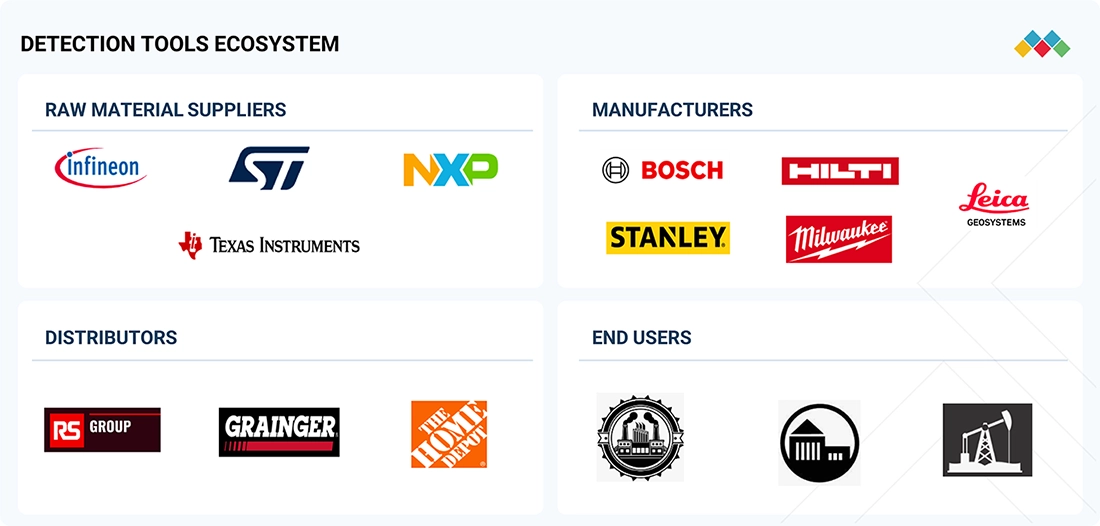
Logos and trademarks shown above are the property of their respective owners. Their use here is for informational and illustrative purposes only.
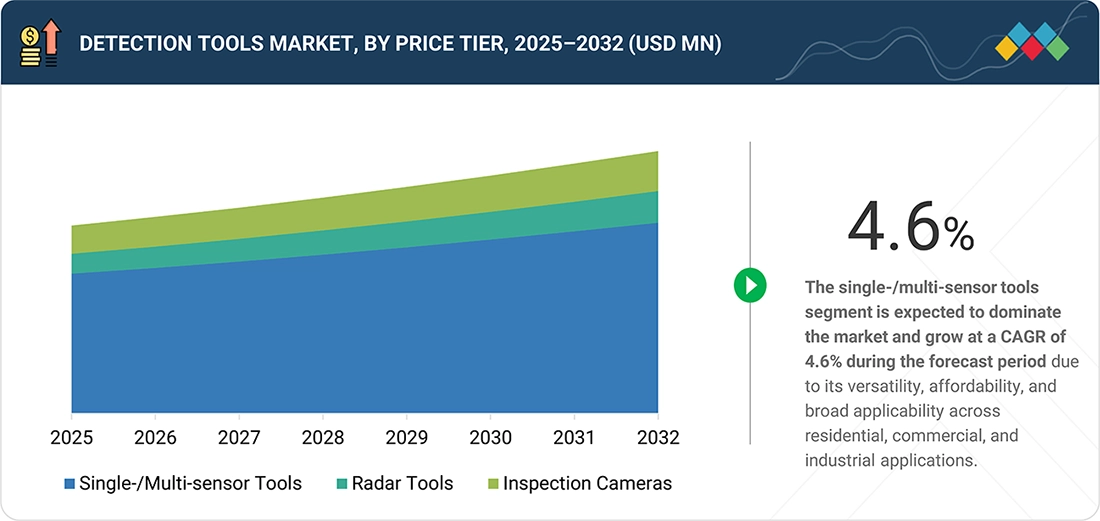
Source: Secondary Research, Interviews with Experts, MarketsandMarkets Analysis
Thermal-assisted detection tools dominate the detection tools market due to their wide applicability across industrial maintenance, electrical inspections, building diagnostics, utilities, and facility management. These tools enable non-contact detection of overheating components, electrical faults, insulation failures, moisture intrusion, and mechanical defects, allowing users to identify potential issues before equipment failure occurs. Their growing adoption is driven by the increasing implementation of predictive maintenance, stringent workplace safety requirements, and the need to improve energy efficiency and asset reliability.
Electromagnetic detection technology dominates the detection tools market due to its widespread adoption in handheld metal detectors, utility & pipe detectors, and wall scanners for locating metallic objects, live electrical wires, underground cables, and conductive pipes. The technology offers an optimal balance of detection accuracy, reliability, portability, and cost-effectiveness, making it suitable for a wide range of construction, utility, industrial, and facility maintenance applications. Its ability to deliver fast, real-time detection with minimal operator training has contributed to its broad acceptance among professional users.
Wholesalers/industrial distributors dominate the distribution channel in the detection tools market due to their extensive reach, established relationships with professional contractors, industrial customers, and utility companies, and their ability to provide a broad portfolio of products from multiple manufacturers. These distributors offer value-added services such as technical support, product demonstrations, after-sales service, calibration, and training, enabling customers to select solutions suited to their applications. Their widespread branch networks, inventory availability, and efficient logistics ensure timely product delivery for large-scale construction, industrial maintenance, and infrastructure projects. As a result, wholesalers and industrial distributors remain the preferred procurement channel for professional users, contributing to their dominant market position.
Industrial facilities dominate the detection tools market due to their continuous need for equipment inspection, preventive maintenance, and workplace safety across manufacturing plants, power generation facilities, oil & gas refineries, mining operations, and process industries. Detection tools such as handheld thermal cameras, inspection cameras, wall scanners, and handheld metal detectors are widely used to identify equipment faults, electrical hotspots, concealed infrastructure, and structural defects without interrupting operations. The increasing adoption of predictive maintenance, and condition monitoring programs is further driving demand for these tools. Additionally, stringent safety regulations and the need to minimize unplanned downtime and maintenance costs continue to reinforce the dominance of industrial facilities in the detection tools market.
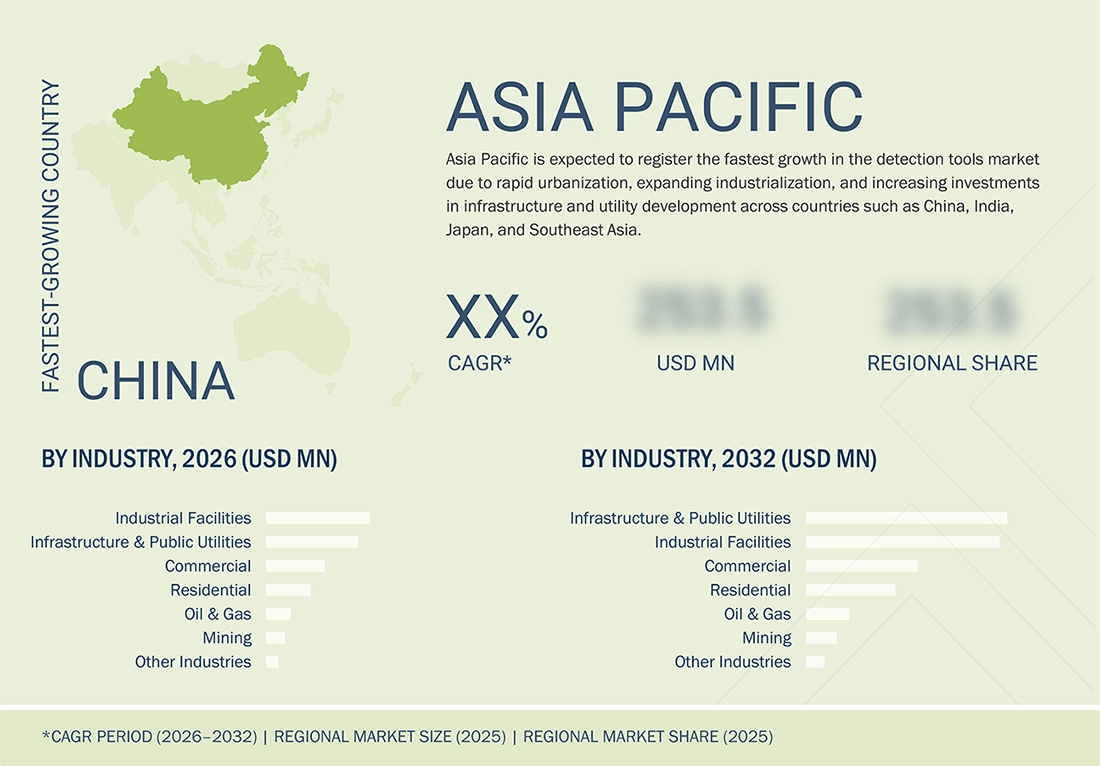
Asia Pacific is expected to register the fastest growth in the detection tools market during the forecast period due to rapid urbanization, industrialization, and increasing investments in infrastructure and utility development across countries such as China, India, Japan, and Southeast Asian nations. Expanding construction activities, growth in manufacturing and energy sectors, and modernization of transportation and utility networks are driving demand for advanced detection tools. Additionally, rising adoption of predictive maintenance, increasing workplace safety awareness, and government initiatives supporting smart cities and industrial development are accelerating market growth. The growing presence of global manufacturers and expanding distribution networks further support the adoption of detection tools across the region.
In the global detection tools market matrix, Stanley Black & Decker (Star) maintains a strong market position through its broad product portfolio, extensive distribution network, and strong brand presence across professional and consumer markets. The company offers a comprehensive range of detection tools, including stud finders, wall scanners, thermal imaging cameras, laser measuring tools, and inspection devices under brands such as DEWALT and STANLEY. ZKTeco (Emerging Player) is strengthening its market presence by expanding its portfolio of handheld metal detectors and security inspection solutions. The company focuses on cost-effective, portable detection devices for applications in public security, transportation, commercial facilities, education, and event venues. Its growing product portfolio, expanding international distribution network, and increasing presence in emerging markets are enhancing its competitive position within the global detection tools market.
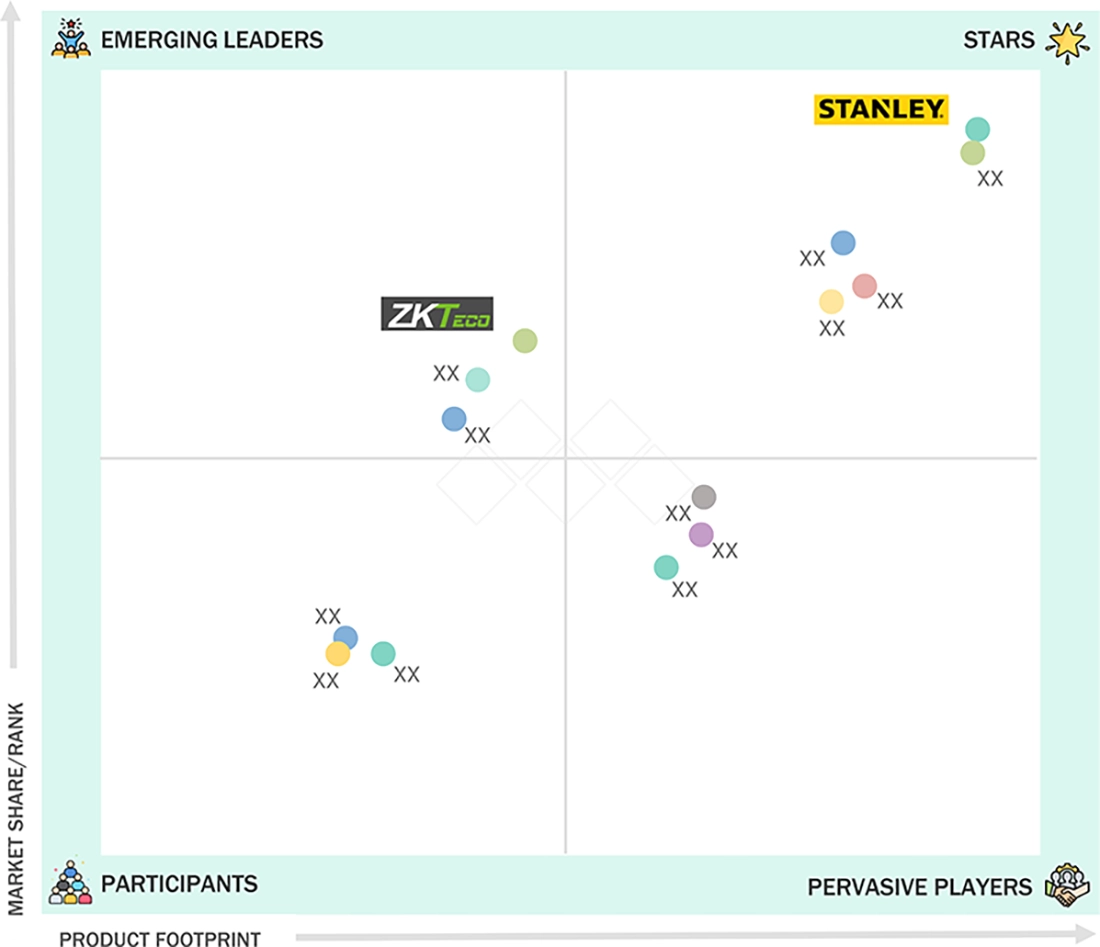
Source: Secondary Research, Interviews with Experts, MarketsandMarkets Analysis
| REPORT METRIC | DETAILS |
|---|---|
| Market Size in 2025 (Value) | USD 6.33 Billion |
| Market Size in 2026 (Value) | USD 6.63 Billion |
| Market Forecast in 2032 (Value) | USD 8.85 Billion |
| Growth Rate | CAGR of 4.9% from 2026–2032 |
| Years Considered | 2022–2032 |
| Base Year | 2025 |
| Forecast Period | 2026–2032 |
| Units Considered | Value (USD BN), Volume (Million Units) |
| Report Coverage | Revenue Forecast, Company Ranking, Competitive Landscape, Growth Factors, and Trends |
| Segments Covered |
|
| Regional Scope | North America, Europe, Asia Pacific, RoW |
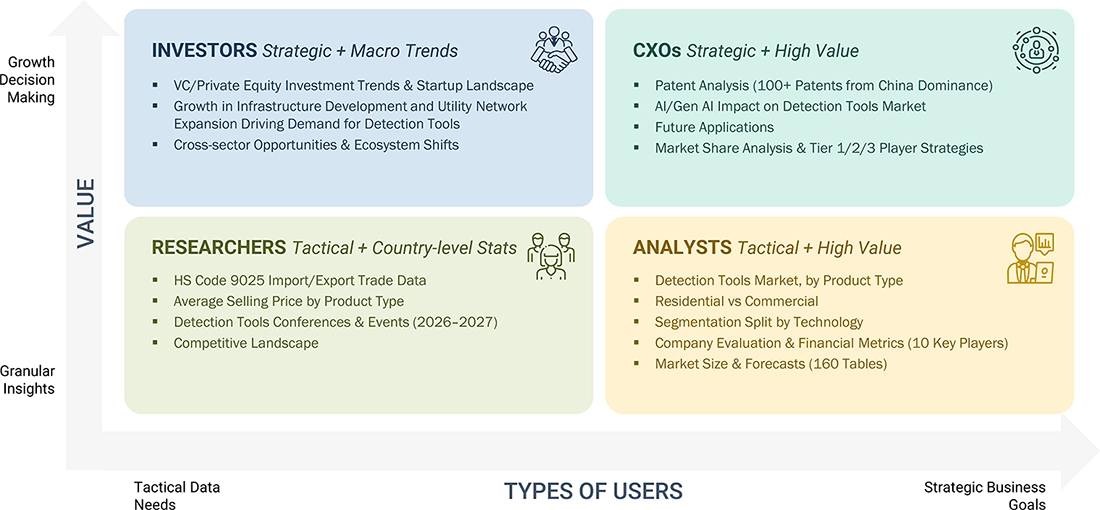
We have successfully delivered the following deep-dive customizations:
| CLIENT REQUEST | CUSTOMIZATION DELIVERED | VALUE ADDS |
|---|---|---|
| Detection Tool Manufacturers |
|
|
| Detection Tool Component Suppliers (Sensors, Thermal Modules, Radar, Camera Modules, Electronics) |
|
|
| Detection Tool End Users (Construction, Industrial, Utilities, Infrastructure) |
|
|
 Exclusive indicates content/data unique to MarketsandMarkets and not available with any competitors.
4
MARKET OVERVIEW
Outlines emerging trends, technology impact, and regulatory signals affecting growth trajectory and stakeholder decisions.4.3
INTERCONNECTED MARKETS AND CROSS-SECTOR OPPORTUNITIES
4.4
STRATEGIC MOVES BY TIER-1/2/3 PLAYERS
5
INDUSTRY TRENDS
Maps the market evolution with focus on trend catalysts, risk factors, and growth opportunities across segments.5.1
PORTER’S FIVE FORCES ANALYSIS
5.2
MACROECONOMIC OUTLOOK
5.2.2
GDP TRENDS AND FORECAST
5.2.3
TRENDS IN GLOBAL MEASURING TOOLS INDUSTRY
5.5.1
AVERAGE SELLING PRICE TREND OF DETECTION TOOLS, BY KEY PLAYER, 2022–2025
5.5.2
AVERAGE SELLING PRICE TREND OF DETECTION TOOLS, BY TYPE, 2022–2025
5.5.2.1
RADAR-BASED TOOLS
5.5.2.2
NON-RADAR-BASED TOOLS
5.5.2.3
INSPECTION CAMERAS
5.5.3
AVERAGE SELLING PRICE TREND, BY REGION, 2022–2025
5.7
KEY CONFERENCES AND EVENTS, 2026–2027
5.8
TRENDS/DISRUPTIONS IMPACTING CUSTOMER BUSINESS
5.9
INVESTMENT AND FUNDING SCENARIO
5.11
IMPACT OF 2025 US TARIFF – DETECTION TOOLS MARKET
5.11.3
PRICE IMPACT ANALYSIS
5.11.4
IMPACT ON COUNTRIES/REGIONS
5.11.5
IMPACT ON INDUSTRIES
6
TECHNOLOGICAL ADVANCEMENTS, AI-DRIVEN IMPACT, PATENTS, AND INNOVATIONS
6.1
KEY EMERGING TECHNOLOGIES
6.2
COMPLEMENTARY TECHNOLOGIES
6.5
IMPACT OF AI ON DETECTION TOOLS MARKET
6.5.1
TOP USE CASES AND MARKET POTENTIAL
6.5.2
BEST PRACTICES IN DETECTION TOOLS MARKET
6.5.3
CASE STUDIES OF AI IMPLEMENTATION IN DETECTION TOOLS MARKET
6.5.4
INTERCONNECTED ECOSYSTEM AND IMPACT ON MARKET PLAYERS
6.5.5
CLIENTS’ READINESS TO ADOPT AI IN DETECTION TOOLS MARKET
7.1
REGIONAL REGULATIONS AND COMPLIANCE
7.1.1
REGULATORY BODIES, GOVERNMENT AGENCIES, AND OTHER ORGANIZATIONS
8
CUSTOMER LANDSCAPE & BUYER BEHAVIOR
8.1
DECISION-MAKING PROCESS
8.2
BUYER STAKEHOLDERS AND BUYING EVALUATION CRITERIA
8.3
ADOPTION BARRIERS & INTERNAL CHALLENGES
8.4
UNMET NEEDS FROM VARIOUS APPLICATIONS
9
PREMIUM RADAR MARKET OPPORTUNITY ANALYSIS
11.5.1
PRICE GAP ASSESSMENT (USD 2,000–8,000)
11.5.2
CUSTOMER REQUIREMENTS DRIVING PREMIUM ADOPTION
10
DETECTION TOOLS MARKET, BY PRODUCT TYPE
Market Size, Volume & Forecast – USD Million10.3
UTILITY & PIPE DETECTORS
10.3.1
CABLE & WIRE DETECTORS
10.4.1
HANDHELD METAL DETECTORS
10.5
VOLTAGE & ELECTRICAL DETECTORS
10.6
THERMAL-ASSISTED DETECTION TOOLS
11
DETECTION TOOLS MARKET, BY TECHNOLOGY
Market Size, Volume & Forecast – USD Million11.2
ELECTROMAGNETIC DETECTION
11.3
RADAR-BASED DETECTION
11.4
ULTRASONIC DETECTION
11.5
INFRARED-BASED DETECTION
11.7
AI-ENABLED SMART DETECTION
12
DETECTION TOOLS MARKET, BY PRICE TIER
Market Size, Volume & Forecast – USD Million12.2.1
LOW PRICE POINT (LPP) - Below USD 50
12.2.2
MID PRICE POINT (MPP) - USD 50–100
12.2.3
HIGH PRICE POINT (HPP) - Above USD 100
12.3.1
LOW PRICE POINT (LPP) - Below USD 400
12.3.2
MID PRICE POINT (MPP) - USD 400–2,000
12.3.3
HIGH PRICE POINT (HPP) - Above USD 2,000
12.4.1
LOW PRICE POINT (LPP) - Below USD 50
12.4.2
MID PRICE POINT (MPP) - USD 50–100
12.4.3
HIGH PRICE POINT (HPP) - Above USD 100
13
DETECTION TOOLS MARKET, BY DISTRIBUTION CHANNEL
Market Size, Volume & Forecast – USD Million13.2
MANUFACTURER DIRECT/WEB STORE
13.3
WHOLESALERS/INDUSTRIAL DISTRIBUTORS
13.4
SPECIALIST TRADE CHANNELS
NOTE: 1-2 EXAMPLES OF COMPANIES OPERATING WITHIN THE DISTRIBUTION CHANNEL ECOSYSTEM IN EACH REGION WILL BE PROVIDED.
14
DETECTION TOOLS MARKET, BY INDUSTRY
Market Size, Volume & Forecast – USD Million14.4
INDUSTRIAL FACILITIES
14.5
INFRASTRUCTURE & PUBLIC UTILITIES
15
DETECTION TOOLS MARKET, BY REGION
Market Size, Volume & Forecast – USD Million15.2.1
COMPETITOR OVERVIEW: RANKING ANALYSIS OF TOP 5 PLAYERS IN NORTH AMERICA
15.3.1
COMPETITOR OVERVIEW: RANKING ANALYSIS OF TOP 5 PLAYERS IN EUROPE
15.4.1
COMPETITOR OVERVIEW: RANKING ANALYSIS OF TOP 5 PLAYERS IN ASIA PACIFIC
15.4.7
REST OF ASIA PACIFIC
15.5.1
COMPETITOR OVERVIEW: RANKING ANALYSIS OF TOP 5 PLAYERS IN ROW
15.5.4.2
REST OF SOUTH AMERICA
16.2
KEY PLAYER STRATEGIES/RIGHT TO WIN
16.3
REVENUE ANALYSIS, 2021–2025
16.4
MARKET SHARE ANALYSIS,
16.5
BRAND/PRODUCT COMPARISON
16.6
COMPANY EVALUATION MATRIX: KEY PLAYERS,
16.6.5
COMPANY FOOTPRINT: KEY PLAYERS,
16.6.5.1
COMPANY FOOTPRINT
16.6.5.2
REGION FOOTPRINT
16.6.5.3
PRODUCT TYPE FOOTPRINT
16.6.5.4
INDUSTRY FOOTPRINT
16.7
COMPANY EVALUATION MATRIX: STARTUPS/SMES,
16.7.1
PROGRESSIVE COMPANIES
16.7.2
RESPONSIVE COMPANIES
16.7.5
COMPETITIVE BENCHMARKING: STARTUPS/SMES,
16.7.5.1
DETAILED LIST OF KEY STARTUPS/SMES
16.7.5.2
COMPETITIVE BENCHMARKING OF KEY STARTUPS/SMES
16.8
COMPANY VALUATION AND FINANCIAL METRICS
16.9
COMPETITIVE SCENARIO
17.2.5
JOHNSON LEVEL & TOOL
17.2.7
MAKITA CORPORATION
17.2.11
ROBERT BOSCH GMBH
17.2.12
STANLEY BLACK & DECKER
17.2.13
TOPCON CORPORATION
17.2.15
ZIRCON CORPORATION
18.1.1.1
KEY DATA FROM SECONDARY SOURCES
18.1.2.1
KEY DATA FROM PRIMARY SOURCES
18.1.2.2
KEY PRIMARY PARTICIPANTS
18.1.2.3
BREAKDOWN OF PRIMARY INTERVIEWS
18.1.2.4
KEY INDUSTRY INSIGHTS
18.2
MARKET SIZE ESTIMATION
18.2.1
BOTTOM-UP APPROACH
18.2.3
BASE NUMBER CALCULATION
18.3
MARKET FORECAST APPROACH
18.6
RESEARCH ASSUMPTIONS
18.7
RESEARCH LIMITATIONS AND RISK ASSESSMENT
The research process for this study involved systematic gathering, recording, and analysis of data on customers and companies operating in the detection tools market. This process involved the extensive use of secondary sources, directories, and databases (Factiva and OANDA) to identify and collect valuable information for the comprehensive, technical, market-oriented, and commercial study of the detection tools market. In-depth interviews were conducted with primary respondents, including experts from core and related industries, as well as preferred manufacturers, to obtain and verify critical qualitative and quantitative information and assess growth prospects. Key players in the detection tools market were identified through secondary research, and their market rankings were determined through a combination of primary and secondary research. This research involved studying the annual reports of top players and conducting interviews with key industry experts, including CEOs, directors, and marketing executives.
Secondary ResearchVarious sources were utilized in the secondary research process to identify and collect information relevant to this study. These include company annual reports, press releases, investor presentations, white papers, technology journals, certified publications, articles by recognized authors, directories, and databases
Secondary research was primarily used to gather key information on the industry’s value chain, the total pool of market players, market classification by industry trends at the most detailed level, regional markets, and key developments from both market- and technology-oriented perspectives.
Primary ResearchPrimary research was also conducted to identify the segmentation types, key players, competitive landscape, and key market dynamics, including drivers, restraints, opportunities, challenges, and industry trends, as well as the key strategies adopted by players operating in the detection tools market. Extensive qualitative and quantitative analyses were conducted across the complete market engineering process to present key information and insights throughout the report.
Extensive primary research has been conducted following secondary research that provided insight into the detection tools market. Several primary interviews were conducted with experts from the demand side (industry and region) and the supply side (product type, price tier, distribution channel, and technology) across four major geographic regions: North America, Europe, Asia Pacific, and the RoW. Approximately 60% and 40% of the primary interviews were conducted from the supply and demand sides, respectively. These primary data have been collected through questionnaires, emails, and telephonic interviews

Notes: The three tiers of companies have been defined based on their total/segmental revenue as of 2025: Tier 1 = > USD 1 billion, Tier 2 = USD 1 billion–USD 500 million, and Tier 3 = < USD 500 million.
Other designations include sales, marketing, and product managers.
To know about the assumptions considered for the study, download the pdf brochure
In the complete market engineering process, top-down and bottom-up approaches, along with several data triangulation methods, were used to estimate and validate the size of the detection tools market and various other dependent submarkets. Key market players were identified through secondary research, and their market shares in each region were determined through a combination of primary and secondary research. This research methodology involved analyzing the annual and financial reports of the top players and conducting interviews with experts (including CEOs, VPs, directors, and marketing executives) to gather key insights (both quantitative and qualitative).
All percentage shares, splits, and breakdowns were determined using secondary sources and verified through primary sources. All possible parameters affecting the markets covered in this study were accounted for, examined in detail, verified through primary research, and analyzed to obtain final quantitative and qualitative data. This data was consolidated and supplemented with detailed inputs and analysis from MarketsandMarkets and presented in this report.
Detection Tools Market : Top-Down and Bottom-Up Approach
After determining the overall market size through the estimation process, as explained above, the total market was divided into several segments and subsegments. To complete the overall market engineering process and obtain precise statistics for all segments and subsegments, the data triangulation procedure was employed, as applicable. The data was triangulated by studying various factors and trends from the demand and supply sides. Additionally, the market has been validated using both top-down and bottom-up approaches.
The detection tools market comprises portable electronic devices used to locate, identify, and inspect concealed objects, underground utilities, and equipment anomalies without causing damage. The market includes wall scanners, utility & pipe detectors, handheld metal detectors, handheld thermal cameras, and inspection cameras, which are widely used across construction, industrial facilities, infrastructure & public utilities, and residential applications. These tools improve safety, inspection accuracy, and operational efficiency by enabling non-destructive detection of hidden structures, electrical components, pipelines, and mechanical defects.
With the given market data, MarketsandMarkets offers customizations according to the company’s specific needs. The following customization options are available for the report:


Business Development Manager-Technology Business
Leading Japanese MNC specializing in optics and imaging products
MarketsandMarkets™ response is quick. Their attitude is flexible and positive. Analyst Insights are globally considered and significant. Client Services quickly respond to our inquiry and demand. Their wide range of global surveys help us make our strategic plan.
We hope Knowledge Store will be easier to search for a report.
We engaged with MarketsandMarkets on a study to perform an analysis and recommend a Go-To-Market strategy for metrology and process control in the semiconductor market. The study was tailored to our targets and needs with well-defined milestones. Our overall experience with the MarketsandMarkets team was very good throughout the project in all aspects including the analysis methodologies used, the quality and depth of primary and secondary data sets, the professionalism and flexibility of the team and the ability to meet the target schedule and milestones. We want to thank MarketsandMarkets team for a job well done.