Просмотр новости
Найдите то, что Вас интересует
 Спутники
 РН
 SpaceX
 Роскосмос
 NASA
СпутникиРНSpaceXРоскосмосNASANew data reveals the relationship between staff presentation, in-store experiences, and retail’s bottom line, writes James Knowles. In today’s competitive retail environment where every penny is hard won from a consumer continuously buffeted by rising costs and shrinking earnings, retailers are under pressure to ensure stores provide experiences and drive profits. This means leaving no...
New data reveals the relationship between staff presentation, in-store experiences, and retail’s bottom line, writes James Knowles.
In today’s competitive retail environment where every penny is hard won from a consumer continuously buffeted by rising costs and shrinking earnings, retailers are under pressure to ensure stores provide experiences and drive profits.
This means leaving no commercial stone unturned. Everything from the fit-out, layout, the product itself, the music, lighting, scent, and service matters in terms of the impact they make on consumers.
That includes uniforms. New data suggests that they might be even more important than most realise.
A new report from leading uniforms provider Murray, Before a word is spoken, sheds light on this often-overlooked facet of the retail experience. The report features findings from a World Retail Congress survey of 2,500 UK consumers about how they feel about interacting with uniformed staff. Alongside that, it also includes data from Coventry University about how uniforms make employees feel when they wear them.
Both studies provide striking results.
Uniform expectations in retailWhen asked if they expect to see employees wearing uniforms, 59 per cent say they ‘always’ or ‘often’ expect to see them being worn.
 That figure rises to 60% of women. Surprisingly this is particularly the case among younger generations – 62 per cent of Generation Z, the highest cohort, followed by 61 per cent of Millennials and Generation X. By contrast that figure falls to 55 per cent of Boomers and just 37 per cent of the Silent Generation.
James Flower, retail policies and operations manager at cardfactory, says that in the business’ own data he sees that consistent presentation and clear branding help reinforce consumer confidence and support the customer experience.
“The findings reinforce that well-designed, practical and inclusive uniforms support confidence, professionalism and brand consistency. For cardfactory uniform is considered an enabler of both colleague engagement and the overall customer experience,” he says.
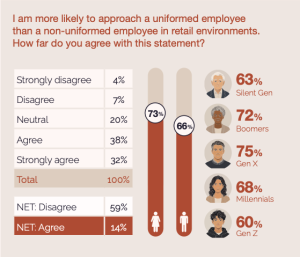 One of the key benefits identified in the research is that 77 per cent of consumers are more likely to approach uniformed retail staff.
This is particularly the case for women (73 per cent) and older consumers (75 per cent of Gen X and 72 per cent of Boomers).
Uniforms help employees stand out in busy retail environments, whereas if consumers can’t easily and quickly identify someone to help they spend longer searching or eventually just abandon their basket.
This is exactly the case for B&Q, says contract services manager Alicia Liddell. “What we sell could be someone’s first project in their home and they could be spending thousands of pounds. Uniforms help the customer identify colleagues quickly and have the trust that they have the expertise to help them,” she says.

Michelle Cemm, chief people officer at OurCoop, agrees: “Automation is a really big thing. We now have electronic shelf-edge labels and self-scanning tolls, so in a busy retail environment you need to be able to spot someone quickly if you have a question. We’re smaller format stores so our colleagues no do everything in stores, they don’t just sit on a till.”
She adds: “Unfortunately we also have a lot of retail crime, so our colleagues wear bodycams and headsets. For a customer who is having a problem they need to be able to quickly identify a member of staff who can help them, call the police, step in or record something that is happening. Uniforms give reassurance that someone is trained and can handle difficult situations.”
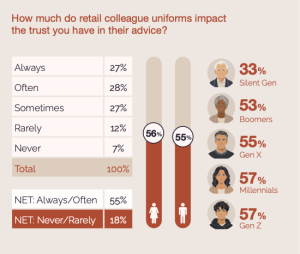 Trust is particularly important in retail. Consumers rely on staff advice around products, pricing, and suitability, and expect personalised service, particularly in sectors such as fashion or luxury goods.
The consumer research study found that 55 per cent said employee uniforms ‘always’ or ‘often’ affect how much they trust advice from staff. Results are consistent across men at 55 per cent and women at 56 per cent, while Generation Z and Millennials are slightly higher than other cohorts at 57 per cent.
This is important because it means uniformed staff have a distinct advantage when trying to upsell or resolve customer concerns positively, while appearing credible and professional.
Impact on purchasing behaviourThe research also shows a clear line between employee presentation and consumer spending behaviour.
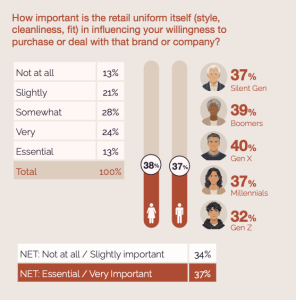 Some 37 per cent say the style, cleanliness and fit of uniforms are ‘absolutely essential’ or ‘very important’ in influencing purchases or dealing with a business, rising to 40 per cent among Generation X consumers.
The study by Coventry University shows that wearing uniforms also have a positive correlation between employee happiness and engagement.
Retail workers were asked to rate a series of statements from 1 (negative) to 10 (positive) about wearing uniforms. When asked how they feel about wearing uniforms, the study found a mean score of 6.57, while ‘I take pride in it’ was rated slightly higher at 6.59.
When asked exactly how wearing their uniforms make them feel, ‘proud’ was rated 6.42, ‘confident 6.25’, and ‘part of a team’ 7.36. While negative sentiments such as ‘dread’ and ‘embarrassed’ were rated lowly, at 3.37 and 3.27 respectively.
B&Q’s Liddell agrees with these findings, having seen the confidence uniforms give staff first-hand. “We found that when we started working with Murray. They did listening exercises with our stores and there was overwhelming feedback that colleagues were not confident approaching customers in our uniform and the way it made them feel,” she explains.
As a result, B&Q worked with Murray to evolve its uniform to build confidence among staff and help them better engage with customers. She adds: “Our ethos is make every customer count and increase that average transaction value, because a lot of our customers don’t always know everything they need to finish a project. So our colleagues are invaluable in that.”
Both the consumer and employee research shows a clear connection between uniformed staff, great in-store experiences, and commercial performance.
In an economically uncertain climate where spending decisions continue to be considered, the importance of trust within retail environments become even greater. In tandem, uniformed employees feel better seen, heard and able to do their jobs, and therefore, better positioned to drive positive outcomes. Something all retailers need right now.
To read the full report, click here
Click here to sign up to Retail Gazette‘s free daily email newsletter
| # | Наименование новости | Тональность | Информативность | Дата публикации |
|---|---|---|---|---|
| 1 | Will AI choose what shoppers buy before they reach the store? | 0 | 7.67 | 26-10-2026 |
| 2 | Store-watch: Islander plots expansion south, while Crisis gives unsold fashion a second life | 0 | 11.03 | 26-10-2026 |
| 3 | Машинное обучение в ритейле: где оно реально работает, что мешает и зачем в Set Loyalty начали свой ML-эксперимент | 0 | 7.62 | 30-06-2026 |
| 4 | Спрос на курьеров начал снижаться | -2 | 6 | 13-08-2025 |
| 5 | Стол заказов: продуктовые ретейлеры масштабируют ресторанный бизнес | 0 | 10 | 14-10-2026 |
| 6 | Согласных уйти на работу к конкурентам больше всего среди молодых мужчин | 0 | 9.22 | 13-08-2026 |
| 7 | Согласных уйти на работу к конкурентам больше всего среди молодых мужчин | 0 | 9.22 | 13-08-2026 |
| 8 | Heatwave hits sales at Topps Tiles as tradesmen down tools | -2 | 6 | 01-07-2026 |
| 9 | «ЮMoney» и «Cбер2B»: средние траты на школьную одежду достигли 13 306 рублей в 2026 году | 0 | 28.52 | 26-08-2026 |