Просмотр новости
Найдите то, что Вас интересует
 Спутники
 РН
 SpaceX
 Роскосмос
 NASA
СпутникиРНSpaceXРоскосмосNASAThe country's first all-display fresh seafood auction would love to attract more and bigger boats, but small hauls have an upside.
 Seafood grader Emma Balboni counts and grades haddock at the Portland Fish Exchange before a mid-September auction. (Shawn Patrick Ouellette/Staff Photographer)
Steve Newman, a national account manager for Browne Trading Company, attended his first auction at the Portland Fish Exchange as a buyer three years ago.
He’d grown up attending livestock auctions in Florida with his great-grandfather, and remembers them as pretty lively affairs. By contrast, the Portland auction was quiet as cod on ice.
“I kind of had this vision of it being kind of cutthroat, a bunch of people fighting over monkfish tails,” Newman said. “That was what I was expecting, and it certainly wasn’t.”
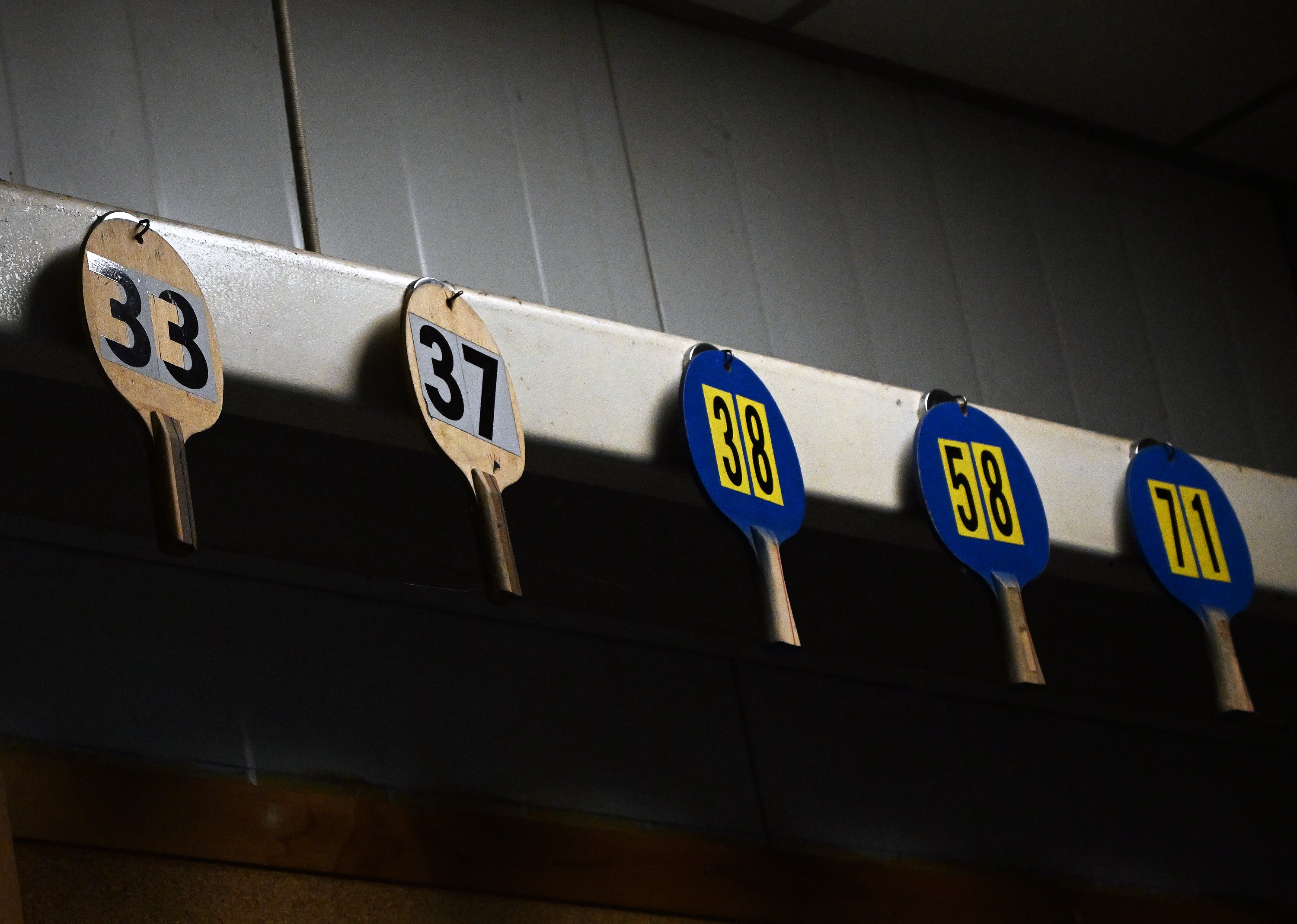 Auction paddles from years past on the auction room wall at the Portland Fish Exchange. (Shawn Patrick Ouellette/Staff Photographer)
Purchase this image
Numbered ping-pong paddles hang on the auction room wall, relics of the exchange’s heyday back in the 1980s and ’90s, when all the buyers were in the room, vying for the lowest prices on the finest lots of seafood. The exchange opened on Commercial Street’s waterfront in 1986 as America’s first all-display fresh seafood auction. But since 2010, the auction has been silent, conducted by computer, with most buyers placing bids remotely from Portland and around the Northeast.
The sedate auction room handles a lower volume of seafood today than in the past, about 70,000 pounds a week in the summer, 50,000 a week in the colder months. On a Monday morning in mid-September, three boats unloaded about 12,000 pounds of groundfish. Pollock, hake, cod, dab, grey sole, monkfish and more were sorted into bins and displayed on the auction show floor, a 22,000-square-foot refrigerated warehouse space.
“The old-timers will tell you there was 300,000 pounds of fish in here, and it was stocked up to the ceilings,” said the exchange’s seafood grader, Emma Balboni, as she inspected groundfish before the 10 a.m. auction. “This is a very small auction compared to what they were doing in the ’80s and ’90s.”
The nonprofit exchange has struggled financially over the past couple of decades. It needed a bailout from the city-owned Portland Fish Pier Authority in 2020 to stay in business, and was in danger of closing at the tail end of the pandemic. Exchange leadership and auction buyers would love more boats to bring their fish here instead of the auctions in Massachusetts. But there’s an upside: The Portland Fish Exchange tends to attract smaller boats on shorter trips, so the fish are often fresher and better quality.
“Portland (Fish Exchange) has a great reputation because they handle nothing but what I would call short-trip or day-boat fishery,” said Nick Alfiero, co-owner of Harbor Fish Market, who routinely buys from the auction and previously served on the exchange’s board of directors.
“We are a higher-quality auction, and everybody knows that,” said fish exchange General Manager Robert Vanmeter. “That’s why we generally get more money for our fish, and we have a lot of happy return customers.”
IMPROVING FISH GRADESIndeed, some of the exchange’s fish supplies the country’s most discerning customers. At the Monday auction, Newman bought 300 pounds of hake that went directly to Le Bernardin in Manhattan, legendary Chef Eric Ripert’s three-Michelin-star seafood palace.
After boats unload their hauls at the exchange, a team of processors sorts them into bins by size and species. Then they forklift them to the auction floor, where Balboni proceeds to inspect them and assign letter grades, from A to F. Buyers use her grades for guidance in placing their bids, though they can also judge for themselves from photos she sends them before the auction; any buyers at the exchange can also examine the fish in person.
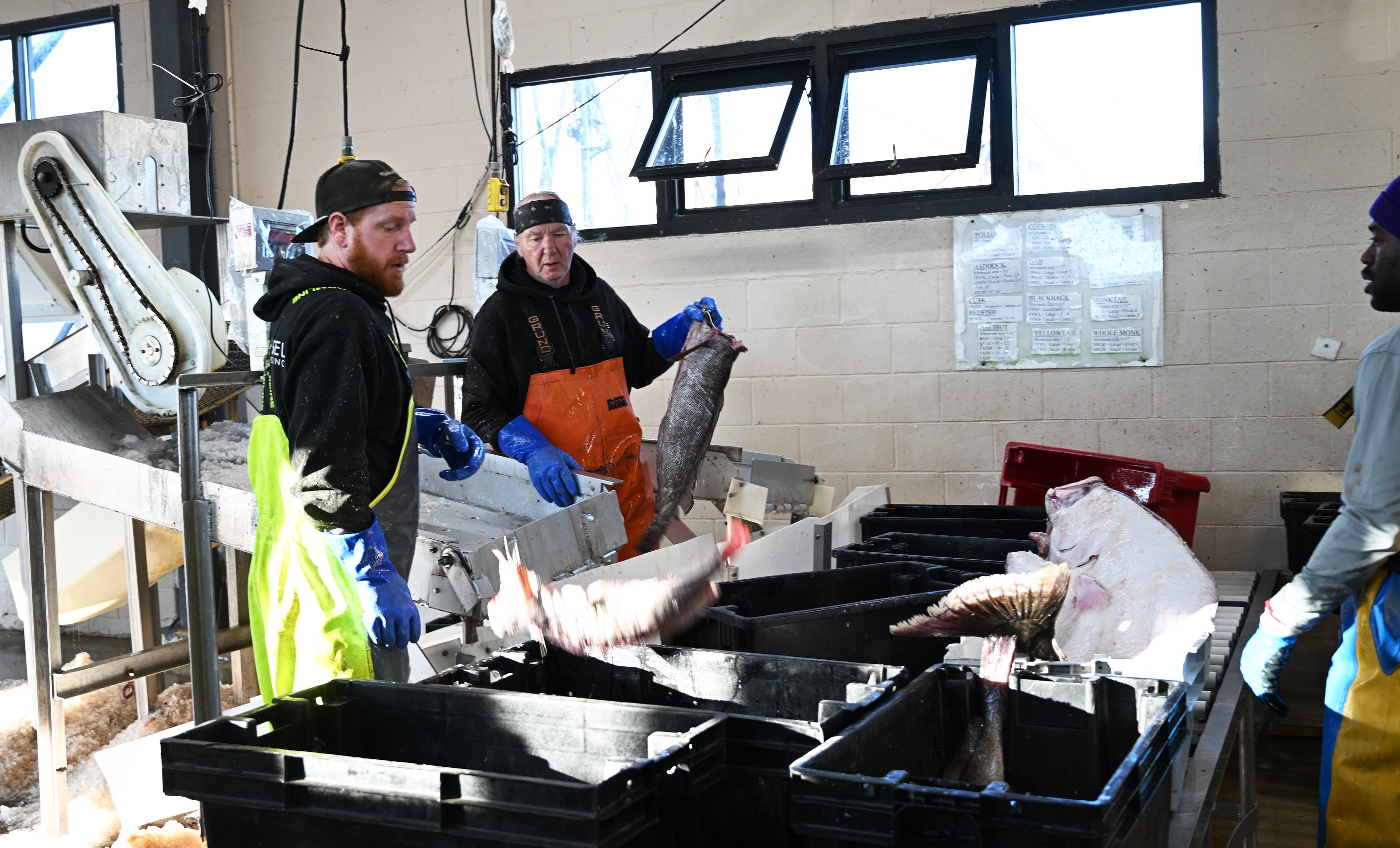 Workers on the processing line sort fish as they arrive at the Portland Fish Exchange. (Shawn Patrick Ouellette/Staff Photographer)
Purchase this image
Rod and reel commercial fishermen tend to get the highest grades, Balboni said, since their small catches are usually subject to less mishandling. She’s only been on the job since early August, having taken over from longtime grader Sandy MacIver, but Balboni’s lowest grade so far for fish caught by any method was a C.
A couple hours before the Monday auction, Balboni sifted through a batch of dab, keeping an eye out for skin bruises. Fish can sustain bruising as they collect underwater in the nets, when they’re hauled aboard or stored in the boat’s hold, or even as they’re unloaded at the exchange.
Balboni also inspects meat color and looks for tears in the skin or flesh; blue belly (from blood settling on the belly side of flatfish); or torn membranes that indicate belly burn. She presses the meatiest part of the fish like a chef checks the doneness of a steak: With older, deteriorating meat, the indentation from her finger won’t spring back. She tests for rigor — the stiffer and straighter it stays when held horizontally by the tail, the fresher the fish.
“I grew up on the ocean,” said Balboni, 25, a native of southeastern Massachusetts. “Salt is in my blood. I ate more fish by the time I was 4 probably than most adults did.”
Balboni said she and her dad are “hardcore” recreational fishermen. She holds a bachelor’s degree in marine science from Unity College, and ran a lobster pound in Boothbay Harbor for five years before joining the fish exchange. “I grew up looking at fish quality. It comes naturally when you handle fish often. You know what to look for.”
Balboni calls MacIver her mentor, and said she strived to make the transition between their tenures as seamless as possible. “The only thing I’m doing a little bit differently is having more open communication with the captains.”
She’s already started to provide the boat captains who sell to the exchange with radar graphs to show them how their fish is faring in the grading process. She wants them to understand how they can boost the quality of their fish (and their selling price) by better insulating their holds, for instance, or being more aware of high air and water temperatures in the Gulf of Maine at certain times of year.
“Ninety percent of the captains are very excited,” she said. “They love to know what’s going on with their fish and how they can improve.”
“With her in that position, it will be exponentially better for sellers,” said Devyn Campbell, an exchange seller and boat captain out of Boothbay Harbor. “What she’s doing has essentially been a missing link there for a long time. For people who want to use the tool, and I think they will, it’ll be a game-changer in getting a more uniform quality standard.”
“We’re so lucky to have her,” Vanmeter said of Balboni. “She’s an innovator for sure. Her whole focus is on giving the best grades possible and helping (sellers) give us better grade fish.”
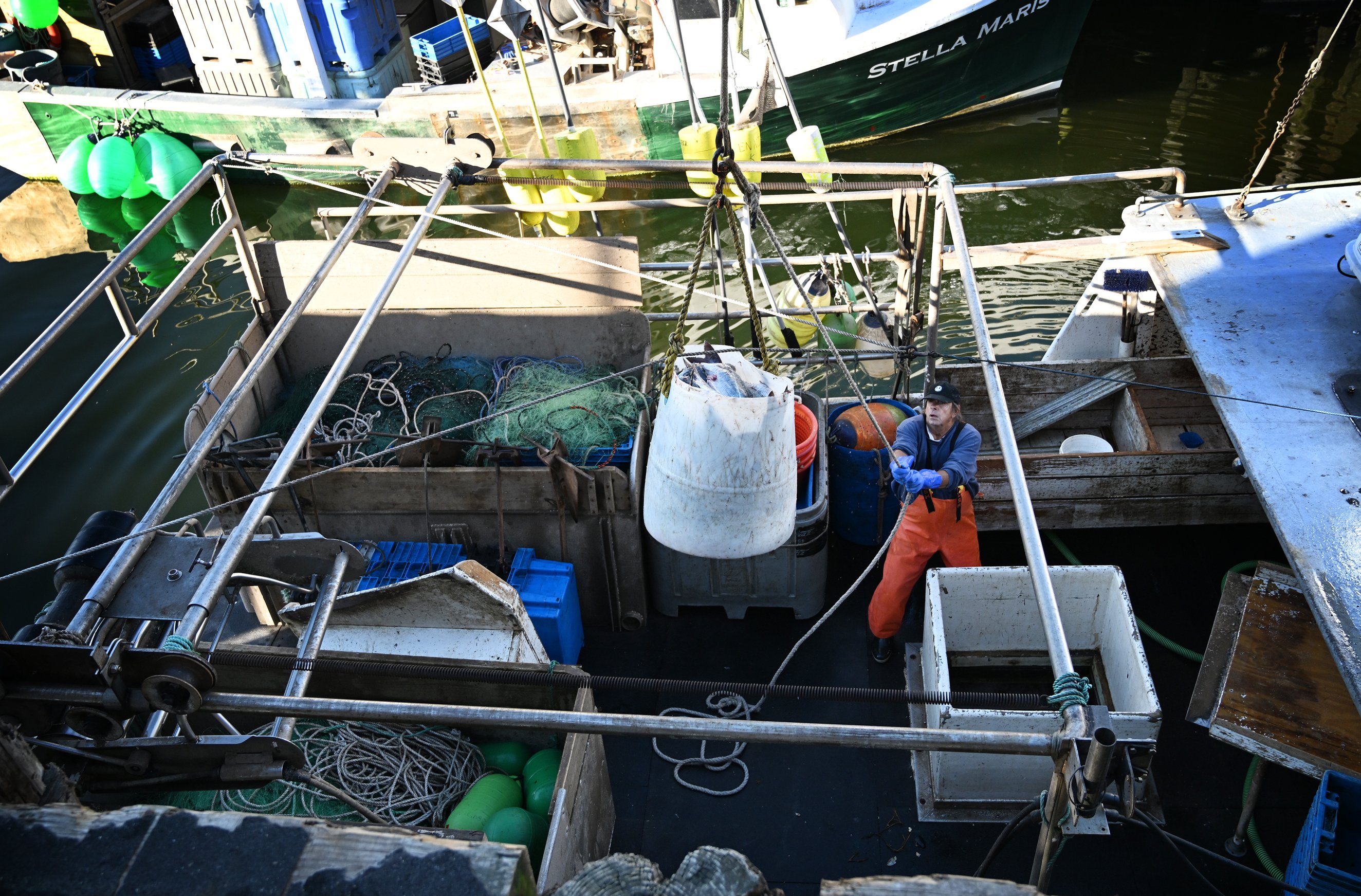 A fisherman raises a barrel of pollock from the boat hold. The barrel is emptied into a chute that feeds a conveyor belt on the processing line at the Portland Fish Exchange. (Shawn Patrick Ouellette/Staff Photographer)
Purchase this imageTHE STICKING POINT
The Portland Fish Exchange handles a variety of seafood, but predominantly groundfish — more than 90% of Maine’s total groundfish catch.
“I dream of a day when we can reintroduce more boats and species into (the exchange),” Newman said.
Many insiders boil the problem down to one word: lobsters.
Groundfishermen on larger vessels often pull drag nets along the sea bed, which naturally scoops up a certain amount of lobsters. But state regulations prohibit fishermen without lobster licenses from landing their lobster bycatch in Maine. So bigger boats take their hauls to auctions in Massachusetts, where they can land up to 500 lobsters per trip.
“In a good year, a bycatch of lobster can generate six figures for these guys,” said Vanmeter, who has tried to lobby for a regulation change that would allow Maine fishermen to land lobsters along with their regular catches at the Portland Fish Exchange.
“I’ve brought that up multiple times in my tenure as general manager, and I’ve been repeatedly told it’s a lost cause. The city of Portland has subsidized us for at least the past 10 years. Without more fish, we’ll be continuing to count on the city to keep us afloat.”
Representatives of the Maine Lobstermen’s Association did not respond to multiple requests for an interview for this story.
Campbell feels it’s a misconception that big boats go to other auctions, like the Cape Ann Seafood Exchange in Gloucester, Mass., just because they can sell lobster. He said the fuel there is cheaper, facilities are more accommodating for larger vessels, and the market is stable for fish that’s been on a boat for five to seven days.
Regardless, lobsters remain a sticking point. Alfiero said he’s suggested allowing groundfishermen to put their lobster bycatch in crates and ship it out of state for sale. “But there are people in the state who won’t want to see that law changed.”
Vanmeter noted that the last time a lobster bycatch regulation change was proposed to the Legislature in 2013, it failed. “You have 5,000 lobstermen in Maine,” he said, “and you have 20 or 25 fishermen at the Portland Fish Exchange.”
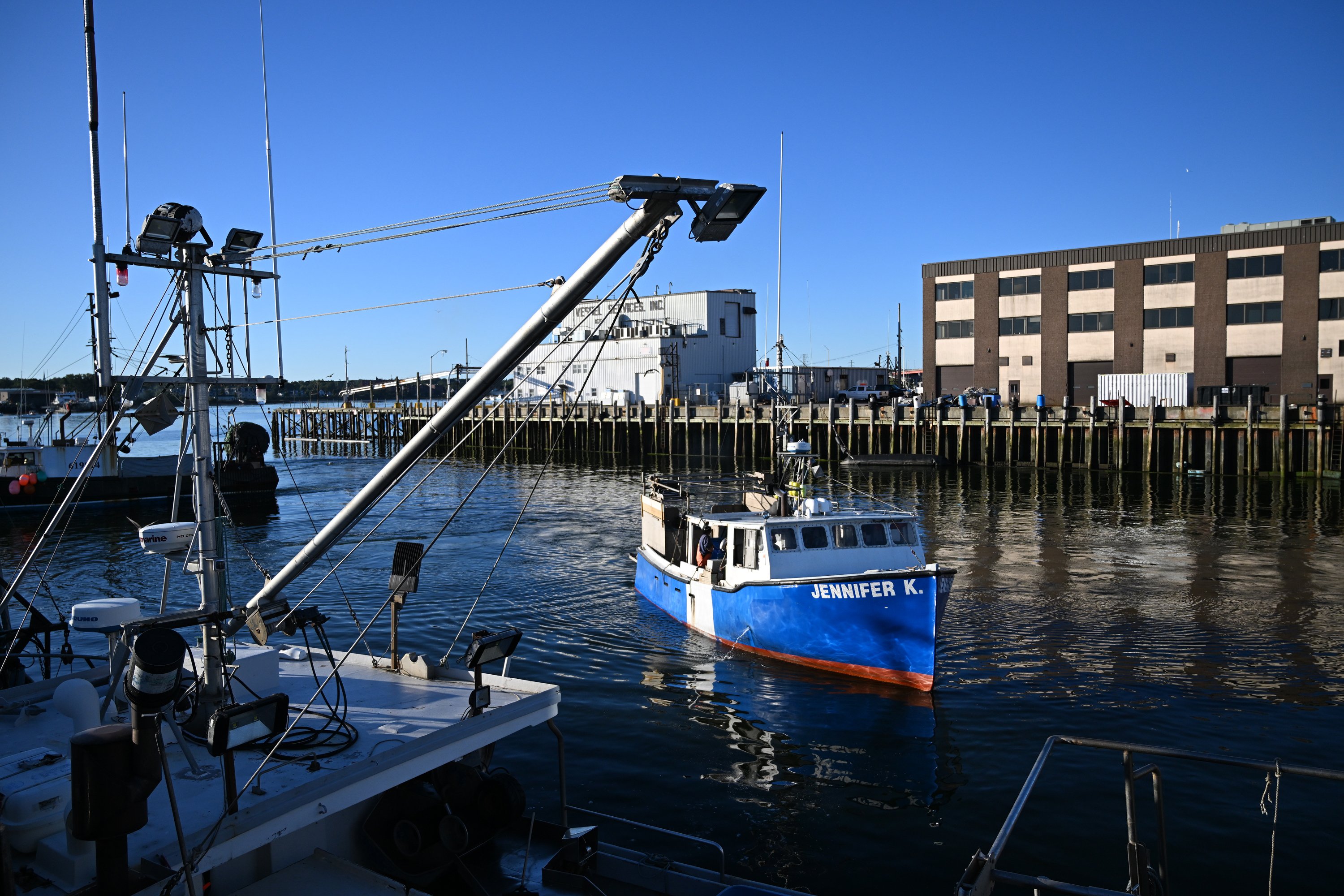 Fishing vessels arrive at the Portland Fish Exchange on a recent Tuesday morning to unload their catch. (Shawn Patrick Ouellette/Staff Photographer)
Purchase this imageREVENUE STREAMS TO STAY AFLOAT
The Portland Fish Exchange and its auction were originally created so fishermen and buyers could do their business in state, supporting and maintaining the local fishing fleet in the process. “The boats benefited, we as dealers benefited, and everything was transparent,” said Alfiero. “The transparency really changed that whole industry in Portland in the ’80s.”
But Alfiero said exchange leadership has always tried to find ways to attract more sellers, even in the ’90s when it was handling up to 500,000 pounds of seafood a week, with processors working on three shifts.
The numbers are at least trending in the right direction. Vanmeter forecasts the exchange will handle about 2 million pounds of seafood in the current fiscal year. Last year it did 1.9 million pounds, and 1.8 million the year before.
“We’ve been pretty steadily getting slightly more volume the past few years,” said auctioneer’s assistant James Needelman, noting that the COVID era dramatically hampered business. “I think we’re just slowly building back from how far back we were set.”
Alfiero calls the exchange a “huge asset” for the state, and Portland in particular. “I think it gives Portland a bit of cachet to say we offload fishing boats and we’re a waterfront community,” he said. “And it helps support the working waterfront, which has been part of Portland’s calling card for centuries.”
“It’s a really important part of the Portland waterfront, and the state’s seafood economy,” agreed Heather Moretti, the city’s waterfront coordinator.
Still, outside of the marine community, the exchange remains one of the best-kept secrets in the city. Vanmeter said during a Portland waterfront walk event last year, more than 200 groups came through the facility for a quick tour. “And I would guess 95 percent of them didn’t even know the auction was there.”
To combat financial losses and make operations more efficient, the exchange merged two years ago with its landlord, the Portland Fish Pier Authority. But without more incoming vessels on the horizon, the search is on for other revenue streams. Vanmeter has brought in eight new buyers in the past few years, and secured more tenants for their Commercial Street property, such as Look Lobster Co.
Moretti said the exchange facility now stores bait as well as oyster seed for aquaculture operations. The University of Maine’s Pelagic Fisheries Lab also dissects and studies bluefin tuna heads there during the summer months. She said the Portland Fish Pier Authority board will meet later this year to discuss their vision for the exchange’s future.
“That’s what the board has been thinking about the past few years — other activities we can add to what the exchange already does, and thinking through additional sources of revenue,” Moretti said. “Hopefully it will evolve as the marine economy evolves.”
| # | Наименование новости | Тональность | Информативность | Дата публикации |
|---|---|---|---|---|
| 1 | USDA considers adapting farm-style safety net for fishermen | 0 | 34.53 | 02-10-2026 |
| 2 | After peak season, Maine restaurants prep for a slower pace | 0 | 34.37 | 20-10-2026 |
| 3 | Lawsuit alleges Hannaford improperly markets some salmon products as sustainable | 0 | 37.55 | 14-10-2026 |
| 4 | Lucky Sevens set to open Friday in Portland’s West Bayside | 0 | 39 | 20-10-2026 |
| 5 | Trump tried to make an ally out of fishermen. Some have started to turn on him | 0 | 36.67 | 05-10-2026 |
| 6 | New Veranda restaurant planned for Portland’s Fore Street | 0 | 35.4 | 05-10-2026 |
| 7 | Hannaford app, website offline as parent company addresses security issue | 0 | 37.35 | 13-10-2026 |
| 8 | October is just another month at this Halloween-themed bar in Portland | Column | 0 | 37.06 | 05-10-2026 |
| 9 | Live updates: Biddeford mayor met with Guerrero family representative | 0 | 5 | 13-07-2026 |


