Просмотр новости
Найдите то, что Вас интересует
 Спутники
 РН
 SpaceX
 Роскосмос
 NASA
СпутникиРНSpaceXРоскосмосNASAElectors to weigh in on questions about Alberta separation, policies linked to immigration, possible constitutional reforms
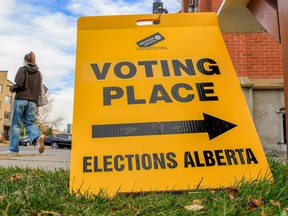 The advance polling station for the 2026 Alberta referendum at Hillhurst United Church on Oct. 17, 2026. Voting day is Monday, Oct. 19. Gavin Young/Postmedia
Albertans cast their ballots Monday in a historic referendum that could have lasting effects on the political landscape, regardless of the vote’s results.

Subscribe now to read the latest news in your city and across Canada.
Subscribe now to read the latest news in your city and across Canada.
Create an account or sign in to continue with your reading experience.
Create an account or sign in to continue with your reading experience.
Among the 10 questions on the ballot was one that asked whether Albertans preferred to remain a part of Canada or to begin the process of holding a binding referendum on separation.
As of 12:15 a.m. Tuesday, the remain side garnered 76.2 per cent of ballots cast, with 34 per cent of polls reporting.
The results of the other nine questions were also being released through the overnight hours.

Your weekday lunchtime roundup of curated links, news highlights, analysis and features.
By signing up you consent to receive the above newsletter from Postmedia Network Inc.
A welcome email is on its way. If you don't see it, please check your junk folder.
The next issue of Noon News Roundup will soon be in your inbox.
We encountered an issue signing you up. Please try again
Earlier Monday, some electors shared their thoughts on the impact of the vote.
“I don’t think most people really want to separate,” said Brayden Temple, a Calgary-Shaw voter. “But it’s time to get our voices heard a bit more here in Alberta.”
Although he is optimistic about a recent slate of pipeline-related announcements, he said he wanted the province to have the power to reject any federal regulations on energy companies to attract more investment.
“If we could get rid of some of that, which I think is what the Conservatives’ goals kind of are, that would be good because we’re a resource nation, right?” said Temple, who works in health care but whose father, he added, worked in the oil and gas sector.
The other nine questions are about policies related to immigration and potential changes to the Constitution.
For Rexall Sillito, who graduated high school last year, maintaining status quo is the wiser choice.
“I mostly voted in immigration favour, as some people moving to Canada do need help coming here and they kind of need that head start,” Sillito said. But he felt the referendum itself isn’t a wasted exercise, saying that instead it’s a way to roar at Ottawa to snatch up some benefits it wouldn’t have otherwise had.
“Quebec did that once, and that’s how Quebec got so many benefits that a bunch of the other provinces don’t have,” Sillito said.
However, that doesn’t mean Alberta should yank all of Ottawa’s power to hold the province accountable.
Elections Alberta has recorded strong turnout for mail-in ballots and advance polls. Those who have yet to cast their ballot were told to vote as early as they could Monday and to anticipate lineups.
However, several polling stations in Calgary’s south were relatively quiet with little to no lineups.
Betty Evans stopped by Riverside School in northeast Calgary on Monday, curious to see how busy the polling station was.
Evans, who had already cast her ballot by mail, said an election officer told her voters had lined up before the polls opened Monday morning, but that the station had been relatively quiet since.
For Evans, voting in the referendum felt like an important action. Having already voted by mail, a process she described as “pretty simple,” Evans said she is now eager to see the results.
Dozens of voting stations across the province opened late Monday morning and stayed open later to accommodate the delay.
Polls were scheduled to be open from 9 a.m. to 8 p.m. Monday, but 35 Calgary voting stations will have hours adjusted, with delays ranging from 10 to 44 minutes.
One Edmonton location’s opening was delayed by two hours, meaning it didn’t close until 10 p.m.
Voters across the city on Monday have reported little to no lineups throughout the day, but Mount Royal University political science professor Lori Williams said that isn’t a surefire indicator of what final turnout will be.
“It reminds us that there isn’t necessarily a link between the advance poll numbers and the day of numbers,” she said, noting that, while advance votes were only slightly higher than in the 2023 provincial election, the number of mail-in ballots were around 10 times higher.
“On the other hand, (Monday’s) lineups could be shorter simply because there are more polling stations open. The numbers could be quite healthy today. Without actually doing a count, it’s hard to know.”
Results reporting won’t start until at least 10 p.m. Monday, after all voting stations have closed, but with the mail-in and advance poll counts starting at 5 p.m., those results could be the first we see.
However, Williams said those early results could be somewhat skewed, as some separatist leaders called the mail-in ballots into question, while federalist campaigners were encouraging voters to vote by mail.
Early results, then, could indicate stronger favour for remaining in Canada, but as Monday’s counts start to trickle in, the needle could start to move the other direction.
Williams also projected that the response rate for the other nine questions could be significantly lower.
Many people she spoke to leading up to the referendum were overwhelmed by the 10 questions, she said, and were relieved to find out they could vote on the separation question but opt out of others.
“There are some people that are on the fence that aren’t going to vote on some of them. Maybe some aren’t going to vote on any of them,” she said. “I think that response rate is going to affect the final mandate.”
If the response rate is only 30 per cent, for example, a majority vote for either option won’t give the government a strong indication of what most Albertans want, she said.
“That’s not enough to claim a mandate,” she said. “So that could be problematic.”
Complete results for all referendum questions aren’t likely to come before Wednesday evening. Elections Alberta is required to have all ballots hand-counted within 48 hours of polls closing, but with 10 questions on separate ballots — making this the largest referendum in Canada’s history — the task will be monumental.
Question 10 — the separation question — will be counted first, followed by questions one through nine in order.
Emily Faye, an agronomist, spent several weeks researching those questions to make up her mind.
“I’ve just been making my own decision of which way I want to vote, rather than what my friends say or what my family says or whatever that might be,” she told Postmedia.
Eventually, she realized the referendum was her opportunity to tell Ottawa “we’re not going to be a pushover anymore, and it’s not about Alberta leaving Canada. It’s about the West having more say in this country.”
That means taking back control over immigration and federal funding, even though some of them would require agreement from the majority of the country’s provinces.
“We produce a lot of Canada’s economy over here, and we get forgotten about when it comes to a federal election because by the time Toronto votes, it’s already decided, right?” said Faye, whose family hails from Saskatchewan.
 A special ballot for question 10 in the 2026 Alberta Referendum was photographed on Tuesday, Oct. 6, 2026. Gavin Young/Postmedia
While legislation requires vote officials to complete the count within the 48-hour timeframe, there aren’t any legislated penalties or consequences if the deadline isn’t met, Elections Alberta spokesperson Maia Hanrahan said.
“We’re expecting to meet that requirement, and that’s why we’ve put out the call for so many ballot counters,” she said. “Regardless, though, we’ll be completing that count regardless of how long it takes.”
As of Friday, 47,000 workers have been hired, but Elections Alberta originally set a target of 60,000 additional workers.
The counting of mail-in and advance vote ballots began at 5 p.m. Monday, but no results will be published until all voting stations have closed, said Hanrahan.
Over the course of the five-day advance vote period, 837,791 ballots were cast, Elections Alberta said, while the agency added it has received and processed 519,082 mail-in or special ballots. The 1,356,873 total represents a turnout of 43.1 per cent.
The 2023 general election saw a 60.5 per cent turnout rate in total, with 1,764,915 valid ballots cast. Just over half were cast on election day, while 757,453 ballots were cast during advance voting and 51,351 were by special ballot.
Elections Alberta has yet to release a cost for the referendum.
Williams said that while the turnout has been promising so far, it’s difficult to predict how it will translate to Monday’s vote.
“It’s hard to game out what people looking at those numbers might decide about whether it’s worth the trouble to stand in the line to vote or not,” she said. “Some are saying it suggests 85 per cent turnout, but I think it’s a bit early to tell.”
 A voter leaves after voting in the advance poll for the 2026 Alberta referendum at the Rehabilitation Society of Calgary in Bridgeland on Oct. 13, 2026. Gavin Young/Postmedia
Some advance voters have reported their wait to only be minutes long, while others have been in line for hours.
“So much is unprecedented here that we just don’t know,” she said. “I see really good signs of commitment, people who think it’s important enough to stand in line. I just don’t know if the final numbers will be sufficient to actually reflect the will of the full range of Albertans or not.”
MRU public policy professor Duane Bratt said there have been elections in the past with high turnout at the advance poll, but no overall impact on total turnout.
“It just shows that people want to vote when they want to vote,” he said. “But when you calculate the degree of the advance polls combined with the mail-in votes with what Elections Alberta is projecting, this could have one of the largest voter turnouts in an Alberta election in decades.”
There are 10 questions on the referendum, nine of which, the province said, came from the recommendations from the Alberta Next panel hosted last year, which aimed to hear from Albertans about how the province’s sovereignty could be enhanced within a united Canada.
The panel consisted of 10 public town hall meetings across the province and one online meeting, attended by a total of more than 5,000 Albertans, who were then surveyed.
Three additional online surveys were conducted, each polling 1,000 Albertans. The resulting report made seven recommendations, which included holding a referendum on the province increasing control of immigration and looking into several constitutional amendments.
The report also recommended a referendum on establishing an Alberta Pension Plan to replace the Canada Pension Plan for Albertans, but that question is not on Monday’s ballot.
The 10th question on separation was prompted by a citizen-led petition asking the province to hold a referendum on separation and another asking for the government to reject separatism, which together garnered around 700,000 signatures.
 View of a mock polling station set up for an Elections Alberta media briefing in Edmonton on Sept. 3, 2026. Shaughn Butts/Postmedia file
However, despite the petitions meeting the signature threshold, a court decision ruled that a binding referendum on separation couldn’t be held without first undergoing a consultation process with First Nations.
Instead, the province added question 10 as it reads on the ballot, which asks voters whether Alberta should remain in Canada, or whether the province should begin the legal process of holding a binding referendum to leave Confederation.
Recent polls have found that support for the latter option ranges anywhere from 22 to 33 per cent, but the outcome will likely come down to turnout.
“If option two wins, we go into further chaos,” Bratt said. “In fact, it would make it worse, because now we’d be having a second referendum, and who knows when that would be, because we have a provincial election next year, and under the current legislation, you’re not allowed to have a referendum in the same year as a provincial election.”
If option one wins, he said, the margin will make a big difference in how the separatist movement responds.
“I don’t think the separatist movement is going anywhere. There’s always been a separatist movement in Alberta, but now they’ve been legitimized by having this vote,” he said.
Williams echoed the sentiment, saying many factors will affect what comes next.
“The question is how powerful, how influential will the organized separatists be that have exerted so much influence up until this point?” she said.
“Will they continue to do that? Will they be diminished? Will they form another party? Will they successfully challenge (Premier) Danielle Smith’s leadership? Will the next premier be a separatist or a moderate? All of those are very difficult to predict at this stage.”
A decisive vote, she said, “could have significant implications for Alberta’s future.”
“If it’s less decisive, I think we have a lot more uncertainty for some time,” she said.
“It’s really important that people not just look at the polls and think that their vote isn’t needed. It is. It’s extremely important.”
 Alberta Premier Danielle Smith speaks to the Alberta Municipalities Annual Convention & Trade Show in Edmonton on Sept. 23, 2026. David Bloom/Postmedia file
But neither Bratt nor Williams can predict what will become of the UCP after the referendum — or what the implications will be for Smith.
“Her party’s divided, and I don’t know how she’s going to get out of this,” Bratt said. “That’s going to be a fascinating discussion to watch between Monday night and the UCP AGM in November.”
The association with separatism and the referendum alone could make the next election more difficult for Smith and the UCP, Williams said.
“The other possibility is that the party splits, the separatists get kicked out, they form their own party,” she said. “Do we then have Wildrose and Progressive Conservative again, and all of the implications of that?”
Speaking at an event in Calgary Friday, former premier and UCP co-founder Jason Kenney suggested the party should purge itself of separatists, while Smith herself did not address this point.
As far as the other nine questions go, there’s some speculation as to how the results will be leveraged.
“You could have a situation where (Smith) continues to go forward on some of these things, even if they are defeated,” Bratt said.
Question five, for example, asks about a requirement for proof of citizenship to vote, but the province is already adding citizenship to drivers’ licences.
“Are they going to reverse course?” Bratt said. “They’re going to interpret the results how they want.”
Such an outcome wouldn’t be unprecedented. When the province held a referendum on switching to permanent daylight time in 2021, 50.2 per cent voted no. However, more recently, the Alberta government implemented permanent daylight time anyway.
Williams added that the province already has the power to act on the first five questions without a referendum vote, and the four constitutional questions would require buy-in from other provinces regardless of the vote’s outcome.
“This is one of the reasons why people are wondering why the questions are on the referendum, because the province has power to do these things or doesn’t have power to do these things, and this vote isn’t going to make any difference,” she said.
“This is not grassroots democracy,” Bratt added. “All of the questions were chosen by the government. Why are we talking about immigration and not pensions or data centres? The government made that choice. The government wrote the questions.”
Bookmark this website and support our journalism: Subscribe now so you don’t miss the Calgary news you need to know and sign up for our free newsletters.
This website uses cookies to personalize your content (including ads), and allows us to analyze our traffic. Read more about cookies here. By continuing to use our site, you agree to our Terms of Use and Privacy Policy.