Просмотр новости
Найдите то, что Вас интересует
 Спутники
 РН
 SpaceX
 Роскосмос
 NASA
СпутникиРНSpaceXРоскосмосNASA
Hall’s euphorically maximalist musical is undeniably queer in its overabundance.
The post ‘Midnight’ Review: Todrick Hall’s Musical Takes a Daring Detour Into Alternate History appeared first on Slant Magazine.
Lin-Manuel Miranda wrote the music, lyrics, and book for Hamilton—and starred in the title role. Now imagine if he’d also directed, choreographed, and served as lead producer, and you get a sense of the multi-hyphenate ambition of Todrick Hall, the man behind the euphorically maximalist and refreshingly innovative musical Midnight.
The Hamilton comparisons, as with most new historical musicals featuring R&B-inflected music and nonstop singing, are inevitable. But Midnight is a wildly different show, undeniably queer in its overabundance. To give a Black, queer story its due, Hall seems to harness every big-budget resource and mega-musical storytelling tool at his disposal: an excess of songs, lighting cues, and key changes, not to mention his own presence.
Hall’s divisive online persona, cultivated largely on YouTube, where his music-centered channel is approaching one billion views, certainly carries a strong current of self-aggrandizement. (Since he also personally runs Midnight’s social media, Hall has spent much of the past few days responding directly to people discussing the show in TikTok comments.) But Midnight, for all its unabashed Todrickness, is also an act of generosity, shining a spotlight on the outsized talents of his 19 castmates. The show’s propulsive score celebrates those voices most grandly through Hall’s intricate choral writing; the ensemble singing, ebullient and wrenching, is its foremost asset. (Music director Laurence Stannard elicits unrelenting vocal intensity and virtuosity through ecstatic gospel and R&B arrangements.)
Midnight is set in the 19th-century American South, during the final years of plantation slavery. Hall plays Rail, an enslaved man who forms a tentative friendship with Richard (Jeremy Beloate), who’s building an integrated home for himself and his fiancée, Rail’s haughty enslaver (Kennedy Caughell). Exactly what an integrated home will entail after the marriage isn’t entirely clear, but Rail and Richard don’t get that far: Their growing closeness eventually crosses the line from uneasy collegiality into something far more dangerous for both men.
By the end of the first act, there’s a sense that the overwhelming run of 18 songs, the effusive choreography, and Beck Jones’s vivid costumes may be helping Hall gloss over the plot’s discordances. How fully, for instance, can we believe in and invest in the connection between two men separated by such an extreme power imbalance?
At its midpoint, Midnight seems to be in unintentional conversation with Jeremy O. Harris’s searing Slave Play, which provocatively depicted sexual encounters between enslaved people and their owners. But Hall has a meta-theatrical booby trap in store for his characters—and his audience—at the start of the second act, one that would be unfair to give away.
Suffice it to say that Midnight shifts into a kind of alternate history, challenging us to keep pace with a device that transforms the show into an astonishing experiment. Not everyone will be convinced by Hall’s gambit, but in an era when most musical theater writers stick to cookie-cutter formulas, it’s exhilarating to see a show attempt something untested and demanding. If you spend more of the second act thinking hard about the storytelling than the story itself, that’s a worthwhile exchange. When was the last time a musical asked you to think much at all?
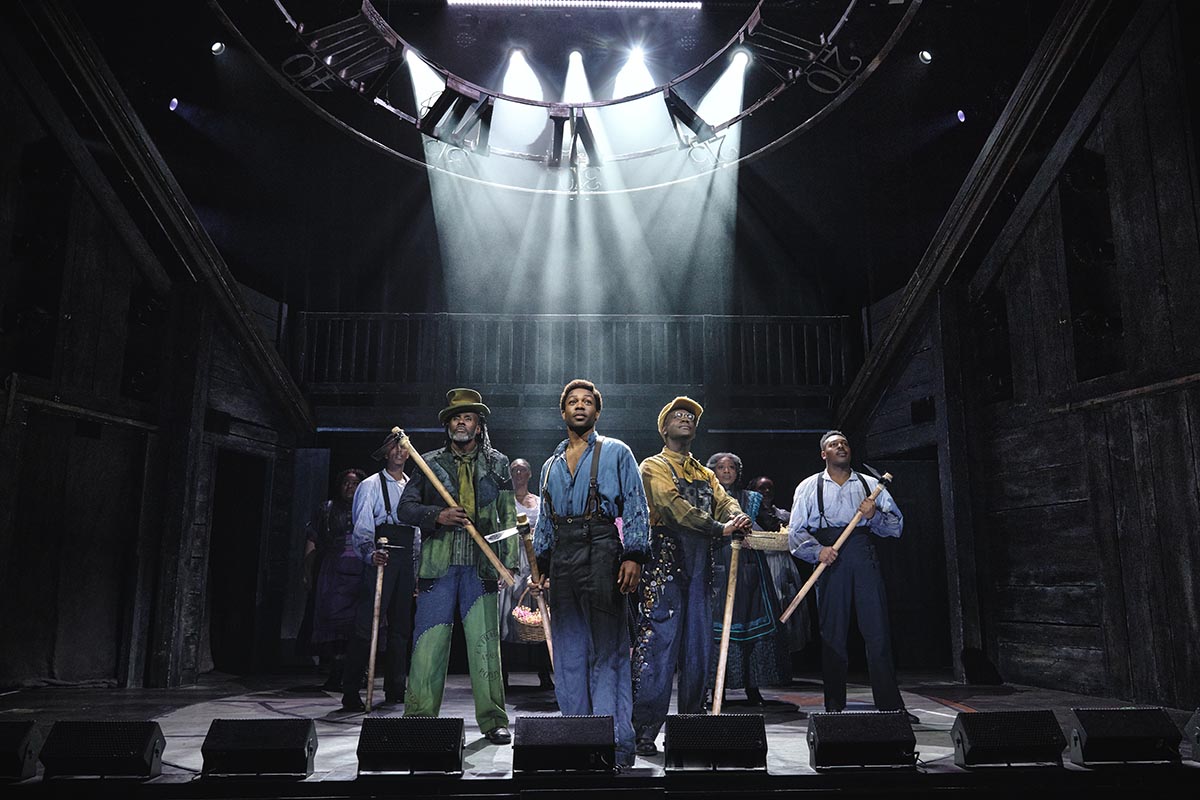 Todrick Hall and the company of Midnight. © Photo: Valerie Terranova
Midnight’s second-act switcheroo recasts much of what seemed bothersome in the first act within a sharper metatheatrical frame. The antebellum and fairy-tale tropes Hall invokes are there to sharpen our subsequent critical attention. Even the stereotypical vocal writing—quasi-operatic, harpsichord-laced trilling for most white characters and bluesy, silken, growling soul for most Black characters—turns out to be entirely self-aware. In the second act, Hall goes out of his way to demonstrate the stylistic versatility of the show’s Black singers, upending assumptions about performers’ specialties and limitations.
Hall’s gifts to his cast include a flirtatious, high-flying showcase, “Pretty Eyes,” for Charlotte Odusanya as Rail’s girlfriend, Lily Rose; a wickedly clever patter trio for a mother and her two daughters, in which the three actresses alternate singing one word at a time; and, best of all, ample room for the ever-electrifying Ayana George to work her magic as Ethel, the enslaved woman who helped raise Rail. George is shattering in Midnight’s most affecting song, “The Dancing One,” in which the lyric “his feet didn’t touch the ground” tragically shifts from describing a dance to evoking a lynching. Hall himself sings splendidly, with acrobatic precision.
Hall’s choice of chattel slavery as a backdrop creates an uneasy context for the show’s promotion of equal, empathetic partnerships across racial lines in the present day. In allegorizing contemporary race relations and their intersections with queerness, Midnight situates itself in that historical moment presumably because its tropes are so familiar—and thus so ripe for subversion. But treating slavery as a fairy-tale metaphor, especially when the show stages murders, beatings, and family separations, ventures into treacherous territory. Any sense of self-aware subversion takes a long time to emerge.
Exploring those tensions and discomforts also seems to be part of the point. If Midnight has one major problem to address, it’s Hall’s eagerness to bundle up the show’s message after raising complex questions about how we perceive race in performance and, by extension, in our lives. A musical this daring ought to dispense with one-size-fits-all answers.
If Midnight makes the leap to Broadway, Hall should embrace the show’s thorny uncertainties, including the risky possibility that audience members asked to see the world through a new lens may glimpse vastly different vistas. Rather than pulling his punches, he can acknowledge that his theatrical experiment, much like race in America, is complex, messy, and resistant to easy solutions. Midnight already sounds, looks, and innovates like the best new musical of the year. Instead of smoothing over its difficulties, Hall should go further, exposing the rough edges.
Midnight is now running at the Daryl Roth Theatre.
If you can, please consider supporting Slant Magazine.
Since 2001, we've brought you uncompromising, candid takes on the world of film, music, television, video games, theater, and more. Independently owned and operated publications like Slant have been hit hard in recent years, but we’re committed to keeping our content free and accessible—meaning no paywalls or fees.
If you like what we do, please consider subscribing to our Patreon or making a donation.