Просмотр новости
Найдите то, что Вас интересует
 Спутники
 РН
РН SpaceX
 Роскосмос
 NASA
NASA
СпутникиРНSpaceXРоскосмосNASAThat old phone gathering dust in a drawer could have a second life far more entertaining than being a paperweight. UCLA researchers have created PhoneBot, a little humanoid that puts your smartphone to work as the brains of a walking robot companion.Continue ReadingCategory: Robotics, EngineeringTags: UCLA, Android, smartphones, Recycling
That old phone gathering dust in a drawer could have a second life far more entertaining than being a paperweight. UCLA researchers have created PhoneBot, a little humanoid that puts your smartphone to work as the brains of a walking robot companion.
The little walker comes from the Robotics and Mechanisms Laboratory (RoMeLa) at the University of California, Los Angeles. In a preprint posted to arXiv, the team describes a bipedal robot that uses a smartphone as its torso, eyes, and brain.
The idea is to skip the costly extras. Small research humanoids usually need separate sensors, a vision computer, and a lot of wiring. PhoneBot borrows all of that from the handset. The camera handles sight, and the phone's inertial measurement unit (IMU), a chip that senses tilt and motion, works like an inner ear for balance. The processor runs the neural network that drives the joints, and the touchscreen shows status and controls.
The body stands 48.3 cm (19 in) tall and weighs 1.8 kg (4 lb), phone and battery included. It has 13 low-cost servo motors, six per leg, plus one that swivels the torso. That swivel lets the camera turn to follow a person without the whole robot pivoting.
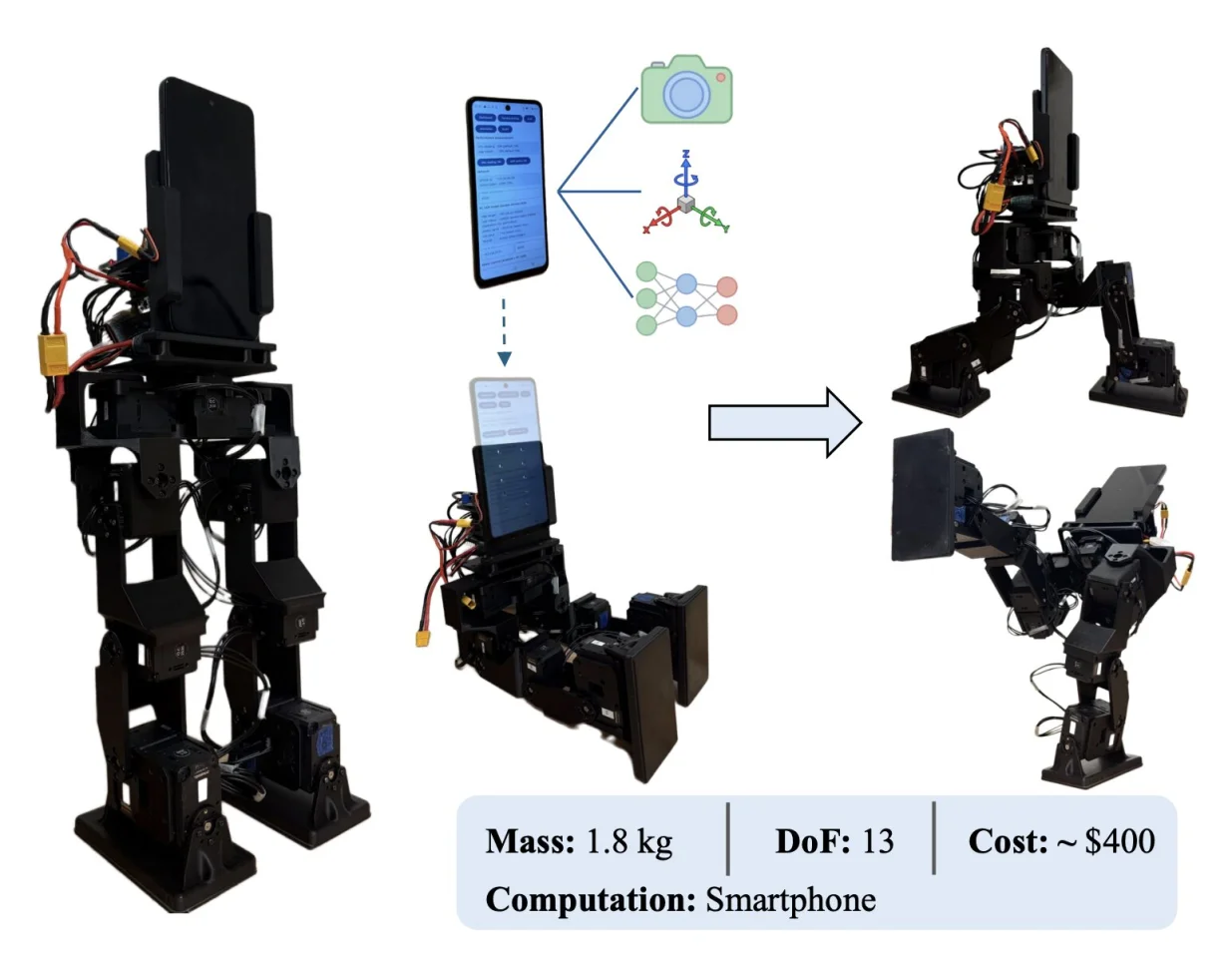
Ruochen Hou et al. / RoMeLa, UCLA
The phone isn't wired to the body. It talks to a small onboard computer over Wi-Fi, which relays commands to the motors. The researchers say this makes it easier to swap in different phone models.
Before taking its first real steps, PhoneBot practiced in a virtual world using reinforcement learning – essentially trial and error with a scorecard. It earned points for keeping pace, alternating its steps, and staying upright, and lost them for bad habits like dragging its feet. The simulation accounted for the real motors’ limited strength and speed, as well as the play in their gears, so the robot learned moves its body could actually pull off in real life. On the real robot, the team demonstrated walking, following a person with the camera and standing up from lying face down.
Conversation isn't fully self-contained yet. Speech recognition and the language model run on a nearby laptop, which the phone reaches over Wi-Fi. Walking and vision run on the phone itself.
The researchers tested PhoneBot on four Android phones: a 2017 Honor 9 and three prepaid models bought for about $50 to $80. All ran the core functions, including motion sensing, walking control, on-device vision, and interaction.
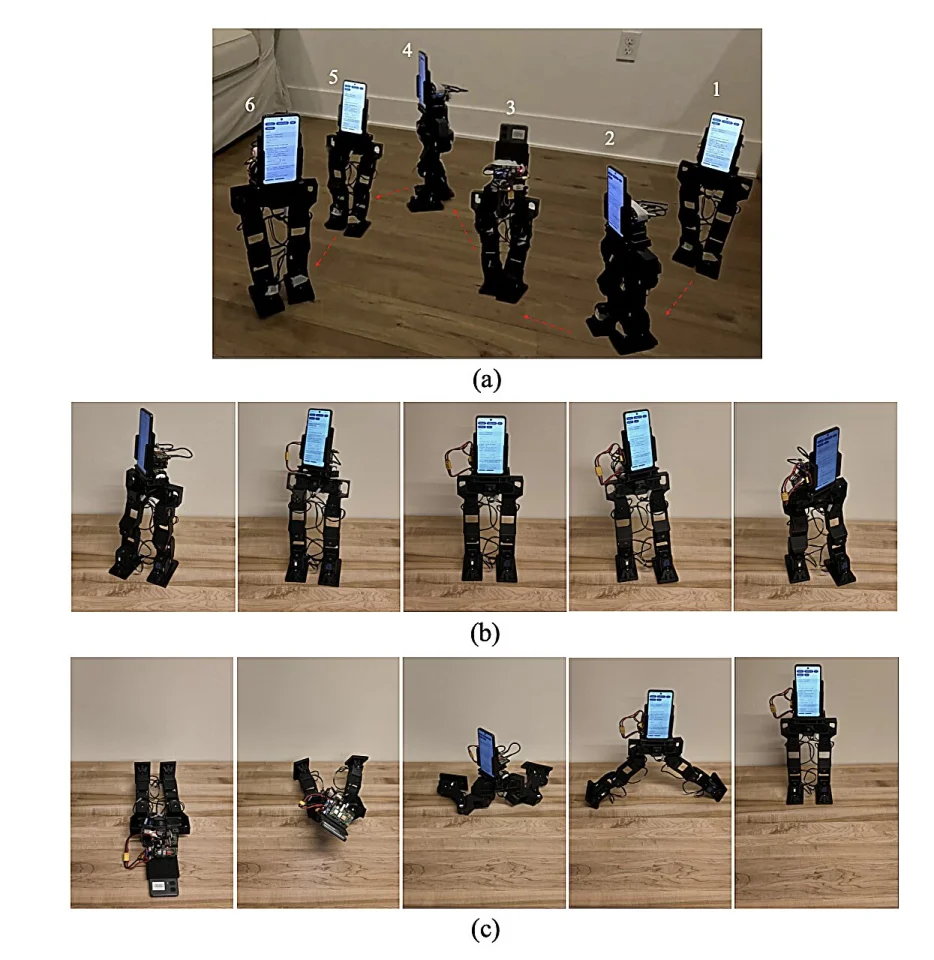
Ruochen Hou et al. / RoMeLa, UCLA
One gap is that camera-based mapping and localization (SLAM) didn't run on the Honor 9, which the researchers attribute to Google services being unavailable on that device in the US. Still, the paper does not establish that PhoneBot will work with every Android phone.
For now, PhoneBot has no arms, and its walking was trained only on flat ground. Its small motors also limit how much weight it can carry and which moves it can pull off. The team plans to explore uneven terrain, lightweight arms and language-model-based planning that turns spoken instructions and visual information into robot actions. The researchers also suggest running suitable language models directly on the smartphone to reduce reliance on the laptop currently handling conversation.
The hardware and software are open source and aimed at education, research, and tinkering. The paper presents PhoneBot as a platform others can build and experiment with, rather than a finished household companion. Or at least not just yet.
The team estimates PhoneBot’s cost at roughly US$400, excluding the smartphone. Other small research humanoids listed in the paper range from about $3,500 to $13,800. Those platforms offer different capabilities, so this is not a direct comparison, but PhoneBot would make bipedal robotics accessible on a considerably smaller budget.
Source: TechXplore
| # | Наименование новости | Тональность | Информативность | Дата публикации |
|---|---|---|---|---|
| 1 | Смартфон стал вычислительным центром двуногого робота PhoneBot | 0 | 8.02 | 15-10-2026 |
| 2 | Water-pumping robot worms its way over rugged coastal terrain | 0 | 10.64 | 12-10-2026 |
| 3 | Wound-helix robot leaps and bounds over obstacles | 0 | 7.03 | 16-10-2026 |
| 4 | Bioinspired robot airdrops into remote waters via morphing wing-sail | 0 | 9.18 | 17-10-2026 |
| 5 | Brain-like synapse chip computes at 'lightning speed', dissolves in mins | 0 | 11.48 | 18-10-2026 |
| 6 | Not Every Robot Wants Your Job | 0 | 7.82 | 26-06-2026 |
| 7 | 30 Years Ago, Robots Learned to Walk Without Falling | 0 | 8.44 | 25-03-2026 |
| 8 | Robovac disappears inside kitchen cabinetry when it’s done cleaning | 0 | 12.94 | 29-04-2026 |
| 9 | Feature-packed smart wallet doubles as phone stand and charger | 0 | 11.34 | 28-08-2023 |
| 10 | Удивительные метаморфозы рук роботов и переливающиеся жетоны | 0 | 26.7 | 16-09-2026 |