Просмотр новости
Найдите то, что Вас интересует
 Спутники
 РН
РН SpaceX
 Роскосмос
 NASA
NASA
СпутникиРНSpaceXРоскосмосNASARegardless of how far EV tech comes, juicing up a car may never be as effortless as pumping gas in an ICE car. Even BYD’s fastest chargers as of now take 9 minutes to take you up to 97%. While I’m sure we’re headed towards a future with even shorter charge times, Honda’s idea for EV charging seems like the most viable solution.Continue ReadingCategory: Automotive, TransportTags: Honda, Charging, Wireless Charging, EV Charging, Electric Vehicles
Regardless of how far EV tech comes, juicing up a car may never be as effortless as pumping gas in an ICE car. Even BYD’s fastest chargers as of now take 9 minutes to take you up to 97%. While I’m sure we’re headed towards a future with even shorter charge times, Honda’s idea for EV charging seems like the most viable solution.
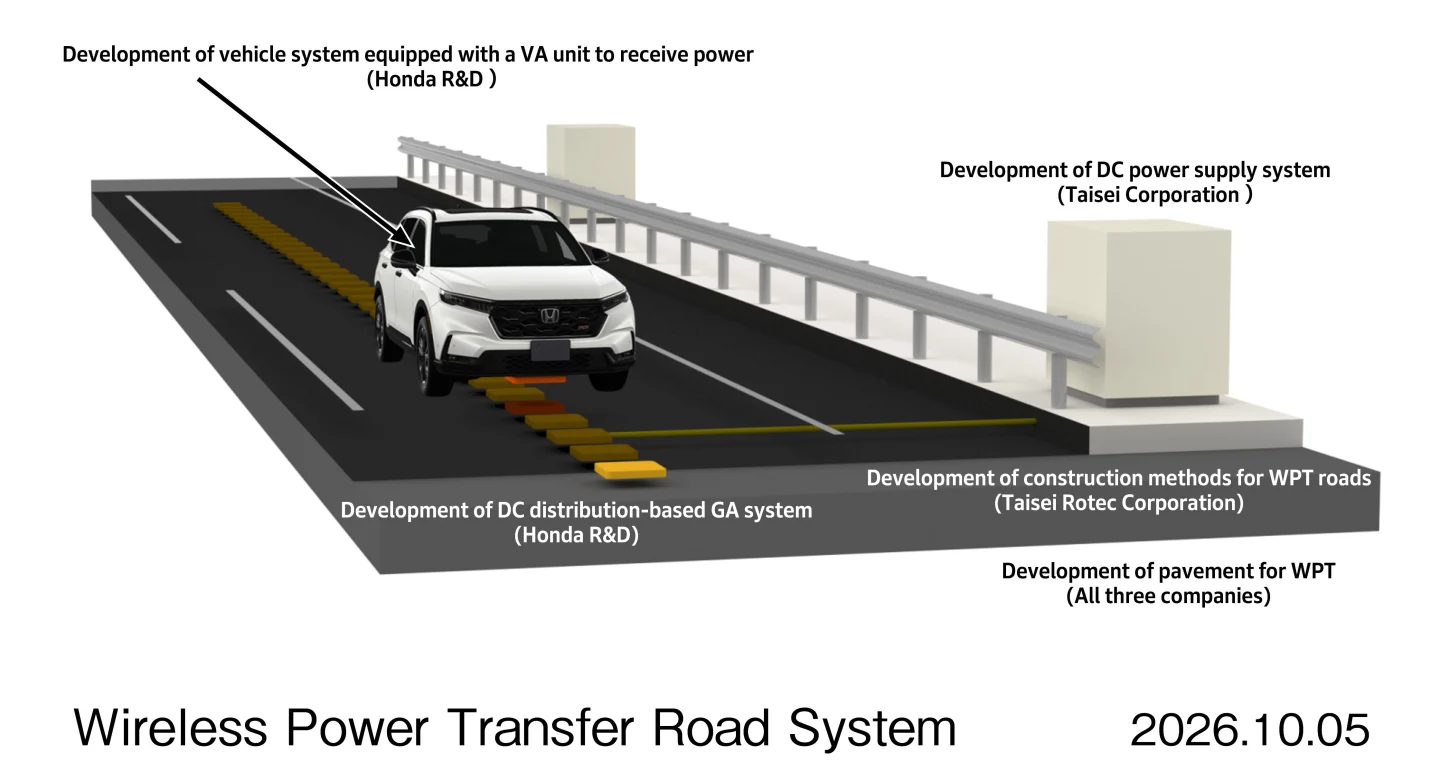
Honda and two partner companies, Taisei and Taisei Rotec, have been working on an interesting way to charge EV batteries… while they are on the go. No stopping, no struggling to find a charging station, no waiting. The car simply charges while it runs … in theory.
I say in theory because Honda has just completed development on the technology. Testing is set to follow shortly. The new tech, which the company refers to as a magnetic coupling dynamic wireless power transfer (DWPT) road system, basically builds a wireless charging system into the roads themselves.
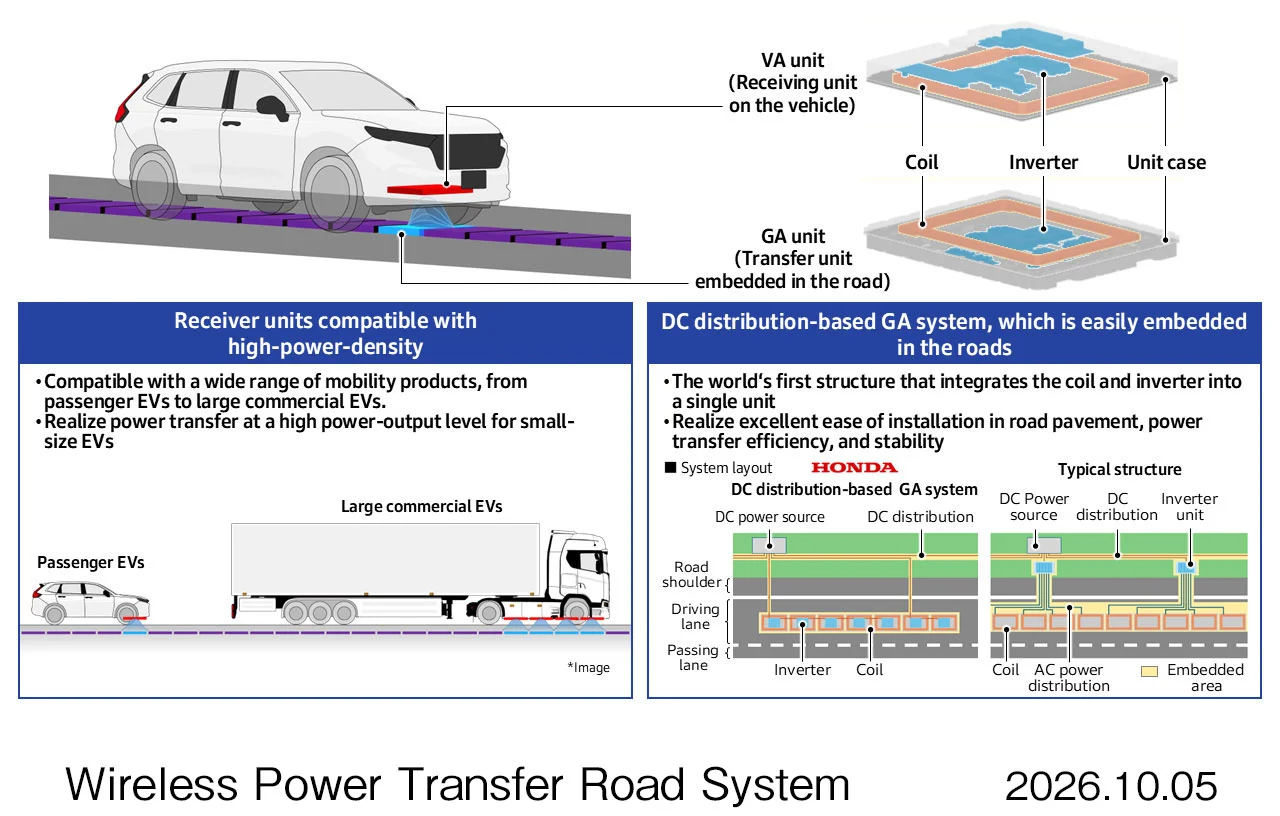
Of course, it’s more nuanced than basically building a ginormous wireless charger underneath the tarmac. It basically includes three different components: a DC power supply system on the ground; a DC distribution-based ground assembly (GA) system that connects multiple GA units (power transmitter units) inside the road via a DC connection; and a vehicle assembly (VA) unit (power receiver unit) installed on the undercarriage of a vehicle, which would receive charge and transfer it to the battery.
Honda
Honda’s basically eyeing installing a ground assembly system on the busy streets and high-traffic roads. An electromagnetic field would be produced by the vehicle-mounted receiver unit and the ground-based distribution unit instead of a contact wire (like in a catenary system) or contact shoe (like in a subway), both of which cause friction.
This system would basically charge any kind of battery-electric vehicle, even ones as big as commercial semis. The Japanese automaker intends to implement DWPT technology in the logistics and transportation industries in the first phase.
The idea of charging an electric vehicle while it drives is hardly new, though. Several projects have already taken the concept beyond the drawing board, with varying degrees of real-world testing.
In France, a partnership involving Electreon and highway operator VINCI has tested a wireless charging system embedded beneath a 0.9-mile (1.5-km) stretch of motorway near Paris. The trial involved a truck, van, car and bus fitted with receiving equipment, with early tests reporting peak power transfer of more than 300 kW. Detroit, meanwhile, became home to a public road equipped with wireless charging technology, while Stellantis has also tested an inductive system on a dedicated track in Italy. The UK has explored similar electric-highway technology, too. In other words, the idea of turning roads into giant wireless chargers has been kicking around for years, and some projects are now producing encouraging results rather than just concept illustrations.
Honda
Meanwhile, Honda, too, is eyeing testing next. A purpose-built test drive lane will be built in the latter stages of this year, where a variety of tests will be carried out. This will comprise performance testing, tests to assess strategies to mitigate electromagnetic field leakage, and long-term durability evaluation utilizing a loading test similar to 1-million-wheel loads (based on a 49 kN load per wheel) using real cars.
By conducting these tests, Honda hopes to guarantee the GA units' safety as embedded roadway constructions as well as their power transfer capability. The next step is to develop the wireless power transfer (WPT) road system further, to eventually put it to work in real-world conditions. That means testing whether it can deliver up to 150 kW of power for potential use with heavy commercial vehicles, while also checking that the system can reliably transfer energy to vehicles traveling at higher speeds.
Honda says it plans to share more information about the technology at upcoming industry events, beginning with Japan Mobility Show Bizweek in mid-October. Beyond that, there's no firm timeline for when the system might be ready for widespread deployment.
For now, this is an intriguing proof of concept, a tantalizing glimpse of what electric mobility might look like someday, and a technology wrapped in enough engineering jargon to make the average driver’s eyes glaze over.
Honda
Of course, some rather obvious questions remain unanswered. How far would an EV need to travel over these specially equipped roads to gain a meaningful amount of charge? Just how efficiently would it transfer power, especially at faster speeds? How durable would this infrastructure be? Most importantly, what would it cost to the end consumer?
You have to understand that such systems require compatible hardware on the vehicle and expensive infrastructure beneath the tarmac, along with reliable power delivery at speed and a way to pay for installation, maintenance, and electricity. There's also the question of whether the energy transferred justifies the cost and complexity, particularly when conventional fast-charging stations are already expanding. Wireless charging roads could eventually make the most sense on heavily used freight corridors, where keeping trucks moving and potentially reducing the size of their batteries could offer real benefits.
Maybe, soon enough, we’ll have those answers.
Source: Honda
| # | Наименование новости | Тональность | Информативность | Дата публикации |
|---|---|---|---|---|
| 1 | BYD's flagship e-SUV packs insane 9-minute flash charging | 0 | 13.64 | 17-10-2026 |
| 2 | Chinese Auto Companies Race Ahead On EV Technology, Achieving 5-minute Ultrafast Charging | 0 | 14.65 | 24-09-2026 |
| 3 | Antonio José, instalador de cargadores para coches: "No subas la potencia de casa. Subirla y no aprovecharla es tirar el dinero" | 0 | 11.32 | 25-07-2026 |
| 4 | Chinese auto companies race ahead on EV technology, achieving 5-minute ultrafast charging | 0 | 10.1 | 24-09-2026 |
| 5 | Audi A2 e-tron: 2026 EV boasts impressive electric range | 0 | 11.73 | 08-08-2026 |
| 6 | Geely заряжает электромобиль за 5 минут: Прощайте, перекуры на заправках! ... | 0 | 9.74 | 01-09-2026 |
| 7 | BYD’s Five-Minute EV Battery Is Detroit’s Problem | 0 | 5 | 19-06-2026 |
| 8 | BYD’s Five-Minute EV Battery Is Detroit’s Problem | 0 | 7 | 19-06-2026 |
| 9 | BYD’s Five-Minute EV Battery Is Detroit’s Problem | 0 | 5 | 19-06-2026 |
| 10 | Hyundai launches $30K electric hatch America can't have | 0 | 11.26 | 24-08-2026 |