Просмотр новости
Найдите то, что Вас интересует
 Спутники
 РН
РН SpaceX
 Роскосмос
 NASA
NASA
СпутникиРНSpaceXРоскосмосNASAIndia's budget smartphone market is opening up for local brands as global companies reduce their presence. Rising memory chip prices have significantly impacted entry-level smartphone production costs. Homegrown companies Ai+ and Lava are gaining traction in this competitive segment. Micromax plans to re-enter the smartphone market by evaluating various strategies. Brands aim to leverage the government's financial incentives under the Mobile Phone Manufacturing Scheme to succeed.
Synopsis
India's budget smartphone market is opening up for local brands as global companies reduce their presence. Rising memory chip prices have significantly impacted entry-level smartphone production costs. Homegrown companies Ai+ and Lava are gaining traction in this competitive segment. Micromax plans to re-enter the smartphone market by evaluating various strategies. Brands aim to leverage the government's financial incentives under the Mobile Phone Manufacturing Scheme to succeed.
 Agencies
Homegrown firms target budget phones as chip prices rise
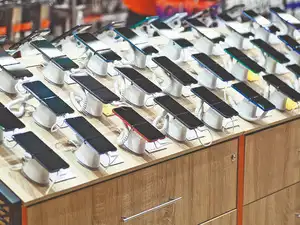
Kolkata: India's budget smartphone market is set for a fresh wave of homegrown challengers as a sharp surge in memory chip prices forced global players to pare their presence in the sub-Rs 20,000 segment, creating an opening for the local companies.
After wearable brands Mivi and Boltt entered the sub-Rs 15,000 smartphone market through Flipkart, rivals Noise, boAt and GoBoult are also exploring entry into the category and holding discussions with e-commerce marketplaces, three senior industry executives said.
Also Read: boAt enters Sri Lanka, Bhutan; says international revenue more than doubled in FY26
The renewed interest follows early traction for brands such as Ai+ and Lava, while legacy players Karbonn and Micromax are also looking to capitalise on the opportunity.
Karbonn is planning a festive-season relaunch, while Micromax is evaluating a return to smartphones, encouraged in part by the government's recent announcement of financial incentives under the Mobile Phone Manufacturing Scheme (MPMS), the executives said.
Also Read: Online mobile sales may not ring loud this Navratri
The new wave of Indian brands is betting on an online-first strategy to keep distribution and operating costs low, allowing them to price devices competitively against Chinese manufacturers and Samsung at a time when affordability is under pressure.
"Being an Indian brand, there are no royalty and profit pressures from overseas headquarters. So, pricing power is in our hands," said Madhav Sheth, founder and chief executive of Ai+ smartphones. The company has already sold this quarter as many handsets as it did in the whole of last year, with devices priced between Rs 10,000 and Rs 25,000, he said.
"We have paved the way for other homegrown companies to enter and compete against global giants. However, this is not just an opportunity play. Indian brands have to focus on design, hardware, software and supply chain, as the entry segment is where 80% of consumers lie," Sheth said.
Micromax founder and promoter Rajesh Agarwal said the company was examining its go-to-market strategy for re-entering the smartphone business across price points and channels. "The MPMS scheme is an opportunity that will provide some benefits," he said.
The MPMS scheme provides incentive at 5% for Indian brands and an additional incentive of 3% for Indian design and R&D, apart from non-fiscal support.
GoBoult co-founder Varun Gupta said there are no plans to enter smartphones, while boAt co-founder Aman Gupta and Noise co-founder Amit Khatri did not respond to queries.
The opening has emerged as memory chip prices have surged, sharply raising the cost of making entry-level smartphones. Memory components can account for around 40% of the bill of materials of budget handsets, squeezing manufacturers' room to absorb higher costs without raising prices. Samsung, Oppo, Vivo and Xiaomi have reduced their exposure in the entry-level market as cost pressures mount, industry executives said.
Lava's head of product Sumit Singh said the price of the company's entry-level 5G smartphone had also increased from Rs 7,999 to Rs 14,499. Yet, Lava has sought to remain competitive by focusing on the core requirements of budget consumers, refining component selection, optimising software and sourcing strategically, he said. The company said its sales had more than doubled this fiscal year.
Read More News on
...moreless
| # | Наименование новости | Тональность | Информативность | Дата публикации |
|---|---|---|---|---|
| 1 | India’s smartphone sales face a festive squeeze, but market value rises 5% | 0 | 10.58 | 12-10-2026 |
| 2 | Smartphone Price Hikes Hit India: Will Diwali Discounts Offset Rising Costs? | 0 | 10.76 | 21-08-2026 |
| 3 | Xiaomi начала повышать цены на смартфоны — некоторые модели подорожают на 25 % | 0 | 11.24 | 24-08-2026 |
| 4 | India’s smartphone business may have lost an old festive-season weapon | 0 | 8.82 | 23-09-2026 |
| 5 | Эпоха дешевых смартфонов кончилась. Их стало невыгодно производить | -2 | 6 | 08-07-2026 |
| 6 | Smartphone Market Set For Record Contraction | 0 | 7.26 | 03-03-2026 |
| 7 | Budget smartphones slowly disappear in the US as memory crisis deepens | 0 | 10 | 15-08-2026 |
| 8 | Smartwatch-maker Fire-Boltt to enter smartphone market with budget 4G, 5G phones | 0 | 7 | 01-07-2026 |
| 9 | Could AI Memory Demand Wipe Out Budget Phones? | 0 | 7 | 05-07-2026 |
| 10 | Online mobile sales may not ring loud this Navratri | 0 | 12.03 | 14-10-2026 |