Просмотр новости
Найдите то, что Вас интересует
 Спутники
 РН
РН SpaceX
 Роскосмос
 NASA
NASA
СпутникиРНSpaceXРоскосмосNASAthe latest experiment from the gboard team reverses the usual logic of typing: this time, the keyboard does the moving.
The post google japan puts gboard on conveyor belts so the keys come to you appeared first on designboom | architecture & design magazine.
Google Japan has looked at the conventional keyboard and decided that perhaps our fingers have been doing too much of the work. Developed by the Gboard team, the new Gboard Kurukuru Version places its keys on moving conveyor belts, allowing characters to travel toward the user rather than asking the user to reach across a fixed layout. The experimental device turns one of the most familiar tools on a desk into something closer to a miniature production line, with typing becoming a matter of catching the right character as it rolls into place.
Four continuous belts make up the keyboard, with 29 keys arranged along each one for a total of 116. As they rotate, users can keep their hand relatively still and press the desired character when it arrives beneath their fingers. Uppercase and lowercase letters can be entered directly, while the moving layout is designed to make the full character set accessible with one hand or even a single finger. In other words, the keys have finally been asked to meet us halfway.
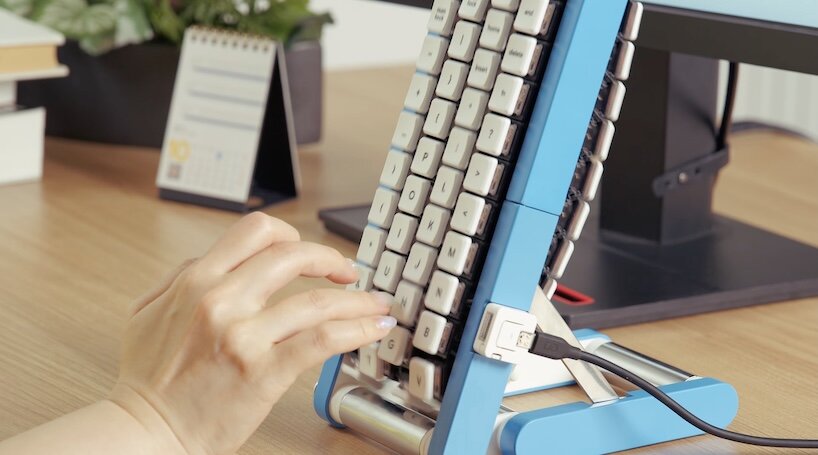 Google Japan introduces the Gboard Kurukuru version | all images courtesy of Google JapanFOUR CONVEYOR BELTS BRING 116 KEYS TO YOUR FINGERTIPS
The mechanism quietly reverses the basic relationship between hand and interface. On a standard keyboard, muscle memory tells the fingers where to go; with Kurukuru, the fingers wait while the interface comes to them. Google Japan imagines the one-handed setup leaving the other hand available for a mouse — or, in the team’s own more leisurely scenario, a cup of tea. For those unwilling to abandon two-handed typing altogether, using two Kurukuru keyboards at once is also floated as a possible route to greater productivity.
Kurukuru arrives as the 15th entry in Google Japan’s long-running series of unconventional Gboard experiments. Previous editions have stretched the keyboard into a single elongated row, twisted it into a double-sided loop and, in 2025, replaced traditional typing with rotary telephone-style dials. The latest version continues that habit of taking an everyday interface far too literally, then engineering it seriously enough to work. Google is also considering color variations, a high-speed mode and longer or more portable short versions, although none have been announced as commercial products.
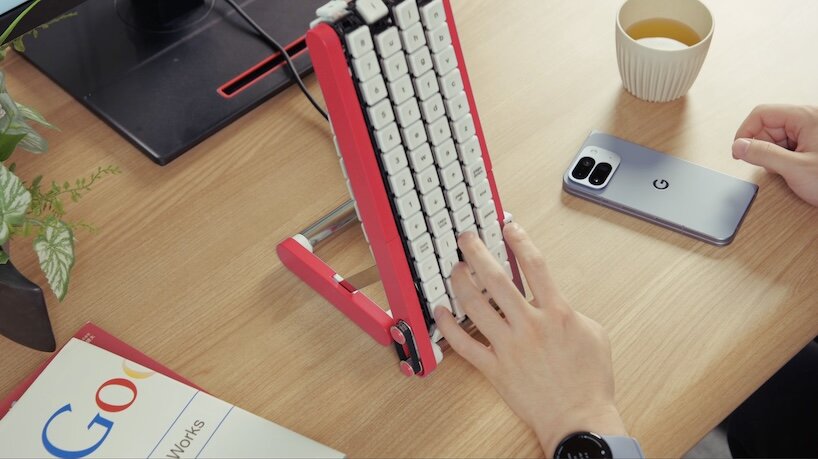 four conveyor belts carry the keyboard’s moving keysOPEN-SOURCE GBOARD KURUKURU TURNS THE JOKE INTO A DIY BUILD
As with earlier Gboard experiments, the moving keyboard is more than a visual gag. Google Japan has released open-source build files so makers can construct a similar device themselves, bringing together 3D-printed components, switches and the mechanical system required to keep the belts circulating. The result sits somewhere between computer peripheral, kinetic object and desktop machinery, exposing all the movement that a conventional keyboard usually hides beneath a very stationary rectangle.
There are no plans to put Gboard Kurukuru on sale, which may be just as well for anyone who prefers their vowels not to escape before being pressed. Instead, the project works as a deliberately exaggerated rethink of an interface that has remained remarkably stable for decades. Google Japan unveiled it on October 1 — a recurring nod to the familiar 101-key keyboard — but behind the wordplay is a simple design question: why should the human body always adapt to the machine? With Kurukuru, for once, the keys do the commuting.
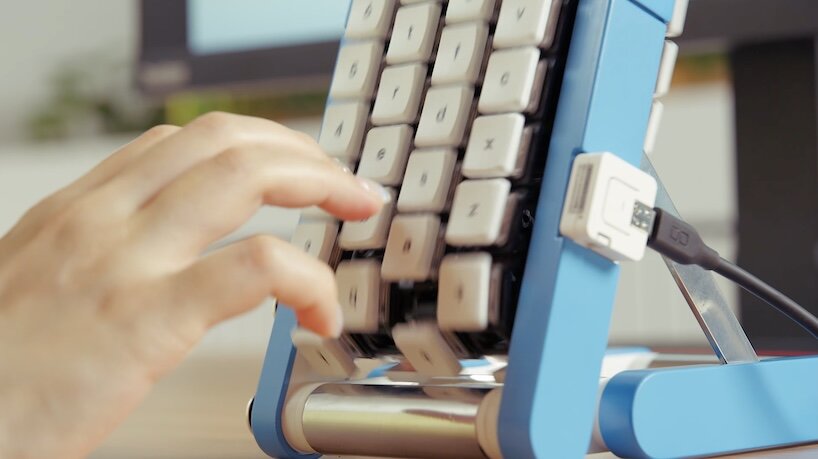 each rotating belt features 29 keys
your own online design shop — no sales commission collected
| # | Наименование новости | Тональность | Информативность | Дата публикации |
|---|---|---|---|---|
| 1 | tree-mounted machines connect to web app to let users knock on wood remotely | 0 | 6.94 | 11-10-2026 |
| 2 | futurewave’s arc silver bracelet politely tells you to put your phone down | 0 | 6.87 | 15-10-2026 |
| 3 | classic G-SHOCK transforms into perfectly ripe banana in BAIT and casio’s collab watch | 0 | 11.21 | 07-10-2026 |
| 4 | james chinlund fills louis vuitton’s louvre runway with hovering concept vehicles | 0 | 10.76 | 08-10-2026 |
| 5 | fiat multiplay concept transforms family car into pickup with sliding rear module | 0 | 5.42 | 13-10-2026 |
| 6 | Googlebook Glowbar doesn’t have the ‘knock-knock’ Chromebook Pixel battery gesture | 0 | 19.03 | 07-10-2026 |
| 7 | MAD opens shenzhen’s tengyun center with lifted, cloud-like offices | 0 | 11.7 | 01-07-2026 |
| 8 | gunther werks GXR-evo reshapes the 993 with ultra-lightweight full carbon body | 0 | 17.13 | 14-08-2026 |
| 9 | I checked out the new Googlebooks — 3 reasons I'd buy one, and 3 reasons I'd skip | 0 | 9.96 | 24-09-2026 |