Просмотр новости
Найдите то, что Вас интересует
 Спутники
 РН
РН SpaceX
 Роскосмос
 NASA
NASA
СпутникиРНSpaceXРоскосмосNASANon-resident Indians residing in Singapore and the United States are expressing significant concerns over withholding taxes. These taxes threaten to diminish their net returns from leveraging FCNR deposit schemes. For instance, borrowing from Indian banks' GIFT City branches triggers Singapore withholding tax, while US-resident NRIs encounter elevated withholding taxes on loan interest payments. Moreover, US tax regulations mandate the reporting of foreign income and assets.
Mumbai: Several non-resident Indians (NRIs) in Singapore and the US are fearing a 'withholding tax' that could shrink their net returns from the foreign currency non-resident (FCNR) deposit scheme that Indian banks are marketing to the diaspora.
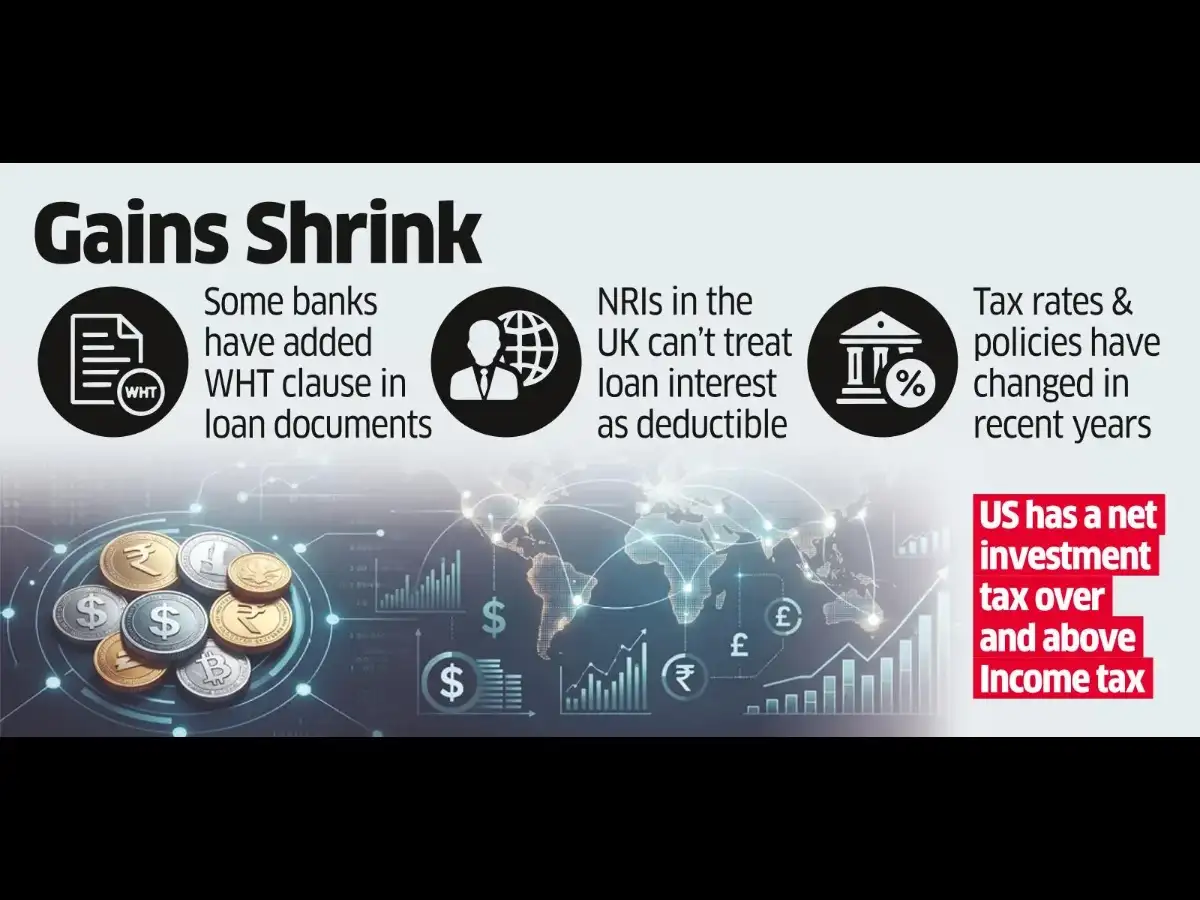
A 10% withholding tax (WHT) can be levied on the interest on loans that NRIs in these countries pay to the lending banks outside the respective jurisdictions.
Thus, if a bank (outside the US or Singapore) is charging, for instance, an interest of 6% on the leverage offered in the scheme, the actual cost to an NRI would be 6.6%.
"If a Singapore resident individual obtains leverage from the Singapore branch of an Indian bank, to invest in FCNR deposits, the interest paid to that branch is not subject to Singapore withholding tax. However, if the borrowing is from the GIFT City branch of the same Indian bank, the interest paid is subject to Singapore withholding tax. The domestic withholding tax rate is 15%, although this can generally be reduced to 10% if the conditions under the India-Singapore DTAA are satisfied," said Eunice Hooi, director, head of tax & transfer pricing at InCorp Global, a Singapore-based corporate services and business advisory firm.
 Agencies
Factoring everything in Final returns from leveraged FCNR deposits to shrink with tax
In the leveraged deposit arrangement, an NRI chips in an initial deposit, say $1 mn, and borrows $9-19 mn, depending on the leverage a bank offers, to push up the final return. Since the difference between the basic FCNR return and the lending rate is 50 to 80 points, a WHT on the loan interest can significantly diminish the effective return from total deposit.
The tax and compliance burden can be heavier in the US. According to Hardik Mehta, founder of the CA firm Hardik D Mehta & Co, "US-resident NRIs considering leveraged FCNR deposits must remember that loan interest paid to Indian banks is US-source income, and 30% withholding tax generally applies though this can be reduced to 10-15% with proper treaty documentation from the bank, which most banks aren't geared to provide. Some advisors suggest that routing the loan through a bank's US branch avoids withholding altogether, but this is an aggressive position unless the branch genuinely handles the lending activity."
Separately, FCNR interest that's tax-free in India is fully taxable in the US, attracting an additional 3.8% 'net investment income tax' (NIIT) on passive income over and above regular federal and state taxes, said Mehta. The NIIT kicks in if total income crosses certain thresholds.
NRIs in the US should also be mindful of reporting obligations like FBAR and Form 8938, which are frequently overlooked, he said. FBAR and Form 8938 are forms that are filed with the US authorities for reporting of foreign assets.
Several large and mid-sized Indian banks, particularly some of the state-owned lenders, are using their GIFT City branches in extending leverage to NRIs. Some of the banks have also added a clause on the withholding tax in their loan document, putting the burden on the borrower.
While the risk-free fixed returns on these special dollar deposits come across as attractive investments, some of the savvy NRI investors argue that the loan interest can be lower since a 5-year floating rate in the US money market can be converted to arrive at a basic fixed rate of a little over 5%. "Banks understandably would add a sizeable mark-up over the basic fixed rate, with different divisions of a bank like the treasury, products group, and private banking adding their spreads," said a senior banker.
| # | Наименование новости | Тональность | Информативность | Дата публикации |
|---|---|---|---|---|
| 1 | FCNR(B) is now Plan A for Gulf NRIs, leaving India-focused funds behind | 0 | 11.26 | 05-08-2026 |
| 2 | NRI deposit inflows dip 23%; FCNR draws 124% more | 0 | 12.51 | 26-08-2026 |
| 3 | Small, medium banks offer higher rates to attract NRI deposits | 0 | 12.05 | 27-07-2026 |
| 4 | How India’s outward FDI has expanded | 0 | 8.09 | 26-08-2026 |
| 5 | Банки будут удерживать НДФЛ с процентов по вкладам | 0 | 10 | 30-09-2026 |
| 6 | Returning to India from the UK? Capital gains and inheritance tax may still apply | 0 | 7.28 | 07-09-2026 |
| 7 | The ultimate ITR checklist before you click ‘submit’ | 0 | 10.71 | 27-07-2026 |
| 8 | Налоговая: стандартный банковский кешбэк не облагается НДФЛ | 0 | 9.18 | 12-10-2026 |
| 9 | US Treasury warns foreign banks: Iran ties could bring sanctions without notice | 0 | 5.33 | 06-10-2026 |