Просмотр новости
Найдите то, что Вас интересует
 Спутники
 РН
РН SpaceX
 Роскосмос
 NASA
NASA
СпутникиРНSpaceXРоскосмосNASAWASHINGTON, Aug. 18, 2026 — In Korean, the term “aegyo” denotes a playful cuteness put on by adults to win someone’s affection, typically in romantic contexts. This […]
The post What Makes ‘Aegyo’ Speech So Cute? appeared first on AIP Publishing LLC.
From the Journal: JASA Express Letters
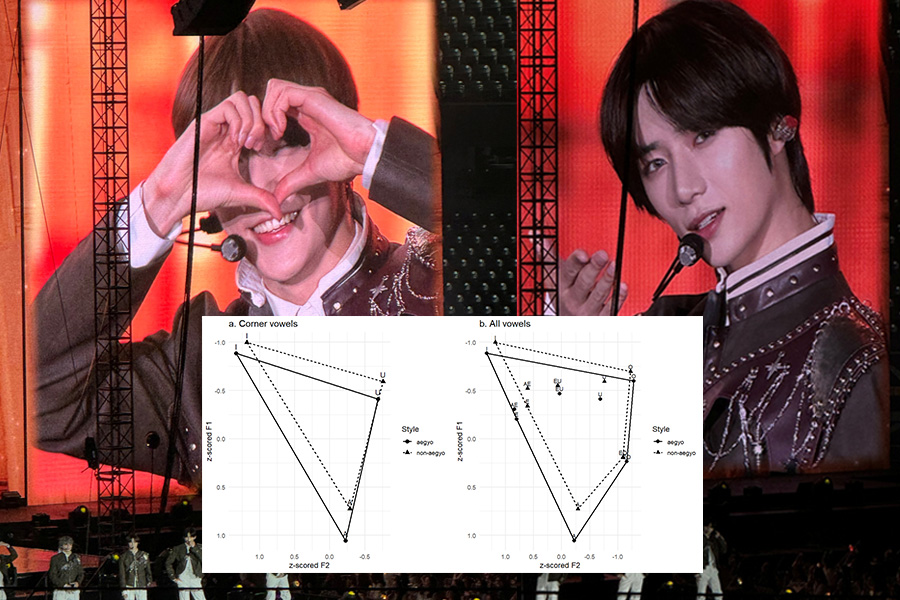 A graph showing vowel differences in aegyo speech on top of two photos of members of the K-pop band Tomorrow X Together performing aegyo on stage during a concert. Credit: Ji-eun Kim and Volker Dellwo (graph), Jade Burr (photographs)
WASHINGTON, Aug. 18, 2026 — In Korean, the term “aegyo” denotes a playful cuteness put on by adults to win someone’s affection, typically in romantic contexts. This is usually accomplished with bashful expressions or a childlike speech that is sometimes known as “baby talk” in Western cultures.
Aegyo is often associated with K-pop idols, who will sometimes be asked to “perform” aegyo by their fans, even competing to see who can be the cutest. In Korean dramas, romantic scenes between young adults sometimes feature aegyo speech, as one character tries to woo another by appearing more endearing to their love interest.
In JASA Express Letters, published on behalf of the Acoustical Society of America by AIP Publishing, researchers from Duksung Women’s University, in South Korea, and the University of Zurich, in Switzerland, set out to understand the acoustics behind aegyo speech — and what about it tugs at our heartstrings.
To measure this, the researchers focused on Formant 1 (F1) values of vowel sounds. Formants are acoustic features of the voice concentrated around a particular frequency in a speech wave based on the movement of our tongue, lips, and jaw. F1 is inversely related to vowel height and is mostly determined by the length of the throat.
“A shorter vocal tract naturally produces higher resonances, and therefore higher formant frequencies, than a longer one,” said author Ji-eun Kim. “This is one of the main reasons why children’s voices sound so different from those of adults.”
By having male and female speakers between the ages of 25 and 31 read sentences with and without aegyo, the researchers discovered that speakers were increasing their formant frequencies when speaking with aegyo, suggesting they changed their voices to make it sound like they had a shorter vocal tract.
“In the animal kingdom, several species lower their larynx to create the impression of a longer vocal tract and, therefore, a larger body size, making themselves appear more formidable than they really are,” author Volker Dellwo said. “Our findings suggest that humans can use the opposite strategy: Rather than sounding larger, speakers of aegyo make themselves sound smaller and younger.”
These results have already raised further questions for Kim and Dellwo, which they are both eager to study. They want to understand how adults make their vocal tract sound shorter and plan to explore the sociological reasons behind why aegyo speech is used.
It’s possible that a smaller, more childlike voice can elicit a protective response from others and strengthen social bonds, but the researchers are also intrigued by another theory: Raising formant frequencies could be a way to make the speaker more memorable.
“If this is the case, sounding cute may not only make someone appear more approachable, but could also help establish a person’s identity in the minds of others, a process that is fundamental at the beginning of any close social relationship,” Dellwo said.
###
Article TitleSystematic F1 increase in Korean aegyo speech may signal childlike qualities
AuthorsJi-eun Kim and Volker Dellwo
Author AffiliationsDuksung Women’s University, University of Zurich
JASA Express Letters is devoted to providing rapid and open dissemination of important new research results and technical discussion in all fields of acoustics. It serves physical scientists, life scientists, engineers, psychologists, physiologists, architects, musicians, and speech communication specialists who wish to quickly report the results of their acoustical research in letter-size contributions.
| # | Наименование новости | Тональность | Информативность | Дата публикации |
|---|---|---|---|---|
| 1 | Making Snoring a Bit More Palatable | 0 | 11.7 | 18-08-2026 |
| 2 | Egypt and South Korea Launch Hydrogen Tram Initiative | 0 | 6.96 | 08-10-2026 |
| 3 | Language in the age of AI: Whimsymaxxing the apocalypse | 0 | 8.1 | 25-09-2026 |
| 4 | Riding Korea’s wave: Yoon & Yang’s pioneer spirit | 0 | 7.09 | 22-09-2026 |
| 5 | K-Beauty’s Brazil Push Signals a New Type of Korean Diplomacy | 0 | 11.82 | 03-09-2026 |
| 6 | Gecko Skin’s Water-Retaining Secrets | 0 | 19.07 | 25-08-2026 |
| 7 | Constitutional Reform as the Lee Jae-myung Administration’s Political Watershed | 0 | 11.13 | 24-09-2026 |
| 8 | Performance art or marketing ploy? The empty promise of South Korea’s ‘dopamine shops’ | 0 | 7.09 | 24-09-2026 |
| 9 | Starship Entertainment Teams with Amuse to Debut Korean-Japanese Boy Group AEN | 0 | 8.21 | 02-06-2026 |