Просмотр новости
Найдите то, что Вас интересует
 Спутники
 РН
РН SpaceX
 Роскосмос
 NASA
NASA
СпутникиРНSpaceXРоскосмосNASAPrint media in India has shown resilience amid global downturns with increased advertising revenue and volumes. As brands continue to invest in print, the festive season is expected to boost spending significantly. Data indicates that English dailies experienced a rise in advertising revenue from accredited agencies, marking a growing trend. This year's festive season is anticipated to drive higher advertising volumes in various sectors.
Mumbai: Print media in India is bucking a global downturn, with advertising revenue and volumes holding up as brands continue to value the medium’s reach, credibility and ability to deliver highly engaged audiences, said industry executives.
The resilience is being bolstered by the festive season, as advertisers step up spending in key categories and publisher-led events introduce an additional avenue for brands to leverage print, they said.
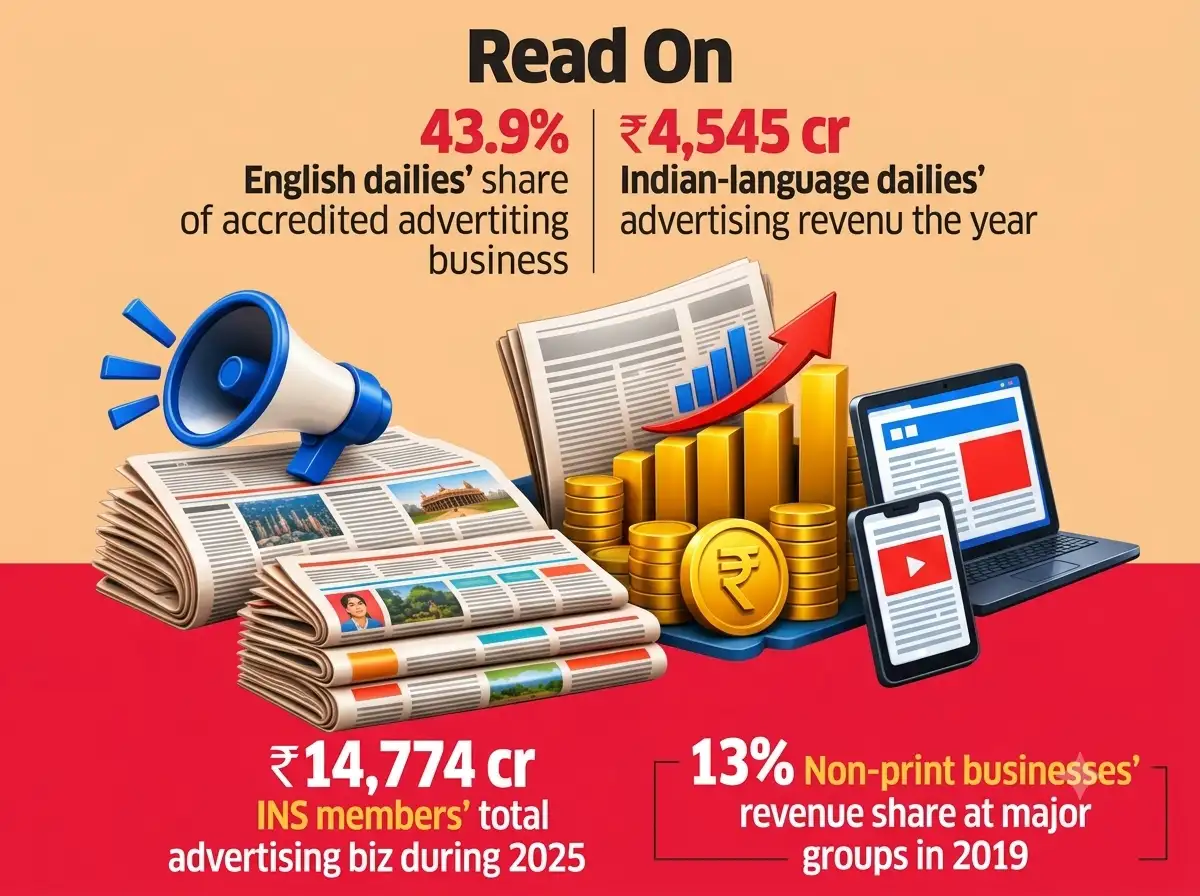
Advertising revenue for English dailies from accredited agencies rose 3.83% to Rs 3,590 crore in calendar year 2025, according to Indian Newspaper Society (INS) data. Their share of business from accredited agencies increased to 43.9% from 42.02% a year earlier, as brands bet big on premium ad inventory amid growing fragmentation in the media landscape.
Also Read: Strong outlook: Indian print media industry is poised to record robust growth in 2024
Indian-language dailies recorded ad revenue of Rs 4,545 crore, compared with Rs 4,718 crore in 2024, which was a Lok Sabha election year when advertising revenue received a boost from poll-related spending. INS members reported total advertising business of Rs 14,774 crore for 2025, compared with Rs 15,316 crore the prior year.
Meanwhile, newspaper publishers are diversifying beyond print to change their revenue mix. A recent Crisil Ratings study said non-print businesses, including digital, outdoor advertising and events, could account for around a quarter of revenue at major newspaper groups this fiscal year, compared with about 13% in FY19.
 ET Bureau
“This festive season looks very promising for marketers and consumers alike. Household consumption is holding up, two-wheelers and consumer durables are growing, and retail credit is expanding. Marketers and brand managers are using that buoyancy and the strength of print to drive sales and lift their categories,” said Sivakumar Sundaram, chief executive, The Times of India.
“We have seen advertising volumes increasing significantly in festive driven sectors like financial services, FMCG, mobiles and retail jewellery. These volumes point to a strong festive season in the coming weeks,” he added.
Print-led events are complementing growth in traditional print advertising, Sundaram said. “Both traditional print advertising and print-led events are doing well, and they work together. Advertisers prefer events run by publishers because print amplification gives an event its gravitas and seriousness,” he said.
Media buyers and brands continue to be bullish on print media, pointing out that India is the only market where the medium continues to remain strong.
“AdEx on print media remains stable, and the Pitch Madison report projects 3% growth this year,” said Sam Balsara, chairman of media agency Madison World. “Print continues to be an important part of the media mix for certain categories, which is supporting its growth. The focus now should be on bringing more categories into print advertising, rather than relying largely on brands and categories that have traditionally advertised in the medium,” he said.
According to the Pitch Madison report, print advertising is expected to grow to Rs 21,388 crore in 2026 from Rs 20,866 crore in 2025.
“Print media continues to grow in India despite the challenges facing the industry globally,” said Navin Khemka, South Asia president - Client Solutions at global media and ad agency WPP Media. “English print is doing well, with key advertising categories such as auto, real estate and education bouncing back. Regional print is also expected to grow, although it remains heavily dependent on retail advertisers. The recovery in retail, particularly during the festive season, should support growth,” he said.
English print offers advertisers access to premium audiences, while regional publications provide mass reach, he said. “Reaching premium audiences naturally comes at a higher cost, while regional print offers advertisers a more cost-effective way to reach a larger audience.”
Dabur India head of media and brand activations Rajiv Dubey said print media bounced back strongly from the disruption caused by the pandemic in 2020. English print, in particular, continues to be attractive to advertisers because of its ability to reach affluent, educated and highly engaged audiences, which makes it a natural choice for premium brands across categories such as automobiles, smartphones and consumer goods, he added.
“At the same time, print has become more focused. Its audience increasingly comprises serious readers who value credible journalism and are willing to pay for quality content. In an environment where fake, manipulated and synthetic content is becoming increasingly prevalent, print offers advertisers and consumers something that is becoming more valuable that is credibility and trust,” Dubey said.
Dabur remains strong believers in print and continues to invest in high-impact formats, including front-page advertising, because of the impact and visibility they deliver, he said. “Print continues to create impact, build brand salience and remain highly relevant for advertisers.”
According to TAM data, print ad space in the January–July period of this year was largely stable, with education, services, auto, BFSI and personal accessories being the top sectors.
“Over the last two years, we have seen more brand launches targeting the premium end of the market across major metro markets. English print is well embedded within this segment of consumers and delivers reach. English print has also opened up placement innovation for advertisers, leading to higher impact, but at a premium value. There is an increased contextual environment for advertisers by segregating pages based on content and allowing brands to customise their offering based on potential readers for the content," said TAM Media CEO LV Krishnan.
“Apart from the above, the 360-degree integrated offering to advertisers — with a print ad packaged with event participation, exhibit booths, digital experiences and even product sampling by riding on the print medium — has given a big jump to overall revenues from advertisers, both national and local," he added.