Просмотр новости
Найдите то, что Вас интересует
 Спутники
 РН
РН SpaceX
 Роскосмос
 NASA
NASA
СпутникиРНSpaceXРоскосмосNASABy Paras Shah There is a particular kind of pain one only learns from by living through it: a defect that surfaces at 11 pm on the bench, two weeks […]
The post Shift-Left Testing with AI in Embedded Systems: Catching Bugs Before They Hit the Bench appeared first on The European Business Review.

There is a particular kind of pain one only learns from by living through it: a defect that surfaces at 11 pm on the bench, two weeks before a customer demo, in a build whose author left for a vacation that morning. I have been there more than once! Across twelve years of embedded validation work, the single variable I have watched bend project timelines more than any other is the lag between when a bug is born and when somebody actually notices it. The shift-left has always been the textbook answer to that lag. What is different in 2026 is that AI finally makes the textbook practical at the scale most product teams actually ship at
Why is now the right moment for using shift-left?Anyone who has run a V-model program knows the rhythm. The coding stage lasts for months, then the integration, and then starts the long climb up the right side of the V. By the time integration and system test begin, the original requirement was written so long ago that the engineer who interpreted it has moved teams!
In firmware that pain compounds. Hardware availability is limited; climate chambers sometimes get double-booked, and tools like JTAG pods are not always available when needed. In addition, reproducing timing-related issues can take a significant amount of time and may consume a large part of the day.
Based on the experiences across multiple embedded and automation projects, fixing an issue during the requirement phase takes minimal effort, while the same issue becomes significantly more expensive and time-consuming if identified during system testing or after release.
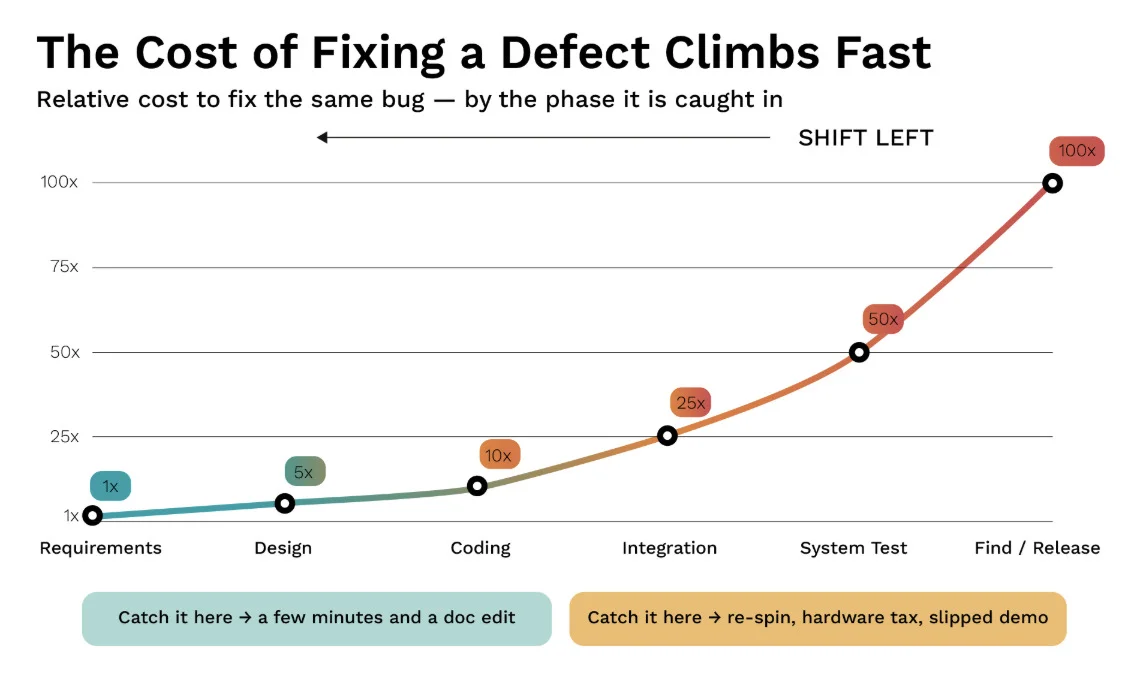
The idea of testing earlier is not new. The early reading on the other hand is. Five years ago, the only honest way to review a 200-page requirements document for ambiguity was to put two senior validation engineers in a room for a week. Today, artificial intelligence makes shift-left practical for modern software testing and quality assurance in embedded teams: it is possible to paste the same document into an LLM, ask it to flag every untestable phrase, every hidden assumption and every requirement that lacks an acceptance criterion, and have a triage list before lunch; 81% of development teams now use AI in testing workflows. The output is not gospel; about a third of what comes back has to be set aside. However, the two-third output that survives review is genuinely useful, and it lets the senior engineers spend their day on the calls that actually need a human in the loop.
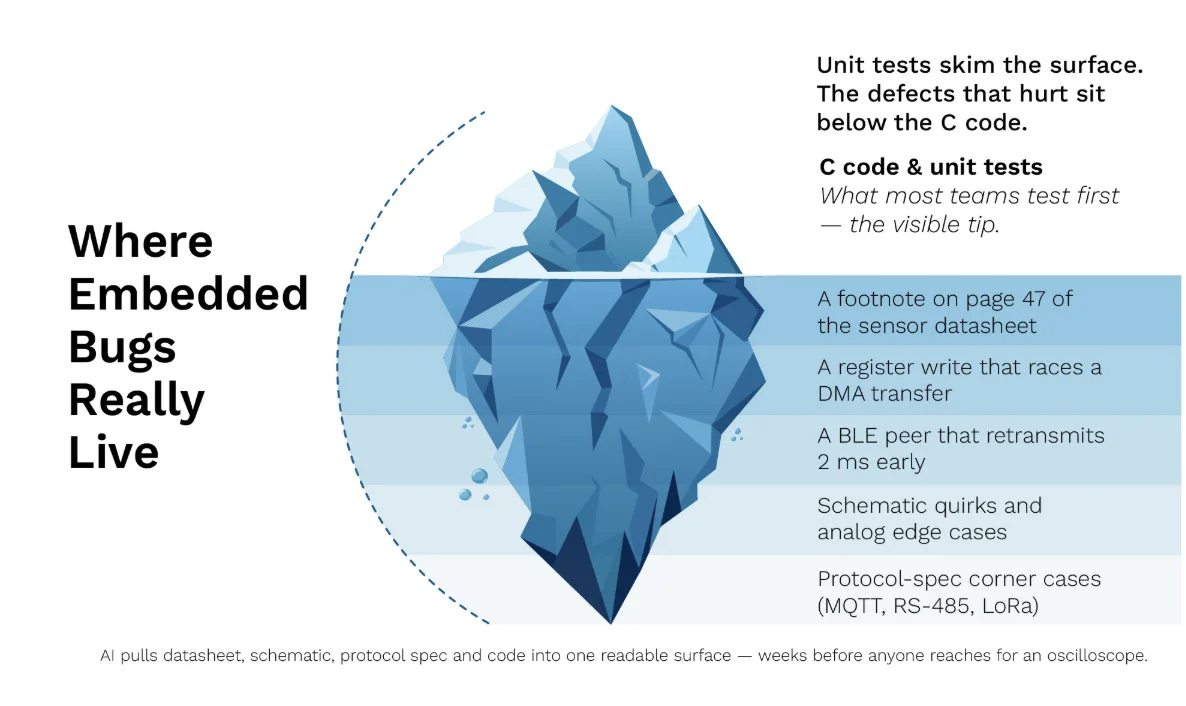
What “Shift-Left With AI” actually looks like for Embedded Systems TeamsA lot of teams reduce shift-left to a single phrase: write more unit tests, sooner. In firmware that misses most of the iceberg. Across the development cycle, and the overall development process, the bugs that hurt embedded products tend to live below the C code, a footnote on page 47 of a sensor datasheet, a register write that races a DMA transfer, a BLE peer that retransmits two milliseconds earlier than the spec said it would. AI is genuinely useful here because it pulls those layers, datasheet, schematic, protocol spec, code, into a single readable surface, and automated testing supports earlier feedback than manual testing alone, weeks before anyone reaches for an oscilloscope.
Concretely, this is how it shows up in everyday work in my projects. Automated testing increases efficiency, accuracy, and test coverage; the automated testing market is projected to reach USD 55.2 billion by 2028, 78% of successful businesses use it in deployment, it can reduce test cycle duration by over 50%, and average ROI can reach 600%.
About 15–20% come back needing rewording before a human even sees them. Shift-left testing improves collaboration between developers and QA teams, though shifting left can still require a team culture change.
What follows is not a reference architecture pulled from a whitepaper. It is a working pipeline for AI-driven testing that I have reused, with small variations, on a continuous-glucose monitor, two factory IIoT gateways and one smart-manufacturing controller in the past three years. None of the individual steps are clever on their own. The win comes from running them every single day, not just as a launch checklist.
1. Requirements and risk, before any code is touchedEach new or changed requirement passes through the test of two questions:
The model proposes wording fixes and a first cut at acceptance criteria. A senior engineer then keeps, edits, or trashes each one. The whole loop typically takes 30–40 minutes per requirements batch, against the day-and-a-half that it used to consume earlier.
2. Code generation, with the safety net wired inTwo house rules apply whenever an AI tool is involved in writing production code.
Both rules exist for one reason. When it is time for the IEC 62304 audit, the trail of who decided what, and why, must read as cleanly as if a human had written every line by hand.
3. Protocol testing, especially the messy partsMost of the products I work on speak some combination of MQTT, RS-485, BLE GATT and LoRaWAN. For each of them the routine is as follows:
We routinely catch interoperability bugs in week two of a project that, on older programs, would have first surfaced during the field pilot.
4. Virtual hardware, so the bench is not the bottleneckWe do not wait for the EVT board to start exercising firmware. Instead:
The result is that developers run something resembling a full system test on their laptop, every push, before the first hardware revision is even back from the fabrication. Self-healing tests can reduce test maintenance by adapting to UI or workflow changes automatically, but manual testers still review the outputs.
5. Failure triage, so that the nightly runs stay actionableWhen the nightly suite finishes, two things happen automatically.
The practical effect is that the same flake does not get rediscovered for three mornings in a row, and CI stops being the most expensive on-call rotation in the building.
Keeping The Whole Thing Auditable with AI Testing ToolsUsually, no notified body has a problem with AI in the loop. Its inputs and outputs are logged, its version is recorded, and a named, qualified engineer signs off on what makes it to the build or the relevant tests in the team’s test automation framework.
Under IEC 62304Shift-left has been the right answer for twenty years. AI did not invent it, and AI on its own will not be the thing that finally delivers it. At eInfochips, AI is leveraged as an enabler that strengthens shift-left engineering practices by accelerating development and validation workflows. What AI does, very specifically, is take the dull middle layer off the work, the parsing of long requirements, the boilerplate scaffolding, the log-grepping, and the recurring why-did-this-fail-again rituals, then hand those saved hours back to the people who actually move the product: the senior reviewers, the firmware leads, and the validation engineers who can spot a timing bug from thirty paces. In embedded systems development, where every late defect carries a hardware tax that nobody enjoys paying, those reclaimed hours become a meaningful advantage. By combining deep engineering expertise with AI-driven automation, eInfochips helps organizations improve efficiency, accelerate product development, and enhance overall product quality.
Not really. In firmware the bugs that hurt me aren’t in the C code they’re in a datasheet footnote, a register racing a DMA transfer, a BLE peer that fires two milliseconds early. AI lets me read the datasheet, schematic, spec and code together, weeks before the board hits my bench, so unit testing starts from clearer assumptions and integration testing doesn’t wait for late surprises. Shift-left was always about timing; AI just made the early reading affordable.
Q2. Where do you let AI work, and where does a human stay in charge?AI does the boring middle reading long specs, flagging weak requirements, drafting test scaffolding, sorting through logs. It doesn’t decide anything. My rules are simple: touch a safety module and the tests get written too (no tests, no merge), and whoever accepts a suggestion has to explain it in plain English. About a third of what the model gives me gets bound anyway.
Q3. How do you keep this defensible when the auditor shows up?I don’t build a separate process for AI that’s what gets you in trouble. The tool just sits in the IEC 62304 tool list with its name, version and known gaps. Anything it flags goes into the same ISO 14971 risk file as every other hazard, and under ISO 13485 nobody uses it on a regulated module without training first. The test: the trail should read as if a human wrote every line.
Q4. How do you test MQTT, RS-485, BLE and LoRa before you have hardware?Two passes. A model drafts the normal-path cases from the spec, then an AI fuzzer goes after the edges malformed packets, out-of-order BLE, RS-485 timing violations. It all runs on QEMU or Renode, in controlled testing environments, on a laptop, every push, then gets checked again on actual hardware when the boards arrive. That’s how I catch interoperability bugs in week two instead of at the field pilot.
Q5. Doesn’t all that testing just bury you in failures nobody reads?It would, so triage is the last step, not an afterthought. After the nightly run, similar failures get folded into one ticket with a quick root-cause guess attached, which helps QA teams sustain test automation without adding hours. So you see five real failures in the test results, not five hundred lines of red and the same flaky tests stop showing up three mornings in a row.
About The Author Paras Shah is a Senior Automation and Embedded Validation Engineer at eInfochips (an Arrow Electronics company). He specializes in embedded automation, protocol-level device validation, and AI-assisted embedded automation for medical, industrial, and IoT products. With over 12 years of experience across Python automation, real-time communication protocols (MQTT, RS-485, BLE, LoRa), and CI/CD pipelines, aligned with ISO 13485, ISO 14971, and IEC 62304. He holds a Bachelor’s in Electronics and Communications Engineering and a Post Graduate Diploma in Management. In his spare time, he mentors engineers and explores how AI-assisted tooling can accelerate regulated validation of Workflows.
| # | Наименование новости | Тональность | Информативность | Дата публикации |
|---|---|---|---|---|
| 1 | The Role of QA in Developing Reliable AI Applications | 0 | 9.39 | 25-09-2026 |
| 2 | How Businesses Are Successfully Adopting AI | 0 | 10.03 | 01-10-2026 |
| 3 | Beyond AI Adoption: How AI Agents Are Reshaping Enterprise Operations | 0 | 6.18 | 25-09-2026 |
| 4 | The Business Case for Bringing Video Production In-House With AI | 0 | 8.78 | 07-09-2026 |
| 5 | What Happens When CX Buys the Tool and IT Inherits It | 0 | 6.54 | 06-10-2026 |
| 6 | Gain Competitive Advantage With AI & Creative Experimentation | 0 | 8.67 | 20-08-2026 |
| 7 | How Professionals Are Using AI Assistants to Save Hours Every Week | 0 | 7.06 | 28-09-2026 |
| 8 | What Enterprises Should Ask Before Buying a Unified IT Operations Platform | 0 | 7.14 | 30-08-2026 |
| 9 | Intel’s AI Comeback Depends on More Than Just CPUs | 0 | 6.87 | 06-10-2026 |
| 10 | Contract Intelligence vs Traditional Contract Management: Which Offers Better Risk Mitigation? | 0 | 7.32 | 30-08-2026 |