Просмотр новости
Найдите то, что Вас интересует
 Спутники
 РН
РН SpaceX
 Роскосмос
 NASA
NASA
СпутникиРНSpaceXРоскосмосNASAFollowing years of back and forth between the seven states that share the Colorado River and the federal government, the Trump administration has settled on a plan for the next two years.
The Trump administration has handed down a final operating plan for the Colorado River for 2027 and 2028 following years of stalled negotiations between seven states and the federal government.
Under the plan — one that largely aligns with what the Lower Basin states of Nevada, California and Arizona had previously proposed — the Silver State will be forced to give up one-sixth of its share of the Colorado River, or about 50,000 acre-feet, each year over the next two years. In total, the Lower Basin states will take 1.25 million acre-feet in reductions each year.
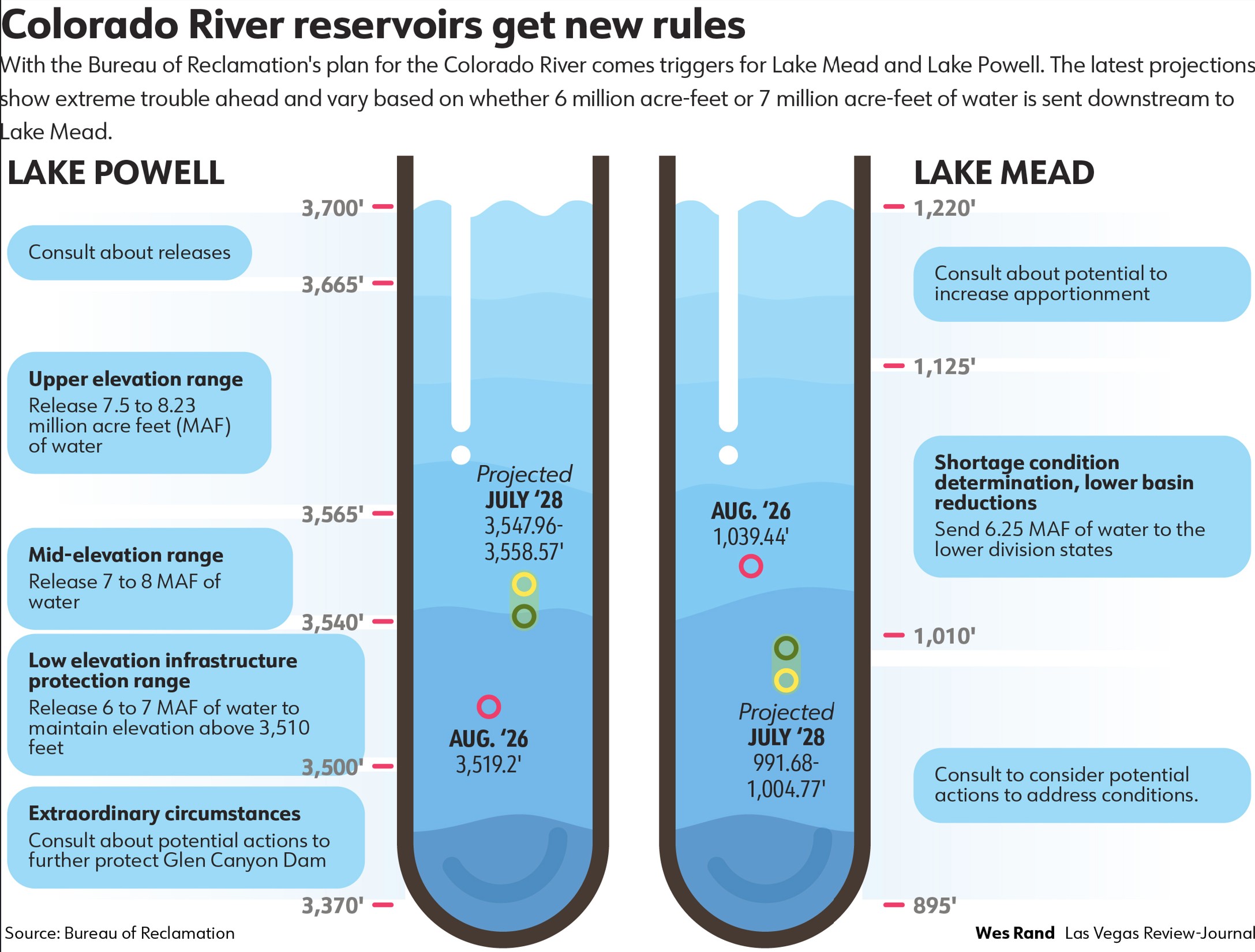
It won’t do much to prop up Lake Mead. According to two different Bureau of Reclamation models released Friday, Lake Mead is likely to drop at least 35 feet to an elevation between 1004.77 and 991.68 above sea level in July 2028, the latest month for which there are projections, depending on how much water is released from Lake Powell.
The Lower Basin states have agreed to conserve and store at least an additional 700,000 acre-feet of water over the two-year period to protect the system beyond the cuts announced Friday. That’s something Nevada already has a head start on: A $16.25 million federal grant for leaving 50,000 acre-feet in Lake Mead this year to partially meet that requirement.
Beyond 2028, talks between the states and the federal government are ongoing. Drought conditions and record-low levels in both Lake Mead and Lake Powell have ushered in a new reality where a 20-year operating agreement is no longer feasible.
“One of our guiding principles was hydrology-responsive operations,” said David Palumbo, deputy commissioner at the Bureau of Reclamation, in a Friday webinar. “As the conditions on the ground change, we wanted to be nimble and be able to adjust throughout the period that the record of decision covers.”
The plan does not include mandatory reductions in the Upper Basin states of Colorado, Utah, New Mexico and Wyoming. Instead, it asks those states to provide 200,000 acre-feet collectively on a voluntary basis.
Throughout yearslong negotiations, Upper Basin officials have argued that greatly reduced flows already force them to shut off high-priority water users due to their legal obligation to send water downstream to the Lower Basin.
Further cuts could loom for NevadaNevada water managers are worried they might not be off the hook when it comes to imposed shortages beyond 2028.
In the environmental impact statement released earlier this month that mirrors the operating plan adopted Friday, the federal government warns bigger cuts could be possible sometime over the next 10 years. Existing legal frameworks could force Nevada to contribute up to two-thirds of its allocation, leaving only 100,000 acre-feet for state use.
Southern Nevada used 198,000 acre-feet of water last year.
Nevada Gov. Joe Lombardo and Southern Nevada Water Authority General Manager John Entsminger expressed hesitance at what could come after the two years are up. Entsminger said state officials are willing to fight back to protect water supplies.
“The federal government has produced a plan that provides little certainty for Nevada and other Lower Basin users,” Lombardo said. “Looking into years three through 10 of the decision framework, the federal government is positioning to short Nevada — the state with the smallest river allocation at only 1.8 percent — sacrificing the health and safety of Nevadans before requiring equal water responsibility for our shared water resources from the Upper Basin.”
Elizabeth Koebele, a professor at the University of Nevada, Reno, who studies how the Colorado River is governed, said while the document is the first time the federal government has asserted its powers to impose cuts in the absence of an agreement, it doesn’t go far enough in making hard decisions.
Passing the buck back to the states again on such an important decision comes at the expense of the larger system, though it does reduce the chances of an immediate fight at the U.S. Supreme Court over water, she said.
“We’re in a little bit of a ping-pong between the states not making a decision and the federal government not making a decision,” Koebele said. “At some point, we need to do something to change that behavior by at least one of those actors.”
Lake Powell at the expense of Lake Mead?Such a poor outlook for Lake Mead was met with some swift condemnation.
Glen Canyon Dam at Lake Powell has long been a concerning piece of infrastructure for the Colorado River Basin. Below 3,490 feet in elevation, water managers have flagged that old river outlet works may not be able to function properly for downstream releases.
Gary Wockner, of the Colorado state-based advocacy group Save the Colorado, called Friday’s operating plan a “near-desperate attempt to try and save the dam.” His organization and others have called for the Bureau of Reclamation to consider decommissioning or bypassing Glen Canyon Dam.
“It’s not if, but when, this solution needs to happen, but again Reclamation has buried its head in the concrete of a dam that should’ve never been built in the first place,” Wockner said in a statement.
Eric Balken, of the nonprofit Glen Canyon Institute, agreed: “Propping up Lake Powell is not a long-term strategy. The current approach from Reclamation will hamstring the entire Basin to avoid operational failure at Glen Canyon Dam.”
Asked in its public webinar about the decision to focus on Lake Powell, Reclamation official Carly Jerla said the federal government hoped to “protect operational reliability and flexibility of the infrastructure.”
When Lake Mead falls below 1,010 feet, the operating plan calls for emergency action from the basin states. It does not specify what could be done that isn’t underway, and neither did Jerla.
Koebele, the UNR professor, said the projections for the two reservoirs are bad enough that the states should already be considering emergency measures. The situation at Glen Canyon Dam underscores how water managers must get more comfortable with the trade-offs of different solutions, she said.
“We’re always in the worst-case scenario,” Koebele said. “Maybe we should be focusing on how to get out of that rather than sketching out a broader plan, where one day we’re magically in a higher elevation tier and we manage the system differently.”
Most experts acknowledge that the federal government and the states are confronted with a near-unsolvable problem.
That is for two big reasons: an expensive, time-consuming and impending threat of a U.S. Supreme Court case over whatever plan they decide on and a multi-decade drought that is being roiled by climate change. This year dealt water managers an abysmal runoff season, with only 13 percent of normal river flows into Lake Powell.
Koebele said while she appreciates that the Bureau of Reclamation has provided clear deadlines for when discussions should resume, the past three years of no progress is an indication that a due date won’t help. However, the flexibility to allow discussions to continue with some set parameters is a step forward, she said.
“I think it is most likely to fail if it simply leaves decision-making until the last minute and gives us sort of more of the same,” Koebele said. “I’m just not seeing a lot in here that pushes us toward consistent and predictable decision-making.”
Jennifer Pitt, Colorado River program director at the Audubon Society, said a lawsuit between the states is “the most destabilizing thing that could happen” along the river.
Both Pitt and Kevin Moran, associate vice president at the Environmental Defense Fund, pointed to the need for investment in projects that will conserve water, like cash-for-grass programs and expanded water recycling, as well as encouraging the development of further ocean desalination to make river diversions less necessary.
Rep. Dina Titus, D-Nev., and a bipartisan coalition of Western lawmakers have made an emergency funding request in Congress to help bankroll these initiatives. Bureau of Reclamation officials said Friday they will continue to review a list of potential projects to fund that the states submitted in April.
“The federal government is doing the best it can to avoid big legal disputes, but these guidelines don’t create water,” Pitt said. “Given the state of the reservoirs and the real risk of degrading conditions over the next two years if the hydrology is bad, it seems like one thing the basin still can do is to invest in a substantial way.”
Moran said he acknowledges taxpayer funds are limited, but that it’s critical for both states and the federal government to consider creating a sustainable funding stream for drought mitigation.
“How do we lean in in ways that get us out of what has become a cycle of depletion and crisis management?” Moran said. “That’s going to take working within this framework in a bold, innovative way across all water user sectors and all states.”
Contact Alan Halaly at ahalaly@reviewjournal.com. Follow @AlanHalaly on X.
| # | Наименование новости | Тональность | Информативность | Дата публикации |
|---|---|---|---|---|
| 1 | Nevada strikes $16.25M deal to keep water in Lake Mead as feds near decision | 0 | 6.82 | 20-08-2026 |
| 2 | ‘Devastating’ cuts: Nevada is first state to file suit over Colorado River plan | 0 | 7.23 | 24-08-2026 |
| 3 | 'Only negotiated solution can end deadlock': Iran as Trump rejects peace plan | 0 | 8.46 | 27-09-2026 |
| 4 | Off-roading on federal lands in Colorado could expand with expected Trump reversal | 0 | 16.41 | 18-09-2026 |
| 5 | Trump Sharply Scales Back Fuel Economy Rules for New Cars | 0 | 7.59 | 29-09-2026 |
| 6 | Trump faces down beef backlash. Will import plan pay off? | 0 | 6.65 | 05-09-2026 |
| 7 | Trump faces down beef backlash. Will import plan pay off? | 0 | 6.65 | 08-09-2026 |
| 8 | США могут ввести пошлины до 100% для партнеров России по энергетике | 0 | 12.65 | 04-10-2026 |
| 9 | Трамп заявил о планах урегулировать девятую по счету войну | 0 | 10 | 07-10-2026 |
| 10 | Judge temporarily blocks border wall construction in Texas’ Big Bend region | 0 | 5.01 | 02-10-2026 |