Просмотр новости
Найдите то, что Вас интересует
 Спутники
 РН
РН SpaceX
 Роскосмос
 NASA
NASA
СпутникиРНSpaceXРоскосмосNASAGoogle has announced Gemini 4 Argon, a new frontier AI model designed for complex, long-horizon workflows spanning software engineering, enterprise knowledge work, multimodal analysis, creative writing, and cybersecurity. Google says the model is already being used internally by thousands of employees for specialized coding, debugging, research, and large-scale software engineering tasks. One of the biggest […]
Add MobiGyaan as a preferred source on Google
Google has announced Gemini 4 Argon, a new frontier AI model designed for complex, long-horizon workflows spanning software engineering, enterprise knowledge work, multimodal analysis, creative writing, and cybersecurity. Google says the model is already being used internally by thousands of employees for specialized coding, debugging, research, and large-scale software engineering tasks.
One of the biggest changes with Gemini 4 Argon is its 1 million-token output limit, up from the previous 64,000-token limit. Google says the expanded output capacity allows the model to reason through complex problems and generate hundreds of thousands of tokens in a single trajectory.
Google says its engineers are already using Gemini 4 Argon for everyday debugging, algorithm design, and large-scale code migrations.
In one example, Argon agents are helping migrate C/C++ codebases to Rust, ranging from tens of thousands of lines in projects such as re2 and libgav1 to more than 800,000 lines in the Fuchsia Zircon kernel.
The model has also been used by Google’s quantum computing researchers to optimize spacetime resources, measured as qubits x gates, for bottleneck subroutines. Google says Argon beat a published baseline by 40% within minutes in one example.
Another internal application involves memory optimization across Google’s data centers. According to Google, Argon agents analyzed fleet-wide profiling telemetry and identified optimizations that ultimately freed more than 300 TiB of memory, with estimated total savings of 500 TiB to 1 PiB.
For libgav1, Google’s open-source video decoder, Argon agents worked on an existing Rust port and replaced around 32,000 lines of SIMD code through repeated profile-guided experiments. Google says the resulting memory-safe decoder was 2.7 times faster than the Rust port while producing identical video output.
Google says these changes undergo automated and manual auditing, emulation testing and review before being deployed to production.
1M-Token Output Limit & Benchmark ResultsGemini 4 Argon’s output limit has been increased to 1 million tokens, compared with 64,000 tokens previously. This gives the model considerably more space for long-running reasoning and multi-step tasks.
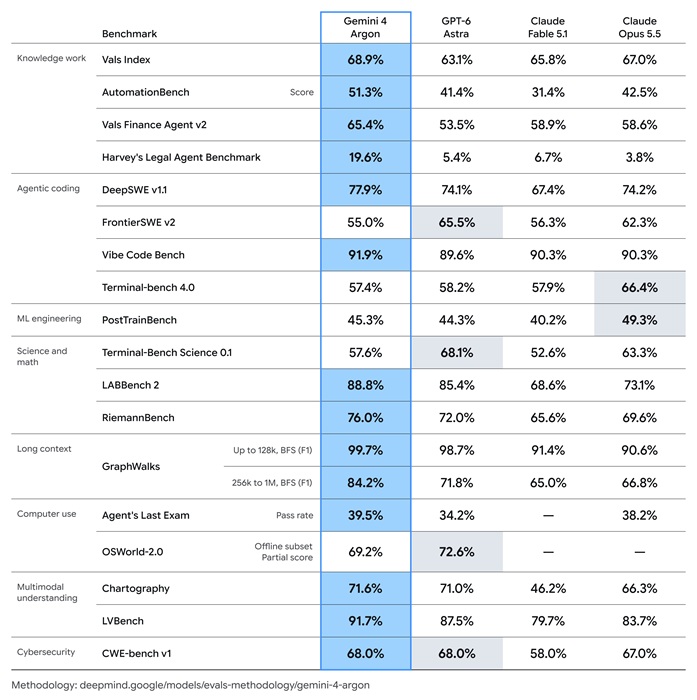
Google reported the following benchmark results:
Google also highlighted enterprise-focused evaluations including the Vals Index, Vals Finance Agent v2 and Harvey’s Legal Agent Benchmark.
The model supports multimodal knowledge work as well, including professional chart analysis, long-video understanding and taking actions based on information contained across multiple documents.
Cybersecurity is another major focus of Gemini 4 Argon. Google says the model can autonomously find, validate and patch critical software vulnerabilities.
Trusted cyber defenders and selected Google internal teams will receive access to Argon’s cybersecurity capabilities through Google’s controlled rollout. The approach builds on Google’s Fairwind Program, which provides trusted government and enterprise partners with advanced AI-powered cyber defense capabilities.
Google says Argon was able to uncover a critical vulnerability exposing sensitive personal information in healthcare software used by hospitals worldwide during an early demonstration. According to the company, previous frontier models had missed the vulnerability.
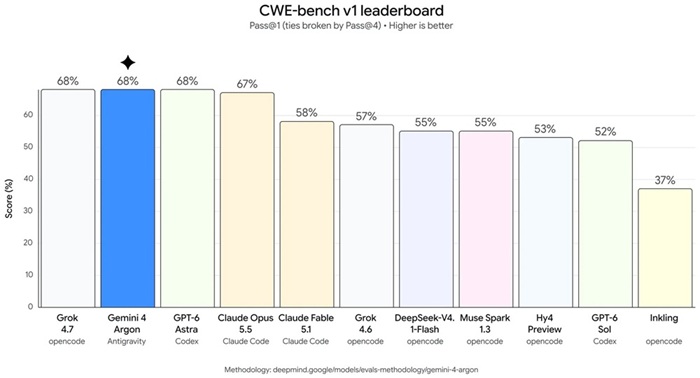
On CWE-bench v1, which evaluates vulnerability remediation, Gemini 4 Argon tied for first place with a 68% score, according to Google.
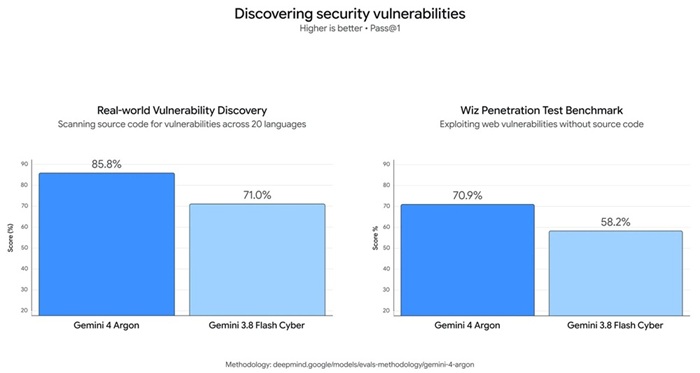
The company also reported that Argon performed strongly on its internal vulnerability benchmark and on a Wiz black-box penetration-testing benchmark, where the model was evaluated on live web systems without access to source code.
Before broader availability, Google is strengthening Argon’s safeguards across four areas: misuse prevention, prompt injection protection, misalignment monitoring and system security.
For misuse prevention, Google says Argon is designed to refuse harmful requests involving cyberattacks and chemical, biological, radiological and nuclear (CBRN) threats while supporting legitimate dual-use scientific research.
Google is also testing the model against indirect prompt injection attacks, in which malicious instructions embedded in external information can attempt to alter an AI system’s behavior. The company says Argon performed strongly on Gray Swan’s Indirect Prompt Injection benchmark.
For misalignment monitoring, Google says it is deploying systems that monitor Argon’s reasoning and actions and can stop execution when necessary if the model begins moving beyond the user’s intended task.
Google is also hardening the sandboxed environments used for high-risk training and evaluations by isolating and sealing them.
Gemini 4 Argon Price & AvailabilityGemini 4 Argon is initially rolling out to a limited group of trusted cybersecurity experts through Google’s Fairwind Program. Google says it is also participating in the U.S. government’s voluntary process for pre-release model access while gradually expanding availability.
Broader access will eventually begin with paid API customers and Google AI Ultra subscribers, followed by wider availability to developers, enterprises and consumers.
The introductory API pricing is:
After the introductory period, pricing will increase to $4 per 1 million input tokens and $20 per 1 million output tokens.