Просмотр новости
Найдите то, что Вас интересует
 Спутники
 РН
РН SpaceX
 Роскосмос
 NASA
NASA
СпутникиРНSpaceXРоскосмосNASAModern IT requires more than legacy models. Learn how Cisco’s three-pillar strategy—Services as Code, AIOps, and AI-powered DevOps—enables a shift to autonomous, self-healing infrastructure that reduces risk and accelerates innovation.
The current technological landscape is defined by a structural divergence between the speed of hybrid infrastructure evolution and the capacity of traditional operating models to govern it. Historically, the industry has operated on the principle of testing, validating, and deploying infrastructure with the goal of minimizing subsequent changes, relying on annual or semi-annual update plans that were once considered adequate. However, the mass adoption of Artificial Intelligence and the increasing complexity of multi-domain ecosystems have revealed a critical phenomenon: operational obsolescence. This condition manifests when Operation and Maintenance processes, originally designed for static and manual-control environments, prove inadequate to support the pace, scale, and risk profile of modern architectures, rendering legacy management models a systemic risk to operational continuity and organizational innovation.
The Shifting Threat LandscapeTwo fundamental factors have accelerated this crisis, radically transforming the threat landscape. First, the infrastructure itself – computers, storage, switches, routers, firewalls, and load balancers—has become the new primary attack surface, as evidenced by sophisticated campaigns such as Salt Typhoon and Volt Typhoon[1], which have put the industry on notice that critical infrastructure is now a direct target. Second, a new generation of frontier AI models has made a significant leap in the ability to identify vulnerabilities in complex software systems. Unlike previous generations of AI coding tools limited to smaller, greenfield contexts, current models are capable of analyzing massive, highly complex legacy code bases developed over many years, drastically reducing the time required for attackers to discover and exploit security flaws.
Evolving ITIL for a Modern ParadigmThis new reality renders traditional manual intervention and static documentation unsustainable. Overcoming this challenge requires an evolution of established reference frameworks such as ITIL. While ITIL remains valid in terms of governance, traceability, and change management discipline, it requires profound re-elaboration. The new operational paradigm, currently being defined, does not aim to replace ITIL’s core principles, but rather to evolve them through the systematic introduction of process automation. This approach allows for the digitalization of intent, the automation of execution, and continuous validation, ensuring consistent infrastructure management in real-time.
The Three Technical Pillars of Modern OperationsThe proposed modernization strategy is built on three complementary technical pillars that define the modern operational lifecycle. The first pillar, Services as Code, transforms the desired state of the infrastructure into versionable data, managed according to Software Development Lifecycle best practices.
The second pillar is machine-speed automation enabled by AI in IT Operations (AIOps – Artificial Intelligence for IT Operations), which allows for the execution and remediation of configurations with a level of consistency unattainable through direct human intervention.
The third pillar is the adoption of the DevOps method powered by AI, which integrates governance, approval, and change traceability directly into the code lifecycle, ensuring that every modification is verified and compliant with the security and operational standards defined by the organization.
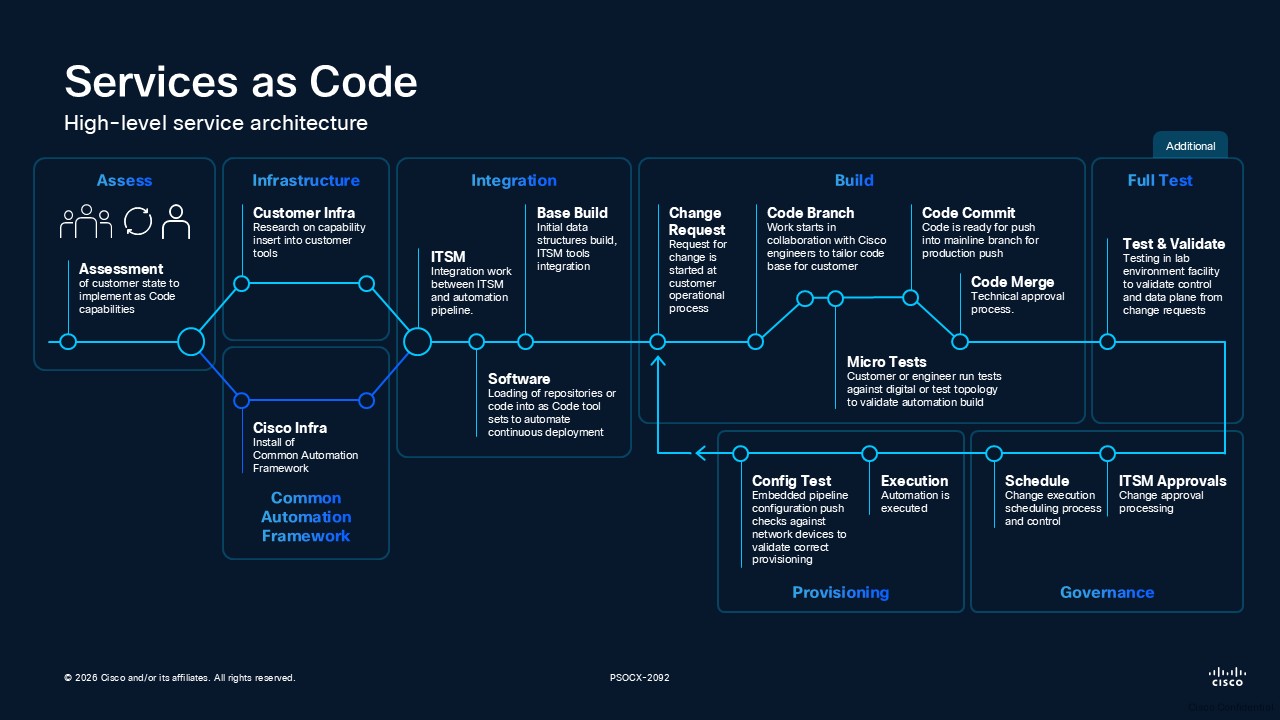 “With Cisco® Services as Code, enterprises can define their network infrastructure state and treat all network elements as software that can be versioned and managed at scale. With infrastructure as code, declarative automation, and DevOps best practices, IT teams can expedite deployment, provisioning, configuration, and testing processes to seamlessly operate and optimize their network operations.” [PSOCX-2092]Establishing a Foundation for Operational Resilience
Translating these strategic pillars into trusted, scalable operations requires a solid foundation. Deploying autonomous AI agents in fragmented or poorly documented environments risks creating cascading operational errors. To achieve true operational resilience and scale safely toward autonomous operations, organizations must establish four core operational foundations:
The transformation toward this new operating model marks the definitive shift from manual-control infrastructures to automated infrastructures with human supervision. In this scenario, the role of the operator undergoes a significant metamorphosis: shifting from repetitive task execution to functions of governance, strategic validation, and intent definition. This evolution is comparable to the manufacturing industry’s transition to Computer Numerical Control (CNC), rendering IT infrastructure inherently programmable, observable, and continuously validated at every step.
The Journey to Autonomous Architecture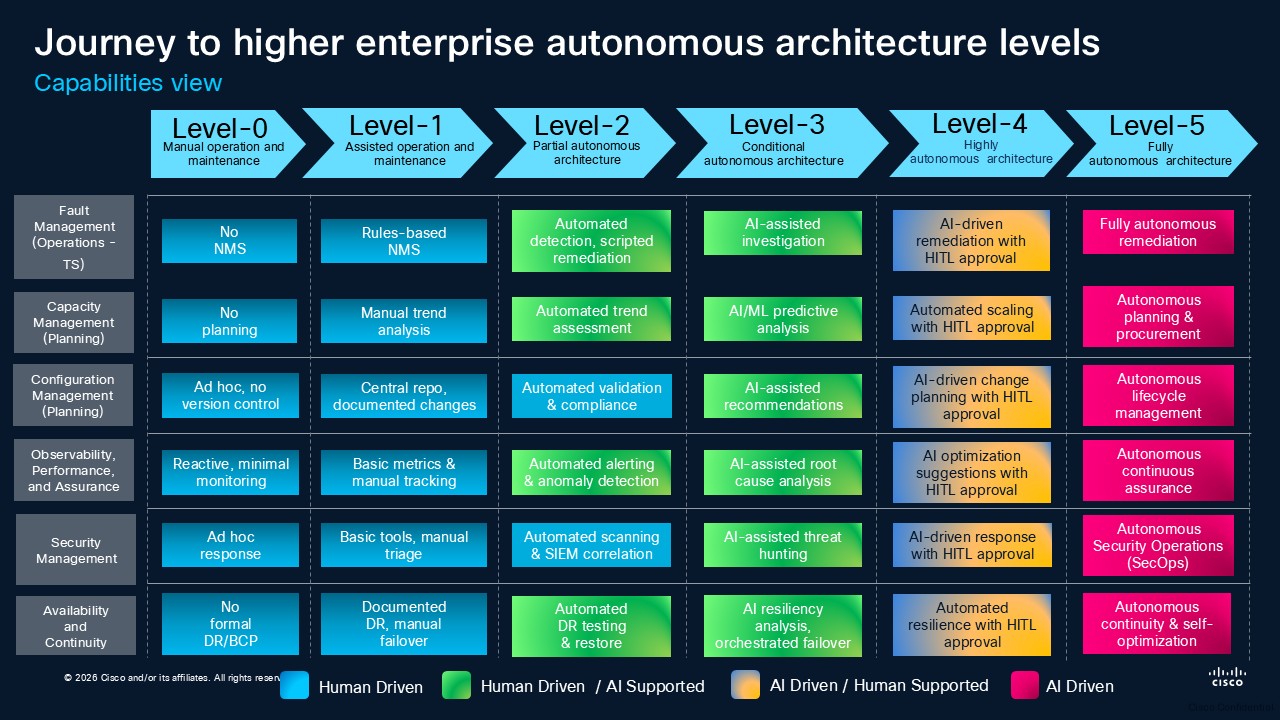 “This slide from Cisco Live 2026 EMEA session PSOCX-2092 illustrates the ‘Journey to higher enterprise autonomous architecture levels’ across six key operational capabilities: Fault, Capacity, Configuration, Observability and Assurance, Security, and Availability Management. The framework outlines a six-stage maturity model moving from Level-0 (Manual) and Level-1 (Assisted) to Level-2 (Partial Autonomous), Level-3 (Conditional Autonomous), Level-4 (Highly Autonomous), and Level-5 (Fully Autonomous). It visualizes a fundamental operational evolution: transitioning from reactive, human-driven tasks with manual troubleshooting and static tooling toward an AI-driven, human-supported paradigm. Advanced stages leverage machine-speed analytics, AI-assisted root cause analysis, and human-in-the-loop (HITL) governance, ultimately culminating in a fully autonomous, self-healing, and self-optimizing enterprise infrastructure with continuous assurance and automated lifecycle management across multi-domain hybrid IT cloud environments.”
Through Cisco’s support, organizations can implement this model, benefiting from an architecture that not only drastically reduces operational risk but also enables the speed and resilience essential for competing in today’s market.
References
BRKSEC-2499 – Salt Typhoon – Cisco Live 2025
PSOCX-2092 – Cisco Live 2026 EMEA
Infrastructure as Code: https://developer.cisco.com/iac/
Explore the future of infrastructure operations at IBM TechXchange: https://www.ibm.com/think/perspectives/from-infrastructure-as-code-to-autonomous-infrastructure-operations
| # | Наименование новости | Тональность | Информативность | Дата публикации |
|---|---|---|---|---|
| 1 | Why Cisco Continues to invest in AI Native RunOn: Bringing Context, Visibility, and AI to Multi-Cloud | 0 | 12.24 | 05-10-2026 |
| 2 | From Release Days to Continuous Promotion: Building the Foundation for Agentic Promotions | 0 | 10.79 | 01-09-2026 |
| 3 | How the Age of AI Is Changing the Network Observability Landscape | 0 | 7.76 | 22-09-2026 |
| 4 | the diginomica network - an inside view of a CIO replacing tools with in-house AI builds | 0 | 17.8 | 25-09-2026 |
| 5 | The Future of Observability Isn’t More Data; It’s Smarter Data | 0 | 11.16 | 17-08-2026 |
| 6 | What Is Keeping IT Leaders and Teams Up at Night Right Now? | 0 | 7.42 | 12-08-2026 |
| 7 | A One-Cisco Approach to Hypervisor Migration for Digital Resilience | 0 | 9.33 | 05-10-2026 |
| 8 | A Sovereign Offering for What Canada Builds Next | 0 | 12.2 | 25-08-2026 |
| 9 | the diginomica network - an inside view of how one CIO rebuilt software development around AI and people | 0 | 7.14 | 25-09-2026 |
| 10 | Beginner’s Guide to Using Claude Code for DevOps Automation | 0 | 11.26 | 21-08-2026 |