Просмотр новости
Найдите то, что Вас интересует
 Спутники
 РН
РН SpaceX
 Роскосмос
 NASA
NASA
СпутникиРНSpaceXРоскосмосNASARoyal and Derngate, Northampton
Inua Ellams displays a Stoppardian or Fraynian relish in turning complex topics into enjoyable theatre in his latest playOver the last decade, Inua Ellams has written inventive and educational plays centred on modern Nigeria, starting with Barber Shop Chronicles in which hair care allowed cutting commentary on masculinity and politics.Although The Half God of Rainfall had a detour to Mount Olympus, typical of Ellams’s structural fun, the focus was postcolonial Nigeria, his superb relocation of Chekhov’s Three Sisters to 1960s Africa showing ructions resulting from British imperial ruler Lord Lugard coercing the playwright’s birth nation from multiple cultures.At the Royal and Derngate, Northampton, until 10 October, then touring Continue reading...
Over the last decade, Inua Ellams has written inventive and educational plays centred on modern Nigeria, starting with Barber Shop Chronicles in which hair care allowed cutting commentary on masculinity and politics.
Although The Half God of Rainfall had a detour to Mount Olympus, typical of Ellams’s structural fun, the focus was postcolonial Nigeria, his superb relocation of Chekhov’s Three Sisters to 1960s Africa showing ructions resulting from British imperial ruler Lord Lugard coercing the playwright’s birth nation from multiple cultures.
Across 24 scenes set from 1865 to 1903, when Lugard crushed local resistance, Ellams’s new play, Once Upon a Time in Sokoto, maps pre-colonial history, mainly around the many emirates of the Sokoto Caliphate in West Africa but with diversions to Libya and Egypt.
Using aspects of traditional storytelling – the audience learns a call-and-response chant in the Hausa language – the expansive narrative is anchored to Zinari (Antonia Layiwola), a matriarchal upper-class entrepreneur, and Nafisa (Adeola Yemitan), her former slave who fights for more agency. Suggesting a precocious feminism in the culture, Ellams also illustrates its limits. When Zinari chooses to be childless, her husband, Hadiru, (Bayo Gbadamosi) cites religious law to take Nafisa as a second, fecund wife.
For many, the play will be a history lesson, though more exuberant and engaging than most schools. Ellams’s international curriculum, though, teaches much deeper.
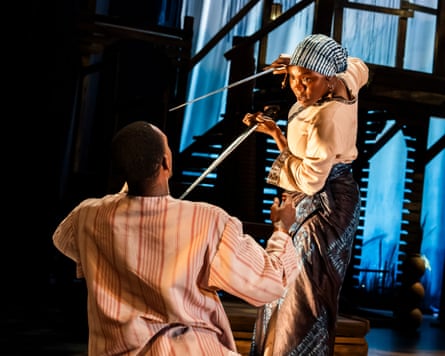
Moral horror about slavery, in this case intra-African, incorporates a cold-eyed account of its economics: “Nafisa’s value has quadrupled 433% to one million, one hundred and forty thousand.” The currency is cowries, sea snail shells, showing how this economy – including literal shell companies – develops competition, taxation, inflation and a catastrophic crash when international predators – represented by the British-schooled Yusufu (Will Atiomo) – flood the market with imported cowries. This felt to me more fiscally astute than James Graham’s JM Keynes play, The Standard of Living.
Another subject tackled is philology, developing languages shown through clashes over rival alphabets and the colonisers’ import of exotic metaphors: “Many ways to skin a cat” alarms pro-feline Egypt. We learn the meaning of “Boko Haram”, later claimed by a Nigerian jihadist group.
The fabular note in the title Once Upon a Time in Sokoto also often inflects the text. Anticipating modern advertising, Zinari adlibs an “ancient” legend to raise sales of her indigo cloth. Later, she and Nafisa conduct a late-19th-century poetry slam in a market square, the former’s Koranic verse trumped by the latter’s more populist quasi-rap.
Scattering incidental but engaging data – the introduction of the lip kiss to a forehead-rubbing culture, the colonial significance of Millwall FC shorts – Ellams shows a Stoppardian or Fraynian relish in enjoyably compressing complex topics. His cast adept at tragedy and comedy, director Roy Alexander Weise brings characteristic grace and pace, a domestic conversation transitioning within seconds to a funeral.
At the Royal and Derngate, Northampton, until 10 October, then touring