Просмотр новости
Найдите то, что Вас интересует
 Спутники
 РН
РН SpaceX
 Роскосмос
 NASA
NASA
СпутникиРНSpaceXРоскосмосNASAGroups are restructuring NBFC and holding-company balance sheets to stay outside RBI’s regulatory definitions and avoid registration and compliance requirements, sources said. NBFCs are boosting non-financial income, while CICs are changing their asset mix.
Synopsis
Groups are restructuring NBFC and holding-company balance sheets to stay outside RBI’s regulatory definitions and avoid registration and compliance requirements, sources said. NBFCs are boosting non-financial income, while CICs are changing their asset mix.
 ReutersHolding companies and NBFCs are reshaping assets and income to stay outside RBI’s regulatory ambit and avoid registration and compliance requirements.
Mumbai: Many groups are resorting to an old trick to take holding companies and non-banking arms outside the Reserve Bank of India's radar and escape a long list of dos and don'ts.
They are tweaking balance sheets of their non-banking finance companies (NBFCs) and core investment companies (CICs, or holding entities) to defeat regulatory definitions.
The move, sources told ET, comes amid RBI notices to enquire why companies have not yet registered with the regulator, or are not complying with rules that accompany registration.
ALSO READ | Finance Ministry seeks banks' inputs on AI tools for loan collection, assesses adoption
 ET Bureau
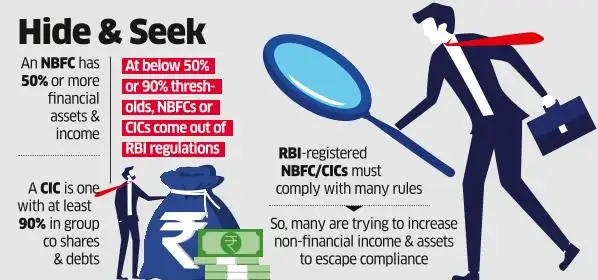
A company is classified as an NBFC if it passes the principal business test as per the last audited numbers: financial assets comprising over 50% of total assets (net of intangible assets), and income from financial assets exceeding 50% of gross income. A CIC is one having at least 90% of net assets invested in equity and debt of group companies, and at least 60% in equity of group companies.
NBFCs unwilling to be registered are rejigging books to change income composition while CICs are undertaking activities to alter asset-mix. How? An NBFC carries out commodity trading - say, buys cotton for 100 crore and sells for 101 crore - to prop up turnover from non-financial activities by 101 crore and thus lowers the share of income from financial assets below 50%. Similarly, a CIC invests in properties to dilute exposure to group equity and debt below 90% of net assets.
Less Rules, More Flexibility
"We are seeing a clear trend of promoter families restructuring investments and holding companies to legitimately fall outside the regulatory ambit of NBFC and CIC regulations. In most cases, the rationale is to avoid heavy compliance under the NBFC/CIC framework. An additional constraint is lack of flexibility: a succession event or family settlement that changes material shareholding can require prior RBI approval. Further, an RBI-regulated entity cannot invest in Gift City AIFs under the automatic route," said Zeel Jambuwala, co-founder and partner, Aurtus, a boutique firm offering tax, transaction and regulatory services.
CICs with assets of at least 100crore and holding public funds, and NBFCs having assets of 1000 crore or more are exploring this. The restructuring takes a few forms. "The first is removing 'public funds' and funding the entity with equity or compulsorily convertible instruments.
A popular route is genuinely failing the principal business test by ensuring that non-financial revenues exceed financial revenues -- for example, merging the holding company into an operating company. Also, many groups hold investments through LLPs or private trusts which don't fall under NBFC definition," said Jambuwala.
However, RBI's recent exemption to entities below 1,000 crore assets and operating without customer interface and public funds is a positive development, she said. Depending on the entity, the compliance load that comes with registration includes board-approved asset-liability management policies and a committee to oversee it, having at least one director with experience of having worked in a bank or NBFC, quarterly statement on changes of directors, with MD/CEO certificate that fit and proper criteria were followed, having audit committee, hiring a chief risk officer if assets exceed 5000 crore, etc. Registered CICs must have a risk management committee and submit a quarterly statement on fund use, among other things.
According to Bhavesh Vora, director of Basilstone Consulting, "Several changes are driving many financial and holding companies to resort to ploys that would help them avoid RBI attention. First, auditors, as per the Companies Act, must now report whether an entity is covered under the NBFC definition. Second, there's wide media coverage on RBI norms, and the regulator is sending notices asking about registration plans. Third, while there's greater awareness, willingness to comply with RBI norms has not found a place for different reasons."
Also, many want to avoid delays while dealing with RBI. "For instance, a company that applies for registration can't make new investments till the application is processed. So, a combination of factors is pushing many to explore options," said Vora, who advises several financial services firms.
Read More News on
...moreless
| # | Наименование новости | Тональность | Информативность | Дата публикации |
|---|---|---|---|---|
| 1 | IRDAI pushes LIC, SBI Life to seek further cost efficiency | 0 | 8.38 | 28-09-2026 |
| 2 | SBI seeks clarity on bank accounts under proposed FCRA rules | 0 | 8.06 | 29-09-2026 |
| 3 | RBI rate hike, FCNR(B) inflows set to boost bank margins and profitability | 0 | 8.99 | 01-10-2026 |
| 4 | RBI asks banks to tackle repeat customer complaints, fix gaps in grievance systems | 0 | 10.09 | 01-10-2026 |
| 5 | LIC’s investment portfolio shifts decisively away from loans | 0 | 8.1 | 08-08-2026 |
| 6 | Insurers mull seeking mutual fund-style expense limits from IRDAI | 0 | 6.71 | 01-10-2026 |
| 7 | Over 200 insolvency professionals’ registrations cancelled in Q1 FY27 | 0 | 25.21 | 15-09-2026 |
| 8 | FPIs’ fortune on the mend with assets under custody increasing 12% in April-July FY27 | 0 | 19.3 | 31-08-2026 |
| 9 | MetLife stake deal deemed approved; Bain and Olin proposals await CCI review | 0 | 10.04 | 28-09-2026 |
| 10 | Часть расплаты: ЦБ накажет банки повышенными взносами за обман клиентов | 0 | 10 | 29-09-2026 |