Просмотр новости
Найдите то, что Вас интересует
 Спутники
 РН
РН SpaceX
 Роскосмос
 NASA
NASA
СпутникиРНSpaceXРоскосмосNASALessons on preserving aircraft, knowledge, and the future of maintenance.
The post How the Flying Bulls keep history aloft appeared first on Vertical Mag.
Published on: August 20, 2026
Estimated reading time 16 minutes, 30 seconds.
Maintaining a fleet of vintage aircraft is about much more than keeping old machines in the air. It requires equal parts engineering, detective work, craftsmanship, and long-term planning.
That’s especially true at the Flying Bulls, the Salzburg, Austria-based operation behind Red Bull’s iconic collection of historic aircraft and airshow performers. Today, the Flying Bulls maintains approximately 40 aircraft representing about 30 different types — from aerobatic Bo.105 helicopters and a Bell AH-1 Cobra to a Douglas DC-6, North American P-51 Mustang, and other rare warbirds.
Speaking on the 100th episode of the Vertical MRO Podcast, Anthony Hill, compliance and safety manager, and Werner Horvath, head of the Flying Bulls’ national design organization, offered a behind-the-scenes look at what it takes to support one of the world’s most unique aviation fleets. While much of the discussion centered on rare warbirds and historic helicopters, the lessons extend well beyond vintage aviation.
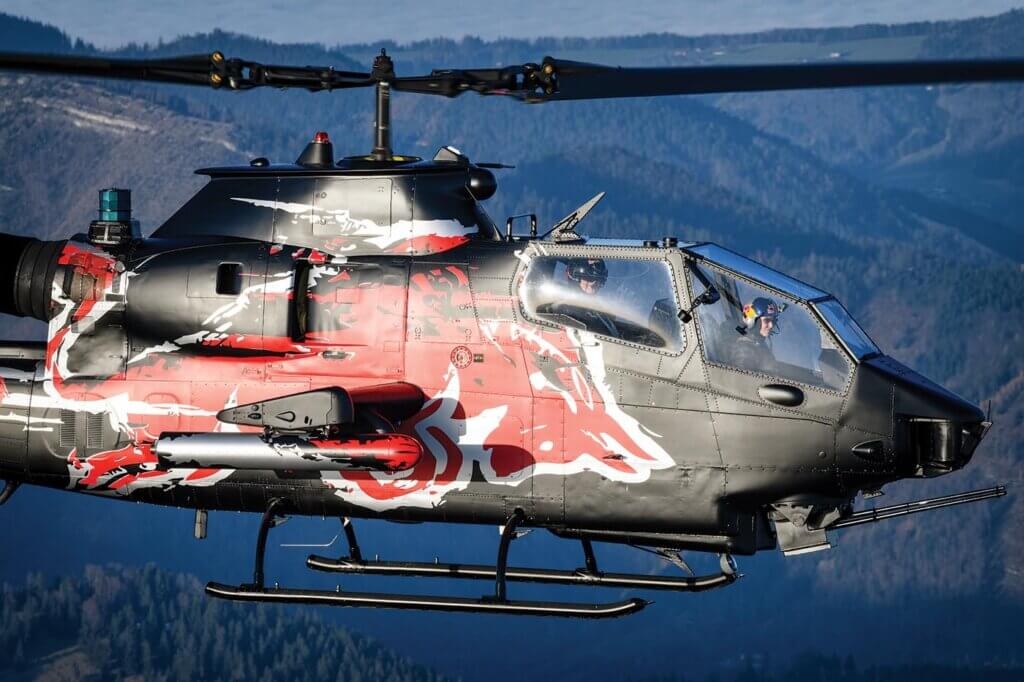 Lloyd Horgan PhotoPreserve knowledge as carefully as the aircraft
For Hill, one of the greatest challenges facing maintenance organizations isn’t sourcing parts — it’s preserving decades of accumulated knowledge before it disappears with retiring technicians.
“Especially in the more historic aircraft, a lot of the knowledge and a lot of little intricacies about certain aircraft, certain engine types, whatever it may be, they’re not necessarily written anywhere,” Hill said. “They’re just in the heads and minds of some of the older guys in your company.”
To combat that, the Flying Bulls developed what Hill described as a “yellow sheet” system. Whenever technicians discover a discrepancy in an original maintenance manual, or uncover valuable maintenance knowledge that’s missing from the documentation, they create an internal supplement that becomes part of the aircraft’s technical records.
By capturing those hard-earned lessons, the team ensures future technicians can build on previous experience rather than rediscover the same solutions.
“If the problem doesn’t come up again for 10 more years and that old guy retires, then the information’s lost,” Hill said. “I think documenting this kind of experience-based information that gets handed down is really important.”
It’s a reminder that preserving aviation history isn’t only about protecting airplanes — it’s also about preserving the expertise required to maintain them.
Invest in people before you need themLike many maintenance organizations around the world, the Flying Bulls sees the technician shortage as one of aviation’s biggest long-term challenges. Rather than reacting to the shortage, the organization has invested in developing the next generation of technicians.
Hill explained that in 2015, Red Bull founder Dietrich Mateschitz challenged the organization to establish an apprenticeship program. At the time, Austria didn’t have a government-approved aviation maintenance apprenticeship, so the Flying Bulls worked alongside government agencies and industry partners to help create one.
More than a decade later, the program has produced licensed maintenance professionals who continue to build careers within the organization.
The investment extends beyond simply filling vacancies. The Flying Bulls wants apprentices to learn the specialized skills required to maintain vintage aircraft — not lose them to other sectors of aviation.
“We don’t want them going off to work for an airline or another operation,” Hill said. “We want them to learn how to work on things like this and our warbirds.”
For organizations reluctant to devote experienced technicians to mentoring newcomers, Hill acknowledged the short-term cost but argued the alternative is far more expensive.
“It’s an investment,” he said. “The industry has to be proactive now because in 10 years’ time it’ll be too late.”
Relationships can be just as valuable as inventoryMaintaining modern aircraft often means ordering the required part from an OEM or distributor. But when it comes to vintage aircraft, it’s rarely that simple.
With a fleet of approximately 40 aircraft representing about 30 different types, the Flying Bulls operates across multiple regulatory systems while supporting aircraft that, in many cases, no longer have manufacturer support. That means sourcing parts sometimes becomes an exercise in networking.
Hill described the contrast between obtaining components for a modern business jet, which may arrive overnight, and searching for parts for a historic aircraft.
“We’ve gotten parts for some of our vintage aircraft literally from a phone number written on a serviette at a meeting in the U.S. somewhere,” he said. “Someone’s told us, ‘I think old John in Idaho has a couple of those rims for your Corsair.’”
When parts simply don’t exist, Horvath’s engineering team steps in to reverse engineer replacements, certify them, and return the aircraft to service.
But for Horvath, engineering goes well beyond designing replacement parts. With many of the aircraft no longer supported by their original manufacturers, the Flying Bulls now serves as the design authority — creating and updating technical documentation, developing repair schemes and modifications, engineering replacement parts, and ensuring each aircraft remains airworthy.
It is an approach that blends modern engineering with old-fashioned networking.
Innovation still depends on experienceWhile the Flying Bulls is dedicated to preserving historic aircraft, its maintenance approach is anything but stuck in the past.
Horvath highlighted the growing role of technologies such as 3D scanning and additive manufacturing, noting that 3D printing currently serves primarily as a prototyping tool rather than a means of producing flight-certified parts. Once a design is validated, the final component is manufactured using proven, approved processes.
Hill also pointed to artificial intelligence (AI) as a technology worth watching. Rather than replacing technicians, he said AI has the potential to support troubleshooting, speed up research, and assist with maintenance decision-making.
Even as the Flying Bulls continues to adopt modern engineering tools, both men emphasized that technology cannot replace experience. Many of the organization’s aircraft still rely on original blueprints, manual engineering analysis, and decades of accumulated maintenance knowledge.
Modern tools can make technicians more efficient, they said, but preserving and passing on that expertise remains essential to keeping vintage aircraft flying.
Safety starts with curiosityAs compliance and safety manager, Hill spends much of his time reviewing procedures, auditing work, and examining how the organization operates.
He said many audit findings aren’t the result of poor maintenance practices. Instead, they often identify opportunities to clarify procedures or improve documentation so the work is communicated more consistently.
That culture of continuous improvement also encourages technicians to question what they see rather than assume the documentation is always correct.
Hill recalled one instance in which a mechanic noticed fluid lines installed differently from what appeared in a maintenance manual. Instead of dismissing the discrepancy, the team reported it to the aircraft’s type certificate holder, who confirmed the manual contained an error and issued a correction to operators.
What began as a single observation in the Flying Bulls’ hangar ultimately improved the documentation for the entire fleet. For Hill, it underscored an important lesson: safety isn’t just about following procedures — it’s also about asking questions when something doesn’t look right.
More than an airshow operationTo the public, the Flying Bulls is best known for its airshow performances. But as Horvath and Hill described during the podcast, much of the organization’s work takes place long before an aircraft ever leaves the ground.
From reverse engineering obsolete parts and maintaining technical documentation to developing new technicians and refining safety processes, the challenges they discussed extend well beyond preserving historic aircraft.
While many of the Flying Bulls’ aircraft are decades old, the conversations around knowledge transfer, workforce development, engineering, and continuous improvement reflect issues facing maintenance organizations across the aviation industry.
Listen to the 100th episode of the Vertical MRO Podcast with Anthony Hill and Werner Horvath.
| # | Наименование новости | Тональность | Информативность | Дата публикации |
|---|---|---|---|---|
| 1 | Mission over maintenance: Choosing the right helicopter for the job | 0 | 5.75 | 19-08-2026 |
| 2 | Helicopter maintenance tool control: Why every tool counts | 0 | 6.84 | 21-08-2026 |
| 3 | Blades of Valor Road Tour: Where the mission happens | 0 | 6.37 | 18-08-2026 |
| 4 | Vertical MRO 2026: New workshops, expert speakers and career development for maintainers | 0 | 9.42 | 11-08-2026 |
| 5 | How air medical operators are building the next generation of talent | 0 | 6.75 | 23-09-2026 |
| 6 | PAC International: Rebuilt for mission | 0 | 8.44 | 26-08-2026 |
| 7 | Pilots Who Ask Why: When Systems Fail | 0 | 9.96 | 28-08-2026 |
| 8 | Q&A: Keith Moreland, vice president of Rotorcraft Services Group Aviation | 0 | 5.59 | 27-08-2026 |
| 9 | Beyond Survival: How flight nurse Krista Haugen turned trauma into a lifesaving mission | 0 | 5.81 | 21-09-2026 |
| 10 | Unleashing the Super Puma | 0 | 7.3 | 17-08-2026 |