Просмотр новости
Найдите то, что Вас интересует
 Спутники
 РН
РН SpaceX
 Роскосмос
 NASA
NASA
СпутникиРНSpaceXРоскосмосNASANew telemedicine technologies are giving HEMS crews instant access to specialists, improving communication, accelerating decision-making, and supporting better patient outcomes.
The post How telemedicine Is transforming HEMS and pre-hospital care appeared first on Vertical Mag.
Published on: September 30, 2026
Estimated reading time 14 minutes, 38 seconds.
Telemedicine offers a range of technologies to support pre-hospital care for helicopter emergency medical services (HEMS) operators, enhancing access to emergency care in remote communities while improving communication with receiving hospitals. Industry experts highlight a variety of innovations in the space and point to significant growth potential in the coming years.
Avel eCare provides a range of virtual care technologies and services for medical professionals, including HEMS operators, said Becky VandeKieft, vice president and general manager of emergency medical services (EMS).
The system uses secure, high-definition video and audio equipment installed in ambulances to support HEMS teams during intercepts, as well as EMS agencies, emergency departments, and receiving facilities.
VandeKieft said HEMS operators use Avel Emergency telemedicine technology to enhance clinical decision-making on the ground, whether responding in an EMS unit or providing care in the emergency department.
 Pulsara PhotoSeamless communication
The aim is to provide seamless communication by coordinating with dispatch centers to initiate air or ground transport when appropriate, delivering advanced patient reports to receiving hospitals, and assisting with the early activation of specialist response teams for stroke, STEMI, trauma, and other emergencies.
VandeKieft said this telemedicine technology “helps improve care coordination, enhance clinical readiness, and support timely, informed decision-making for patients requiring urgent or emergent care.”
Rapid access to emergency expertise is fundamental to improving patient outcomes, VandeKieft added. She said telemedicine enables response times to be measured in seconds rather than minutes, with emergency physicians and clinical teams appearing on screen almost immediately after activation.
“This rapid response supports earlier clinical assessment, faster activation of HEMS or EMS resources, timely requests for advanced life support [ALS] intercepts, and more efficient coordination of patient transport when every minute matters.”
VandeKieft said that by bringing clinical support directly to the scene through telemedicine-enabled EMS, the technology “helps ensure patients receive the right care, at the right time, while facilitating timely access to higher levels of care when needed.”
 Pulsara PhotoBeyond radio reports
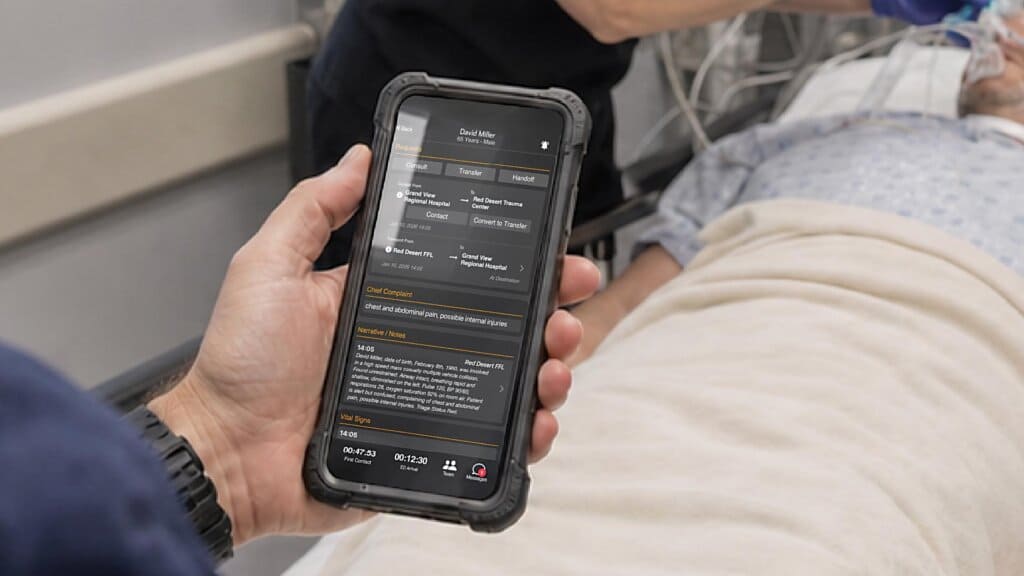
Pulsara provides a telehealth app designed to replace multiple phone calls, radio reports, and other forms of communication with a single, unified patient channel. The app works across a wide range of devices, including smartphones and tablets, enabling geographically dispersed care teams to interact in real time through a dedicated channel for each individual patient.
Corey Ricketson, senior vice president at Pulsara, said that while telemedicine is still not broadly used, tools like Pulsara mean “HEMS crews can connect with specialists, medical control, etc., through secure video. For complex interfacility patients, this adds an additional tool to the toolbox to help ensure they receive the right care.”
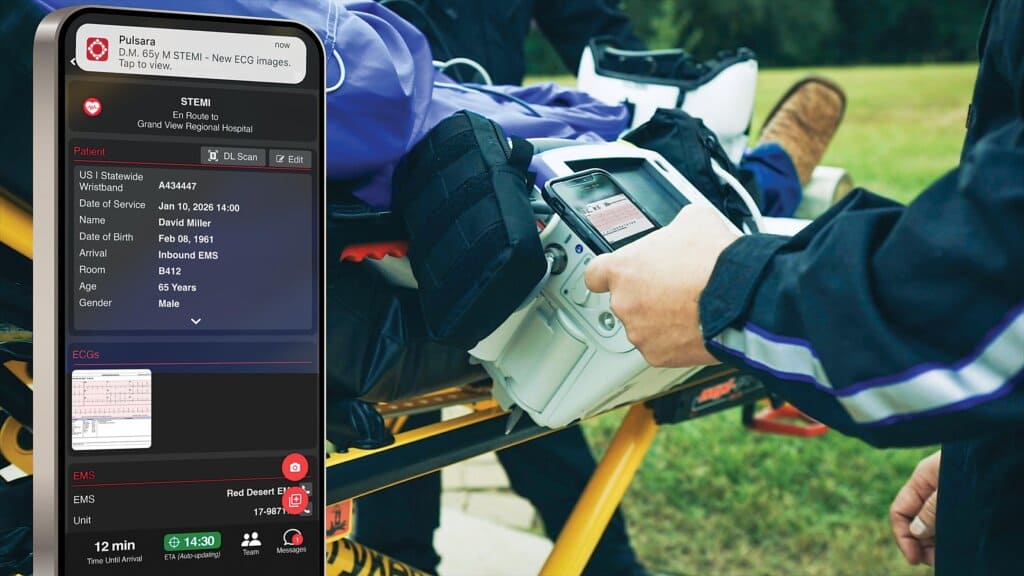
Ricketson said app-based tools like Pulsara can be used instead of, or in addition to, “the age-old radio report,” allowing HEMS crews to transmit EKG data, send images of injuries, and even view clinical findings before arriving to pick up a patient. This information can help providers formulate a treatment plan, he noted.
Activating a secure video call between the sending hospital, transfer center, and specialists in areas such as neonatology or neurology is a valuable option in certain situations, Ricketson said.
“Although flight crews are highly trained and qualified, complex patients can benefit from an extra set of eyes, and secure video can paint a clearer picture than a phone call. These connections are available when the situation requires them.”
Most crews already use devices such as smartphones or tablets, he noted. Pulsara operates on iOS and Android, allowing existing technology to be leveraged for communication through the app, typically using Wi-Fi or native cellular service. Pulsara also interfaces with systems such as cardiac monitors to transmit EKGs and other images, providing receiving teams with a more complete clinical picture of the patient.
“Being able to send images of lab values, chest X-rays, injuries, vent settings, etc., is a definite upgrade from just a verbal radio report. Additionally, the data collected within Pulsara can integrate with electronic patient care reports and hospital electronic health records [EHRs],” he said.
 Pulsara PhotoBenefits for remote communities
Hospitals can leverage the technology to build a more complete clinical picture for transfer requests, Ricketson added, which can be particularly beneficial in rural environments.
They can provide critical treatment information to incoming transfer teams or use video consult capabilities to help formulate treatment plans. When care is transferred from ground to air, or from a sending hospital to an air medical crew, Pulsara ensures critical information is passed along.
For example, a ground ambulance might initiate a Pulsara channel for a patient before transporting them to a primary care facility, where initial stabilization occurs. A transfer request can then be initiated using the same Pulsara communication channel, and a video consult arranged to determine patient acceptance and the treatment plan.
“Flight crews can be added to the channel to see what they are responding to so they can better prepare to receive the patient,” Ricketson said. “Finally, that flight crew may alert the tertiary care facility with an updated report. This results in tertiary care seeing the entire picture, which results in better patient safety.”
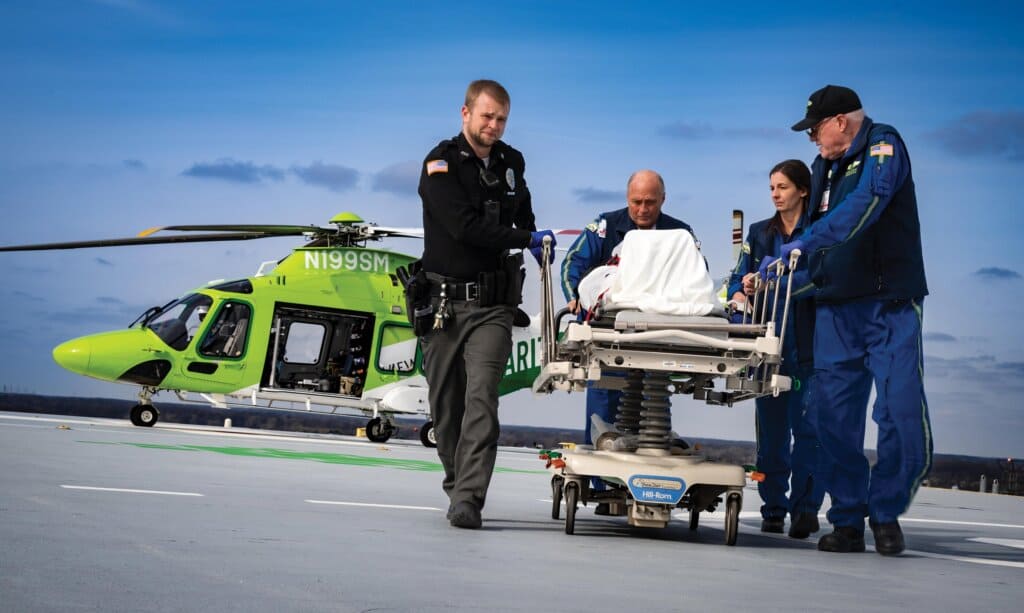
Historically, flight crews were discouraged from using mobile devices in flight, Ricketson said. However, that has changed with advancements in avionics and other technologies. He said most aircraft are now equipped with 5G-compatible radar altimeters and onboard Wi-Fi. While using live video in flight can be challenging, video communication on the scene is both practical and appropriate.
“While it is still a critical safety consideration to minimize distraction during critical phases of flight, when safe to do so, Pulsara can offer asynchronous options for multimedia communications.”
Telemedicine offers a range of benefits for patient care, particularly in remote and rural environments, Ricketson noted. In these settings, “sending hospitals do not have access to the same level of specialty care as the urban environments and are always looking to get their patients to comprehensive care faster and easier.”
The technology allows pre-hospital HEMS crews to connect with specialists for consultations, even in remote areas, he said.
“This may not always result in transporting long distances but could rather result in more treat-in-place and secure follow-up visits, for example.”
VandeKieft echoed the advantages for rural and remote communities, where specialized emergency medicine expertise may not be immediately available.
“Through real-time collaboration with board-certified emergency physicians, experienced emergency nurses, and paramedics, frontline clinicians and EMS providers receive expert guidance for complex patient presentations, critical decision-making, and stabilization prior to transport,” she said.
Future advancesA range of technological innovations could shape telemedicine in the coming years. For instance, most companies are evaluating their telemedicine products and exploring how artificial intelligence (AI) could benefit customers and patients, Ricketson said. At the same time, they are considering how the rapidly evolving technology could complicate or disrupt workflows in some situations.
“Some obvious benefits have already been shown with things like ambient listening or being able to take the spoken word and translate that into usable data,” he added. “For instance, when a provider speaks into Pulsara, certain elements such as vital signs receive a time stamp, which then integrates with electronic patient care reporting systems, saving providers time.”
Additionally, Ricketson expects predictive modeling to play a role “in determining where patients could be routed for transfer or how to ‘load balance’ patients in a mass casualty event.”
VandeKieft said Avel eCare believes AI will be an important tool in advancing connected care.
“AI has the potential to enhance patient care by improving efficiency, supporting faster decision-making, and helping clinicians access information more effectively,” she said. “However, the foundation of successful innovation remains strong clinical relationships, trusted workflows, and a connected ecosystem built around the patient.”
One of the primary challenges of delivering telemedicine in the prehospital environment is maintaining reliable connectivity while caring for patients in motion or in remote locations with variable cellular coverage, VandeKieft said.
To address this issue, Avel Emergency/EMS uses dual-SIM router technology, “providing automatic failover between cellular networks to improve connection reliability and minimize interruptions during critical patient encounters.”
Looking ahead, VandeKieft said Avel eCare’s current initiatives include evaluating satellite connectivity to extend coverage in underserved areas, advancing audio technology to improve communication in noisy prehospital environments, and expanding system integrations that streamline workflows and information sharing.
VandeKieft said Avel eCare is also open to exploring opportunities to extend connectivity and support beyond the ground environment and into flight operations. However, she stressed that these innovations are not intended to replace existing patient care. Instead, the aim is to “come alongside local providers as an extension of their team, offering additional expertise, clinical support, and resources when needed.”
| # | Наименование новости | Тональность | Информативность | Дата публикации |
|---|---|---|---|---|
| 1 | Drone as First Responder: The uncrewed advantage | 0 | 9.03 | 10-08-2026 |
| 2 | How air medical operators are building the next generation of talent | 0 | 6.75 | 23-09-2026 |
| 3 | Beyond survival: From HEMS crash survivor to patient safety advocate | 0 | 6.55 | 29-09-2026 |
| 4 | Beyond Survival: How flight nurse Krista Haugen turned trauma into a lifesaving mission | 0 | 5.81 | 21-09-2026 |
| 5 | Beyond the mission: The human connection | 0 | 10.41 | 21-09-2026 |
| 6 | Mission over maintenance: Choosing the right helicopter for the job | 0 | 5.75 | 19-08-2026 |
| 7 | Unleashing the Super Puma | 0 | 7.3 | 17-08-2026 |
| 8 | Helicopter maintenance tool control: Why every tool counts | 0 | 6.84 | 21-08-2026 |
| 9 | PAC International: Rebuilt for mission | 0 | 8.44 | 26-08-2026 |
| 10 | Q&A: Keith Moreland, vice president of Rotorcraft Services Group Aviation | 0 | 5.59 | 27-08-2026 |