Просмотр новости
Найдите то, что Вас интересует
 Спутники
 РН
РН SpaceX
 Роскосмос
 NASA
NASA
СпутникиРНSpaceXРоскосмосNASAWhoever made this decision at Kwalee needs a raise. Welcome to Elderfield from developer Chris Cote is a turn-based RPG with a sizeable amount of cozy and adventure. Strangely, it’s also a farming simulator. Honestly, I am not sure how all those genres meshed together so well in this game. On paper, they shouldn’t, but […]
The post Welcome to Elderfield Review (PC) appeared first on digitalchumps.
Whoever made this decision at Kwalee needs a raise.
Welcome to Elderfield from developer Chris Cote is a turn-based RPG with a sizeable amount of cozy and adventure. Strangely, it’s also a farming simulator. Honestly, I am not sure how all those genres meshed together so well in this game. On paper, they shouldn’t, but Chris Cote made it work, and work very well. The only hitch in the giddyup is the stop-and-go pacing of its turn-based elements, but it doesn’t get in the way of enjoying the overall gameplay experience.
Starting with the story, it’s really a come-and-go type of narrative. Welcome to Elderfield doesn’t have a clear main story; it’s more a series of random happenstances. The player’s character is sent into the world investigating random strangeness and horror in the town of Elderfield, while also making friends and the best decisions possible along the way. Again, nothing too straightforward, but it offers good flexibility in the player experience.
The narrative experience is a mix of a David Lynch dream and something you might find on the Sci-Fi channel when it was good. There is just enough horror to make the narrative unsettling, such as meeting death in a sewer or helping a giant skeleton rebuild a farm, and just enough comedic oddity to balance it out, such as poisoning the wine of a couple for funny-ha-ha reasons. The stories aren’t all connected, and they generally happen in small spurts built into short quests. The upside of this design choice is that its lack of a giant, cohesive storyline makes room for adventuring, exploration, and eventual expansion. It also fits right in with the Stardew Valley construct, where short stints of non-farming moments help tame boredom and give the player more gameplay. It’s a good trade-off, in my opinion, and one I wish more games of this type would make.
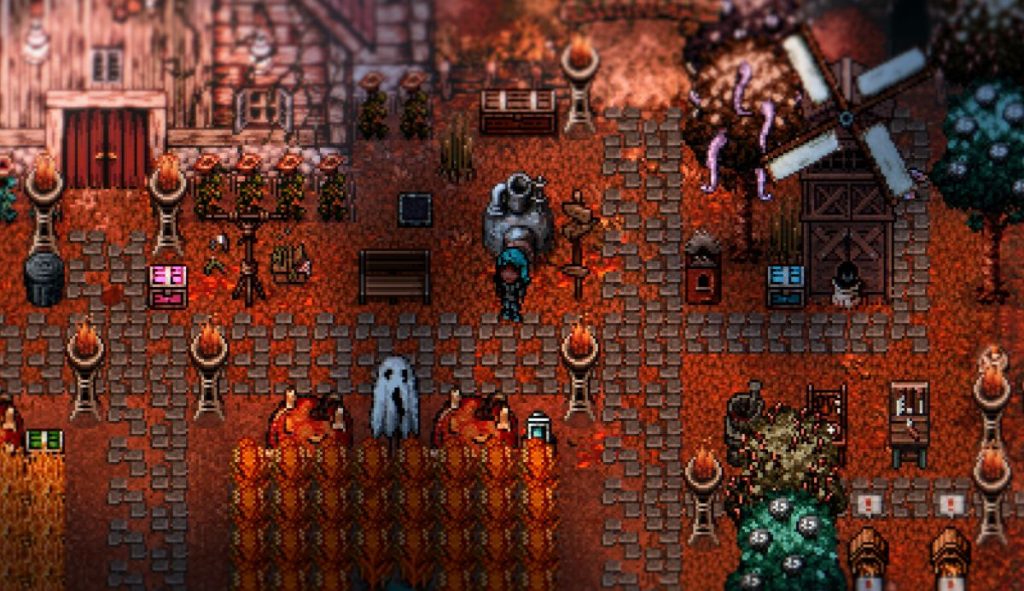
As mentioned above, the few stories that do happen come through various gameplay channels. The first is through meet-and-greet moments with NPCs. This means players can randomly speak with Elderfield residents and agree to quests. These quests are short, but reward good items when completed. Those items could be money, crafting goods, or farming tools. Quests can be as complicated as trying to find a lost child who wants to play a mean prank on his parents, which leads to different stages and steps of poisoning their wine. Lots of small steps, but also good ones that introduce various gameplay elements.
The quests could be as simple as making a pizza slice for Death, who is hanging out in the city’s sewer system. It’s a small effort with a big payoff, and it also helps open up the world of Elderfield by showing off the complexity of the sewer system and just how big the city can be. Between the wine and pizza quest, they offer a great example of how the game throws in a good variety of quests to constantly keep the gameplay interesting. And these examples are just random encounters.
Other quests can be given through the player’s television set at home. Each day, the player will have a television news segment waiting for them that directly relates to something going on in Elderfield. This could be ghosts cropping up randomly at a location, or a monster spotted by residents in a part of town. The quests are plentiful and push the player to explore the town in hopes of finding the solution to said quest, or at the very least running into the ‘thing’ that the news station was crowing about. It’s a good way to keep the game going, and the different channels of communication create a creepy outlet for players to try to solve a mystery.
Together, the questing gameplay opens up a larger world and pushes the player to get cozy with the creepy-ass town. Anytime you can push your player to keep their eyes open to the environment, or encourage them to keep exploring to open the next hidden object within town that leads to another quest, well, that’s a good time. And that is only scratching the surface with this game. It reminded me of my childhood experience with Lucasfilm Games’ Habitat, where questing and exploring made the world feel bigger and more interesting. Welcome to Elderfield captures that same feeling.
Related to questing and communicating, the game also features an interesting friendship system. Occasionally, as the player moves through town, they will randomly meet a stranger. Dialogue choices build friendships in town, which also earn rewards. The game encourages a certain amount of social interaction, though the player can be hateful through the experience (would not recommend). This element is borrowed directly from Stardew Valley and is meant to build a closer, more cohesive bond between characters in town. That adds to the world’s girth and creates another element for the player to juggle throughout the adventure. While this aspect doesn’t play a commanding role in the game’s overall structure, it is a nice sideshow that adds a bit more value to the gaming experience. In other words, the player isn’t losing out on anything important if they don’t actively keep up with their social connections, but they do benefit if they do.
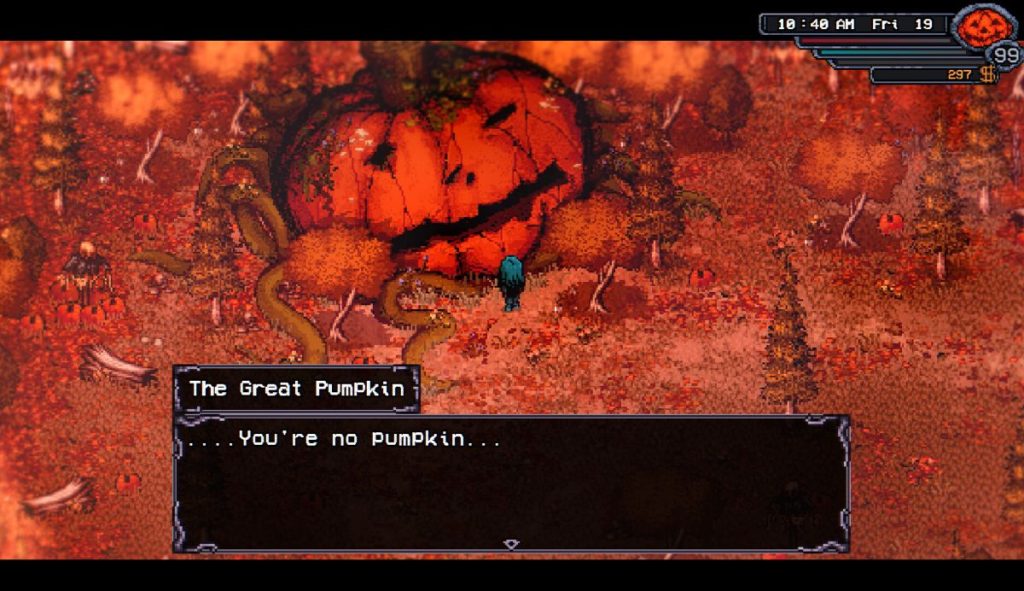
Another huge gameplay element in Welcome to Elderfield is its farming simulator aspect. Early in the game, the player will meet a giant skeleton who helps them establish farmland to plant and grow crops. The farming aspect spans a multi-day effort, which fits well between quests. For example, planting a seed and keeping it going is a multi-day process that requires care, as well as a watchful eye against animals and monsters that would plunder the farmland. Players plant a seed, water it, but up defenses against veggie thieves, mainly in the form of scarecrows, and then go about solving quests while waiting for the next day to arrive. When that next day arrives, they have to check on their crops, keep caring for them, and wait until they are ready to harvest. It’s a slow process, but players won’t feel it at all, since it falls between questing and exploring the town. It’s very balanced in this regard.
Now, as much as farming is tedious and a real waiting game, it serves many purposes. The first big purpose is recipes. As the player grows and harvests crops, they can also open up and buy recipes from a local seller. These recipes directly affect the adventurer’s health, as well as occasional quest goals. Going back to that Death-in-the-sewers example, the player must gather ingredients and grow them to create a perfect pizza slice for Death. While there are other solutions, growing goods and forming them into a pizza slice is the most controlled and easiest path. Anyway, it’s a good way to encourage the gamer to keep up with their crops while also tying back to quests, which helps the entire world of Elderfield keep moving.
Of course, crafting is tied to recipes and growing crops. To create recipes, the game offers a variety of different ways to craft materials and goods. Players must forage for goods and mine elements to create ovens, melting pots, and workbenches. Players can use all of these directly with crops and recipes, making the gameplay even richer and more meaningful. Welcome to Elderfield is well-designed and well-executed, with all these gameplay elements connecting beautifully. It makes the game feel bigger and more rewarding for the hard work. Plus, it also feels somewhat like a puzzle game, as quests ask for specific (and sometimes non-specific) items and the player must figure out how to make them through various farming and foraging methods. In my gaming book, that is a pretty good read on how to keep your players engaged and interested in the gameplay. It works well, and there isn’t a down moment for the player. It’s just a big batch of fun.
On the role-playing game side, the game features a turn-based fighting system. Occasionally, players will run into enemies on screen, which will launch into a random turn-based fight. This fight takes players into a battle system that lets them use a variety of weapons and skills to take down enemies. Much like Stardew Valley, there isn’t a definitive way to lose the game, which means that if a player loses a fight, they will simply wake up back home. The game doesn’t really have a permadeath element. That makes sense, especially if you’re rooting for your players to keep going through the rest of the cornucopia of genres mashed together in the experience.
Now, while I love the turn-based insert into the gameplay, I think the result of a fight needs some work. Or at least, needs a skip button. Well, it just really needs a skip button.
After completing a fight, the player will likely be thrown into a dice-driven reward system. This means that the player will have to roll a single die to see if there was good treasure left behind. The process is slow, and the rewards are a bit unbalanced, as players will lose more than they will win. By lose, I just mean getting shoddy rewards for winning a fight. Sadly, after seeing the pattern multiple times during my playthrough, I also found that there was no way to decline the roll. This meant I had to sit through the game, watch a die roll, and get rewards ranging from par to subpar that took up my very limited inventory space. I couldn’t even decline the objects; I had to take them.
The player should be able to choose whether to roll a die. They should also be able to accept or decline the rewards. Without either option, players will have to sit through randomly forced die rolls that push rewards on them. While I appreciate the 1992 throwback to a Phantasy Star II-type of reward system, the player should have more say in how the dice rolling plays out. A little more player agency would go a long way for pacing and for avoiding constant inventory trips to toss things out. Granted, Cote did include an inventory box that seems limitless, but having to find that box at specific locations is just an exhausting waste of gameplay time. This might seem like a petty complaint, but it’s legitimate, as this problem is prominent.
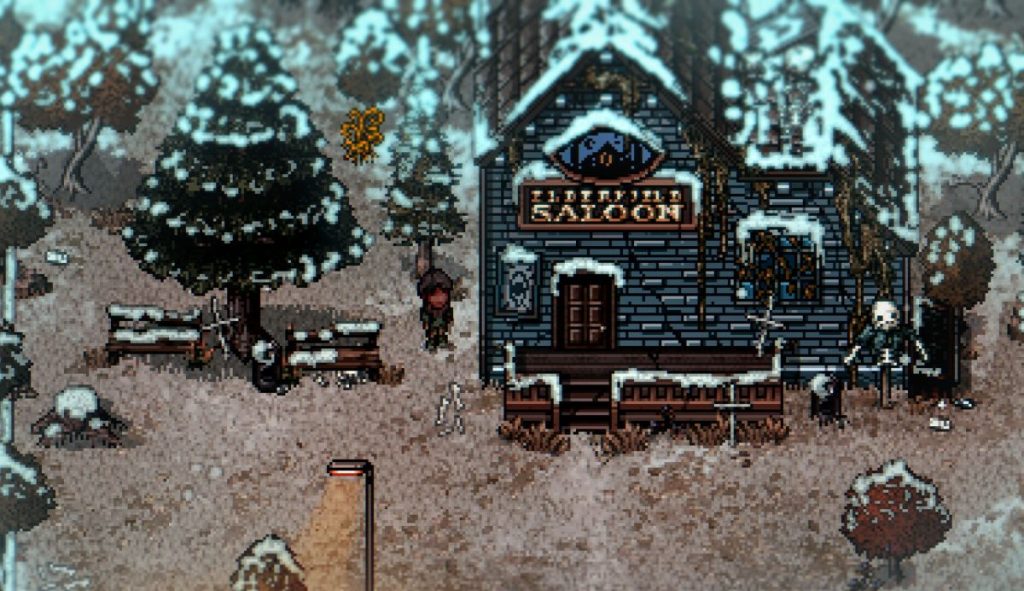
Inventory and rewards aside, I did thoroughly enjoy my time with Welcome to Elderfield. It is a horror-filled Stardew Valley that is fun as hell to play and creepy enough to feel different from other games of its type. Chris Cote made one helluva fun game that has prepared me for the spooky season quite well. I hope this game keeps expanding and gets even better. As it stands, it’s a great game that deserves your attention.
On that sweet note, let’s wrap up this review.
Conclusion
Welcome to Elderfield from developer Chris Cote and publisher Kwalee is a horror-filled cozy game that offers plenty of questing content, a well-designed farming and crafting system, and features just enough turn-based combat to deliver a cornucopia of fun. While it has a few minor, correctable issues, it’s an enjoyable overall gameplay experience.
| # | Наименование новости | Тональность | Информативность | Дата публикации |
|---|---|---|---|---|
| 1 | Well Dweller Review | 0 | 13.12 | 28-09-2026 |
| 2 | Keeper Review | 0 | 7.22 | 26-09-2026 |
| 3 | Silent Hill: Townfall Review (PS5) | 0 | 12.5 | 22-09-2026 |
| 4 | Garfield: Escape from Monday Review (PS5) | 0 | 10.39 | 23-09-2026 |
| 5 | Dragon Quest Heroes: Torneko’s Mystery Dungeon Classic HD Review | 0 | 8.26 | 23-09-2026 |
| 6 | What we've been playing - "I curl up on my sofa and breed my army of battle cats" | 0 | 8.29 | 26-09-2026 |
| 7 | KEMOVE K94 Keyboard Review (PC/MAC) | 0 | 8.77 | 24-09-2026 |
| 8 | SPRAWL zero Review | 0 | 7.79 | 28-09-2026 |
| 9 | Состоялся релиз игры Deskrawl: Idle ARPG: vk.cc/d2aRrF Стоимость — 234 ... | 0 | 17.39 | 28-09-2026 |
| 10 | Год в истории видеоигр — 2023 🎮 • Baldur's Gate ... | 0 | 10.99 | 28-09-2026 |