Просмотр новости
Найдите то, что Вас интересует
 Спутники
 РН
РН SpaceX
 Роскосмос
 NASA
NASA
СпутникиРНSpaceXРоскосмосNASABANGKOK, 21 September 2026: Almost one in every two new passenger aircraft required worldwide over the next 20 years is expected to come to Asia-Pacific. That is perhaps the most striking conclusion from the latest Airbus Global Market Forecast for 2026–2045. To understand the enormity, look at the global numbers. The world’s passenger aircraft fleet […]
The post Can Asia handle the influx of new aircraft? appeared first on TTR Weekly.

BANGKOK, 21 September 2026: Almost one in every two new passenger aircraft required worldwide over the next 20 years is expected to come to Asia-Pacific.
That is perhaps the most striking conclusion from the latest Airbus Global Market Forecast for 2026–2045.
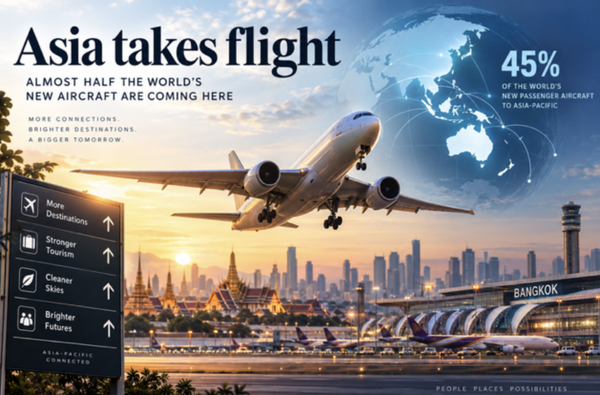 Asia takes flight — half the world’s new aircraft are coming to the Asia-Pacific region.
To understand the enormity, look at the global numbers. The world’s passenger aircraft fleet is forecast to grow from around 23,310 aircraft at the end of 2025 to 45,550 by 2045, almost doubling in just two decades.
Airbus estimates it will need to deliver 42,060 new aircraft during that period. Around 33,920 will be single-aisle aircraft and 8,140 widebodies.
Nearly 20,000 will replace older aircraft, but another 22,240 will be required to accommodate growth.
Asia-Pacific is expected to account for an extraordinary 45% of new passenger aircraft demand.
Passenger traffic in the region is forecast to grow by 5.1% annually, considerably faster than the global average. That means more aircraft, more passengers and potentially hundreds of new connections.
For Southeast Asia, the implications are enormous.
Thailand, Vietnam, Indonesia, Malaysia and the Philippines sit in one of aviation’s great growth corridors. Longer-range single-aisle aircraft also make direct services between secondary cities increasingly practical.
For Thailand, could Chiang Mai, Phuket, Krabi and other regional gateways capture substantially more direct international traffic rather than funnelling passengers through Bangkok?
But is there an elephant in the room, or in this instance, the departure lounge? What happens to emissions if Asian air travel expands on anything approaching this scale?
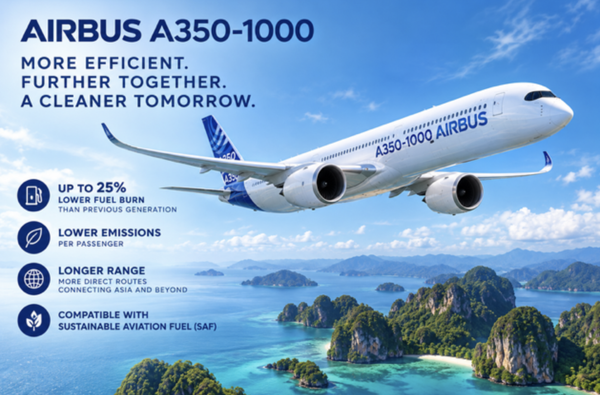 The eco-friendly A350-1000
Fleet renewal will help. New-generation aircraft are considerably more fuel-efficient than many of the aircraft they replace. But another important part of the equation is Sustainable Aviation Fuel, or SAF.
Unlike conventional jet fuel made entirely from fossil crude oil, SAF can be produced from sources including waste oils, agricultural and forestry residues and, increasingly, synthetic fuels made using renewable energy.
Aircraft still produce carbon dioxide when SAF is burned, but the potential benefit comes from its life-cycle carbon footprint. Carbon absorbed or recycled in producing the fuel can substantially reduce net greenhouse-gas emissions compared with conventional fossil jet fuel.
SAF can also be blended with existing jet fuel and used in today’s aircraft and airport fuel systems, making it a practical near-term option. At the same time, hydrogen and other new propulsion technologies remain much further off.
The challenge is producing enough of it, at an affordable price, to make a meaningful difference as Asian aviation expands.
Asia therefore faces two races.
The first is commercial: airlines, airports and destinations competing for aircraft, routes and passengers.
The second is environmental: cleaner aircraft, fuels and operations racing against rapidly increasing demand.
Thailand needs to think about both.
Can Suvarnabhumi and Don Mueang accommodate another generation of growth? Can regional airports capture more international services? Can Thailand expand aviation training, maintenance and aerospace industries? And can cleaner aviation infrastructure grow alongside passenger numbers?
Asia-Pacific taking 45 per cent of future global aircraft demand represents an extraordinary shift in aviation’s centre of gravity.
The aircraft are coming.
The much bigger question is whether Asia will be ready for them.

About the author
Andrew J Wood is a Bangkok-based travel writer and former hotel executive with almost five decades of experience in hospitality and tourism. He chairs the Tourism Committee of the Joint Foreign Chambers of Commerce in Thailand (JFCCT) for 2026–2028 and is a long-standing member of Skål International.
| # | Наименование новости | Тональность | Информативность | Дата публикации |
|---|---|---|---|---|
| 1 | Airbus monitors Asia Pacific aircraft demand | 0 | 12.52 | 22-09-2026 |
| 2 | AirAsia reaffirms confidence in long-term strategy | 0 | 12.14 | 21-09-2026 |
| 3 | AirAsia gears up for high season | 0 | 8.36 | 23-09-2026 |
| 4 | AirAsia wins SkyTrax salute 17 times | 0 | 10.38 | 23-09-2026 |
| 5 | Air India pilots new in-flight platform | 0 | 14.51 | 24-09-2026 |
| 6 | CX declares robust August results | 0 | 9.34 | 21-09-2026 |
| 7 | Ethiopian boosts flights to Nigeria | 0 | 9.29 | 23-09-2026 |
| 8 | Air Astana joins hands with Kazakh Tourism | 0 | 6.62 | 23-09-2026 |
| 9 | Vietjet joins NYSE bell ringing | 0 | 8.82 | 23-09-2026 |
| 10 | WSJ: Boeing выявила сбой в программном обеспечении самолетов 737 MAX | -1 | 7.13 | 26-09-2026 |