Просмотр новости
Найдите то, что Вас интересует
 Спутники
 РН
РН SpaceX
 Роскосмос
 NASA
NASA
СпутникиРНSpaceXРоскосмосNASAIn the social-media era, personal style has become a valuable business asset for celebrities and influencers. Authentic, recognisable fashion identities can generate massive media value, attract brand partnerships and help luxury labels enter India’s market.
Picture this. A Bollywood star disembarks from her car at the airport. She’s wearing an oversized shirt and baggy pants. Or mom jeans, a vest that looks suspiciously like my dad’s banian but costs more than my rent, and a cardigan that’s slipping just the right degree off a perfectly toned shoulder. She balances a giant bag in the crook of her arm. Her face is inscrutable beneath dark sunglasses. She could be going to a flea market in Goa or jetting off for the Paris Fashion Week. No one can tell.
Before she’s even cleared security, her airport look has whizzed manically across the internet and been discussed, dissected and declared a hit or a miss by hawk-eyed fashion commentators. By the time she reaches the tarmac, her outfit has been reverse-searched, price-tagged and crammed into multiple “get the look” carousels. None of this is scheduled. There’s no social media brief, or marketing campaign, or inspired collab to credit for this moment. Yet, it is potent enough to catapult a struggling brand into a stratosphere of sales. Does this mean the fashion economy runs on fragile, photogenic coincidences?
Anyone who has spent any length of time in the business of fashion can tell you this: It is rigorous orchestration presented as spontaneity. Our obsession with the “airport look” exists because we intuitively trust the outfit nobody paid for far more than the one that gets worn because eye-watering invoices exchanged hands.
STYLE IS SUBSTANCE
An audience that has been sold to, tagged and targeted for almost two decades has developed a sharp, unforgiving instinct for the gap between a look and a lie. It has led to a structural shift in the business. Personal style is the hot, new currency in circulation.
Fashion has always generated serious money. But now the ownership of the asset is shared between the designer and the person wearing it. In an age of constant content, having a distinct, dependable and honest style is a solid business strategy—and the only way to survive the brutality of algorithmic vagaries.
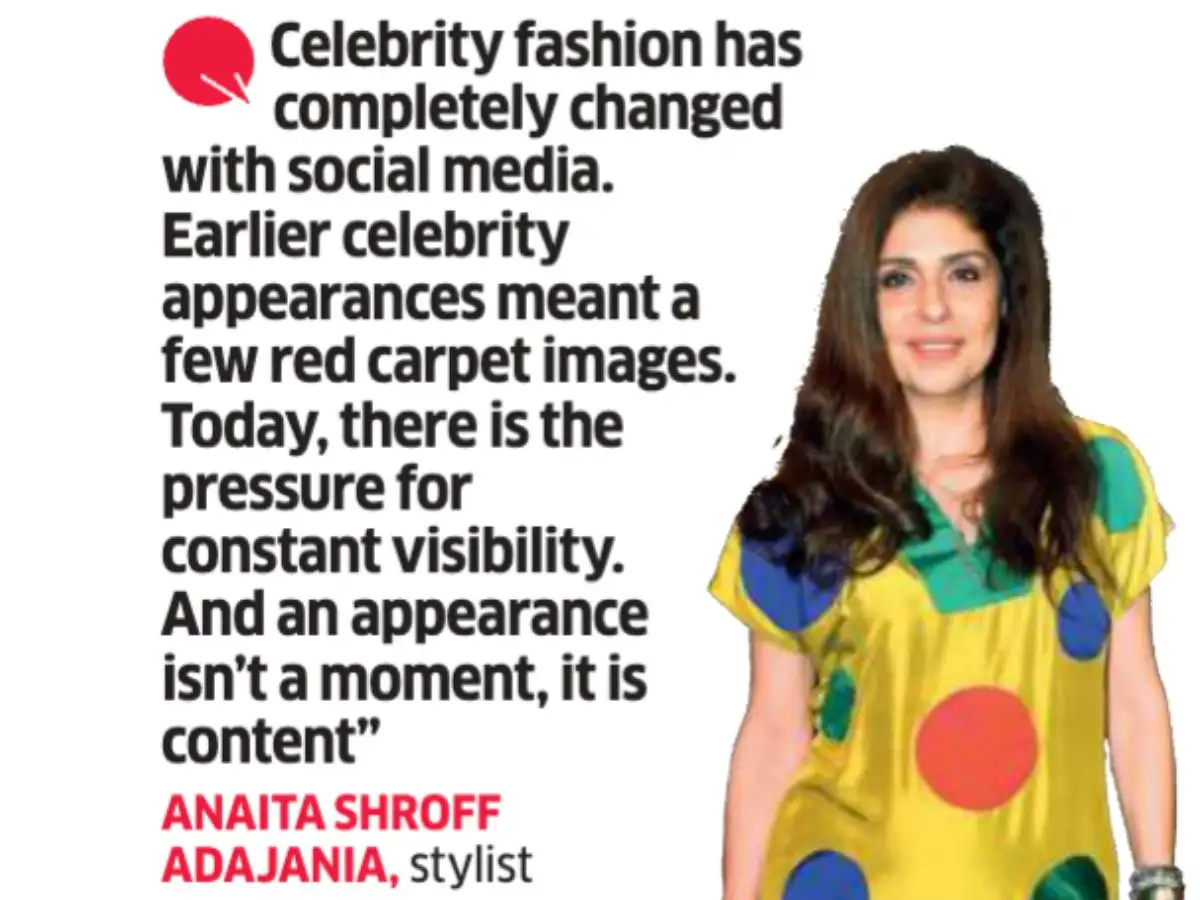
“Celebrity fashion has completely changed with social media. Earlier celebrity appearances meant a few red carpet images,” says stylist Anaita Shroff Adajania. “Today, there is the pressure for constant visibility. And an appearance isn’t a moment, it is content—reels, stories, reposts, engagement.”
 ET Bureau
Successful advertising has always been contingent on a trio of workhorse ideas. The alchemy of source credibility (we believe people we find trustworthy), source attractiveness (people we find appealing have a better shot at persuading us to do something), and the elegantly named match-up hypothesis—the 1980s theory that an endorsement only works when a celebrity’s public image and the product they are selling make sense together.
Sharp stylists know this instinctively. “The real skill lies in making brand associations feel authentic rather than imposed,” says Adajania. “The clothes have to work within the celebrity’s existing identity and visual language, otherwise the endorsement can feel purely commercial.” Which is to say that the match-up hypothesis isn’t a test the celebrity passes once, at the signing table. They have to pass it over and over, every time the celebrity leaves the house.
Bollywood has had a long and glorious tradition of stars cultivating instantly recognisable personal styles long before they became monetisable assets. Think back to the 1970s and ’80s. Rekha did not “do looks”; she lived in a universe devoted to Kanjeevarams, bindis and grand jewellery. Her “more is more” aesthetic is a world-view, not a style experiment.
Zeenat Aman wore the same decades like they had been tailored for her—bohemian, slightly dangerous and Western cuts that somehow never felt imported.
Even Govinda—bless him—cobbled together a chaotic but coherent aesthetic of loud print and shiny fabrics that somehow made perfect sense on him. That, friends, is indubitable brand equity.
The logic holds firm even now, just with higher stakes and crushing pressures.
Sonam Kapoor’s decades-long persistence in switching between high-fashion risk-taking and Indian traditionalism without giving her audience whiplash; Diljit Dosanjh’s unabashed turban-tracksuit-bling signature; Ranveer Singh’s resolute maximalism, gender-fluid tailoring and theatricality in every stitch he deigns to wear; Vidya Balan’s staunch refusal to abandon the sari; Neha Dhupia’s commitment to unconventional silhouettes.... All point to the same thing: the stars whose style we can instantly conjure up in our mind’s eye are not those who follow fashion most faithfully, but those who are stubborn enough to make it answer to them consistently.
LEANING ON BOLLYWOOD
This consistency is what brands and audiences are increasingly hungry for. When a celebrity’s style is recognised as authentic, every appearance compounds their fashion equity. When it lands as random, thoughtless, or slavishly driven by trends, it depreciates. And in an era where every look’s impact is calibrated through the metrics of earned media value (EMV, which estimates the worth of a brand’s organic exposure in terms of paid advertisement) and media impact value (MIV, which assigns a monetary value for brand mentions), the numbers are no longer abstract.
At the 2024 Met Gala, Alia Bhatt’s Sabyasachi sari generated upwards of $4 million in EMV, making it the most visible brand of the night, according to the influencer marketing platform Lefty. In 2025, Shah Rukh Khan’s floor-length Sabyasachi coat and Dosanjh’s Prabal Gurung sherwani and cape earned $19 and $7 million in MIV at the Met. At Cannes 2025, Bhatt’s appearance in Gucci’s first-ever sari was largely responsible for driving the brand to the top of the EMV rankings with close to $13 million.
Indian celebrities, collectively, have become a dominant force on global red carpets: this year, India-generated content tapped a staggering $249 million in MIV, according to brand performance and marketing analytics platform Launchmetrics.
These are not vanity metrics. This is how brands justify fees, ambassadorships and long-term partnerships. The share of digital deals in total celebrity endorsements has risen to 60-75%, up from 40-60% just two-three years ago, according to brand valuation firm Kroll. India’s luxury fashion industry is estimated to be about $10 billion currently, according to the 2025 State of Fashion report by McKinsey and The Business of Fashion, and is expected to cross $15 billion in the next 10 years.
This explains why luxury houses are no longer casting wide nets or parachuting global campaigns and calling it a day in India. Instead, they’re leaning on Bollywood for specific fits.
Of all the attractive, famous people they could have chosen, there’s a reason Dior signed Sonam Kapoor, Louis Vuitton chose Deepika Padukone as its first Indian ambassador, Bulgari picked Priyanka Chopra, Gucci chose Bhatt, and Tiffany & Co calls Singh a friend of the house. These appointments are strategies for entering India’s booming luxury market. These stars serve a purpose far bigger than selling products—they are helping these brands carve out permanent places in the aspirations and lexicons of millions of people who believe in the authenticity of their style language implicitly.
This ethos has seeped into mass-market branding as well. Levi’s recent campaigns with Padukone and Dosanjh, built around the idea of experimentation, worked only due to her polished-but-grounded aesthetic and his culturally rooted ease. Both justify why they are part of the brand’s story beyond raw reach.
This ‘why’ is gaining traction with brands. Big followings are obviously very welcome and still a prerequisite, but brands also want to know: does this person’s style language truly align with ours? Do they make our product feel inevitable, not just visible?
 ET Bureau
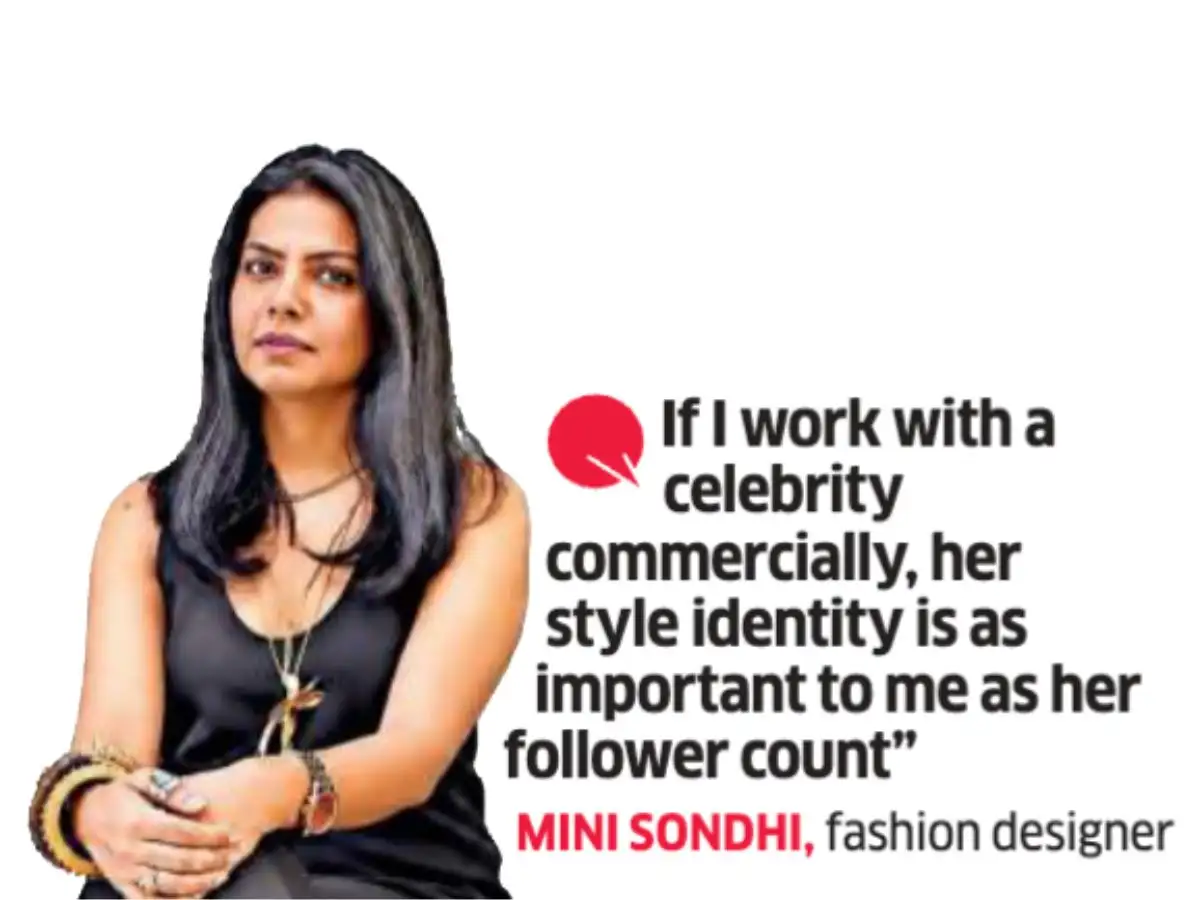
Mini Sondhi, fashion designer and founder of an eponymous label, says: “If I work with a celebrity commercially, her style identity is as important to me as her follower count.”
INFLUENCE IS IN THE AIR
If celebrities are the headliners, fashion influencers are the opening acts that sometimes steal the show. They don’t just show up in clothes; they contextualise them—why a silhouette works, how a fabric behaves, what a designer is trying to say. They build a consistent body of work so that their audience knows what to expect, not just price points, but points of view. They use their reach to shine a light on new designers and homegrown brands.
They pick partnerships that align with their own aesthetic and values, creating a win-win: the brand gets credibility, the influencer gets content that doesn’t feel like an ad, and the audience gets discovery without the ick.
Of course, not all influencing happens this way. Most influencers will say anything and wear anything for a fee. A depressingly large swathe of the ecosystem operates on a transactional logic: post the outfit, tag the brand, collect the fee, move on. But within the clutter, there are those who understand that authenticity is a long-term business model, not a buzzword.
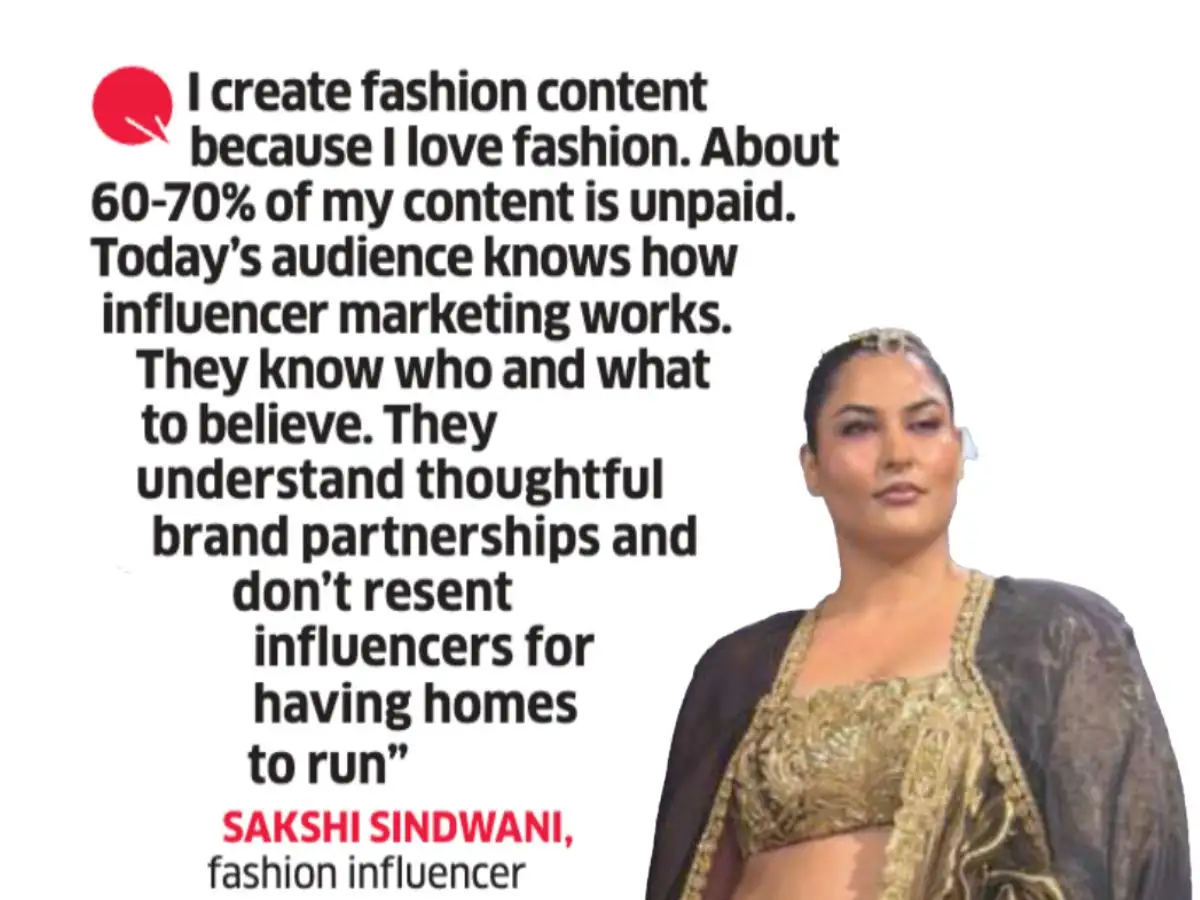
Sakshi Sindwani is a fashion influencer who has used her platform to champion body positivity and size-inclusive styling. She says, “I create fashion content because I love fashion. About 60-70% of my content is unpaid. Today’s audience knows how influencer marketing works. They know who and what to believe. They understand thoughtful brand partnerships and don’t resent influencers for having homes to run!”
 ET Bureau
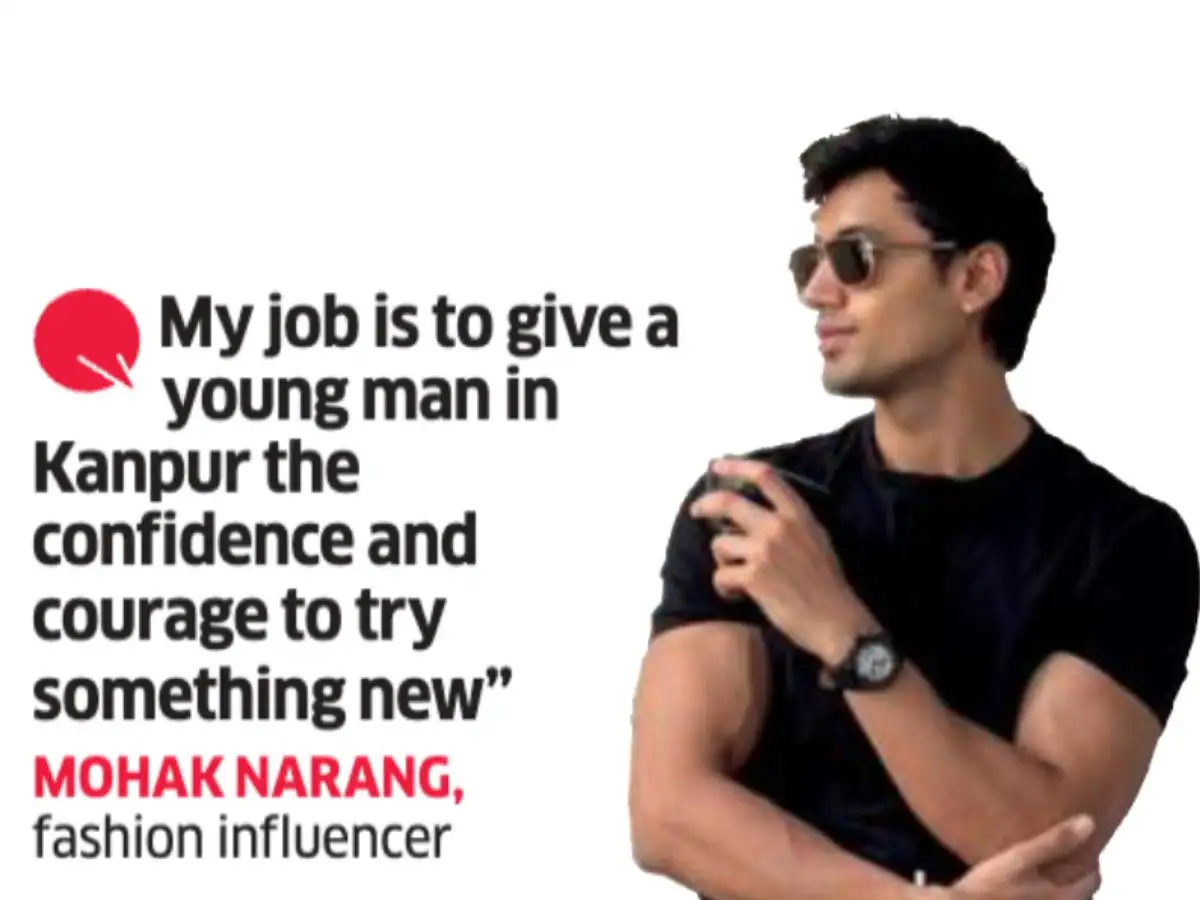
Mohak Narang, who has over 3 million Instagram followers, calls relatability the most important anchor for influencer content. “My job is to give a young man in Kanpur the confidence and courage to try something new. He’s not going to look at Vicky Kaushal’s red carpet look and think, ‘I should wear this.’ That’s why he follows and trusts me.”
 ET Bureau
BUY BUY FASHION
I often wonder if all of this—the muses, the media-impact math, the carefully orchestrated authenticity—has made us take clothes far more seriously than we are meant to. Individually, that might be a good thing. There’s something admirable about people who have taken the trouble to develop and defend an actual point of view about how they dress.
Collectively, I’m not so sure, because the whole system runs on a deafening contradiction. It sells the idea of a deeply personal style, then demands that it be refreshed every season or get branded as stale.
A culture that has made visual identity an aspiration for everyone is also a culture that has to keep buying its way there. And for most regular people, that appetite is fed by fast fashion—bought quickly, discarded easily.
An entire economy built on the premise of authenticity. But kept running by the least authentic thing any of us do.
The irony shouldn’t be lost on anyone.
Sonali Kokra is a Mumbai-based writer
(Disclaimer: The opinions expressed in this column are that of the writer. The facts and opinions expressed here do not reflect the views of www.economictimes.com.)