Просмотр новости
Найдите то, что Вас интересует
 Спутники
 РН
РН SpaceX
 Роскосмос
 NASA
NASA
СпутникиРНSpaceXРоскосмосNASAA new report from the Network of Chinese Human Rights Defenders reveals that PRC authorities torture and ill-treat prisoners of conscience with near-total impunity. Drawing on 209 cases of alleged torture between 2016 and 2025 across the country, and interviews with 25 human rights defenders (HRDs), family members, and lawyers, the 53-page report, “Swept Under the Rug”: Systemic Failures to End Torture in the People’s Republic of China, finds that authorities persist in their use of torture, typically to extract confessions, and fail to investigate allegations of ill-treatment.
September 16, 2026

(中文版本)
Widespread abuses against prisoners of conscience; no disciplinary action against perpetrators
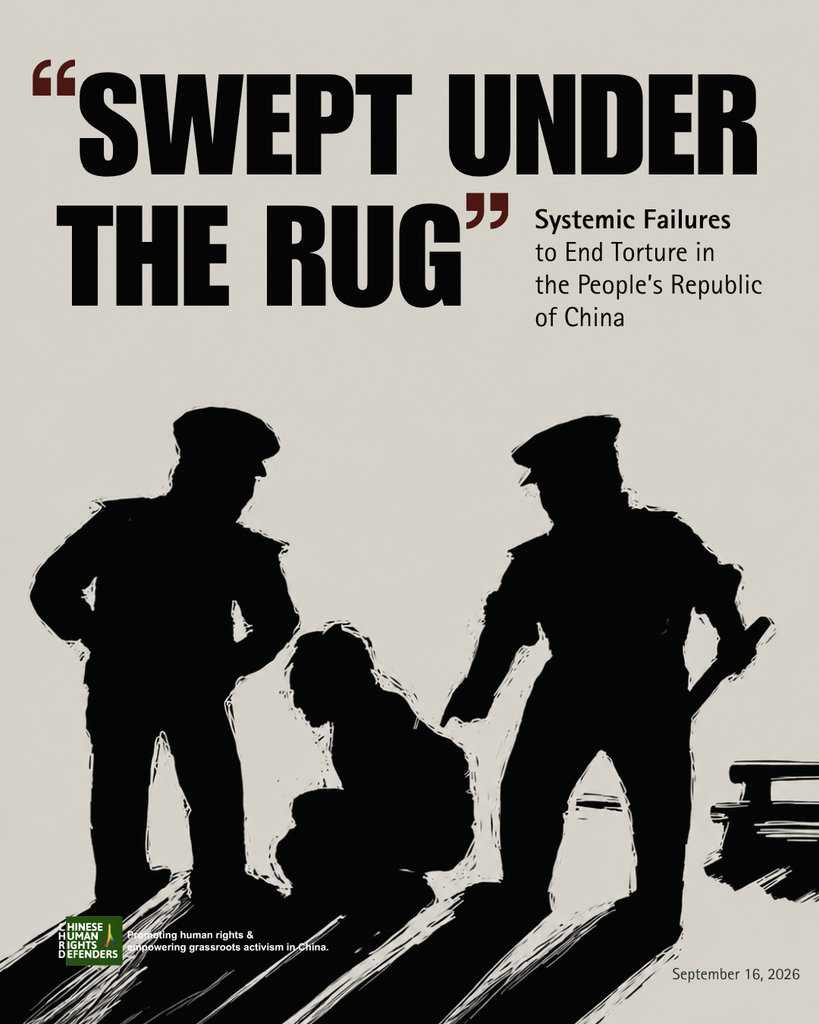
(Network of Chinese Human Rights Defenders, September 16, 2026) — Chinese authorities torture and ill-treat prisoners of conscience with near-total impunity, the Network of Chinese Human Rights Defenders said today in a new report. Drawing on 209 cases of alleged torture between 2016 and 2025 across the country, and interviews with 25 human rights defenders (HRDs), family members, and lawyers, the 53-page report, “Swept Under the Rug”: Systemic Failures to End Torture in the People’s Republic of China, finds that authorities persist in their use of torture, typically to extract confessions, and fail to investigate allegations of ill-treatment.
“The Chinese government’s ongoing reliance on torture isn’t a function of gaps in law or process—it’s a political choice,” said Sophie Richardson, Co-Executive Director of CHRD. “When every safeguard against torture is ignored—year after year, nationwide—impunity for police, courts, and officials is all but guaranteed.”
One in five of the cases CHRD examined included allegations of beatings by authorities. Others reported being subjected to electric shocks and solitary confinement. 35 percent described deprivation of adequate medical care—the most common form of torture—and 16 died in detention as an apparent result. More than half of prisoners of conscience alleging torture had been imprisoned for “picking quarrels and provoking trouble,” a charge United Nations human rights experts have called vague and imprecise; the UN High Commissioner for Human Rights has called for it to be repealed.
CHRD found reference to courts conducting investigations into torture allegations in only two of the 209 cases, those of rights lawyer Ding Jiaxi and journalist Huang Xueqin. Those courts subsequently claimed they found no evidence of torture. In the case of HRD Ji Xiaolong, the court agreed to exclude his confession on the grounds it was obtained through ill-treatment—the only such exclusion CHRD found among the 209 cases—but convicted him anyway, stating that his lack of a confession made him a “recidivist” deserving harsher punishment. CHRD found no evidence that any official was prosecuted or disciplined for torturing a prisoner of conscience in the cases under consideration.
In June 2025, the Supreme People’s Procuratorate (SPP) and Ministry of Public Security jointly issued the first regulations on Residential Surveillance at a Designated Location (RSDL), a form of detention established under the Criminal Procedure Law. According to UN human rights experts, RSDL is a de facto form of enforced disappearance. The new regulations require that family members and lawyers be notified of the facility’s address, yet detainees continue to be held outside recognized facilities, may be denied access to a lawyer depending on the charge they face, and family notification can still be withheld under the vague exception “where it is impossible to notify.” A new SPP “Prosecutorial Investigation Department” to handle rights violations, including illegal detention and torture to extract confessions, was also established in June 2025, but there is no indication yet that it has investigated those violations. In April 2026, the National People’s Congress passed proposed changes to the Prison Law, which will take effect from November 1, 2026. The revision includes provisions enabling practices that amount to torture, such as expanding the use of solitary confinement and restraints.
Despite having ratified the UN Convention against Torture and Other Cruel, Inhuman or Degrading Treatment or Punishment in 1988, Chinese authorities have failed to engage reviews with the goal of eradicating torture. At China’s last review, in 2015, the Committee against Torture (CAT) concluded that these abuses remain “deeply entrenched.” The Chinese government delayed submitting its most recent periodic report for five years and as a result is significantly overdue for review by the committee, one of the few remaining avenues of redress for torture survivors. Chinese authorities are increasingly combative in rejecting international scrutiny, telling the UN Working Group on Arbitrary Detention in 2021 that “the risk of being ‘subjected to torture’… does not exist” in China.
CHRD urges the Chinese government to bring its laws and practices into conformity with the Convention, establish an independent mechanism to investigate torture complaints, and drop charges and quash convictions against wrongfully imprisoned human rights defenders.
The CAT can seek to expedite China’s long-overdue review and press the government publicly on the scale of torture of prisoners of conscience. The UN Human Rights Council should urgently debate the Chinese government’s grave human rights violations, including allegations of crimes against humanity made by the Office of the High Commissioner for Human Rights and the Working Group on Arbitrary Detention, and establish a standing mandate to monitor and report on the country’s human rights record.
Concerned governments can vigorously advocate against torture of detained human rights defenders, call for the release of specific individuals by name, especially at high-level meetings with Chinese leaders, and support independent investigations into torture allegations. Governments should also consider whether their own stated opposition to torture is undermined by their engagement with individual Chinese officials credibly alleged to be complicit in those violations.
“Chinese authorities have had four decades to make good on their promises to end torture,” Richardson said. “Must prisoners of conscience pay with their health—and, in some cases, their lives—for Beijing’s intransigence?”
(Download and read the Full Report Here)
For more information, please contact:
Sophie Richardson, Co-Executive Director, Chinese Human Rights Defenders, sophierichardson[at]nchrd.org, +1 917 721 7473
Shane Yi, Researcher, Chinese Human Rights Defenders, shaneyi[at]nchrd.org
| # | Наименование новости | Тональность | Информативность | Дата публикации |
|---|---|---|---|---|
| 1 | Torturas en cárceles de China: informe denuncia jaulas de hierro, descargas eléctricas y hambre | 0 | 6.73 | 16-09-2026 |
| 2 | Госсовет КНР опубликовал доклад о прогрессе Китая в защите прав человека | 0 | 0 | 12-08-2021 |
| 3 | Over 16,000 civilians detained by Russia during the war in Ukraine are still held, UN estimates | 0 | 7.39 | 11-08-2026 |
| 4 | «Моя тюрьма просто стала больше»: пытки и жизнь после них в Центральной Азии | -2 | 7 | 26-06-2026 |
| 5 | В ООН потребовали остановить пытки пленных россиян на Украине | -2 | 4 | 03-07-2026 |
| 6 | Сексуальное насилие как оружие и пытка: 89% преступлений совершены силами РФ с начала войны против Украины | 0 | 10.33 | 18-09-2026 |
| 7 | Some half of Russian POWs interviewed by UN report torture in Ukraine | 0 | 12.14 | 24-08-2026 |
| 8 | В ООН призвали США расследовать сообщения о пытках в тюрьме Гуантанамо | 0 | 0 | 23-02-2021 |
| 9 | УВКПЧ ООН: на Украине пытали 170 человек за якобы сотрудничество с РФ | 0 | 0 | 30-06-2025 |
| 10 | China’s escalating crackdown on VPN use | 0 | 9.95 | 12-06-2026 |