Просмотр новости
Найдите то, что Вас интересует
 Спутники
 РН
РН SpaceX
 Роскосмос
 NASA
NASA
СпутникиРНSpaceXРоскосмосNASAA land dispute may have led to the massacre 3,000 years ago, suggesting Europe’s transition to farming wasn’t always peaceful.
The victims may have been targeted for massacre in a culture clash 3,000 years ago
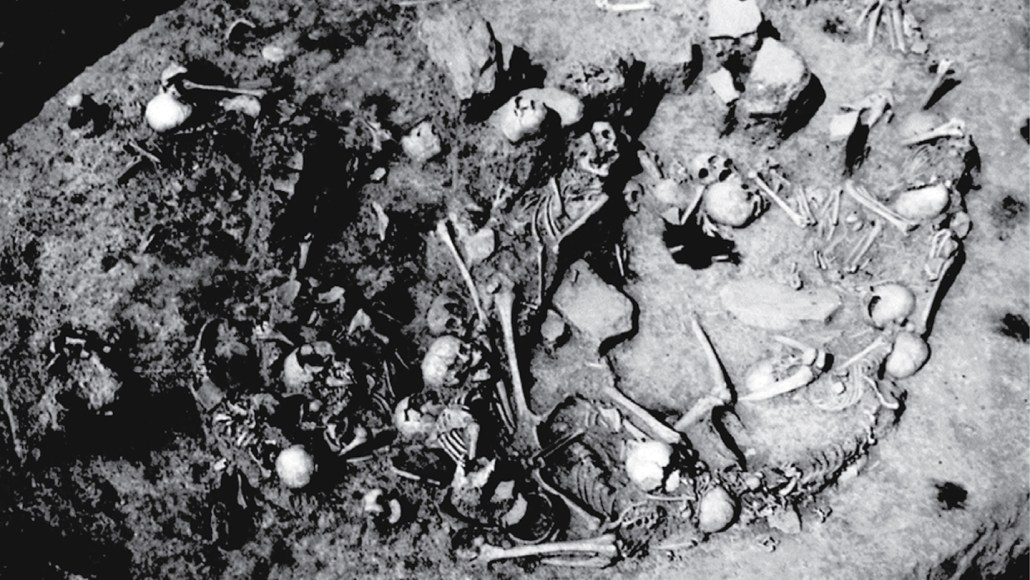
Archaeologists found the ancient Gomolava burial pit in northern Serbia more than 50 years ago, and a new genetic study shows it held mostly women and children.
Museum of Vojvodina, reproduced in Fibiger et al./Nature Human Behaviour 2026
This is a human-written story voiced by AI. Got feedback? Take our survey . (See our AI policy here .)
A mass grave from roughly 3,000 years ago in what is now Serbia is filled with the remains of women and children and may indicate they were targeted for organized slaughter.
The 9th century B.C. burial pit holds 77 individuals. More than 60 percent were children and more than 70 percent were female, an unusually high proportion, researchers report February 23 in Nature Human Behaviour.
Just under three meters across but only half a meter deep, the pit was found more than 50 years ago by Yugoslav archaeologists. The remains are now curated at the Museum of Vojvodina in the nearby Serbian city of Novi Sad, and were only recently analyzed with modern methods. The latest analysis also identifies the remains of about 20 men and boys, but “it’s not a random difference,” says archaeologist Barry Molloy of University College Dublin. “There’s clearly a choice being made about who’s being killed.”
Mass graves from indiscriminate killing usually have roughly equal numbers of men and women, while wartime massacres usually have more men. Young women and children are often absent from the slaughter of captives — instead, they were probably taken as slaves.
Molloy and his colleagues conducted DNA analysis, determined sex via proteins in tooth enamel and studied how the bones are shaped, among other assessments. They suggest the massacre reflects a clash between different cultural groups who wanted to control the area, one of an increasing number of violent episodes after the introduction of farming to Europe between 8,000 and 9,000 years ago. Earlier archaeological studies suggested this escalated from occasional raids to more organized violence as methods of warfare developed, and that it reached its peak around the time of the early Iron Age massacre at Gomolava, an archaeological site near the modern Serbian village of Hrtkovci.
Previous research has shown that the people buried at Gomolava were semi-sedentary farming people. The researchers say that ethnological studies and indications that the people in the mass grave were killed by blows from horseback suggest they were attacked and massacred by semi-nomadic herders from another culture. Additional evidence suggests two branches of another farming culture settled nearby, but farther away.
At Gomolava, “we seem to have people who liked to control the landscape and use it in a farming way, and this other group looking to move through and keep it open,” Molloy says. “They essentially came into conflict over land ownership.”
The high proportion of women and children killed in the massacre may be a sign that they held high status in their farming community, and so were targeted in the killing. “Gomolava was at a flashpoint of all these different ways of using the land,” he says.
Bioarchaeologist Mario Novak of the Institute for Anthropological Research in Zagreb, Croatia, was not involved in the latest study but led research into the genetics of victims of a much earlier massacre near the modern Croatian village of Potočani, about 230 kilometers northwest of Gomolava.
He says the authors are “very convincing” about suggesting reasons for the unexpected number of women and children killed at Gomolava, but he notes there are no written sources about the 3,000-year-old massacre. “Unfortunately, we will probably never know the exact reason behind the tragic event.”
| # | Наименование новости | Тональность | Информативность | Дата публикации |
|---|---|---|---|---|
| 1 | Archaeologists uncover brutal Iron Age massacre of women and children | 0 | 9.12 | 09-03-2026 |
| 2 | Ancient bones reveal chilling victory rituals after Europe’s earliest wars | 0 | 6.76 | 08-02-2026 |
| 3 | 'The lance head was still inside the pelvis': Mass grave found in Austria may hold casualties of unknown ancient Roman battle | 0 | 8.18 | 14-08-2026 |
| 4 | A ‘jar’ jammed with human bones may solve Laos’ ‘Plain of Jars’ mystery | 0 | 9.28 | 18-05-2026 |
| 5 | Ancient DNA reveals how women helped transform prehistoric Europe | 0 | 9.93 | 30-05-2026 |
| 6 | 'Full-on berserker mode': Archaeologists solve mystery of medieval soldiers with gruesome square holes in their skull | 0 | 9.84 | 14-08-2026 |
| 7 | Под вулканическим пеплом нашли человеческие останки | 0 | 10 | 27-07-2026 |
| 8 | Civil War mass grave with at least three bodies discovered in Malaga town cemetery | 0 | 10 | 24-07-2026 |
| 9 | Underground scans reveal Biblical 'ark layout' in Turkey | 0 | 10.4 | 21-04-2026 |
| 10 | Monty Python Got It Wrong About Medieval Disease | 0 | 9.08 | 13-03-2026 |