Просмотр новости
Найдите то, что Вас интересует
 Спутники
 РН
РН SpaceX
 Роскосмос
 NASA
NASA
СпутникиРНSpaceXРоскосмосNASABy creating the most detailed map ever of cold gas around Sagittarius A*, astronomers have provided compelling evidence for a long-sought black-hole wind Astronomers using the Atacama Large Millimeter/submillimeter Array (ALMA) have finally found clear evidence that the supermassive black hole at the center of the Milky Way, Sagittarius A*(Sgr A*), is blowing a hot...
4 June, 2026 / Read time: 4 minutes
By creating the most detailed map ever of cold gas around Sagittarius A*, astronomers have provided compelling evidence for a long-sought black-hole wind
Astronomers using the Atacama Large Millimeter/submillimeter Array (ALMA) have finally found clear evidence that the supermassive black hole at the center of the Milky Way, Sagittarius A*(Sgr A*), is blowing a hot cosmic wind – something scientists have been hunting for over 50 years. Astronomical theory says that when a black hole feeds on gas, it should also blow some material back out as winds or jets. Until now, the wind coming from our own Galaxy’s black hole had never been seen clearly. Using several years of highly detailed ALMA observations, astronomers mapped cold gas within just a few light‑years of Sgr A*. After carefully removing the black hole’s bright radio glow, they uncovered a giant, cone‑shaped hole in the cold gas, pointing straight at the black hole – the unmistakable imprint of a large, hot, active wind launched from Sgr A*.
With over five years of ALMA observations (made at a wavelength of 1.3 millimeters) astronomers mapped emission from carbon monoxide (CO) molecules, a classic tracer of cold molecular gas, within only about three light‑years of Sgr A*. By carefully modeling and subtracting the black hole’s own rapidly varying radio emission, they were able to reveal extremely faint, intricate structures in the surrounding gas. Data from NASA’s Chandra X-Ray Observatory show hot gas filling the same region, confirming that this is a black hole–powered outflow, not something caused by nearby stars.
The resulting map is roughly 100 times more sensitive and 80 times higher in angular resolution than previous CO maps of the region, making it the most sensitive, highest‑resolution map of cold gas within three light‑years of Sgr A* ever obtained. This discovery relied not only on years of ALMA observations but also innovative data‑processing techniques to model and subtract Sgr A*’s rapidly variable emission, revealing fainter structures in the surrounding gas.
The team estimates this wind has been blowing for at least 20,000 years, but it’s relatively gentle compared to the dramatic jets seen in other galaxies. By revealing this long‑sought wind, ALMA (and Chandra) have helped solve a decades‑old mystery and given scientists their clearest view yet of how a supermassive black hole can both feed on and reshape its surroundings at the heart of our Milky Way Galaxy.
Additional InformationThe study appears as “The Discovery of a Large Active Wind from the Milky Way's Central Black Hole” by M. Gorsky and E. Murchikova in The Astrophysical Journal Letters.
This article is based on the original press release by the U.S. National Science Foundation National Radio Astronomy Observatory (NRAO), an ALMA partner on behalf of North America.
The Atacama Large Millimeter/submillimeter Array (ALMA), an international astronomy facility, is a partnership of the European Southern Observatory (ESO), the U.S. National Science Foundation (NSF) and the National Institutes of Natural Sciences (NINS) of Japan in cooperation with the Republic of Chile. ALMA is funded by ESO on behalf of its Member States, by NSF in cooperation with the National Research Council of Canada (NRC) and the National Science and Technology Council (NSTC) in Taiwan and by NINS in cooperation with the Academia Sinica (AS) in Taiwan and the Korea Astronomy and Space Science Institute (KASI).
ALMA construction and operations are led by ESO on behalf of its Member States; by the National Radio Astronomy Observatory (NRAO), managed by Associated Universities, Inc. (AUI), on behalf of North America; and by the National Astronomical Observatory of Japan (NAOJ) on behalf of East Asia. The Joint ALMA Observatory (JAO) provides the unified leadership and management of the construction, commissioning and operation of ALMA.
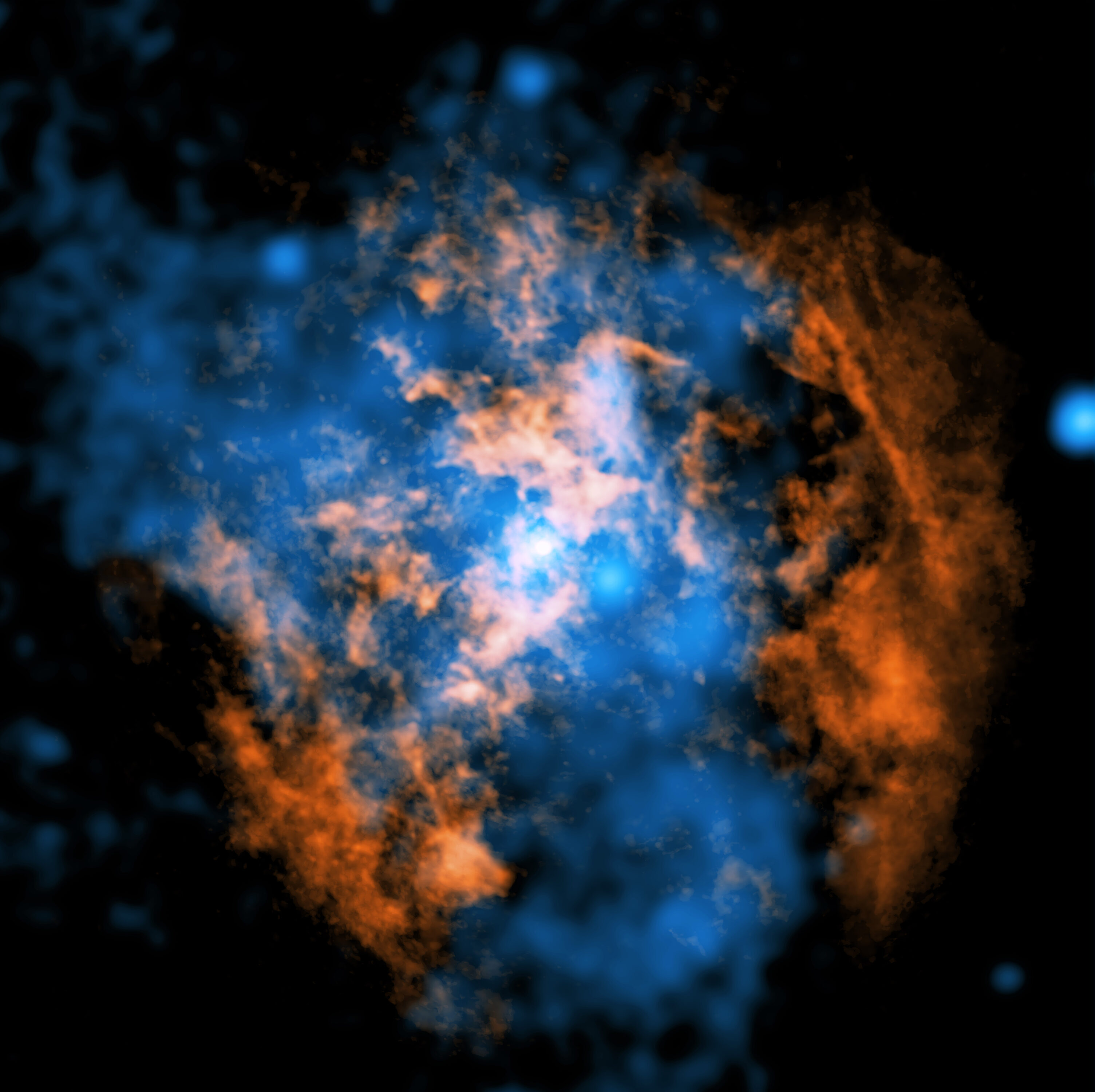 This composite image overlays data from the Atacama Large Millimeter/submillimeter Array and NASA’s Chandra X-Ray Observatory. It shows evidence for a wind blowing away from Sagittarius A* (Sgr A*), the supermassive black hole in the center of our galaxy. The white dot in the center of the image shows Sgr A*. In orange is data from ALMA radio telescopes in Chile, mapping the location of cold gas composed of carbon monoxide in the image. In blue is X-ray data from NASA’s Chandra X-ray Observatory. A large cone-shaped cavity, visible as an absence of cold gas in the ALMA data, is filled by hot X-ray-emitting gas in the Chandra data. Researchers think a hot, energetic wind blowing from Sgr A* created this structure by sweeping the cold gas away or heating it up.
 Image Credit: Northwestern Univ./M. Gorski; X-ray: NASA/CXC/SAO; Radio: ESO/NAOJ/NRAO/ALMA
| # | Наименование новости | Тональность | Информативность | Дата публикации |
|---|---|---|---|---|
| 1 | Milky Way's giant black hole blows surprisingly gentle breeze | 0 | 6.73 | 07-06-2026 |
| 2 | ALMA Lifts the Veil on Hidden Nurseries of Massive Star Clusters in Nearby Galaxies | 0 | 5.04 | 17-06-2026 |
| 3 | ALMA Reveals a Hidden Starburst Galaxy Linked to a High-Energy Neutrino | 0 | 11.14 | 19-06-2026 |
| 4 | ALMA Witnesses Star Birth Beyond the Milky Way | 0 | 8.82 | 27-04-2026 |
| 5 | Found: Milky Way black hole’s missing wind | 0 | 9.41 | 05-06-2026 |
| 6 | ALMA Discovers Chemically Rich Stellar Cradles Inside a Supernova Remnant | 0 | 4.79 | 13-07-2026 |
| 7 | ALMA Reveals Long-Lived Hotspots on Betelgeuse’s Bubbling Surface | 0 | 10.74 | 24-08-2026 |
| 8 | ALMA Reveals Turbulence May Dominate Magnetic Fields in the Seeds of Massive Star Clusters | 0 | 7.07 | 22-05-2026 |
| 9 | A star’s violent death exposed a hidden supermassive black hole | 0 | 7.57 | 06-08-2026 |
| 10 | Ученые открыли странное явление в космосе Сверхмассивная черная дыра Стрелец ... | 0 | 7 | 05-07-2026 |