Просмотр новости
Найдите то, что Вас интересует
 Спутники
 РН
РН SpaceX
 Роскосмос
 NASA
NASA
СпутникиРНSpaceXРоскосмосNASAToday, there are millions of Buddhists in the United States, including many who were born to Buddhist families and others who converted into the religion.
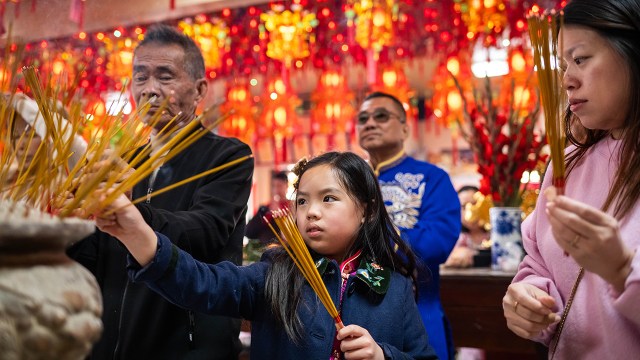 Buddhists seek blessings for the Lunar New Year as they welcome the Year of the Horse at Kwan Ying Vietnamese Buddhist Temple in Los Angeles on Feb. 17. (Sarah Reingewirtz/MediaNews Group/Los Angeles Daily News via Getty Images)
Buddhism has a long history in America. In the 1800s, Chinese migrants working in the gold rush and building railroads brought their Buddhist beliefs and practices with them. Today, there are millions of Buddhists in the United States, including many who were born to Buddhist families and others who converted into the religion.
Here are some key facts about Buddhists in the U.S., based on Pew Research Center’s 2025 report “How the Global Religious Landscape Changed From 2010 to 2020,” the 2023-24 Religious Landscape Study (RLS) and the 2022-23 Survey of Asian Americans (SAA). (Read the Appendix for details about how we combined results from the RLS and SAA.)
About this researchThis analysis shares key facts about Buddhists in the United States, including the number of Buddhists in the country, what regions they live in, and movement into and out of Buddhism.
Why did we do this?
Pew Research Center does opinion surveys, demographic studies and other research to better understand religious identity, beliefs and practices in the U.S. and around the world. Buddhism is among the major world religions we regularly study.
Learn more about Pew Research Center.
How did we do this?
This analysis is based on three Pew Research Center studies:
For the RLS, we surveyed Americans in English and Spanish. As a result, the RLS may have missed U.S. Buddhists who are not proficient in either of those languages. For the SAA, we surveyed Americans in English, Chinese (Simplified and Traditional), Hindi, Korean, Tagalog and Vietnamese. By combining information from both the RLS and SAA in this analysis, we can better represent all U.S. Buddhists. Read the Appendix for more details.
Funding for these studies came from numerous funders. For details, go to each report’s acknowledgements section.
There were around 4.4 million Buddhists in the U.S. in 2020. The number of Buddhists, including adults and children, rose by 22% between 2010 and 2020. That outpaced the 9% growth of the non-Buddhist population during that time.
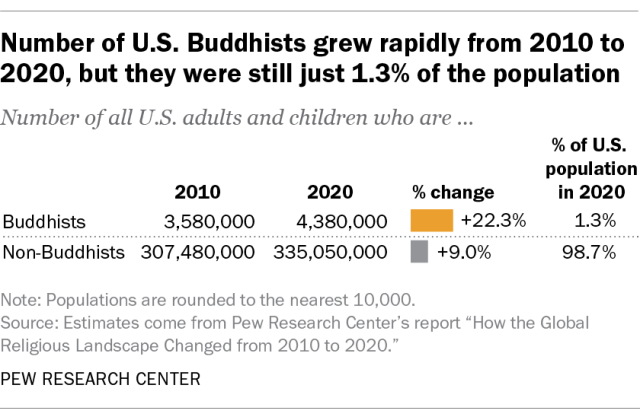
Despite this increase, Buddhists remained a small share of the U.S. population, estimated at 1.3% in 2020.
(These estimates come from our 2025 report. Unlike estimates from the RLS and SAA, they include both adults and children.)
Most U.S. Buddhists are immigrants, and most are Asian by race. An estimated 52% of U.S. Buddhist adults were born in Asia. The most common places of birth for foreign-born U.S. Buddhist adults are Vietnam, China and Thailand.
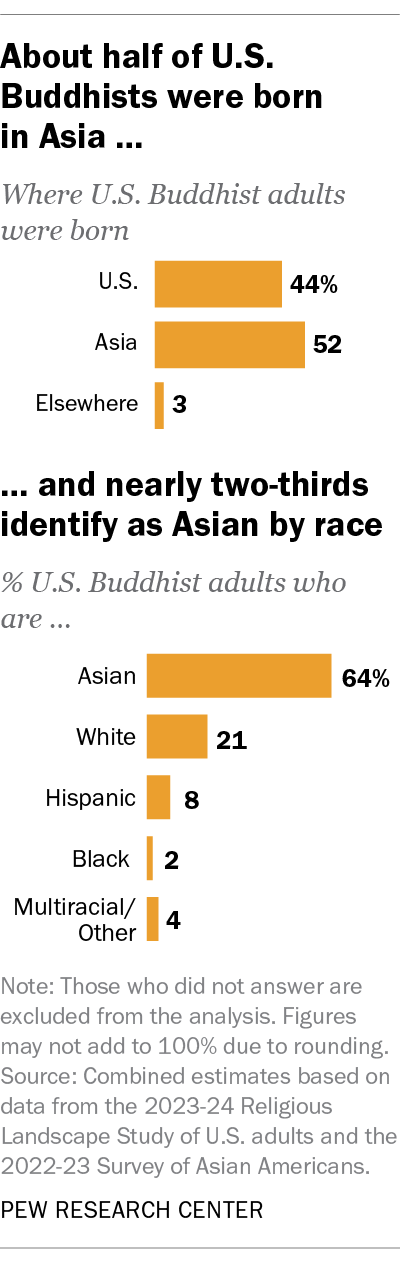
In addition, 64% of U.S. Buddhist adults are Asian by race. Most of the rest are White (21%) or Hispanic (8%).
Related: Buddhism’s Recent Decline in Asia
Buddhist adults are much more likely than U.S. adults overall to live in the West (46% vs. 24%). In contrast, they’re less likely than U.S. adults overall to live in the Midwest (9% vs. 21%) or South (29% vs. 38%). Roughly equal shares of Buddhists and all U.S. adults live in the Northeast (16% vs. 17%).
There is a lot of turnover in the U.S. Buddhist population due to people moving into and out of the religion. By our estimates, 48% of current Buddhist adults were not raised Buddhist (in other words, they are converts). And 55% of U.S. adults who were raised Buddhist no longer identify that way (i.e., they are former Buddhists).
But because Buddhism is a small religion in the U.S., these figures translate into tiny percentages of all U.S. adults. Overall, 0.5% of all U.S. adults have converted to Buddhism, while 0.7% are former Buddhists. So there’s an overall small net loss (0.2% of all U.S. adults) from switching in both directions. This means that immigration, not religious switching, has driven the growth in the number of Buddhists.
Related: Why is Buddhism shrinking worldwide?
Around 3% of American adults consider themselves Buddhist “aside from religion,” according to the RLS. This might mean they identify with Buddhism ethnically, culturally or because of their family background. In other words, the share of U.S. adults who connect with Buddhism broadly is much bigger than the share who say Buddhism is their religion.
The 2022-23 Survey of Asian Americans (SAA) asked Asian Americans a similar question and found that 21% consider themselves close to Buddhism for reasons aside from religion. That’s almost twice the share of Asian Americans who formally identified as Buddhist in the SAA (11%).
In our focus group interviews with Asian Americans, many Buddhists – as well as non-Buddhists who consider themselves close to Buddhism – commonly described Buddhism as a “way of life” or a “lifestyle.” They contrasted this to the concept of organized religion, which they described as something that tends to be more formal and dogmatic.
Related: In Their Own Words: Cultural Connections to Religion Among Asian Americans
Fahmy, Dalia, Yunping Tong and Conrad Hackett. 2026. “5 facts about Buddhists in the United States.” Pew Research Center. doi: 10.58094/drp5-a714.

Dalia Fahmy is a senior writer/editor focusing on race, ethnicity and migration at Pew Research Center.

Yunping Tong is a senior researcher focusing on religion research at Pew Research Center.

Conrad Hackett is a senior demographer and associate director of research at Pew Research Center.
| # | Наименование новости | Тональность | Информативность | Дата публикации |
|---|---|---|---|---|
| 1 | В США нашлось больше миллиона живых потомков английских колонистов XVII века | 0 | 10 | 16-05-2026 |
| 2 | Why is Buddhism shrinking worldwide? | 0 | 20.74 | 11-03-2026 |
| 3 | More than 440K people became millionaires in the US last year | 5 | 5 | 06-07-2026 |
| 4 | Buddhism’s Recent Decline in East Asia | 0 | 12.34 | 11-03-2026 |
| 5 | ВОЗ: более 100 млн человек в мире курят вейпы | 0 | 0 | 06-10-2025 |
| 6 | Более 20 млн американцев получили бустерные дозы вакцин от коронавируса | 0 | 0 | 03-11-2021 |
| 7 | Эксперт объяснил сложную ситуацию с коронавирусом в США социальным неравенством | 0 | 0 | 17-01-2022 |
| 8 | Число жертв коронавируса в США превысило 90 тыс. | 0 | 0 | 18-05-2020 |
| 9 | Власти США признали, что не имеют ресурсов для высылки всех нелегальных мигрантов | 0 | 0 | 30-09-2021 |
| 10 | Southerners tend to be more religious than other U.S. adults – but less religious than they used to be | 0 | 5.62 | 03-03-2026 |