Просмотр новости
Найдите то, что Вас интересует
 Спутники
 РН
РН SpaceX
 Роскосмос
 NASA
NASA
СпутникиРНSpaceXРоскосмосNASAThe post Fact sheet: Georgian ports suspected of violating sanctions on Russian oil appeared first on Centre for Research on Energy and Clean Air.
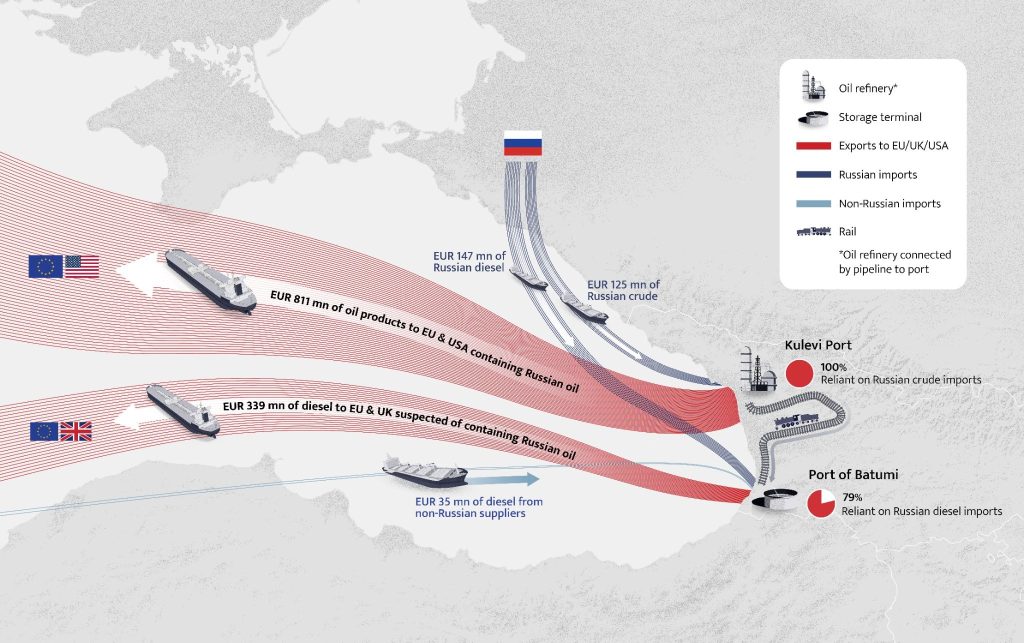
The EU’s 18th sanctions package, agreed on in July 2025, announced a ban on the importation of oil products (HS trade code 2710) made from Russian crude oil (HS 2709). However, this ban does not address the issue of refined Russian oil products entering ports in non-sanctioning countries and being blended, processed, or re-exported to the EU and other sanctioning jurisdictions.
Georgia appears to have taken advantage of a lack of enforcement and loopholes in the sanctions in two ways. The Kulevi refinery — a newly commissioned oil refinery near Georgia’s Kulevi oil terminal and port, and connected to them via pipeline — has exploited the refining loophole to import 100% of its crude oil feedstock from Russia and then export oil products to the EU and the USA via the port of Kulevi (hereafter referred to as Kulevi port). The Kulevi refinery appears to have violated EU regulation Article 3ma of Council Regulation (EU) No 833/2014, which prohibits the importation by EU countries of oil products derived from Russian crude after 21 January 2026. Simultaneously, Georgia’s Batumi oil terminal and port (hereafter referred to as the port of Batumi) appears to be blending and relabelling Russian oil products before reselling them to sanctioning countries, thereby violating EU and UK sanctions.
The two ports (Kulevi and Batumi), located on the Black Sea coast, are connected to Georgia’s national railway network, which makes tracking Russian oil molecules contained in their exports to sanctioning jurisdictions especially difficult. The land connections and routes exploit challenges in tracing oil flows and circumventing enforcement paradigms.
Both ports appear to be importing significant quantities of Russian oil and exporting cargoes that violate both the EU and the UK sanctions.
Key findings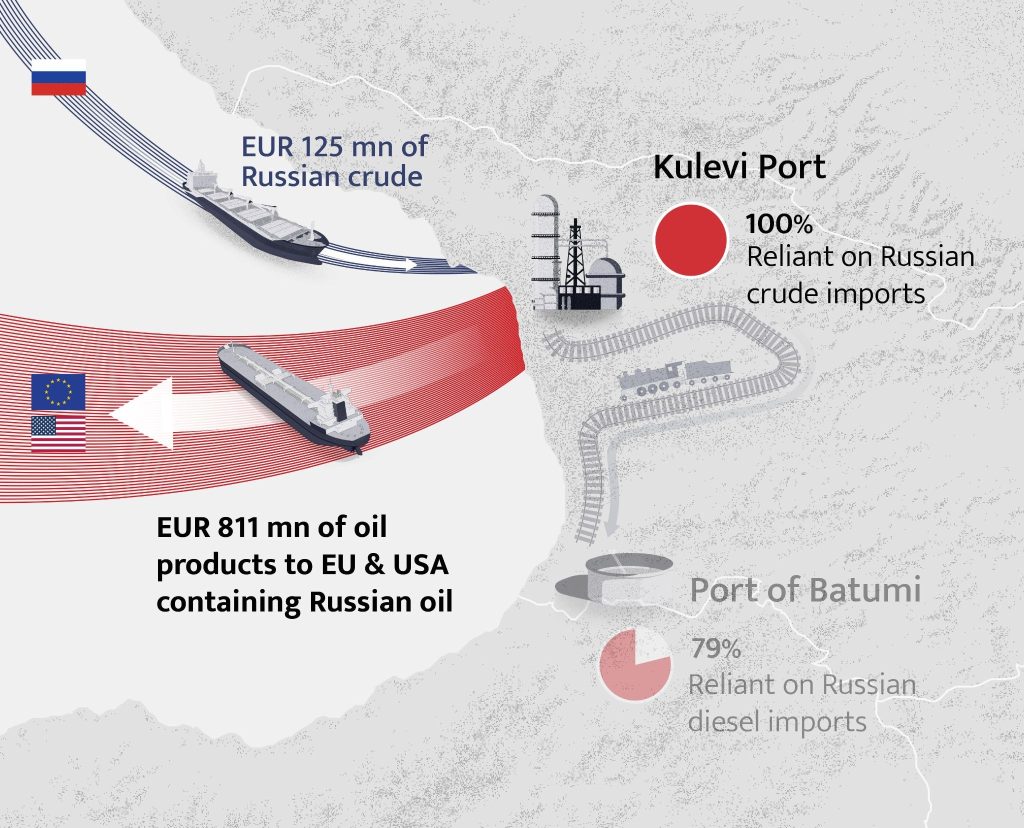
Figure 1 — The Kulevi port
KuleviThe Kulevi refinery is located on Georgia’s Black Sea coast near the Kulevi port, and is connected to the port via pipeline. The refinery has reportedly relied solely on Russian crude since opening in October 2025.
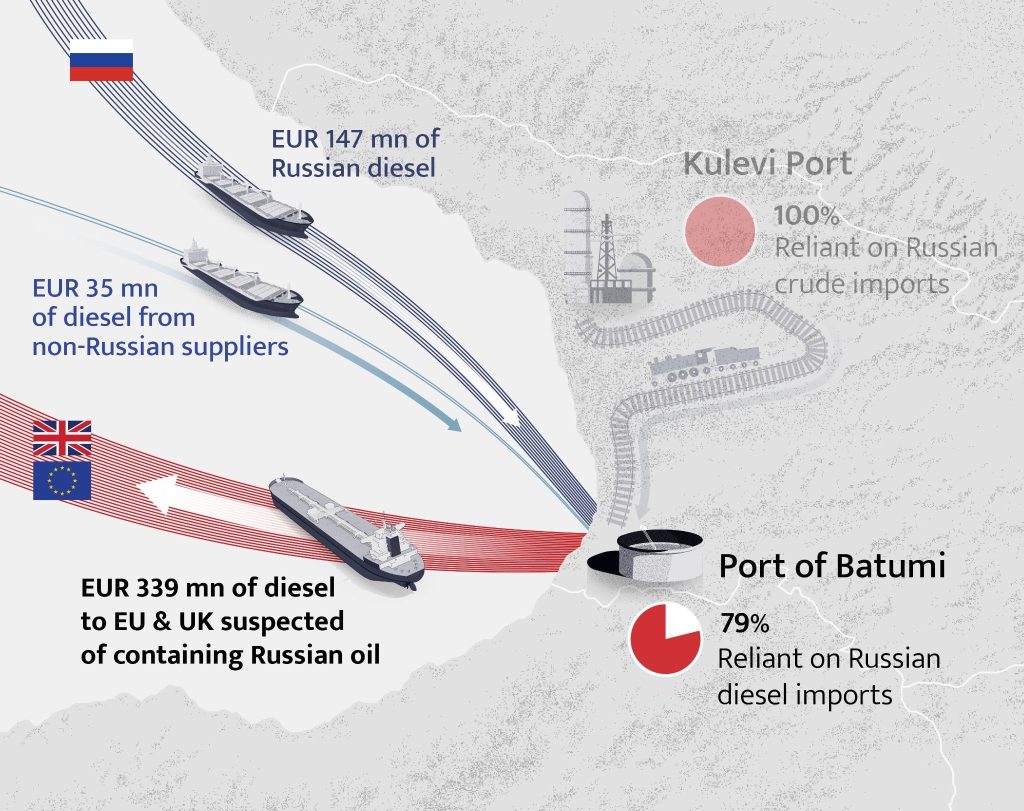
Figure 2 — The port of Batumi
BatumiMeanwhile, less than 100 kilometres along the Black Sea coast sits the port of Batumi and oil terminal.
Policy recommendations
CREA’s proposed measures aim to prevent sanctioning jurisdictions from importing oil products containing Russian molecules and to discourage refineries and re-export terminals from relying on Russian hydrocarbons if they want access to Western markets.
CREA uses data from Kpler and government sources for refinery data to estimate the value and volume of oil products made from Russian crude for export to G7+ countries from third countries.
We assume that all feedstock crude oil is perfectly mixed by refineries to produce refined oil products. For each refinery, we multiply the percentage of the feedstock crude oil that is Russian-origin by the total volume of oil products flowing out of the refinery. This allows us to attribute products as being derived from Russian crude. For example, if 30% of a refinery’s feedstock crude is of Russian origin, and the refinery exports 100 tonnes of diesel, we assume that 30 tonnes of the diesel comes from Russian origin crude.
We use Kpler data to estimate the refineries’ imports of Russian crude oil and apply CREA’s pricing model to Russian crude.
CREA’s full data methodology is available here.
Find more relevant data and reports here.
The Centre for Research on Energy and Clean Air (CREA) is an independent research organisation focused on revealing the trends, causes, and health impacts, as well as the solutions to air pollution. CREA uses scientific data, research, and evidence to support the efforts of governments, companies, and campaigning organisations worldwide in their efforts to move towards clean energy and clean air.
CREA is politically independent. The designations employed and the presentation of the material on maps contained in this report do not imply the expression of any opinion whatsoever concerning the legal status of any country, territory, city or area or of its authorities, or concerning the delimitation of its frontiers or boundaries.
Find more information here: energyandcleanair.org.
| # | Наименование новости | Тональность | Информативность | Дата публикации |
|---|---|---|---|---|
| 1 | June 2026 — Monthly analysis of Russian fossil fuel exports and sanctions | 0 | 8.22 | 10-07-2026 |
| 2 | July 2026 — Monthly analysis of Russian fossil fuel exports and sanctions | 0 | 8.22 | 10-08-2026 |
| 3 | EU imposes sanctions on three oil refineries in Russia and one in Belarus | 0 | 6.31 | 23-07-2026 |
| 4 | Грузинский НПЗ перестанет перерабатывать российскую нефть | 0 | 9.32 | 24-07-2026 |
| 5 | India’s oil imports from Russia soar despite end of US waiver | 0 | 5 | 30-06-2026 |
| 6 | Грузия сможет принимать рейсы не подпавших под санкций ЕС авиакомпаний России | 0 | 0 | 11-05-2023 |
| 7 | 100% US tariffs may not deter India from buying Russian oil - report | 0 | 12.31 | 10-08-2026 |
| 8 | EU facing revolt over new Russia sanctions – FT | -3 | 6 | 20-07-2026 |
| 9 | Кулевский НПЗ в Грузии полностью отказался от российской нефти | 0 | 7 | 02-07-2026 |
| 10 | Путин не считает нужным вводить санкции против Грузии | 0 | 0 | 09-07-2019 |