Просмотр новости
Найдите то, что Вас интересует
 Спутники
 РН
РН SpaceX
 Роскосмос
 NASA
NASA
СпутникиРНSpaceXРоскосмосNASAA team led by researchers at the Centro Nacional de Investigaciones Cardiovasculares Carlos III (CNIC) has identified a potential strategy to prevent the arrhythmias associated with Short QT syndrome type 3 (SQTS3), a rare inherited disease with a high risk of sudden death. The study, published in Nature Communications, shows that polyamines—small molecules naturally present in all cells—restore normal function to the altered cardiac channel responsible for the disease.Each heartbeat depends on the coordinated action of millions of ion channels that regulate the flow of electrical charge across cardiac cells. When one of these channels stops working properly, the heart's rhythm can become disrupted, triggering potentially fatal arrhythmias.This is what happens in Short QT syndrome type 3 (SQTS3), a rare inherited disease caused by mutations in a potassium channel that abnormally accelerates the heart's electrical recovery. Patients, even at a young age, face a very high risk of developing ventricular arrhythmias and sudden death. Few treatment options are available, and most treat the disease symptoms and do not correct the underlying defect that causes the disease.The study, led by Professor José Jalife, head of the CNIC Cardiac Arrhythmia group, and Dr. Ana I. Moreno-Manuel, the study's first author, presents a completely different strategy.The study shows that polyamines can restore normal function to the altered channel and prevent arrhythmias in an experimental model of the disease.Polyamines—including spermidine and spermine—are involved in numerous biological processes related to cell growth and survival. Although they are already used as nutritional supplements and some of their physiological functions were already known, their potential to correct inherited electrical abnormalities of the heart had not previously been recognized, the authors explain.The researchers found that oral or intravenous administration of these molecules restores normal interaction with the potassium channel altered by the genetic mutation responsible for SQTS3. As a result, the channel regains much of its normal function, reducing the occurrence of potentially fatal ventricular arrhythmias.“What matters most about this study is that we don’t just suppress the arrhythmias—we act directly on the molecular mechanism that triggers them”, explains Dr. Ana I. Moreno-Manuel, a researcher in the CNIC Cardiac Arrhythmia group."We have shown that restoring the interaction between polyamines and the mutated channel makes it possible to recover electrical function much closer to normal”, she adds.The main value of the study lies in demonstrating that it is possible to directly correct the molecular defect responsible for an inherited heart rhythm disorder.Until now, most available therapies have focused on controlling the clinical consequences of the disease. This approach instead targets the root of the problem, opening the door to the development of more specific and potentially more effective treatments.Although the results are still limited to an experimental model, and their safety and efficacy will need to be confirmed in future preclinical and clinical studies, they represent an important proof of concept for a disease that currently has few therapeutic alternatives.The authors believe the impact of this study could extend to other inherited diseases caused by similar alterations in cardiac ion channels.A detailed understanding of how polyamines regulate these channels could help the development of new therapies aimed at correcting the molecular defects responsible for different heart rhythm disorders, rather than simply treating their clinical manifestations.“This study not only improves our understanding of the mechanisms responsible for Short QT syndrome type 3, but also opens a new avenue for developing targeted treatments for this disease and other heart rhythm disorders caused by similar mechanisms”, concludes Professor José Jalife.This study was funded by the “la Caixa” Banking Foundation (LCF/PR/HR19/52160013); the Carlos III Health Institute (ISCIII), through project PI23/01039 of the 2023 Health Research Projects call; the Ministry of Science, Innovation, and Universities (MICIU) through projects BFU2016-75144-R and PID2020-116935RB-I00, co-funded by the European Regional Development Fund (ERDF); and the La Marató de TV3 Foundation (736/C/2020). The research also received support from the European Union Horizon 2020 programme (GA-965286); the CNIC Microscopy and Dynamic Imaging Unit (ICTS-ReDib), funded by the MICIU/State Research Agency (MICIU/AEI) and the ERDF (ICTS-2018-04-CNIC-16); and project EQC2018-005070-P. Moreno-Manuel, A.I., Cruz, F.M., Macías, Á. et al. Repurposing polyamines to prevent life-threatening arrhythmias in Short QT Syndrome type 3. Nat Commun (2026). https://doi.org/10.1038/s41467-026-74259-7
A team led by researchers at the Centro Nacional de Investigaciones Cardiovasculares Carlos III (CNIC) has identified a potential strategy to prevent the arrhythmias associated with Short QT syndrome type 3 (SQTS3), a rare inherited disease with a high risk of sudden death. The study, published in Nature Communications, shows that polyamines—small molecules naturally present in all cells—restore normal function to the altered cardiac channel responsible for the disease.
Each heartbeat depends on the coordinated action of millions of ion channels that regulate the flow of electrical charge across cardiac cells. When one of these channels stops working properly, the heart's rhythm can become disrupted, triggering potentially fatal arrhythmias.
This is what happens in Short QT syndrome type 3 (SQTS3), a rare inherited disease caused by mutations in a potassium channel that abnormally accelerates the heart's electrical recovery. Patients, even at a young age, face a very high risk of developing ventricular arrhythmias and sudden death. Few treatment options are available, and most treat the disease symptoms and do not correct the underlying defect that causes the disease.
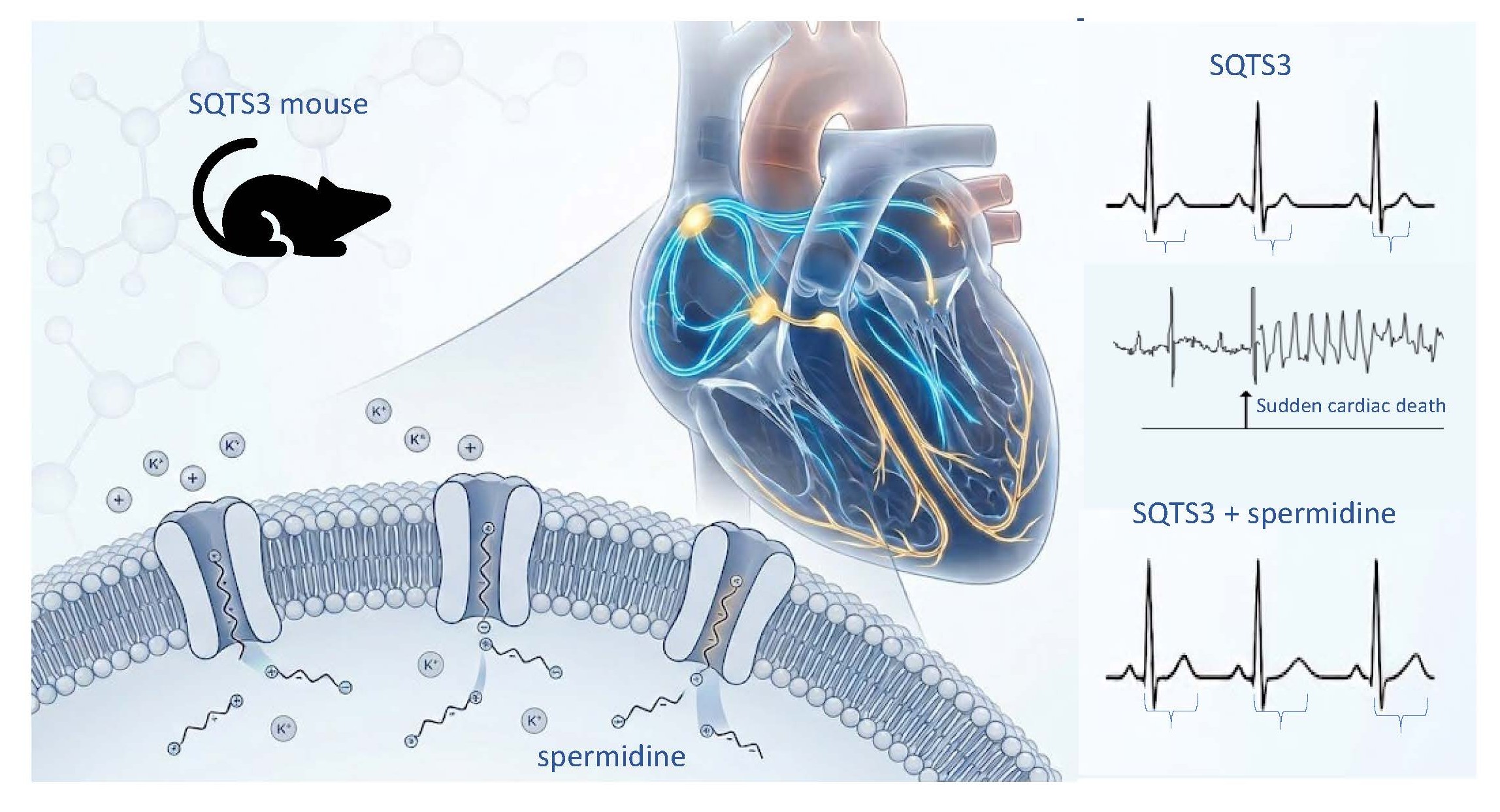
The study, led by Professor José Jalife, head of the CNIC Cardiac Arrhythmia group, and Dr. Ana I. Moreno-Manuel, the study's first author, presents a completely different strategy.
The study shows that polyamines can restore normal function to the altered channel and prevent arrhythmias in an experimental model of the disease.
Polyamines—including spermidine and spermine—are involved in numerous biological processes related to cell growth and survival. Although they are already used as nutritional supplements and some of their physiological functions were already known, their potential to correct inherited electrical abnormalities of the heart had not previously been recognized, the authors explain.
The researchers found that oral or intravenous administration of these molecules restores normal interaction with the potassium channel altered by the genetic mutation responsible for SQTS3. As a result, the channel regains much of its normal function, reducing the occurrence of potentially fatal ventricular arrhythmias.
“What matters most about this study is that we don’t just suppress the arrhythmias—we act directly on the molecular mechanism that triggers them”, explains Dr. Ana I. Moreno-Manuel, a researcher in the CNIC Cardiac Arrhythmia group.
"We have shown that restoring the interaction between polyamines and the mutated channel makes it possible to recover electrical function much closer to normal”, she adds.
The main value of the study lies in demonstrating that it is possible to directly correct the molecular defect responsible for an inherited heart rhythm disorder.
Until now, most available therapies have focused on controlling the clinical consequences of the disease. This approach instead targets the root of the problem, opening the door to the development of more specific and potentially more effective treatments.
Although the results are still limited to an experimental model, and their safety and efficacy will need to be confirmed in future preclinical and clinical studies, they represent an important proof of concept for a disease that currently has few therapeutic alternatives.
The authors believe the impact of this study could extend to other inherited diseases caused by similar alterations in cardiac ion channels.
A detailed understanding of how polyamines regulate these channels could help the development of new therapies aimed at correcting the molecular defects responsible for different heart rhythm disorders, rather than simply treating their clinical manifestations.
“This study not only improves our understanding of the mechanisms responsible for Short QT syndrome type 3, but also opens a new avenue for developing targeted treatments for this disease and other heart rhythm disorders caused by similar mechanisms”, concludes Professor José Jalife.
This study was funded by the “la Caixa” Banking Foundation (LCF/PR/HR19/52160013); the Carlos III Health Institute (ISCIII), through project PI23/01039 of the 2023 Health Research Projects call; the Ministry of Science, Innovation, and Universities (MICIU) through projects BFU2016-75144-R and PID2020-116935RB-I00, co-funded by the European Regional Development Fund (ERDF); and the La Marató de TV3 Foundation (736/C/2020). The research also received support from the European Union Horizon 2020 programme (GA-965286); the CNIC Microscopy and Dynamic Imaging Unit (ICTS-ReDib), funded by the MICIU/State Research Agency (MICIU/AEI) and the ERDF (ICTS-2018-04-CNIC-16); and project EQC2018-005070-P.