Просмотр новости
Найдите то, что Вас интересует
 Спутники
 РН
РН SpaceX
 Роскосмос
 NASA
NASA
СпутникиРНSpaceXРоскосмосNASAGEM Consulting report shows that production forecasts may overstate future supply due to risks in processing and delivery.
Critical mineral shortages by 2035 depend on miners’ processing and delivery, not just mining tonnage. (Stock image by Fahroni.)
Critical-mineral shortages through 2035 may depend as much on whether miners can reliably process and deliver usable material as on whether enough tonnes are mined, according to GEM Mining Consulting.
GEM analyzed copper, lithium, nickel, cobalt, battery-grade graphite and magnet rare earths using the International Energy Agency’s 2035 outlook. Expected supply covers just 68% of lithium requirements, 74% for cobalt and 75% for copper.
Yet the biggest deficits don’t necessarily represent the weakest supply chains. Graphite and magnet rare earths are expected to reach 96% and 107% supply coverage, respectively, but carry GEM’s highest chain-fragility scores at 89 and 95 out of 100.
Lithium has the greatest volume pressure, scoring 80 on GEM’s Volume Scarcity Index, while copper scores 62. Cobalt combines a supply deficit with high chain fragility, scoring 78 on that measure.
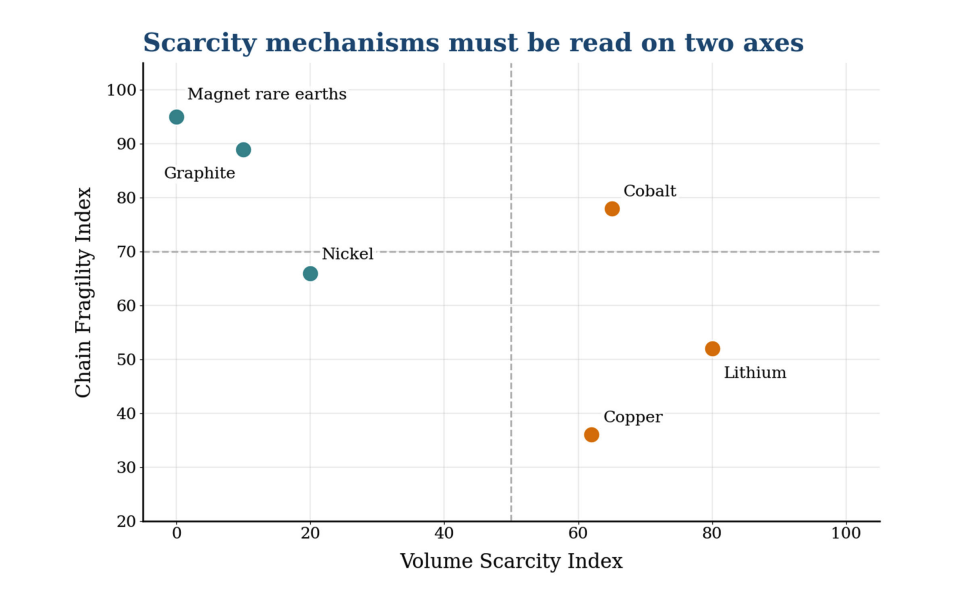 Scarcity mechanisms must be read on two axes. GEM Volume Scarcity is derived from IEA 2035 supply coverage; Chain Fragility is a GEM screening score, not a disruption probability. (Source: GEM calculations from the IEA Global Critical Minerals Outlook 2026.)
Nickel shows the reverse problem. Supply is expected to cover 92% of requirements, but its chain-fragility score reaches 66 because of Indonesia-China concentration and limited diversified refining.
The findings suggest governments and industry need different solutions for different minerals. Copper, lithium and cobalt require dependable project development, while graphite and magnet rare earths need more diversified processing, technology and customers.
Reliable tonnesGEM also argues announced production capacity can exaggerate future supply because nameplate output doesn’t account for commissioning, ramp-up, product quality, customer qualification and operating disruptions.
In a worked example, those hurdles cut a hypothetical project’s 100,000-tonne annual nameplate capacity to 60,200 tonnes of reliable output. GEM stressed the assumptions illustrate its methodology rather than represent a market forecast.
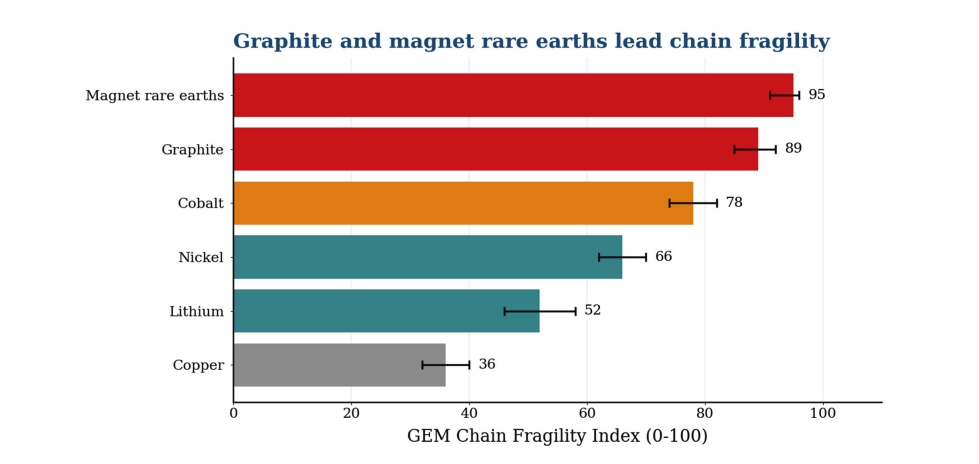 Chain fragility is highest in battery-grade graphite and magnet rare earths. Values are GEM screening scores on a 0-100 scale; black whiskers show model-sensitivity ranges and the numeric labels show the central scores. The ranges are not forecast confidence intervals.
That means a smaller mining project with proven processing, qualified products and dependable infrastructure could carry greater strategic value than a larger resource without a viable path to customers.
The broader message is that reserves alone aren’t supply: critical minerals must ultimately be financed, permitted, mined, processed, qualified and reliably delivered.
| # | Наименование новости | Тональность | Информативность | Дата публикации |
|---|---|---|---|---|
| 1 | Copper price run signals deeper supply squeeze: Sprott | 0 | 9.22 | 19-08-2026 |
| 2 | Public trust is key to faster permitting: report | 0 | 9.18 | 11-08-2026 |
| 3 | Coal mine plans grow even as new capacity plunges | 0 | 10.99 | 13-08-2026 |
| 4 | Op-Ed: ASM risk is becoming harder to manage | 0 | 9.72 | 16-08-2026 |
| 5 | ‘Squatting’ on mining assets a concern, says Mines Secretary | 0 | 10.41 | 22-09-2026 |
| 6 | India’s Odisha state warns iron ore miners, steelmakers over grade manipulation | 0 | 8.26 | 04-08-2026 |
| 7 | Greater regulatory scrutiny no bar to mining mergers, bosses say | 0 | 6.52 | 19-08-2026 |
| 8 | Botswana: AI Helps Unlock Botswana's Hidden Copper Clues | 5 | 7 | 01-07-2026 |
| 9 | Iron ore mine depletion to underpin prices next decade, Rio Tinto says | 0 | 4.05 | 05-08-2026 |
| 10 | Fortescue says China’s CMRG actions disrupting supply stability | 0 | 16.2 | 30-07-2026 |