Просмотр новости
Найдите то, что Вас интересует
 Спутники
 РН
РН SpaceX
 Роскосмос
 NASA
NASA
СпутникиРНSpaceXРоскосмосNASAThe feast of the Assumption has generated at least two distinct iconographic traditions in the history of Christian art, each emphasizing a different theological dimension of the same mystery. At his Angelus address on August 15, Pope Leo XIV described both with sufficient precision to constitute a brief but substantive introduction to what might be Read More…
Two ways to paint the Assumption, and what they mean
The feast of the Assumption has generated at least two distinct iconographic traditions in the history of Christian art, each emphasizing a different theological dimension of the same mystery. At his Angelus address on August 15, Pope Leo XIV described both with sufficient precision to constitute a brief but substantive introduction to what might be one of the richest subjects in Western religious painting.
The Dormition: The older traditionThe earlier of the two traditions — and, as Leo noted, the only one for nearly a millennium — depicts the Dormitio Virginis: the falling asleep of the Virgin Mary before her bodily assumption into heaven. In this iconography, Mary lies on a funeral bier, hands folded, eyes closed. The apostles gather around her in attitudes of prayer and lamentation. At the center stands the risen Christ, holding her soul — depicted as a small swaddled child — in his arms. The theological content is pretty straightforward: it is Christ who comes to take her, fulfilling the promise of John 14:3 — “I will come again and will take you to myself, that where I am you may be also.”
The Dormition tradition dates back to the 5th and 6th centuries or even before, initially appearing in Syria, Palestine, and Egypt. It became the dominant representation of Mary’s end of life in the Eastern Church, where it is still celebrated under the Greek name Koimesis — the repose. It appears in monumental Western art by the late 13th century, for instance in the apse mosaic of Santa Maria Maggiore in Rome.
That mosaic remains the most important surviving example of the tradition in the Latin West, and the one Leo singled out by name. The Virgin Mary lies on her bed, asleep rather than dead, while Christ stands within a rainbow cradling her soul.
The placing of the Dormition at the center of the lower band of the apse, directly beneath the Coronation of the Virgin above, makes a theological argument: the sleeping body below is what leads to the glorified queen above. Torriti was active during the same period as Cimabue and Giotto, but his fame has been obscured by theirs.
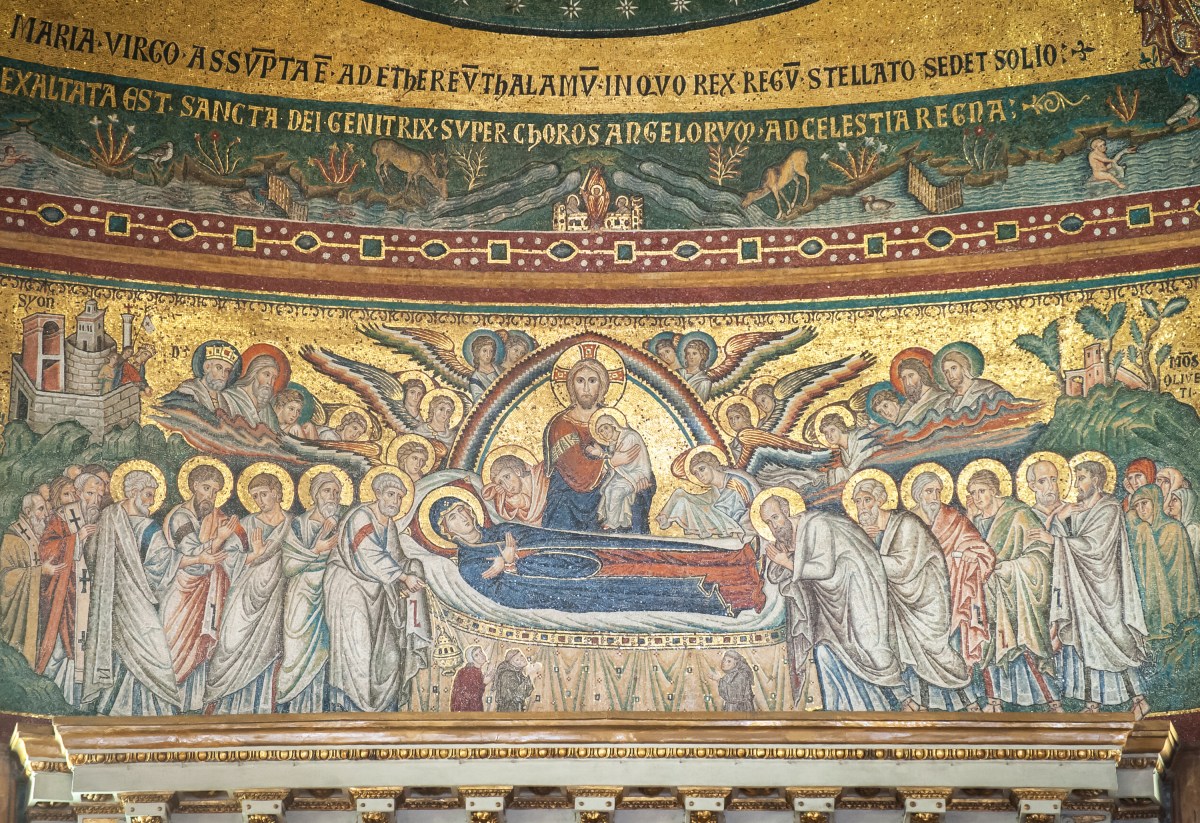 Jacopo Torriti's mosaic 'The Dormition of the Virgin Mary' (1296) in the apse of the Papal Basilica of Santa Maria Maggiore, Rome, Italy.
StrippedPixel.com | Shutterstock
The second tradition, which developed fully in the Renaissance and Baroque periods, depicts Mary already assumed into heaven — her body glorified, enveloped in light, surrounded by angels and saints. The scriptural reference shifts from the apocryphal Dormition narratives to the vision of Revelation 12:1: “a woman clothed with the sun, with the moon under her feet, and on her head a crown of twelve stars.” The apostles below gaze upward at an empty tomb, often filled with flowers; the Virgin rises above them into divine light.
The defining image of this tradition is Titian’s Assumption of the Virgin, painted between 1516 and 1518 as the altarpiece for the Basilica di Santa Maria Gloriosa dei Frari in Venice, where it remains on the high altar. Nearly seven meters high, it was Titian’s first major commissioned work in the city. When it was unveiled in May 1518, it instantly established the young artist as the pre-eminent figure of Venetian art.
The composition divides into three registers: at the bottom, the apostles gesturing upward in astonishment; in the middle, Mary rising on a cloud of cherubim, her red robe blazing against a golden ground; at the top, God the Father opening his arms to receive her. The vertical movement of the composition draws the eye upward in a visual enactment of the mystery it depicts.
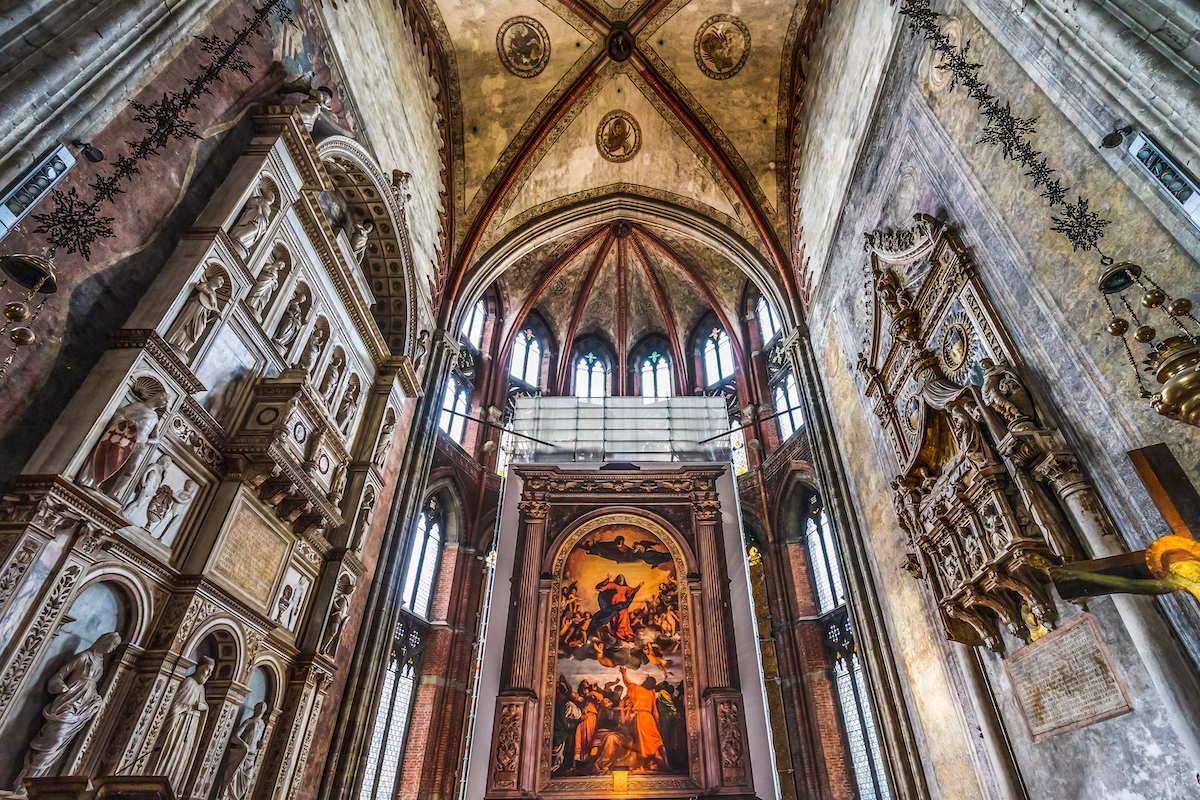 Nearly seven meters high, it was Titian’s first major commissioned work in Venice.
Leo’s point was that the two iconographic models are complementary. The Dormition emphasizes the agent of the mystery: it is Christ who raises Mary, as he will raise all the faithful. The glorious Assumption emphasizes the content of the promise: the whole human person, body and soul, is the object of redemption. What the apostles see rising above the empty tomb is not a spirit but a person — the same person who gave flesh and blood to the Incarnate Word, now drawn by him “forever into glory.”
Both traditions are doing theology in pigment and mosaic and marble. Torriti's sleeping Virgin in Santa Maria Maggiore and Titian's Assunta in the Frari are sustained arguments about what death is, what the body is for, what Christ accomplishes, and what awaits, in Paul’s phrase, “at the end of time, when the Risen Christ will change our lowly body to be like his glorious body” (Phil 3:21).
| # | Наименование новости | Тональность | Информативность | Дата публикации |
|---|---|---|---|---|
| 1 | Pope Leo’s wishes on this feast of Assumption | 0 | 8.09 | 15-08-2026 |
| 2 | How to find Mary’s beauty: Pope’s Assumption homily | 0 | 8.07 | 15-08-2026 |
| 3 | Leo XIV calls for reverent and dignified liturgy | 0 | 6.48 | 19-08-2026 |
| 4 | Pope takes up theme of sacred music | 0 | 8.03 | 19-08-2026 |
| 5 | Pope: In the liturgy, we are with the saints | 0 | 8.34 | 19-08-2026 |
| 6 | The Assumption: Patroness of the Maltese Islands | 0 | 8.56 | 14-08-2026 |
| 7 | Lebanese president to visit Pope Leo in Vatican | 0 | 7.55 | 18-08-2026 |
| 8 | Leon al XIV-lea la Assisi: Tineri, Europa și întreaga lume caută în voi noi sfinți | 0 | 7.43 | 06-08-2026 |
| 9 | Leon XIV merge la Assisi: agenda vizitei pastorale | 0 | 12.37 | 30-07-2026 |