Просмотр новости
Найдите то, что Вас интересует
 Спутники
 РН
РН SpaceX
 Роскосмос
 NASA
NASA
СпутникиРНSpaceXРоскосмосNASAThe many shapes of Cartier were on full display at Cartier during Watches & Wonders, where the brand released the Privé Les Opus, a trio of platinum models with burgundy accents to mark the 10th anniversary of the brand’s Privé collection. The Crash Squelette is the only all-new model — with a new open-worked calibre […]
The many shapes of Cartier were on full display at Cartier during Watches & Wonders, where the brand released the Privé Les Opus, a trio of platinum models with burgundy accents to mark the 10th anniversary of the brand’s Privé collection. The Crash Squelette is the only all-new model — with a new open-worked calibre — and the only limited edition.
The Tank Normale and Tortue Chronographe Monopoussoir tread little new ground, but the platinum-and-burgundy livery is easy to like, and manages to be both distinctive and discreet.

Cartier occupies an enviable position in the luxury watch landscape, being the only brand among the top 10 luxury watchmakers (by revenue) with a sizable jewellery business. Perhaps for this reason, it’s also the only brand to achieve this level of success primarily on the basis of design, rather than technical innovation or haute horlogerie complications.

The Opus trio proves why. Cartier earned its reputation as the “watchmaker of shapes” over more than a century, and today enjoys a rich back catalogue of designs. The three models chosen to represent the 10th anniversary of the brand’s high-end Privé line — the Tank Normale, the Crash, and the Tortue Monopoussoir — are among the fan favourites.
The Tank Normale — especially on this bracelet — is one of my favourite Cartier models, offering a truly vintage look with modern build quality.

Reflecting Cartier’s growth as an industrial watchmaker, each watch is powered by an in-house movement, though the Tortue Monopoussoir’s shaped cal. 1928 MC was developed with the help of Le Cercle des Horlogers. The Crash is powered by an all-new cal. 1967 MC, which introduces a surprising hand-hammered finish.
The hammered finish — which is said to take two hours to complete for each movement — is surprising because Cartier’s value proposition is not rooted in its movement finishing. As discussed, Cartier doesn’t have much in the way of direct competition as a maker of elegant, jewellery-like watches, and as such faces less pressure to conform to the prevailing emphasis on movement finishing.

On one hand, it’s refreshing to see a vision of watchmaking that focusses on deign and doesn’t involve an immaculately finished Unitas-based calibre and a generic-looking pocket watch-inspired design. After all, the movements are finished well enough, and they get the job done. On the other hand, the high price of entry for the Privé collection justifies higher expectations.

For a simple watch, the Cartier Crash has a special mystique. Once said to have been based on a client’s round watch that was misshapen in a fiery car crash, the Crash has always been instantly recognisable and in short supply. These factors make it especially collectible.
But once the storytelling is stripped away, the Crash is easy to understand. It is, after all, a simple manually wound, time-only watch, albeit one shaped to within an inch of its life. That’s true for the cal. 1967 MC as well, which takes its name from the year Cartier London built the very first Crash.

The new movement reorients the crown position closer to four o’clock, giving the watch an even more organic look than that of its predecessors, which were just as sensuously curved but featured a more traditional three o’clock crown. Consequently, the beautifully wrought crown, complete with its ruby cabochon, tucks elegantly into the concave flank of the case, adding to the thoughtfulness of the design and instantly differentiating the new model at a glance.
Cartier didn’t leave itself anywhere to hide in the cal. 1967 MC, and the open-worked architecture makes it easy to understand the flow of power from the (extremely small) mainspring barrel near 12 o’clock to the balance wheel at six. The movement is probably not the best timekeeper due to its compromised architecture, but it’s an acceptable trade-off for the immense aesthetic value of the Crash.

Like its 2014 predecessor, the perimeter of the base plate is open-worked in the form of Roman numerals, though only digits five through twelve are represented. The rest of the space is devoted to showcasing the hand-hammered finish, which looks good at arm’s length but loses some of its lustre up close. That said, there has clearly been an effort to polish some of the bevels, some of which reflect their surroundings with surprising clarity.
In platinum, the Crash is delightfully hefty given its compact size. This gives it a reassuring presence on the wrist, while its narrow strap lends it a vintage, almost dainty feel. The platinum pin buckle is “crashed” and comfortable, but conceptually represents a step down from the more elaborate folding buckle of prior editions.

Given its open-worked design, the Crash is short on burgundy accents, but the functional jewels and ruby cabochon provide enough colour to create harmony with the slim burgundy alligator strap.
New NormaleThe “Les Opus” Tank Normale is an incremental update to the ref. CRWGTA0111 that debuted in 2023, but two small changes make a big difference. The biggest difference is, ironically, not the burgundy printing, but rather the blued hands, which make the watch far more legible than its predecessor, which featured rhodium-plated hands that were easy to lose against the silver dial.

That said, the burgundy printing looks good. It’s vibrant enough to feel like the special edition that it is, without looking ostentatious or clashing with the discreet, vintage feel of the watch.
While this is something of a moot point when it comes to highly collectible watches like the Tank Normale, platinum watches with platinum bracelets can feel daunting on the wrist, and often require precise fitting for long-term wearing comfort. The Tank Normale is the exception to the rule — the extraordinarily compact size of the case results in a supple, bracelet-like feel on the wrist with excellent balance.

Speaking of the bracelet, it reflects Cartier’s unique value proposition as a maker of both watches and jewellery. The seven-link brick design looks suitably vintage, but it’s made to contemporary standards and suits today’s taste for minimlism and so-called “quiet luxury.”
The impressive fit and finish of the links exceeds what most makers of capable of, and the integrated folding clasp (partly) disappears into a dedicated groove machined into certain links. For this reason, the four rows nearest the clasp are not removable.
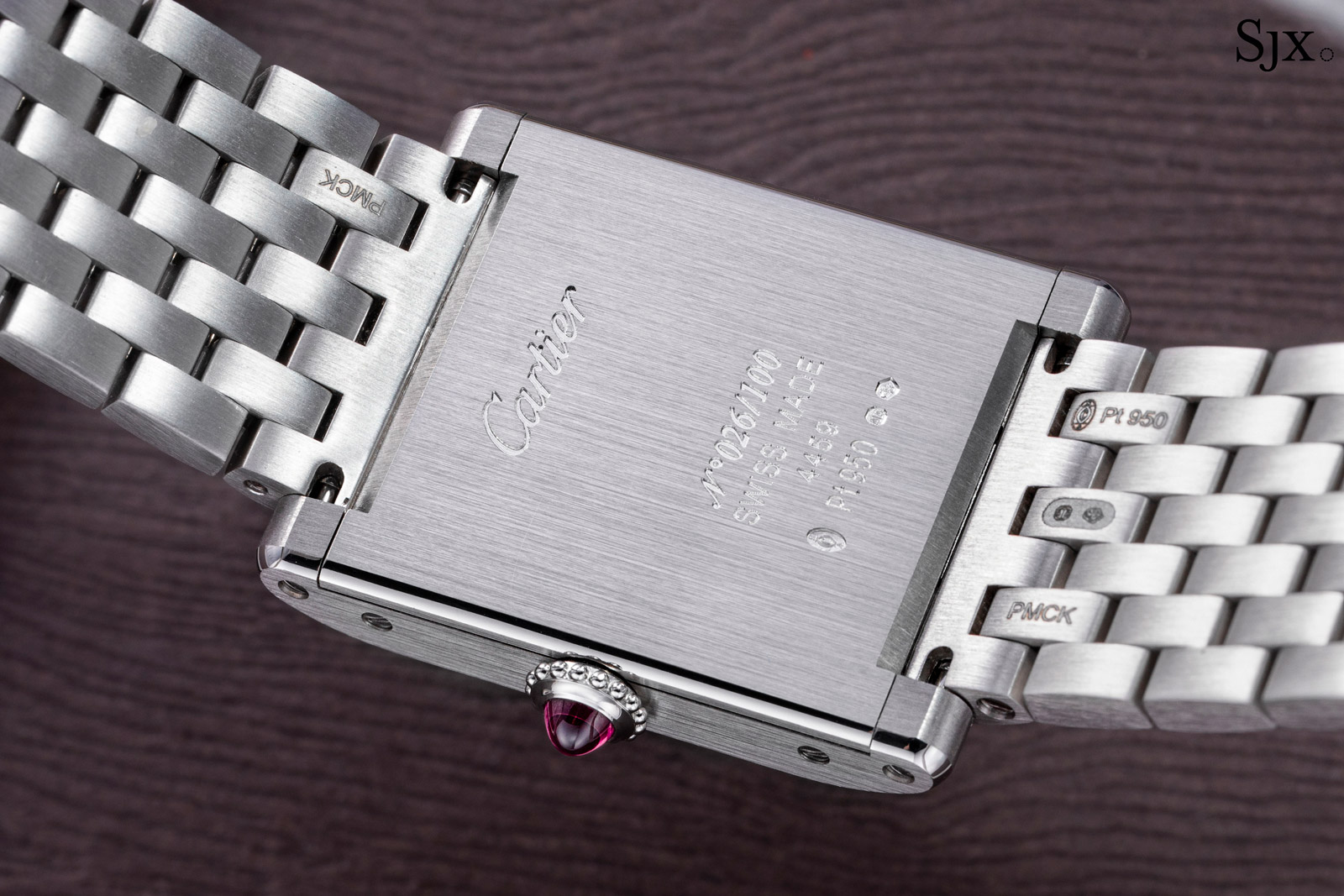
The entire package could easily pass for steel with members of the general public, which enhances the wearing experience with the excitement of hiding a secret in plain sight.
The manually wound cal. 070 MC is concealed from view by a solid platinum case back — the only watch of the trio thus equipped. While I’d normally prefer an open case back, the solid case back feels vital for completing the vintage feel of the Normale — a feel that is reinforced by a domed and slightly bevelled sapphire crystal that mimics the distortions of the thick glass of the 1917 original.

The Tortue Monopoussoir applies the same platinum-and-burgundy format to the brand’s latest monopusher chronograph, which launched in 2024. The dial design, however, with applied studs and a massive Roman twelve, calls back a little further to one of the original Collection Privée Cartier Paris (CPCP) models launched in 1998: the Tortue Monopoussoir ref. 2396.
But while the ref. 2396 featured elegant blue printing, the Opus Tortue gets the burgundy treatment. Unfortunately, the “Paris” designation has been lost in translation, since that detail was specific to the CPCP models.

Fortunately, the anniversary Tortue’s cal. 1928 MC — named for the launch year of Cartier’s first-ever Tortue monopusher — is a step up from the original cal. 045 MC in several important ways.
While it’s true the older calibre was developed by Techniques Horlogères Appliquées (THA), a complications specialist set up by François-Paul Journe, Vianney Halter, and Denis Flageollet, the cal. 1928 MC is formed to fit the Tortue’s tonneau-shaped case and features a more elegant horizontal clutch architecture, rather than an oscillating pinion.

When the cal. 1928 MC was first unveiled two years ago, the wide spacing of the teeth on the chronograph runner seemed like cause for concern, all but guaranteeing a jerky start to the timing sequence. But early movements shown at Watches & Wonders proved to be prototypes, which explains the suitably fine teeth of the central runner visible today.
As a result, the chronograph action is reasonably crisp and precise, even though it exhibits the occasional stutter that’s almost unavoidable with the horizontal clutch format.

The movement is industrially finished but several details liven up the look. The first is the wide, diamond-cut bevel on the chronograph bridge, which glitters despite its industrial roots, and the second is the selection of long, slim tension springs that give the movement a sense of lightness and delicacy — the long jumper spring for the elapsed minutes wheel is an especially nice detail.
That said, details like the low-cost (but functional) Etachron regulator feel out of place given the price — a critique that applies across all three models.

Cartier Privé Les Opus Crash Squelette
Ref. CRWHCH0012
Diameter: 45.34 mm by 25.18 mm
Height: 12.97 mm
Material: Platinum
Crystal: Sapphire
Water resistance: 30 m
Movement: Cal. 1967 MC
Features: Hours, minutes
Frequency: 28,800 beats per hour (4 Hz)
Winding: Manual wind
Power reserve:
Strap: Alligator strap with platinum pin buckle
Limited edition: 150 pieces
Availability:
Price: €97,000 before taxes
Cartier Privé Les Opus Tortue Chronographe Monopoussoir
Ref. CRWHTO0012
Diameter: 43.7 mm by 34.8 mm
Height: 10.2 mm
Material: Platinum
Crystal: Sapphire
Water resistance: 30 m
Movement: Cal. 1928 MC
Features: Hours, minutes, seconds, and chronograph
Frequency: 25,200 beats per hour (3.5 Hz)
Winding: Manual
Power reserve: 44 hours
Strap: Alligator strap with platinum pin buckle
Limited edition: No
Availability:
Price: €53,000 before taxes
Cartier Privé Les Opus Tank Normale
Ref. CRWHTA0031
Diameter: 32.6 mm by 25.7 mm
Height: 6.85 mm
Material: Platinum
Crystal: Sapphire
Water resistance: Not applicable
Movement: Cal. 070
Features: Hours and minutes
Frequency: 25,200 beats per hour (3.5 Hz)
Winding: Manual
Power reserve: 38 hours
Strap: Matching platinum bracelet with white gold clasp
Limited edition: No
Availability:
Price: €58,000 before taxes
For more, visit Cartier.com.
| # | Наименование новости | Тональность | Информативность | Дата публикации |
|---|---|---|---|---|
| 1 | Hands On: Patek Philippe Calatrava Ref. 5227G-015 “Rose Gilt” | 0 | 21.96 | 11-08-2026 |
| 2 | Hands On: Breguet Classique Tourbillon Sidéral | 0 | 18.85 | 07-08-2026 |
| 3 | Агидель: Ночь 20 дек, Чт | 0 | 0 | 19-12-2018 |
| 4 | Hands On: Ferdinand Berthoud Chronometre FB 2TV | 0 | 24.79 | 14-08-2026 |
| 5 | Евросоюзный суд не разрешил Латвии добычу снежного краба | 0 | 0 | 07-02-2020 |
| 6 | Hopeful Thinking: Walking in the footsteps of Good King Wenceslaus | 0 | 0 | 28-12-2024 |
| 7 | 🇷🇺#Russia #Россия #Путин #Putin #Кремле #Kremlin: Путин наградил коллектив предприятия ... | 0 | 0 | 19-02-2025 |
| 8 | Poļu vārtsargs Ščensnijs pagarinājis līgumu ar "Juventus" līdz 2024. gadam | 0 | 0 | 12-02-2020 |
| 9 | Uk, Tcfd obbligatoria da aprile 2022 | 0 | 0 | 10-11-2021 |
| 10 | Arrowhead Regional Medical Center achieves Maternity and Patient Safety Honor Roll | 0 | 0 | 15-02-2020 |