Просмотр новости
Найдите то, что Вас интересует
 Спутники
 РН
РН SpaceX
 Роскосмос
 NASA
NASA
СпутникиРНSpaceXРоскосмосNASAIreland is one of the places in western Europe where temperatures were much higher than average last month.
NEW FIGURES SHOW that this July has tied with July 2024 as the second-warmest July on record globally (second only to… July 2023).
From wildfires in France to sweltering temperatures in Spain to our own intense heat here in Ireland, this summer has been an exceptionally hot one in western Europe.
That was already clear to anyone who had sleepless nights due to the heat or who smelt the smoke from fires in places like Slievenamon, and figures published this morning by European climate monitor Copernicus put into context exactly how hot it was.
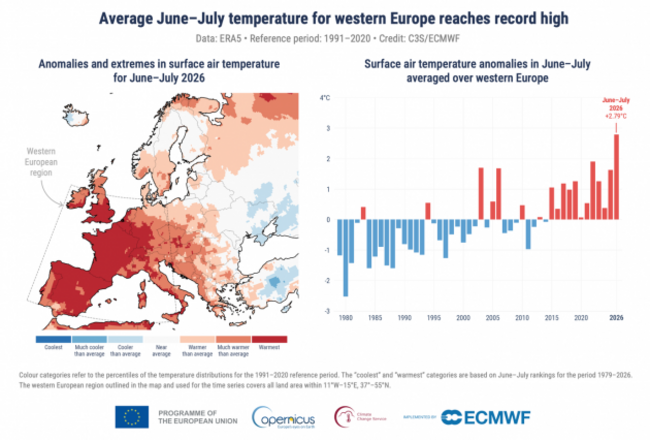
Western Europe recorded its hottest ever June-July period this summer, Copernicus said, with an average temperature of 21.6 degrees Celsius – 2.79 degrees above average for this time of year.
It experienced four heatwaves since May – a level of frequency that is “exceptional” for the region.

Ireland is singled out as one of the places in western Europe where temperatures were much higher than average last month, alongside France, Spain and England.
France, Spain, parts of Germany and the UK had exceptionally low rainfall and/or soil moisture, and rivers like the Seine, the Rhine and the Danube saw river flows that were far lower than average, impacting water supply, irrigation and energy production.
“As soils dry out, they lose their ability to provide natural cooling, allowing heat to build more readily,” said Samantha Burgess, strategic lead for climate at the European Centre for Medium-Range Weather Forecasts (ECMRWF), which runs Copernicus.
“This is a clear example of how climate change is intensifying heat extremes, with heat and drought increasingly reinforcing one another,” Burgess said.
Taking Europe as a whole, the average temperature over European land last month was 20.5 degrees, which is 0.66 degrees above the long-term average from 1991 to 2020.
That puts it at the 11th warmest July on record for Europe as a whole. Copernicus has explained that this “relatively low ranking” comes down to large parts of eastern Europe and Scandinavia having lower temperatures than usual, despite the mercury soaring further to the west.
Zooming further out, globally, this July was the joint second-warmest on record. The average surface air temperature for the month was 16.9 degrees Celsius, which is 0.67 degrees above the 1991-2020 average for July and 1.47 degrees above the estimated pre-industrial 1850-1900 average.
Wildfire riskThe high temperatures and dry soil meant that many areas experienced a heightened level of wildfires last month.
We saw it in Ireland in places like Slievenamon and the Comeragh Mountains, while abroad in France, for example, more than 200,000 people had to evacuate to escape a fire burning through woodlands near Bordeaux.
“Climate change is increasingly bringing the kinds of hot and dry conditions that favour large, high-intensity wildfires in southern Europe while extending the fire season northwards,” said Laurence Rouil, director of the Copernicus atmosphere monitoring service.
“Larger fires produce more smoke and inject it higher into the atmosphere, meaning it can travel further and impact air quality not only locally, but across the wider region,” Rouil explained.
“Countries that experience relatively few wildfires may be increasingly impacted by long range transport of smoke, even if they are thousands of kilometres away.”
| # | Наименование новости | Тональность | Информативность | Дата публикации |
|---|---|---|---|---|
| 1 | Western Europe records its hottest June as heat waves surge: EU monitor | 0 | 7 | 09-07-2026 |
| 2 | Europe swelters through record heat as drought and wildfires intensify | 0 | 7.92 | 12-08-2026 |
| 3 | The summer that burned Ireland - so where do we go from here? | 0 | 8.71 | 15-08-2026 |
| 4 | В Западной Европе зафиксирован рекордно жаркий месяц | 0 | 5 | 09-07-2026 |
| 5 | Rising sea temperatures threaten 'mass mortality events' among Irish marine life | 0 | 6.64 | 19-08-2026 |
| 6 | Heatwave across western Europe – in pictures | 0 | 7 | 10-07-2026 |
| 7 | Европейскую страну накрыла рекордная жара | 0 | 5 | 26-06-2026 |
| 8 | Copernicus: июнь и июль побили рекорды температур в Западной Европе | 0 | 7.26 | 10-08-2026 |
| 9 | Klima: USA - Juli war wärmster Monat seit mehr als 130 Jahren | 0 | 9.26 | 11-08-2026 |
| 10 | You can see how the Irish landscape changed during the drought through satellite images | 0 | 6.94 | 08-08-2026 |