Просмотр новости
Найдите то, что Вас интересует
 Спутники
 РН
РН SpaceX
 Роскосмос
 NASA
NASA
СпутникиРНSpaceXРоскосмосNASAWhat happens to our code in 2030? As the digital world enters a "common winter" of enclosure and predation, Software Heritage is repositioning its 28-billion-file archive as a permanent utility. It’s no longer about just saving code; it’s about building a global tech stack that can survive the frost and protect human rights.
The post Software Heritage and the long game for global infrastructure appeared first on Software Heritage.
After 10 years of steady preservation, Software Heritage has reached what founder Roberto Di Cosmo calls « the end of the beginning. » The archive now holds 28 billion files of source code. The project has grown past its initial ‘digital library’ phase. It’s now the baseline record for the world’s source code.
The shift was the central theme of a recent 10th-anniversary discussion featuring Di Cosmo alongside leaders from UNESCO and the Inria Foundation. The takeaway was clear: the time for proving the concept is over; the era of scaling for industrial utility in AI and cybersecurity has begun. Catch the whole session on YouTube.
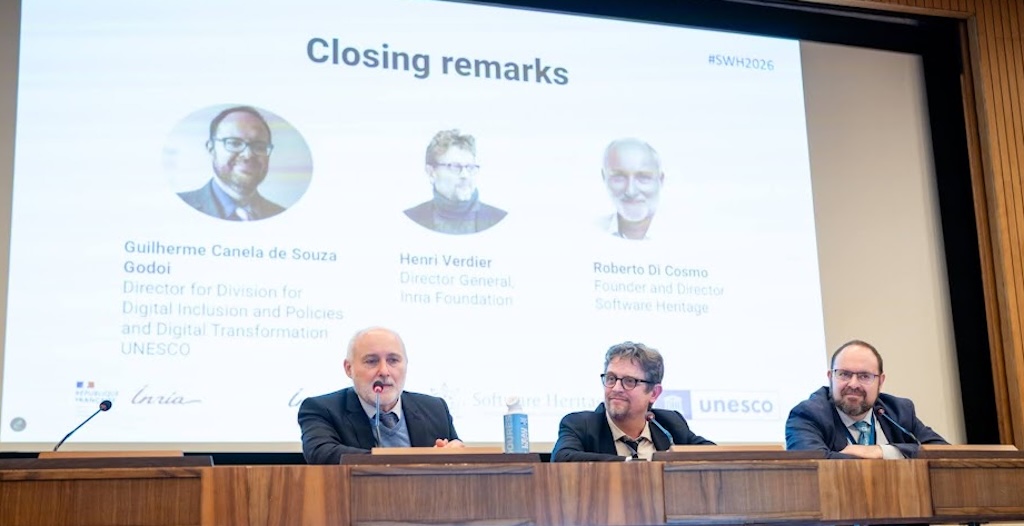
The scale of Software Heritage is now difficult to ignore. Those 28 billion files represent an « unthinkable treasury » of human intelligence. But while the first decade was about accumulation, the second is about application. Software Heritage has spent the last decade evolving from a massive archive into a searchable resource, and finally into a global common infrastructure. The « treasury of intelligence » represented in the Archive now provides key data layers for real-world applications in AI and cybersecurity.
This isn’t your standard Silicon Valley « move fast and break things » story. While most tech startups are built for a quick 100x exit, Di Cosmo credits the project’s survival to a different kind of perseverance—the kind required to build a shared utility that can withstand shifts in policy and management. The goal for 2030 is to secure the institutional support needed to turn these existing capabilities into a standard utility for the global tech stack.
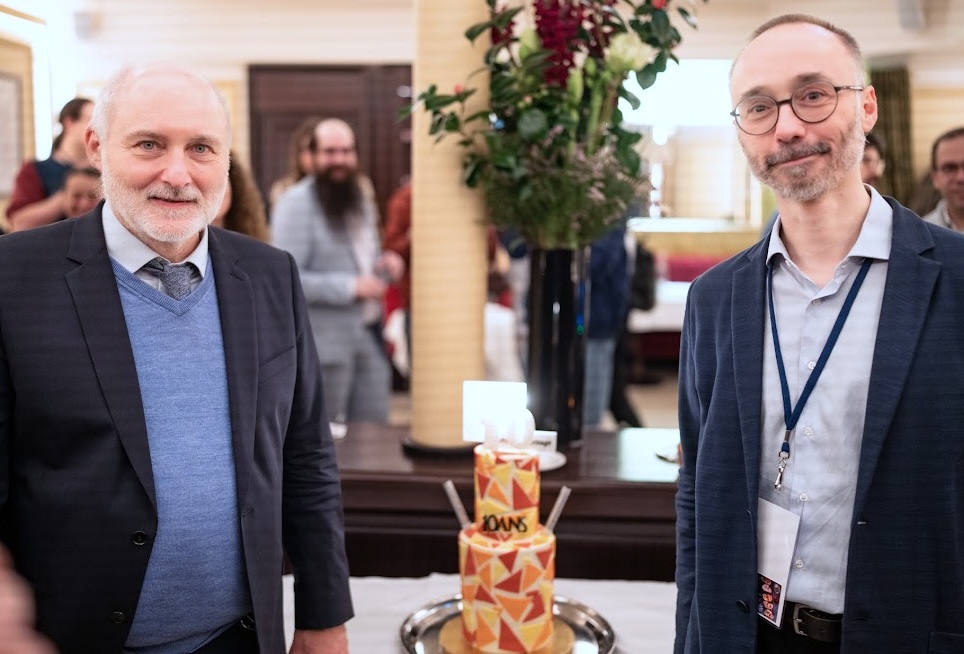 Co-founders Di Cosmo and Stefano Zacchiroli
 The move comes at a high-stakes moment for the digital world. Henri Verdier is the new CEO of the Inria Foundation, the entity that hosts Software Heritage in the broader Inria ecosystem. Drawing on his experience as the former French Ambassador for Digital Affairs, he offered a sober, geopolitical perspective on the current state of digital cooperation.
Verdier introduced the concept of a « common winter, » a period of « digital glaciation » where the principles of openness and cooperation are under threat. He argued that we are living through a time where the « logic of the race for power, enclosure, predation, [and] weaponization » of digital infrastructure has become dominant.
Verdier draws a parallel to the « AI Winters » of the past. Just as AI survived periods of neglect through the grit of researchers in France and Canada, he believes the movement for open commons will eventually see its own « spring. » When it does, society will look for the projects that held the line. By maintaining this massive infrastructure, Software Heritage is essentially « paving the way » for that recovery. Verdier asserts that society eventually has « no choice » but to return to cooperation.
The road to 2030: Policy and public goodsThis strategic pivot is being backed by a five-year program with UNESCO, aimed at moving beyond just labeling code as a « public good » and toward enacting real policies to protect it. This initiative aims to move beyond merely labeling code as a « public good » and toward enacting concrete policies to protect these commons from « enclosure » and predation.
The program will focus on critical pillars to guarantee that digital public goods are protected for the education, science, and AI sectors. Guilherme Canela de Souza Godoi, Director for Division for Digital Inclusion and Policies and Digital Transformation at UNESCO, flagged a recent trend of framing innovation and human rights as opposing forces. This false binary suggests that people have to choose between progress and protection. As he put it: « We innovate if we can protect the human rights of everyone… if we are not doing that, we are not innovating. » For the partners involved, the message is clear: the infrastructure of the future must be built on the protection of human rights, not at their expense.
As the project moves toward its 20th anniversary, the focus remains on the old African saying cited by Di Cosmo: « Alone you go faster, together you go farther. »
As Di Cosmo notes, this isn’t the end of the story. It’s the moment that infrastructure finally becomes real enough to deliver on its promise. The « winter » may be here, but the foundations for the spring are already being laid.
Catch all the sessions from the Symposium on YouTube.
#SWH10
| # | Наименование новости | Тональность | Информативность | Дата публикации |
|---|---|---|---|---|
| 1 | Software Heritage Archive recognized as a digital public good | 0 | 6.38 | 21-01-2026 |
| 2 | Open infrastructures for software as a digital public good | 0 | 4.35 | 19-03-2026 |
| 3 | Software Heritage Archive recognized as a digital public good | 0 | 6.38 | 21-01-2026 |
| 4 | Open infrastructures for software as a digital public good | 0 | 4.35 | 19-03-2026 |
| 5 | The invisible code running the world (and who pays for it) | 0 | 5.12 | 20-03-2026 |
| 6 | Software Heritage Activity Report: 2025 | 0 | 8.92 | 16-01-2026 |
| 7 | Software Heritage at UN Open Source Week 2026 | 0 | 5.6 | 08-07-2026 |
| 8 | Roberto Di Cosmo on software sovereignty | 0 | 6.09 | 12-02-2026 |
| 9 | Software Heritage Activity Report: 2025 | 0 | 8.92 | 16-01-2026 |
| 10 | Sovereign Tech Agency and Software Heritage partner to safeguard critical open-source software | 0 | 5.56 | 28-01-2026 |