Просмотр новости
Найдите то, что Вас интересует
 Спутники
 РН
РН SpaceX
 Роскосмос
 NASA
NASA
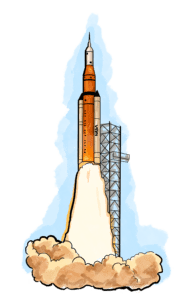
СпутникиРНSpaceXРоскосмосNASAArtemis II is the second of five missions with the goal of establishing a lunar base.
The post Students track Artemis II for NASA appeared first on Daily Trojan.
At 3 a.m. on Wednesday morning, a group of students trudged to the south side of University Park Campus, flicked some equipment to life and prepared to start their shift. From the dark side of the Earth, they could now directly track the Orion spacecraft on its mission to the Moon.
As with all missions to the Moon, Artemis II must contend with what is known as a three-body problem: the spacecraft is caught between the gravitational fields of Earth, the Moon and the Sun.
The computational power needed to constantly track and refine the frequencies of communications in a three-body problem is immense, which has led NASA to outsource some of this tracking and measuring to institutions like USC.
“Everybody sees the four heroes and all their things that are happening, [but] in all honesty, we’re talking thousands and thousands of people; engineers and scientists and technicians that have been supporting all this,” said David Barnhart, the director and co-founder of USC’s Space Engineering Research Center. “For us, it’s sort of cool to be just a really small part of that sort of beehive of activity.”
Artemis II is the second of five missions in the Artemis program, the end goal of which is to establish a lunar base, set a cadence for annual Moon missions and ultimately lay the foundation for a mission to Mars.
Artemis I was a flight of an unmanned variant of the Orion spacecraft, while Artemis II is the first manned mission to the moon in over half a century. Artemis III is a test flight of commercial landers from SpaceX and Blue Origin, which will be used in Artemis IV to transfer astronauts from the Orion spacecraft to the Moon’s surface.
The students’ work is part of a class led by David Barnhart, a research professor of astronautics in the department of astronautical engineering. Barnhart said the tracking is helped in large part by the spacecraft’s Doppler effect.
The Doppler effect is the phenomenon where frequencies increase as they move toward an observer and decrease as they move away; a speeding car gets louder as it gets nearer, and quieter as it gets farther.
Barnhart’s group measures the Doppler shift of the Artemis II to constantly refine the frequencies used for transmissions of photos, spacecraft diagnostics or voice communication. These refinements can only be made while their equipment is facing the Artemis II, which is between the hours of midnight to 7 a.m. The data generated by the group’s refinements will be sent to NASA and used in future Artemis missions.
“What we’re trying to do is to help NASA tune the communications that come back and forth from the spacecraft, so [for] future missions it locks in and is able to track specific frequencies,” Barnhart said. “If you’re not on the right frequency and they’re sending a picture, you’re only going to get three quarters of the picture.”
Barnhart said that spaceflight is at an “inflection point” where spacecrafts are beginning to be maintained and prepared for longer lifespans instead of being used once, and infrastructure is being developed to sustain ecosystems in space, both around the Earth and on the Moon.
Michael Gallagher, a graduate student studying astronautical engineering and part of the class working in the Artemis data, said NASA’s goal of establishing a lunar base was “realistic and ambitious.”
“That kind of stuff is really exciting, because it injects the industry with new possibilities,” Gallagher said. “A big part of what holds back most programs is that you haven’t done it before. … You either have very little money and you’re trying to do something new, or you have a lot of money and you’re afraid to do anything new; [NASA has] a lot of money and they’re going to do something new.”
Vishruti Gohel, a graduate student studying astronautical engineering, said that she’s noticed excitement among her class.
“Since it’s human lives at stake, it’s a big mission, ” Gohel said. “You have to take each step with safety, and you have to ensure that the crew would be safe. It’s not just a normal spacecraft that’s launched. It has humans in it. … That calls for additional testing, stringent redundancy, reliability requirements, and passing through that all is a Herculean mission.”
Gohel said she plans on returning to her home country of India to help their space program, acknowledging the collaborative nature of spaceflight on an international scale. To that end, the Artemis Accords were signed in 2020, delineating a set of standards for international conduct in outer space.
“If everybody sort of buys into [the Artemis Accords]: ‘Yes, we’re going to have a set of rules and behaviors,’” Barnhart said, “Then that also fosters standards, which then translates to commercial markets and updates. … They can connect things together, as an example, which then only will help.”
In the near future, the class is looking to launch its “Maverick” cube satellite, roughly the size of a coffee mug, which weighs less than three pounds.
Maverick is being tested with projectors and screens to display useful information onto a camera, much like a heads-up display. The class will use the experience from tracking Artemis to efficiently track and pull data from Maverick, which is set to hitch a ride on a SpaceX rocket launch this summer.
Artemis II is expected to return to Earth on Friday evening and splash down in the Pacific Ocean near Southern California.
We are the only independent newspaper here at USC, run at every level by students. That means we aren’t tied down by any other interests but those of readers like you: the students, faculty, staff and South Central residents that together make up the USC community.
Independence is a double-edged sword: We have a unique lens into the University’s actions and policies, and can hold powerful figures accountable when others cannot. But that also means our budget is severely limited. We’re already spread thin as we compensate the writers, photographers, artists, designers and editors whose incredible work you see in our paper; as we work to revamp and expand our digital presence, we now have additional staff making podcasts, videos, webpages, our first ever magazine and social media content, who are at risk of being unable to receive the support they deserve.
We are therefore indebted to readers like you, who, by supporting us, help keep our paper independent, free and widely accessible.
Please consider supporting us. Even $1 goes a long way in supporting our work; if you are able, you can also support us with monthly, or even annual, donations. Thank you.
| # | Наименование новости | Тональность | Информативность | Дата публикации |
|---|---|---|---|---|
| 1 | Can You See Artemis II From Earth? Here’s What to Know | 0 | 17.78 | 03-04-2026 |
| 2 | NASA Tests Twin Probes For Artemis Lunar Base | 0 | 10.58 | 03-08-2026 |
| 3 | NASA Moon Base Missions Could Transform Lunar Exploration In 2026 | 5 | 7 | 27-05-2026 |
| 4 | Space Foundation Statement on Artemis II Launch | 0 | 7.3 | 01-04-2026 |
| 5 | Artemis II Fun Activities | 0 | 26.53 | 29-03-2026 |
| 6 | Artemis II’s Slow Crawl to the Moon: Inside the 8-Hour Journey to Launch | 0 | 5.68 | 20-02-2026 |
| 7 | США планируют обеспечить возвращение своих астронавтов на Луну в 2025 году | 0 | 0 | 09-11-2021 |
| 8 | Why is the US going back round the Moon with Artemis II? A space policy expert explains | 0 | 7 | 27-03-2026 |
| 9 | Источник http://vk.com/club12372407 ✅Временное окно для запуска к Луне миссии "Артемида-2" ... | 0 | 7 | 30-06-2026 |
| 10 | Student group launches inclusive gym hours at Lyon Center | 0 | 8 | 07-04-2026 |